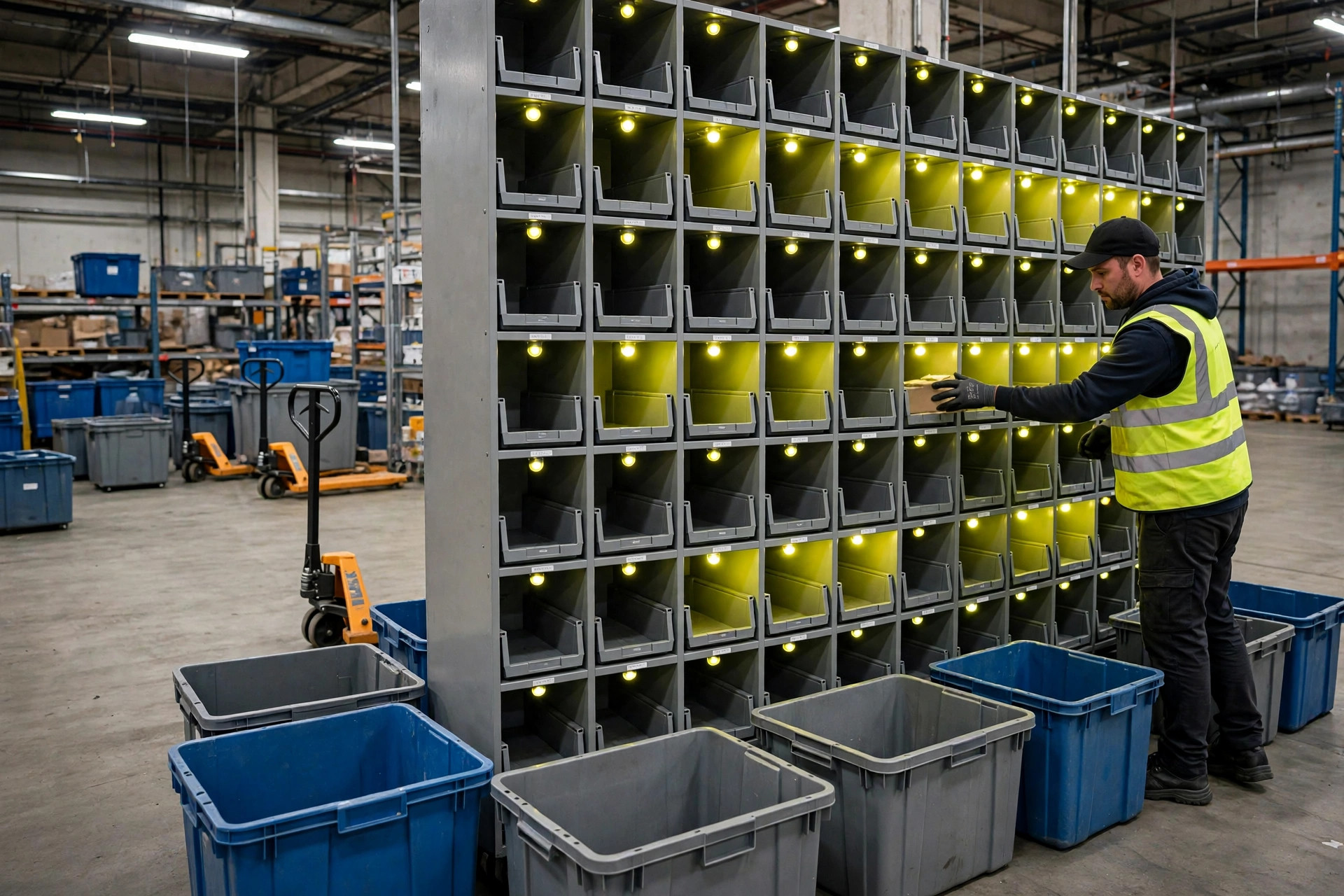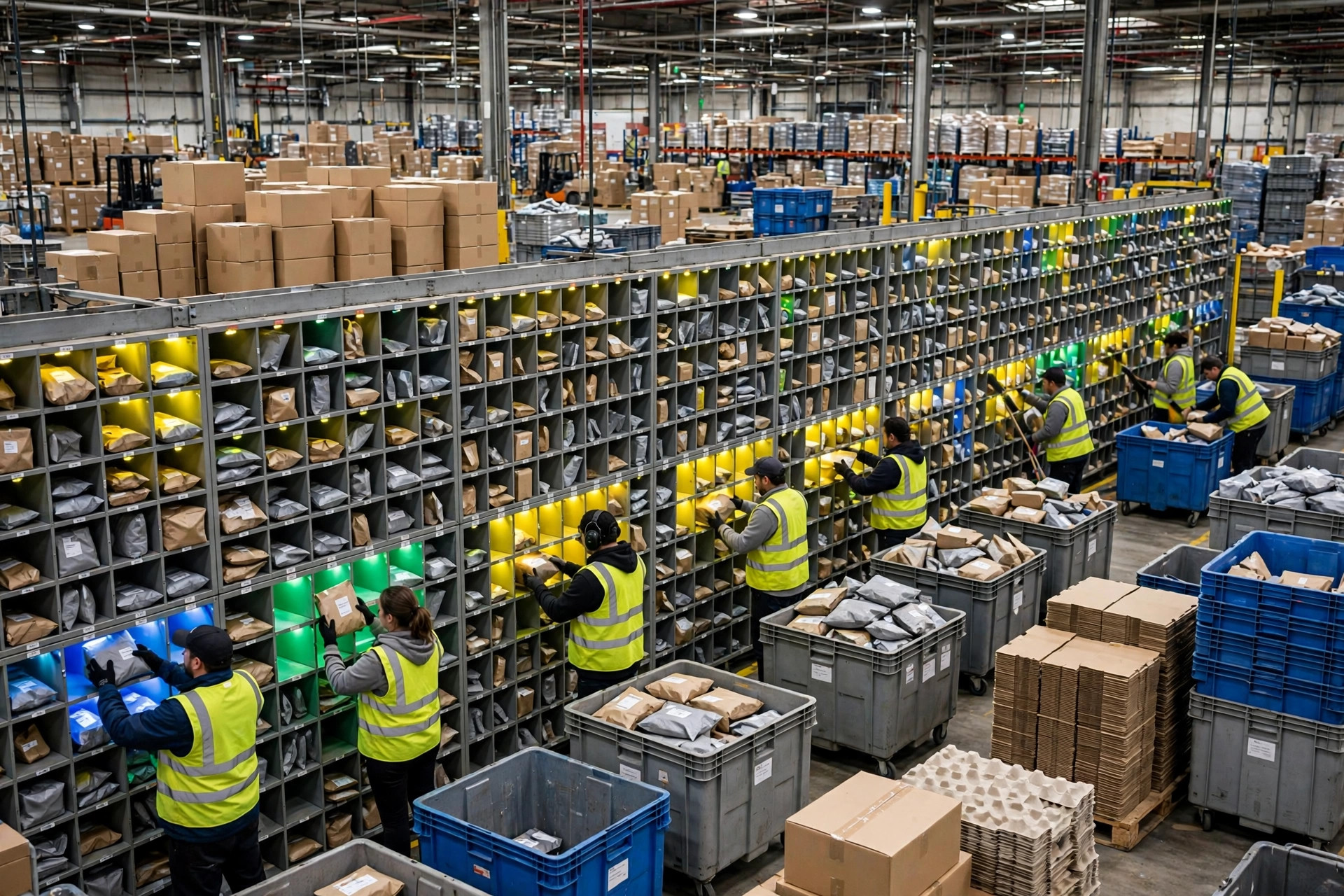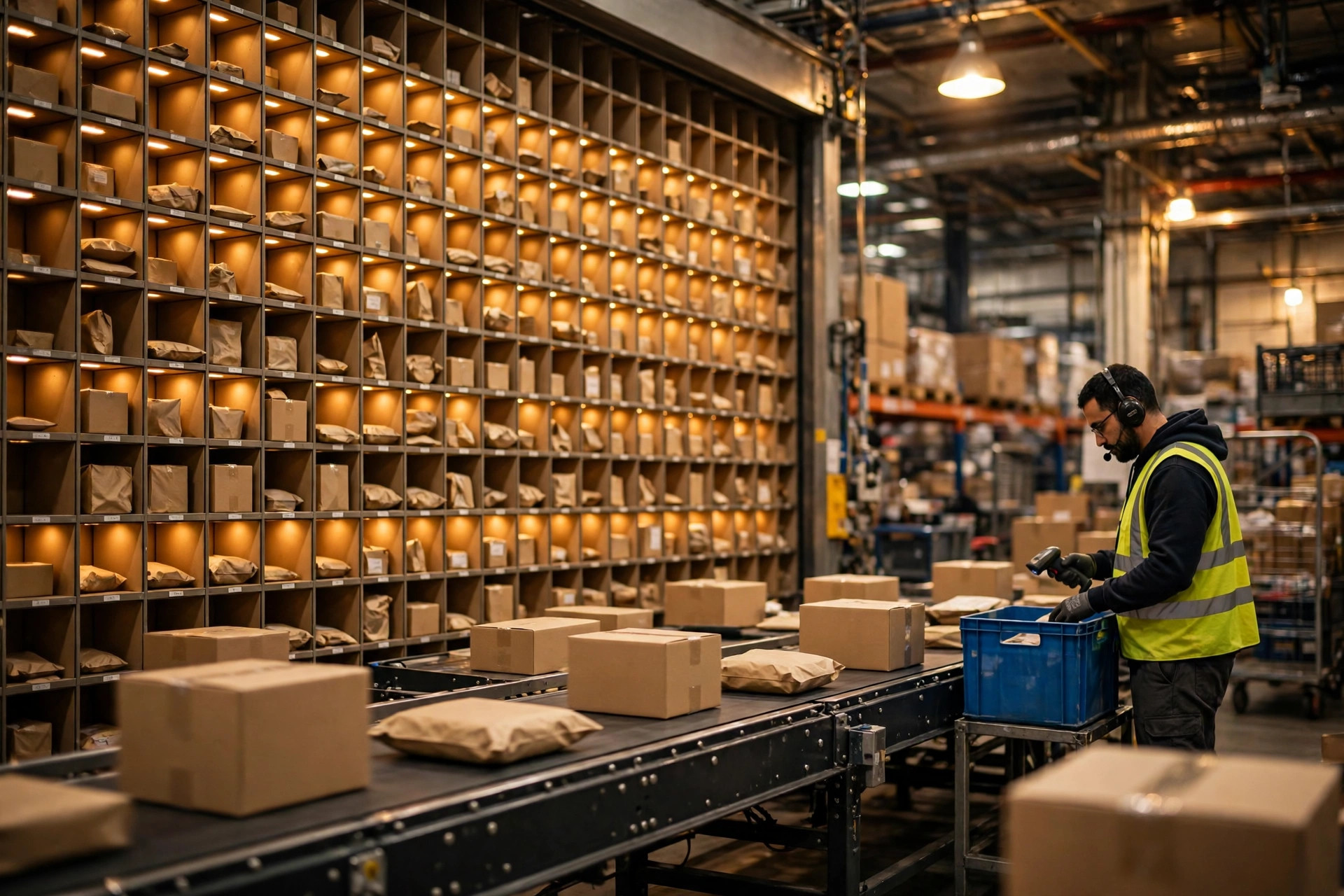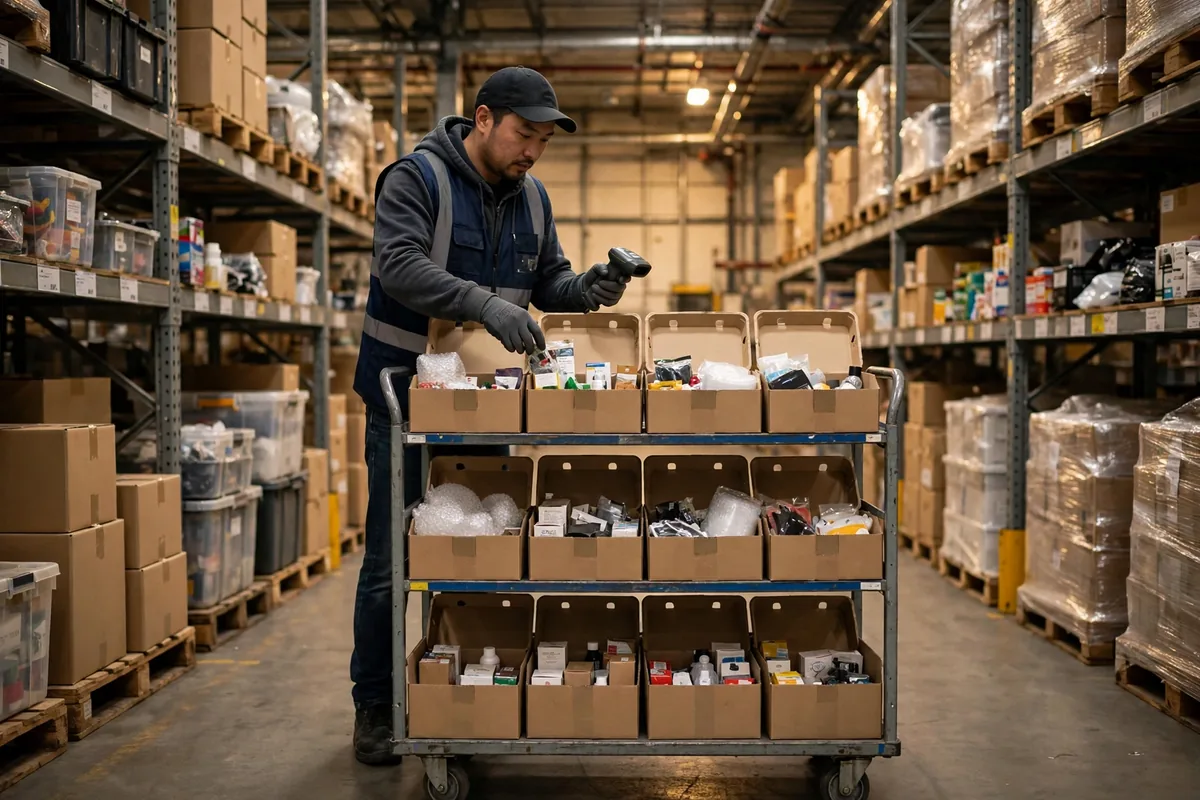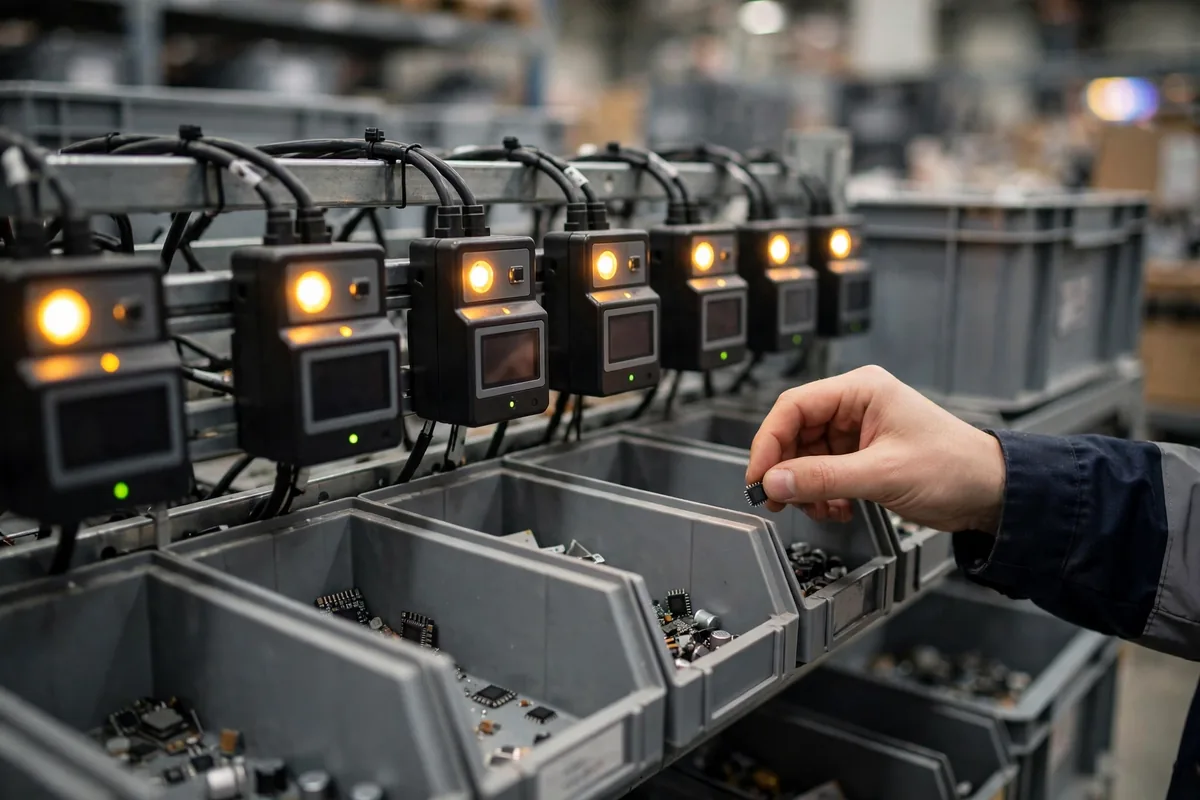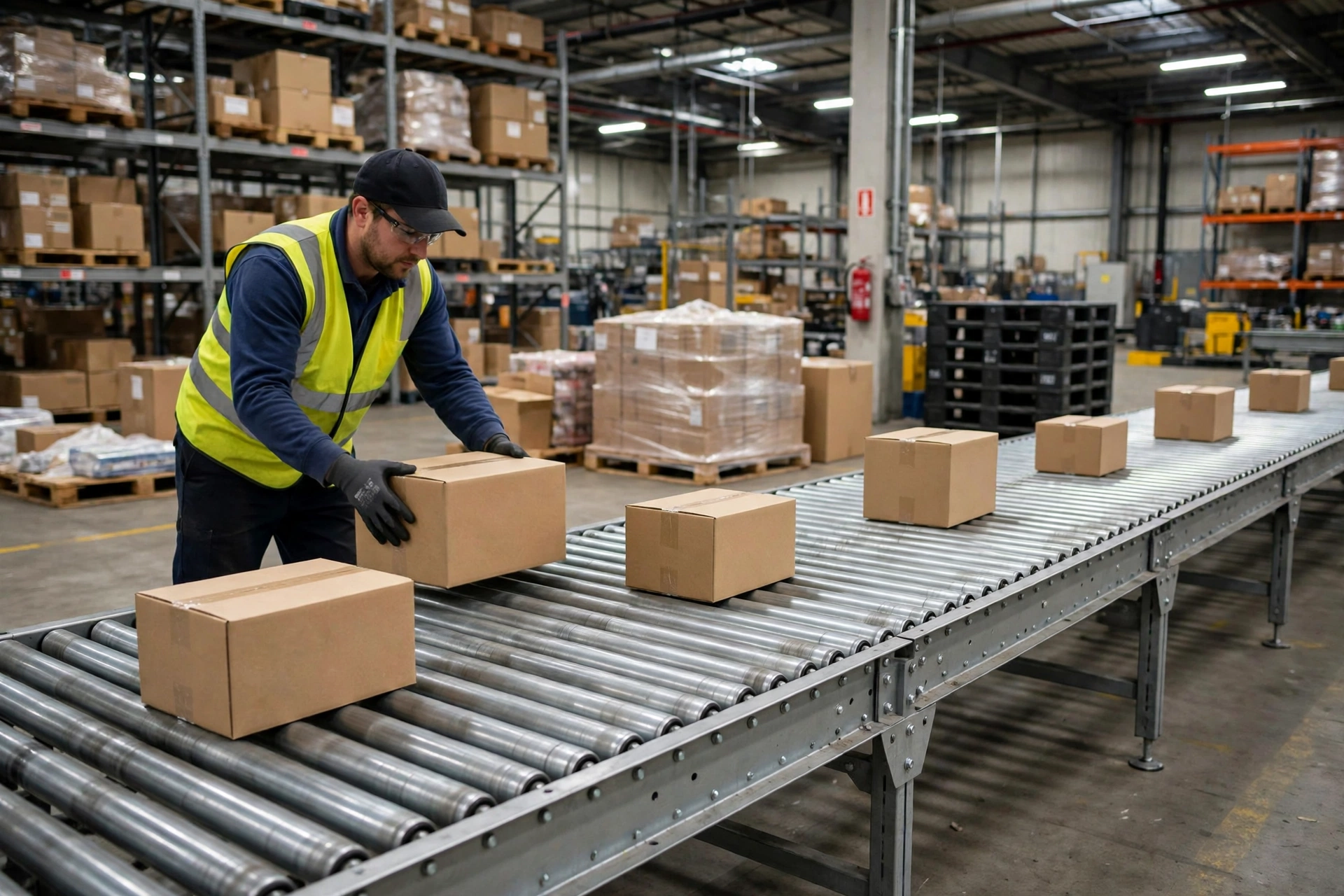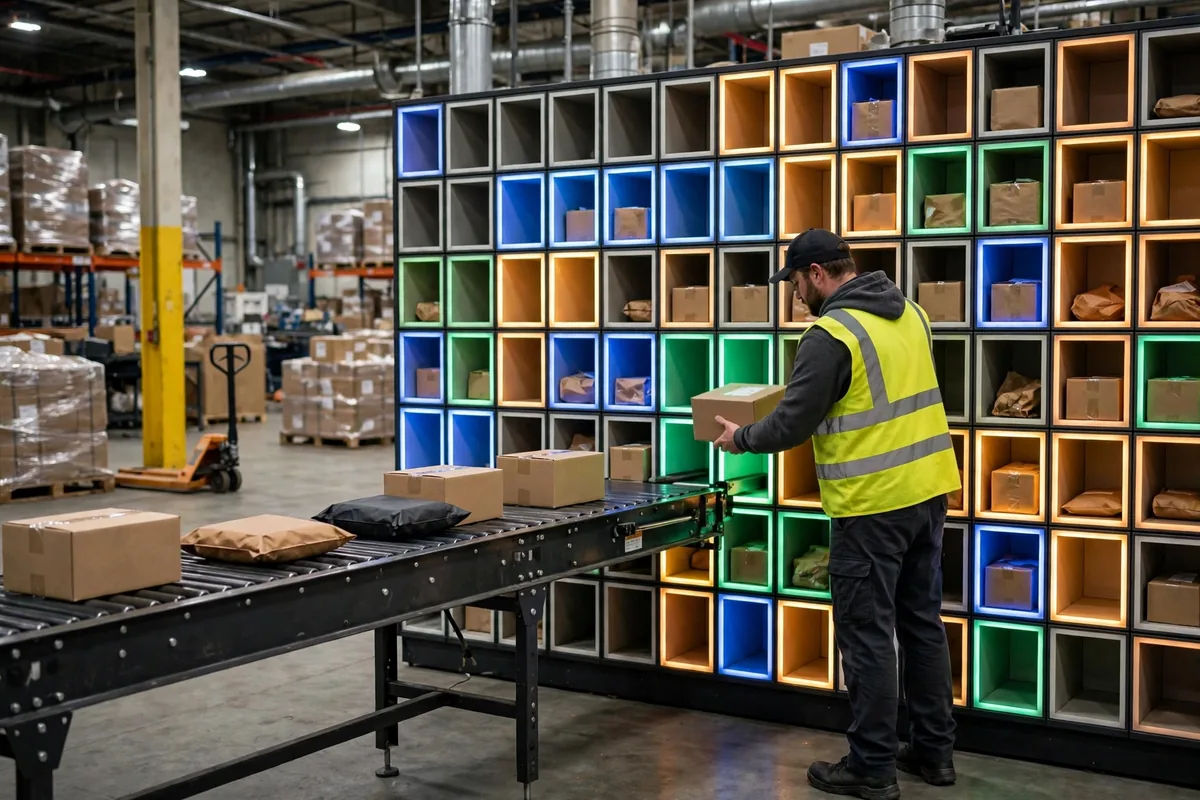
A warehouse pick and sort wall is not an upgraded put wall. Vendors love selling it that way, and that is the first piece of nonsense I want to call out. Both have lights and slots, so they look like cousins. Underneath, the logic is opposite: one splits orders while the picker is still walking, the other brings everything back in bulk and splits it at a fixed wall.
Think of it like this. A put wall is buying a whole crate of groceries first, then plating each meal at the counter. Pick-and-sort is pushing a cart with labeled bags down the aisle and dropping each item into the right bag as you pass. You save one handling step in the second model. Whether that saving is real depends entirely on what your orders look like, not on the wall.
How a warehouse pick and sort wall really sets its takt
The takt here is limited by walking and human switching, not by lights. Light on, place item, press to confirm — it sounds instant. In a cosmetics warehouse in East China where I spent three days timing the floor last year (case figures), one picker pushed a 24-slot cart, averaged 2.3 units per order, and held steady at 110 to 130 orders per hour. Push past 150 and mis-sorts climbed fast. The light was never the bottleneck. The brain switching between slots was.
A put wall has the opposite profile. Goods are batch picked into totes, then sorted at the wall by a stationary operator who only scans, places and confirms. A trained station sorting 400 to 600 units per hour is unremarkable (case figures), because nobody is walking. When units per order are high, that fixed station will beat a moving cart on pure sort speed every time. I covered that second-pass flow in detail in our piece on put-to-wall secondary sortation, so here I will only draw the boundary: the question is not which wall is newer, it is where in your flow an order should be split.
The three numbers that decide warehouse pick and sort wall vs put wall
Do not size this from a sales spreadsheet. Pull your last 30 days of orders and check three numbers.
| Factor | Favors pick-and-sort | Favors put wall |
|---|---|---|
| Units per order | Mostly 1 to 3 | Mostly 4 or more |
| Wave size | Small, frequent waves | Large batch waves |
| SKU concentration | Hits concentrated in top SKUs | Long, scattered tail |
| Cut-off pressure | Pick and ship in one pass | Orders can wait for a full wave |
First, order density. In 2023 I sized a system for a small-appliance parts warehouse in Suzhou (case figures). They ran about 6,000 orders a day, 1.8 units per order, only around 900 SKUs, with most orders hitting the same 200 fast movers. That is a textbook pick-and-sort profile: one cart pass filled most slots, orders went straight to pack, and the whole bulk-consolidation step disappeared. They skipped a fixed wall entirely and bought mobile 20-slot carts, adding carts at peak instead of adding wall.
Second, wave size and SKU spread. The counter-example is an apparel warehouse near Zhengzhou (case figures). Volume was solid, but orders averaged 5.6 units across more than ten thousand seasonal SKUs, and waves released at roughly 800 orders. Their pick-and-sort trial was painful to watch: a single cart tour took over 40 minutes, slots were still half empty, and pickers were exhausted, because each order needed five or six items scattered across the building. They went back to batch picking plus a put wall. Consolidate first, sort second. Same headcount, shipping started two hours earlier.
Here is the counter-intuitive part: the more SKUs you carry, the worse pick-and-sort performs, even at high volume. Its travel distance is dictated by your order profile. Scatter the SKUs and the walk gets longer, until the handling step you saved is paid back entirely in footsteps. A put wall costs you one extra handling, but it decouples walking from sorting. People walk, the wall sorts.
Slot count is the third trap. Slots equal orders handled per tour. More slots means a heavier cart, more lights, and more chances to drop an item in the wrong cell. My working range is 16 to 28 slots per tour. If you think you need more than 32, your wave is probably too big. Fix the wave before you buy a bigger wall.
Maintenance pits nobody puts in the brochure
Now the part integrators skip. A fixed put wall lives in one controlled spot. A warehouse pick and sort wall, especially on carts, gets shaken, bumped and dusted all day. Confirmation buttons and slot sensors start double-triggering after months of rack bumps. During selection, ignore the headline MTBF number and ask one question: can a single light module be swapped without powering down the whole row? If not, one dead slot in peak week parks the entire cart.
Battery and Wi-Fi are the second pit. Cart electronics run on batteries, and warehouse Wi-Fi fades behind high racking. When a scan confirmation lags, operators press twice, and now your data is wrong, not just slow. You will never catch this in an empty demo hall. Acceptance testing has to happen in a full warehouse, under a real peak wave, or do not sign.
One more number belongs in the decision: your exception rate. Slots on a moving cart are built for clean forward orders. Park an incomplete order in a slot while you wait for a missing item and that slot is dead for the rest of the tour. In a household goods warehouse in Ningbo in 2024 (case figures), nearly a fifth of the slots on each tour were blocked by exception orders, which quietly erased a fifth of the cart's capacity. The fix was blunt: any order not complete within ten minutes got cleared to an exception area, and the cart shipped what it could. A put wall handles exceptions more gracefully, because there is a staging spot beside the wall and a blocked cell does not slow the operator behind it. If your exception rate is high, cost that blockage in, not just the clean-order math.
Before signing anything, I also run a taped-floor test: mark the slots on the ground, push a real cart through the real route three times — once clean, once with oversized and exception orders mixed in, and once with the newest hire operating it. Whatever survives those three tours will survive peak. Spec sheets describe best-case conditions. Warehouses never run best-case; they run peak, short-staffed, with temps.
Third, slot sizing by average parcel is a rookie mistake. The first oversized order jams the slot, the picker piles goods on the side of the cart, and your elegant system degrades into pick-and-pile. Two to four oversized slots are worth more than a perfectly uniform grid.
Whether this money is well spent comes down to one number: look at how much travel your order profile forces per completed order. If that travel eats the handling you saved, a warehouse pick and sort wall is just put-wall work moved into the most tiring part of the shift.
By Da Liu, Automation Engineer