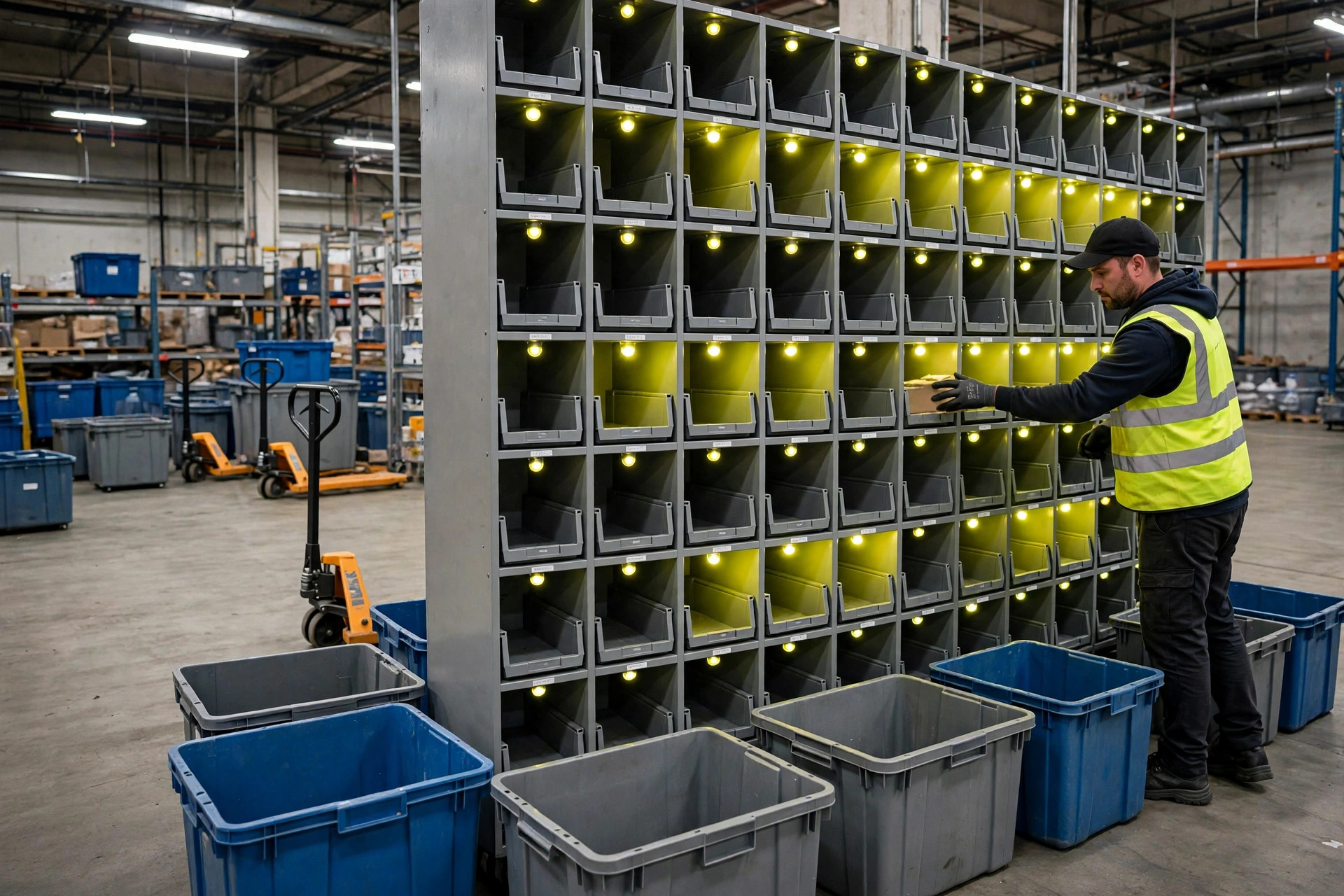
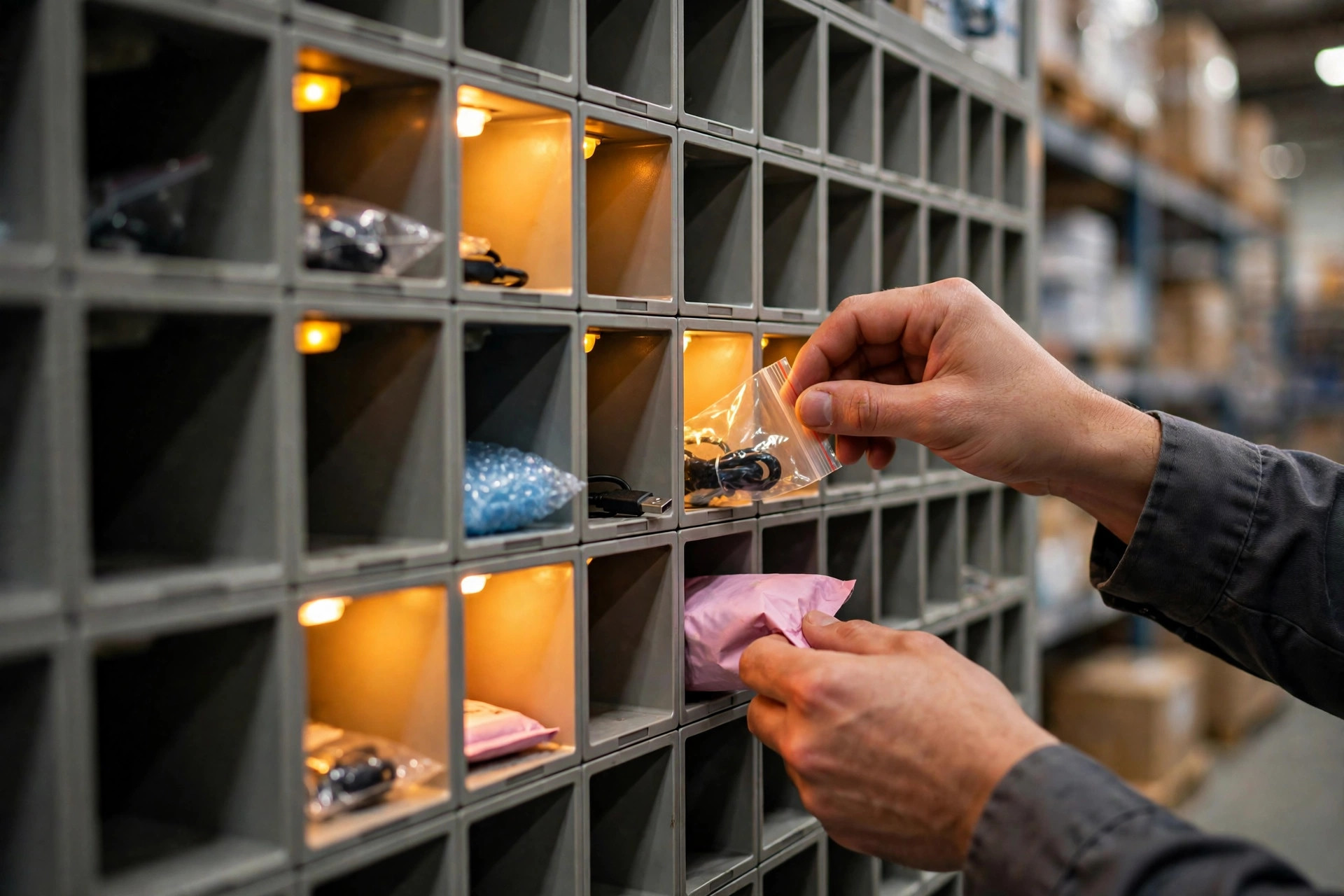
At 2 a.m. on Singles' Day 2024, in a beauty e-commerce warehouse in eastern China, a 200-cubby put-to-light system glowed across the pack area: four operators stood at the wall, light on meant drop the item, light off meant move on. Two hours, 2,400-plus orders sorted, 2 mis-sorts. The owner watched for a while and said, "Worth every penny."
Whether it was worth it has nothing to do with how pretty the lights look. A put-to-light system takes five minutes to explain, but nine out of ten warehouses that regret buying one regret it for the same reason: they assumed the wall was the whole solution.
What a put-to-light system actually does
A put wall does exactly one thing: it replaces human memory with light commands for the sort-by-order step. Think of it as a parcel locker in reverse — a locker is "enter code, take parcel"; a put wall is "see light, drop item." The WMS pushes a wave of orders; each cubby is one order; the light comes on with a quantity; the operator picks up an item, sees the light, drops it in, and kills the light with a button press (or a sensor does it automatically). That's the whole trick.
So a put-to-light system never fixed "slow picking." It fixes chaotic sorting. You can batch-pick (one trip, many orders' worth of goods) or pick-and-sort; the wall handles the second half — hundreds of orders of mixed goods, sorted back to orders fast and accurately. Think of a restaurant pass: the kitchen (picking) can cook fast, but if the pass (the wall) can't tell which dish goes to which table, dinner is still a disaster.
Hard numbers first. A trained operator sorts roughly 200–350 orders per hour at one wall station — it depends on the goods, since lipsticks and down jackets are not the same cycle time, so don't apply a small-parcel rate to a bulky-goods warehouse. The light modules themselves barely fail: LEDs plus a sensor or button, MTBF measured in tens of thousands of hours. What fails is wiring and process. One cubby normally holds one order; oversized goods take multiple cubbies. Cubbies are counted in orders, not square footage.
One distinction worth making: put-to-light and pick-to-light (PTL/DAS) run in opposite directions — PTL is "see light, take," the light telling you how many to pull from a slot; put-to-light is "see light, drop," the light telling you how many go into a cubby. One serves picking, the other serves sorting. Buy the wrong direction and you've bought the thing backwards.
Sizing the put-to-light wall: three dividing lines
In autumn 2023, the owner of an apparel e-commerce warehouse in southern China came back from a trade show determined to buy a wall: 800 orders a day, 3,000-plus SKUs, 1.2 units per order on average. I told him straight: at your volume you can't even fill a 50-order wave — half the cubbies would sit dark all year. That's serious money spent on a glowing shelf. A put wall feeds on waves; without wave planning, the wall is furniture. He didn't buy it, re-laid his manual sort flow instead, and kept the money.
Three lines decide whether you get a wall, and only then do we talk price.
The volume line. Under about 3,000 orders a day, manual sorting wins — the wall's cost never amortizes thin enough. Between 3,000 and 10,000 a day, one wall of 100–200 cubbies fits well. Past 10,000 a day, think multiple walls by zone or a fully automated sort line. A quick sanity check: one wave's order count should reach at least 70% of cubby count, or the wall is chronically underfed.
Wave design matters too: cutting by carrier cut-off time is the baseline; clustering by carrier on top of that kills the second manual sort after the wall. When product profiles clash (bulky mixed with smalls), split into two waves — cycle time beats mixed waves by a mile. Good waves double wall utilization; bad waves leave operators standing around waiting for goods.
The order-profile line. Average of 3 lines or fewer per order, and the wall is a weapon. Five lines or more, and one order's goods won't fit its cubbies — operators walk the wall hugging armfuls of goods, and cycle time gets cut in half. It's like entering a sprinter in a marathon: wrong event, training won't save it. Warehouses heavy on multi-line orders (beauty kits, baby bundles) should split waves or skip the wall entirely.
The money line. Compute cost per sorted order. The framework below uses typical assumptions — plug in your own numbers and rerun it:
| Cost item | Manual sort | Put wall (150 cubbies) |
|---|---|---|
| Orders per operator-hour | 100–150 | 250–350 |
| Mis-sort rate | ~1% magnitude | ~0.1% magnitude |
| Labor cost per order | ~$0.20 | ~$0.08 |
| Equipment amortization per order | — | ~$0.012 |
| Total per order | ~$0.20 (+ mis-sort aftercare) | ~$0.09 |
Assumptions: $5,000/month fully-loaded operator cost, 208 hours/month; $55,000 wall amortized over 5 years; 3,000 orders/day, 26 operating days/month. Note that I left mis-sort aftercare out of the manual column — customer service, reshipping, and returns, honestly amortized, dwarf that eleven-cent gap. During peak season, one mis-sort's service cost pays for hundreds of correctly sorted orders.
One more honest note on payback, because it flips by labor market: at the wage assumptions above, the eleven-cent gap on 3,000 orders a day pays the $55,000 wall back in under a year — labor math alone closes the case. Where labor is cheap, it doesn't: the same wall against a five-cent gap takes the better part of a decade on labor savings, and then the wall has to earn its keep on mis-sort aftercare and peak-season continuity — the temps you can't hire, the error spike you can't staff through. Know which market you're in before you sign.
Here's the counter-intuitive one: more cubbies is not better. If wave order counts can't keep up, cubbies idle, wall utilization sags, and waiting for wave fill stretches your carrier cut-off. Optimal cubby count is roughly order arrival rate times sort cycle time — Little's law from queuing theory, and it applies in warehouses too. An oversized wall spends peak season with half its cubbies waiting for goods. You paid for waiting.
One more shot: if you're buying a wall to achieve "zero mis-sorts," you've got the wrong end of the stick. The light tells you where to put it; it can't guarantee you picked the right SKU — wrong picks happen at picking, not at the wall. A wrong pick sorted perfectly is still a wrong pick. To cut errors, audit your picking verification first; the wall answers the sorting step, not the whole warehouse.
The lights don't break. Waves and process do.
In all my years doing integration, I can count on one hand the times a light module itself was the problem. The pitfalls are elsewhere.
Light strips run on a daisy-chained bus — one loose connector in the middle kills every light downstream. Rookies replace the strip; veterans check the connector first. Apparel warehouses have it worse: lint cakes onto sensor heads, false triggers spike, and a regular pass with an air gun beats any replacement part.
The bigger pitfall is WMS waving. If waves aren't clustered by carrier cut-off and shipper, operators finish the wall sort and then sort again by hand — the wall was pointless. The wall only mechanizes the "sort" motion; real efficiency comes from the wave algorithm. The wall is the hand; the wave plan is the brain. A fast hand with a confused brain still drops dinner.
One more detail: sensor auto-off versus button confirm. For peak season I recommend the button — the sensor saves half a second per put, but one false trigger costs you the time of a thousand button presses hunting the mis-sort. Cycle time is nice; accuracy pays.
A field routine to close with: three minutes at shift start, pick 10 random cubbies, trigger the lights and confirm on/off plus quantity display; once a month, power down and check every bus connector. Hitting 99%+ uptime on a put wall isn't hard — what's hard is nobody treating it as equipment. Left as furniture, no wall survives two peak seasons.
Whether the money was worth it comes down to one number: cost per sorted order. Amortization, labor, mis-sort aftercare — all in. If it went down, the wall earned its keep. If it didn't, the brightest wall in the building is still just decoration.
By Da Liu, Automation Engineer