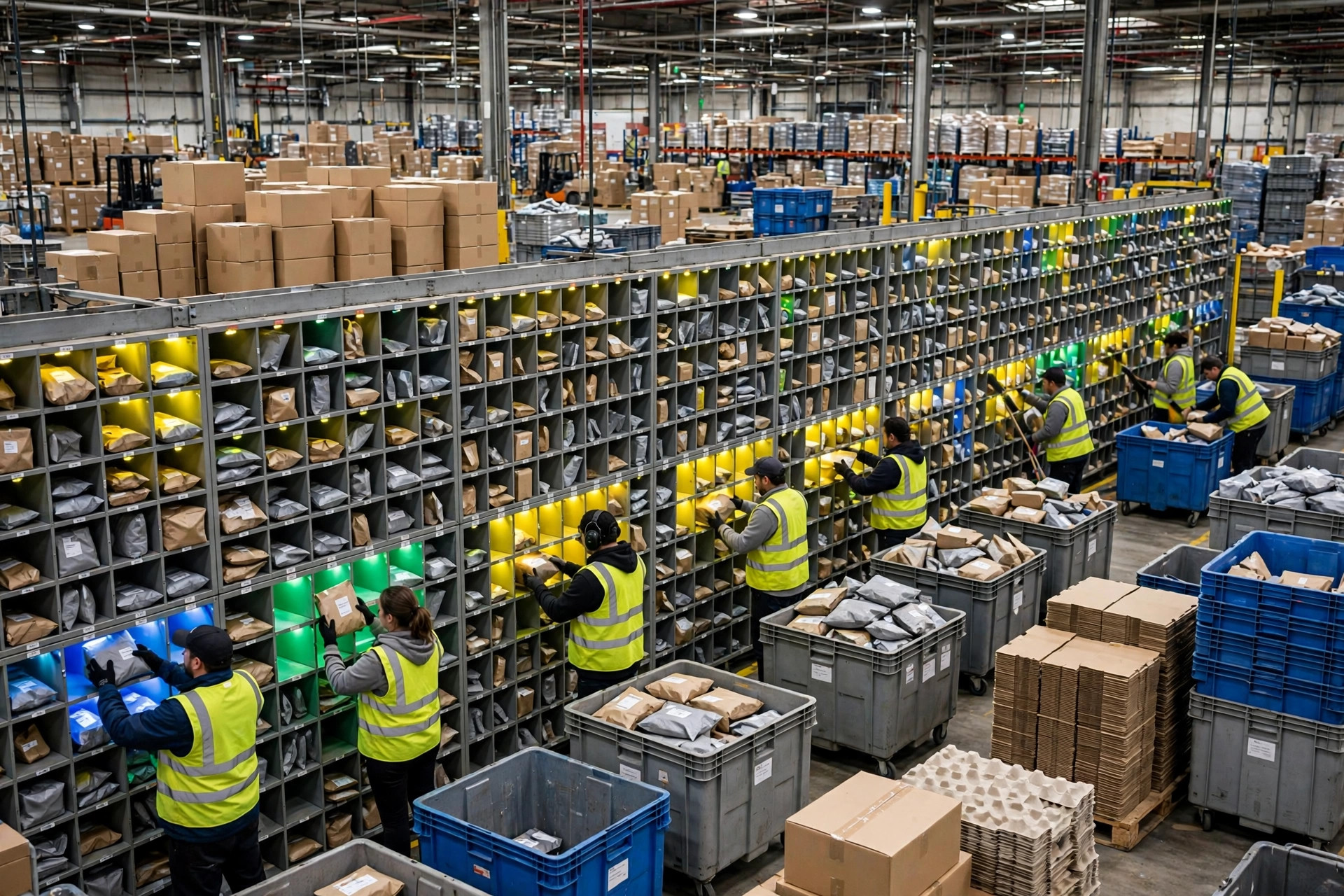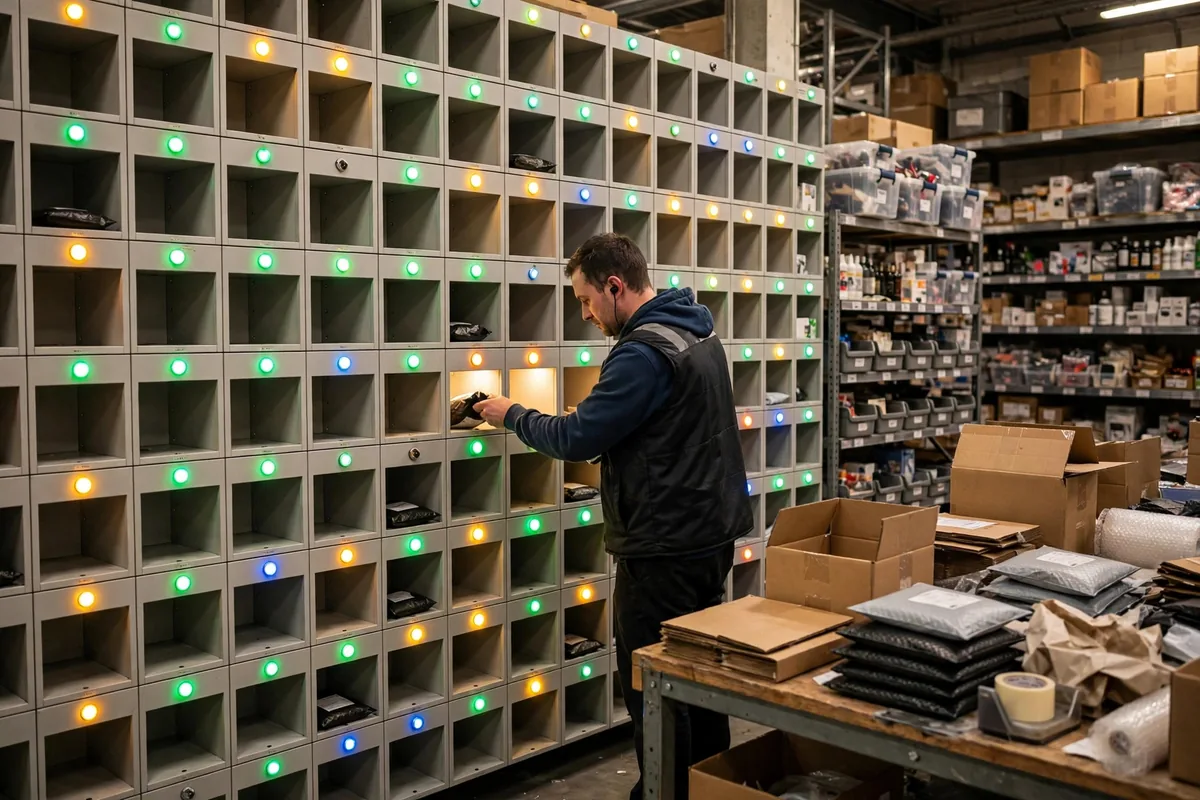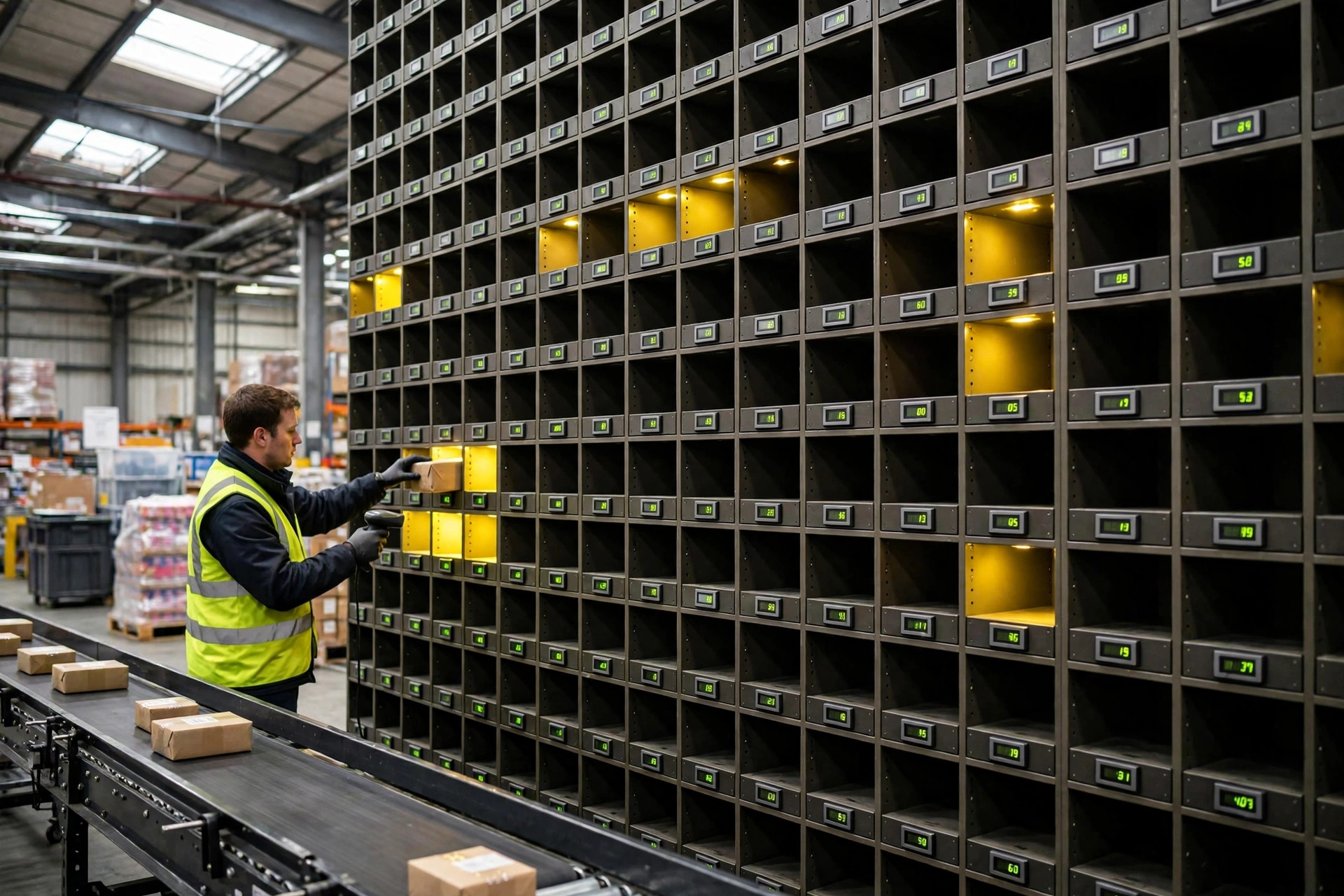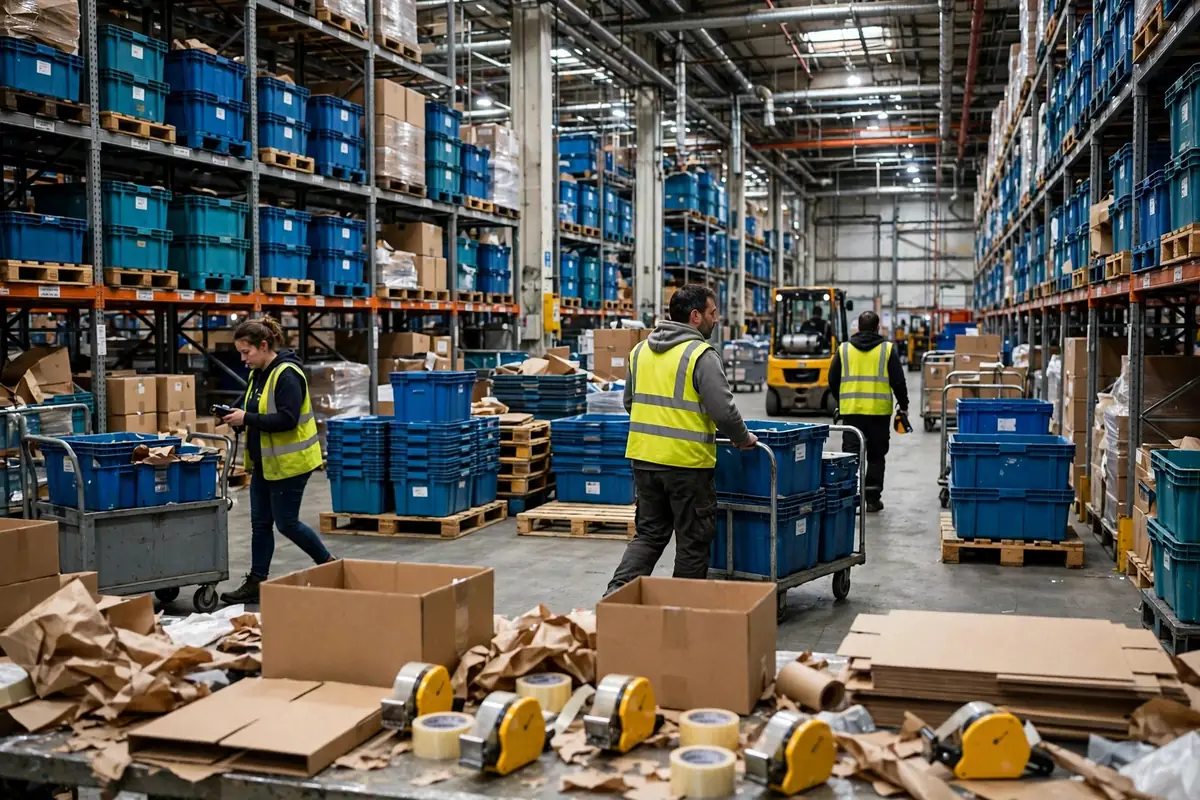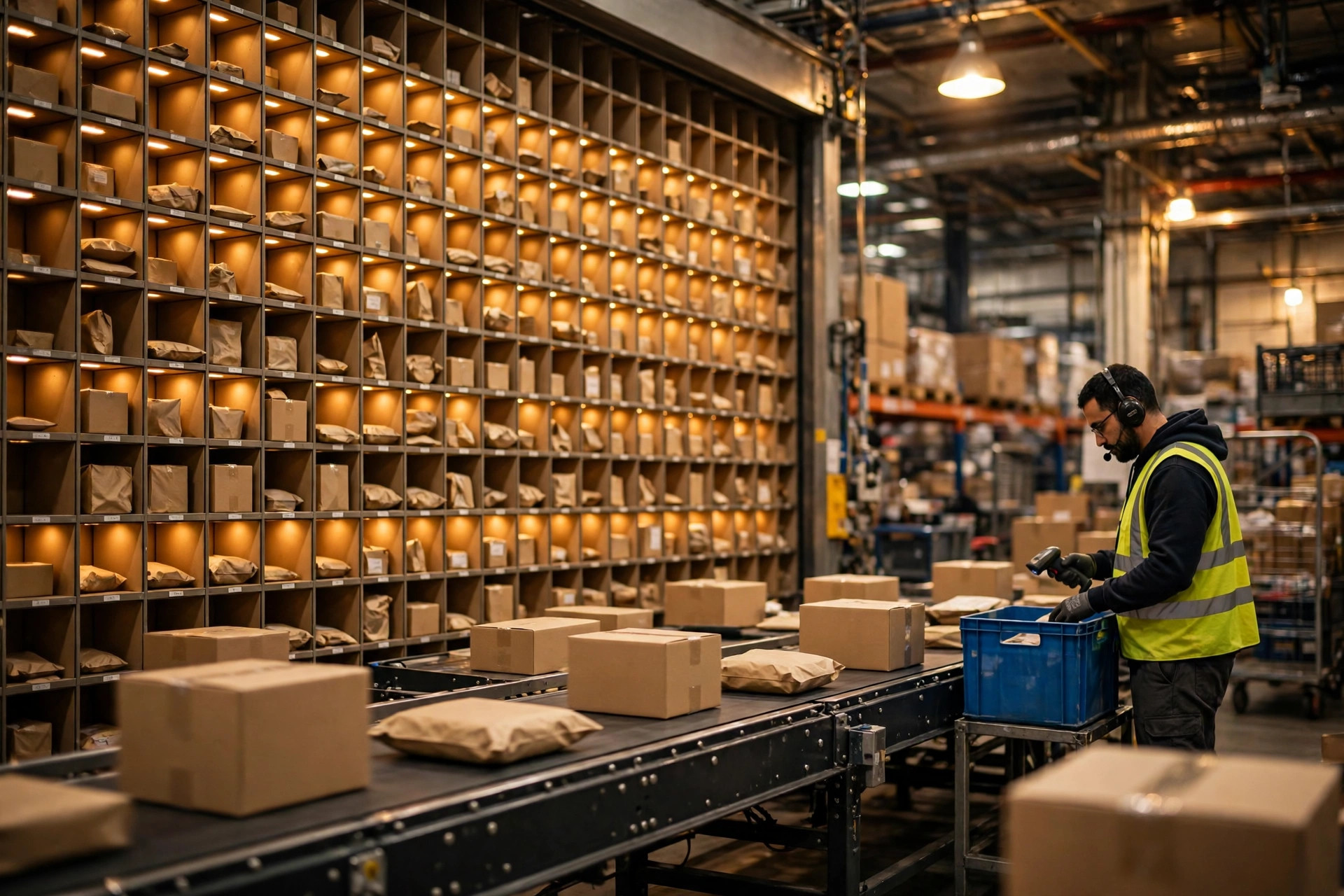
In November 2024 I stood in a Dongguan 3PL warehouse shipping small appliances, watching peak season spool up. Their high volume warehouse sorting wall had 240 compartments, four inductors working the front and two packers already falling behind at the back. Forty-five minutes into the wave, seventy percent of the compartments were occupied and the inductors were still holding product with nowhere to put it. The manager told me the wall was bought on the supplier's word: 240 compartments would handle 8,000 orders a day. One look at the wave plan told me the problem. The wall was not too small. The math was done in the wrong place.
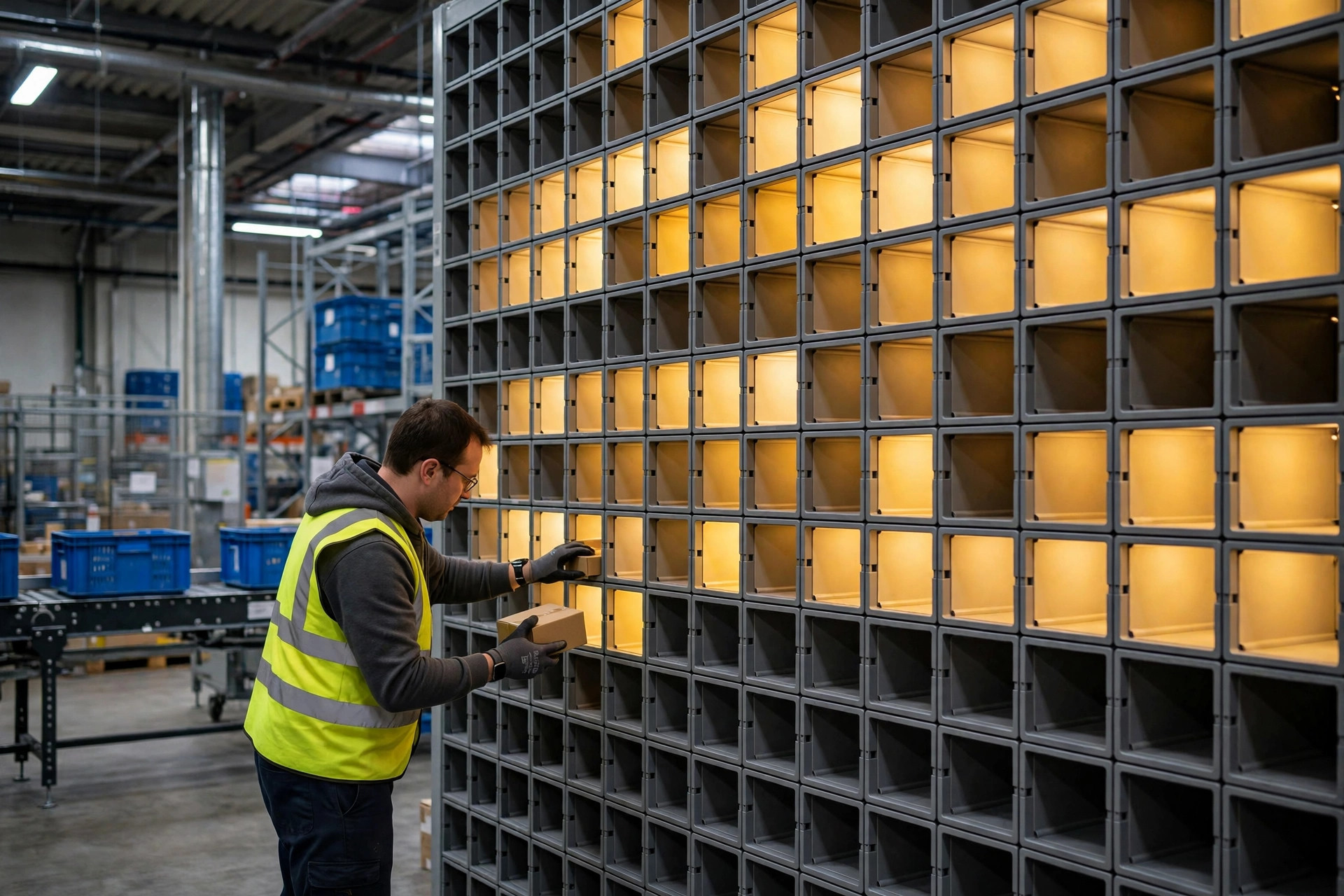
Think of it like a restaurant. A compartment is a table: one table seats one party at a time, and it only turns over when that party finishes and leaves. A sorting wall works the same way. One compartment belongs to one order until that order is complete and packed out. So a wall's capacity is not daily pieces, but how many unfinished orders it can hold at the same moment. With 240 compartments that sounds like plenty, until the average order needs three picking passes to complete. By the end of the second pass, you can easily have 260 orders hanging on the wall at once. The supplier's "8,000 orders a day" assumed every compartment turns over instantly and nothing ever goes wrong. That is not a warehouse. That is a brochure.
A High Volume Warehouse Sorting Wall Runs on Three Numbers, Not One
The first number is compartments, and it is set by order structure, not daily volume. The compartments you need equal the peak number of orders hanging on the wall at the same time in one wave, plus ten to fifteen percent of headroom for exceptions and re-picks. Worked example, clearly hypothetical: 300 orders averaging 2.4 lines each, picked in three passes. By the end of pass two, roughly 260 orders are still incomplete and occupying compartments. A 240-compartment wall overflows by 20 orders, and the extra product ends up on the floor waiting for a slot. Flip the order mix and the same wall behaves completely differently. If eighty percent of orders are single-line, 240 slots can run a dozen waves a day without strain. If half the orders are multi-line, the same wall starts gasping after six waves. Daily order count tells you almost nothing here. Order profile tells you everything.
The second number is induction rate: how many pieces per hour actually go onto the wall. A skilled inductor puts away 400 to 600 pieces an hour, and that is close to the ceiling once you measure a real shift instead of a vendor demo. The demo runs on an empty wall with the vendor's best operator; peak season runs on a full wall with whoever showed up. Same worked example: four induction stations at 500 pieces an hour each gives a ceiling of 2,000 pieces an hour. A day of 8,000 orders at two pieces each is 16,000 pieces, which needs eight hours of induction alone, before pack-out and exceptions. Warehouses that buy by compartment count and never ask about induction rate discover this in week one of peak.
The third number is the one almost everyone forgets: pack-out speed. Compartments only free up as fast as the pack side clears them, and that has nothing to do with how fast you induct. I have seen a wall with four induction stations running flat out and one pack station behind it, the packer also printing labels and handling exceptions. The faster the front runs, the worse the jam at the back, and the wall quietly turns into a very expensive temporary shelf. Pack-out capacity has to be sized together with induction, and the real throughput of the wall is whichever of the two is smaller.
| Measure | How to size it | Worked example (hypothetical) | | Compartments needed | Peak simultaneous open orders in a wave × 1.10–1.15 | 300-order wave, 260 peak open orders: 286–300 compartments | | Induction rate | Stations × pieces per inductor per hour | 4 stations × 500 pieces: 2,000 pieces/hour | | Pack-out rate | Pack stations × compartments cleared per hour | 2 stations × 90 compartments: 180 compartments/hour | | Wave duration | Total wave pieces ÷ bottleneck rate | 7,200 pieces ÷ 1,800 pieces/hour: about 4 hours | | Daily capacity | Effective hours × bottleneck rate ÷ pieces per order | 8 hours × 1,800 ÷ 2 pieces: about 7,200 orders |
The wave-duration row stings. The bottleneck is not the 2,000 pieces an hour going on the wall. It is the 1,800 pieces an hour coming off it. The wave takes four hours, real daily capacity lands around 7,200 orders, and no fudge factor gets you to the supplier's 8,000. Get any one of the three numbers wrong and the wall exposes it in the first week of peak.
What a High Volume Sorting Wall Looks Like Right Before It Breaks
A wall does not break all at once. It gives warnings. The first is compartment occupancy sitting above ninety percent for hours, with inductors staging product on carts while they wait for a slot. Then waves start stretching: a two-hour wave becomes three, the carrier cutoff arrives with orders still incomplete, and packers clear only the complete ones while the rest hang overnight. Then exceptions take over: re-picks have nowhere to go, and pallets of held product block the aisle behind the wall. In March 2025 I saw exactly that in an apparel e-commerce warehouse in eastern China: a 320-compartment wall, 400-order waves, high returns, the aisle behind the wall half-blocked. The wall ended up demoted to single-line orders only, with multi-line orders sent back to manual sortation. Watch one number instead: average compartment dwell time, from first piece placed to pack-out. Single-line orders should clear in under thirty minutes, multi-line orders inside two hours. Once average dwell passes half the wave duration, the wall is already running on borrowed time. Any WMS can report this daily, and most warehouses never look at it.
Sorting Wall Maintenance: Dead Lights Cost More Than a Small Wall
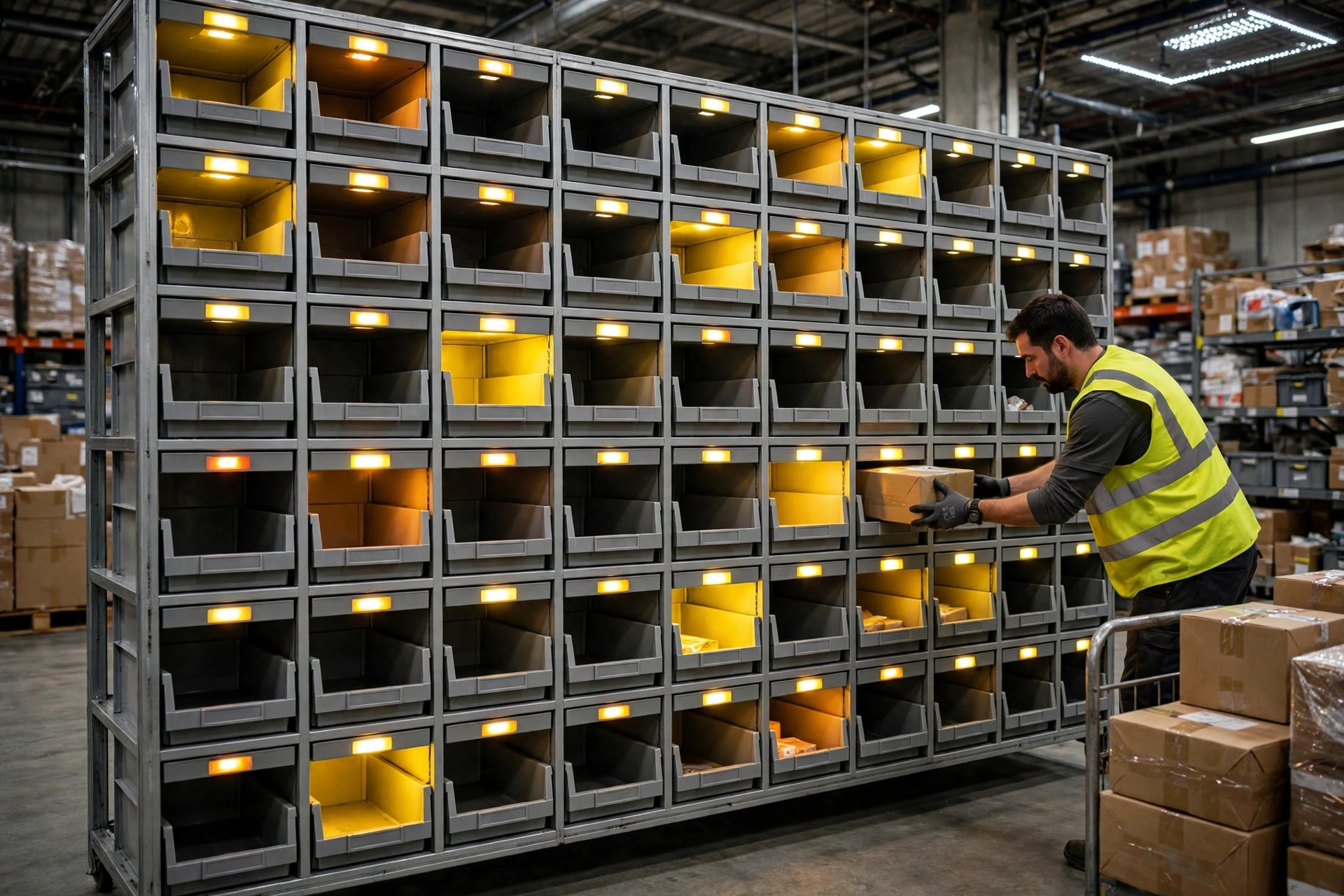
Even a correctly sized wall can lose a fifth of its throughput to maintenance. The lights and buttons on a wall are consumables. One dead light means one blind compartment, and inductors fall back to paper checks, which kills the rate immediately. I have walked past walls with thirty-odd dead lights nobody fixed because the wall "still worked", while misplacement rates doubled and verification worked overtime every night. Lights, buttons, and scanners need a weekly check and same-day replacement. Vendors publish MTBF figures for the light strips; in a dusty warehouse, plan on seventy percent of that life.
The other trap is compartment size. Walls get built around the average order volume, and then peak brings bigger orders that do not fit. Product gets stacked sideways, and pack-out turns into digging pieces out one by one. Keep ten to twenty percent of compartments oversized for large and multi-line orders. It looks wasteful on paper. In peak it saves the operation. Adjustable dividers are worth the money: when the SKU mix changes, the wall changes with it. And measure the floor before you talk about compartment counts. I have seen a wall installed tight against a column where pack-out ran twenty percent slower than the identical wall in the next building, purely on layout.
So when do you add a second wall, and when do you stretch the wave? The line is simple. If compartment occupancy runs above eighty-five percent all day and wave duration is already pressing the carrier cutoff, the bottleneck is compartments, and a second wall is the answer. If occupancy is only sixty percent and waves still do not finish, the bottleneck is induction or pack-out, and a second wall buys you nothing. Fix the pack stations, fix the lights, fix the layout first. For the wave and wall coordination itself, this guide to how secondary sortation works at a put wall lays out the process side; do the capacity math first, then match the process to it. Before approving a second high volume warehouse sorting wall, pull the three numbers for the wall you already have: dwell time, induction rate, pack-out rate. If only one is out of line, fix that one. If all three are out of line, then talk about a second wall.
Whether the money was worth it comes down to a single number: orders cleared per compartment per hour. Compartments times turnover is the wall's real capacity. Everything else is paper.
By Da Liu, Automation Engineer