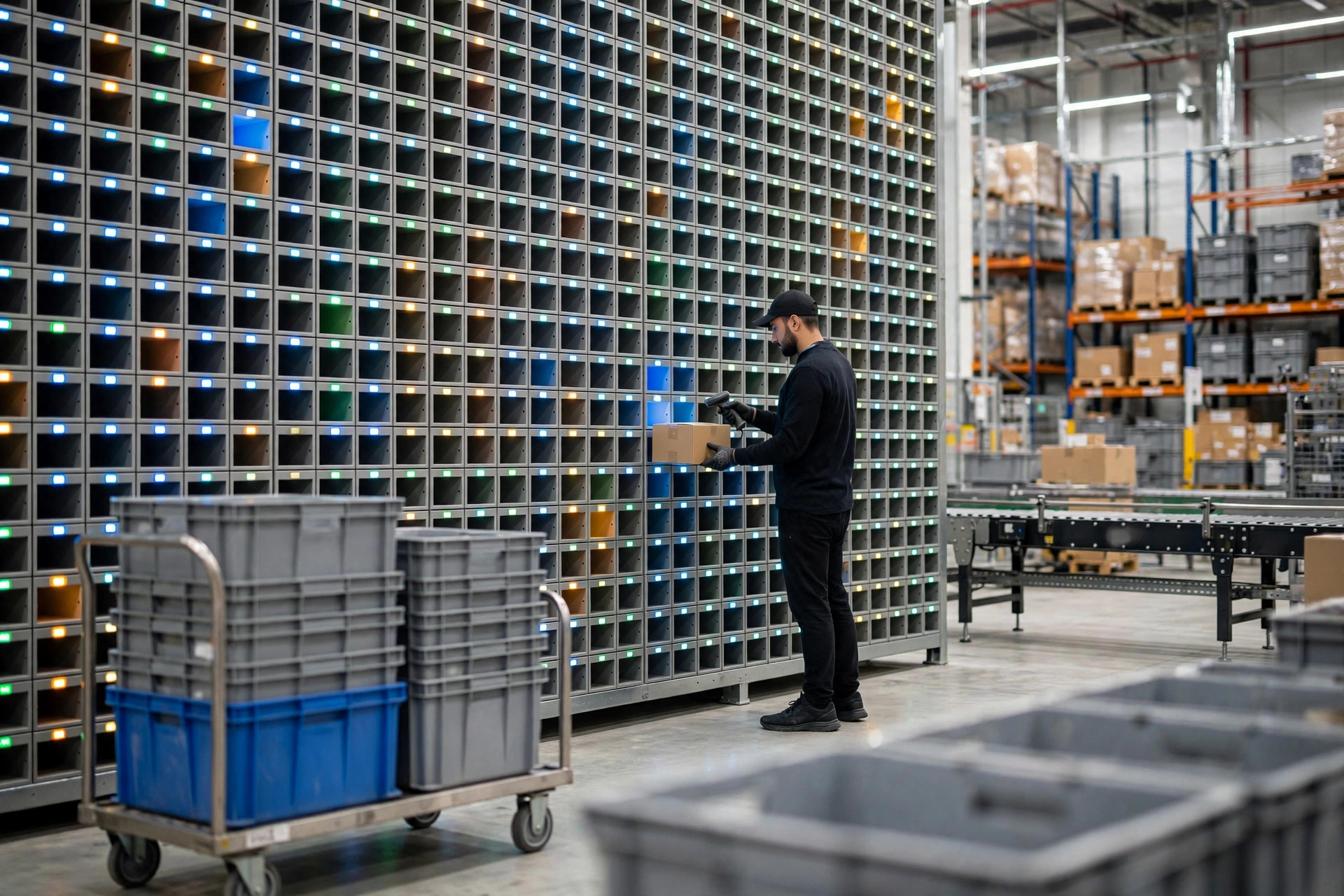
Here's the short version: a put wall does one thing — it takes batch-picked product grouped by SKU and re-splits it by order. That's it. But that single regroup-and-split step is what decides whether the wall prints money or collects dust. I've seen facilities double their labor productivity after installing one, and I've seen walls sit idle while workers went back to hand-sorting. The difference was never the wall. It was the order profile in front of it.
What a Put Wall Actually Does: Think "Sorting Halloween Candy"
Think of it like sorting Halloween candy for a group of kids: first you dump everything out and pile it by type — all the chocolate bars together, all the gummies together. That's batch picking: pick by SKU, visit each location once. Then you deal the piles out into labeled bags, one bag per kid. That's secondary sortation — the put.
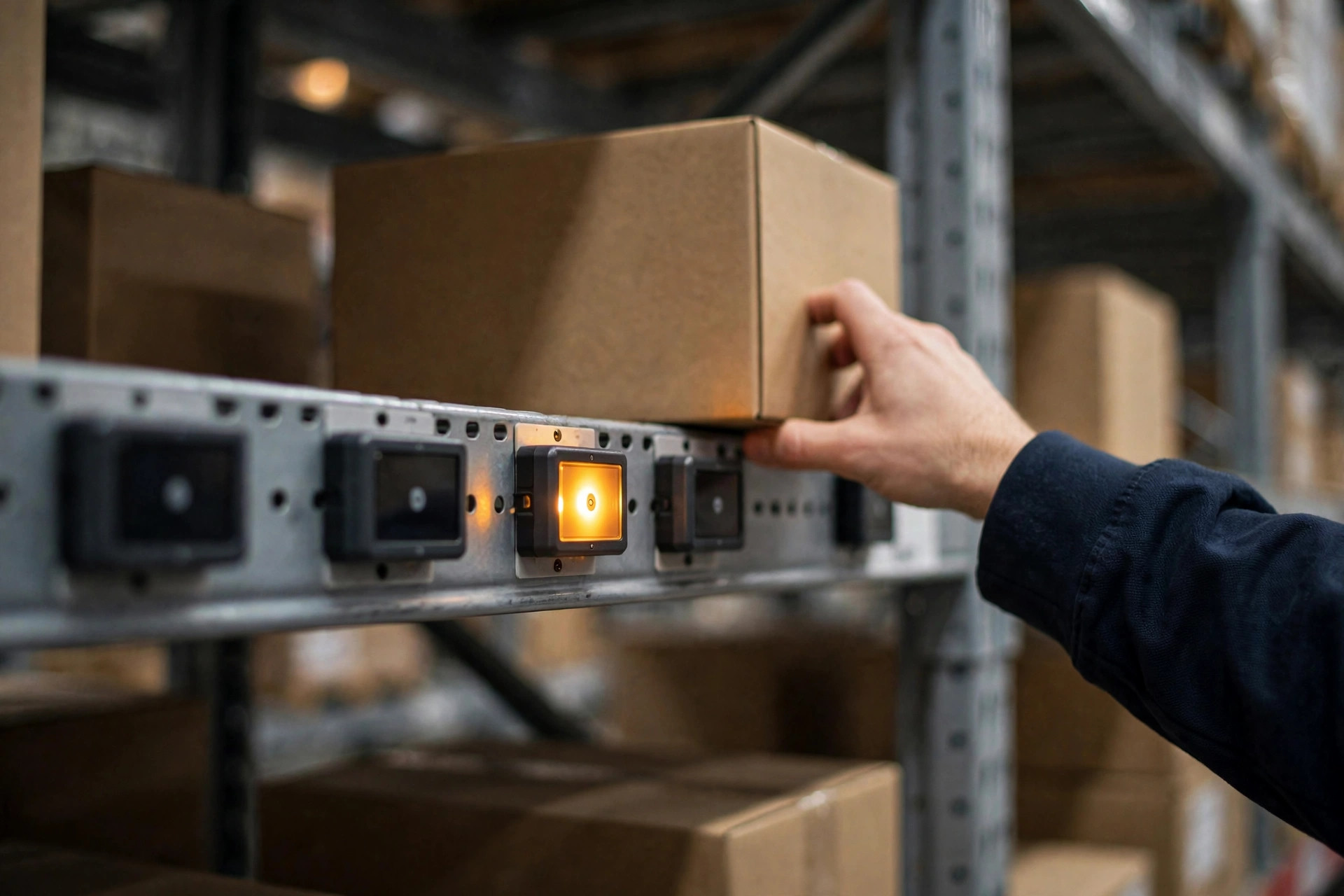
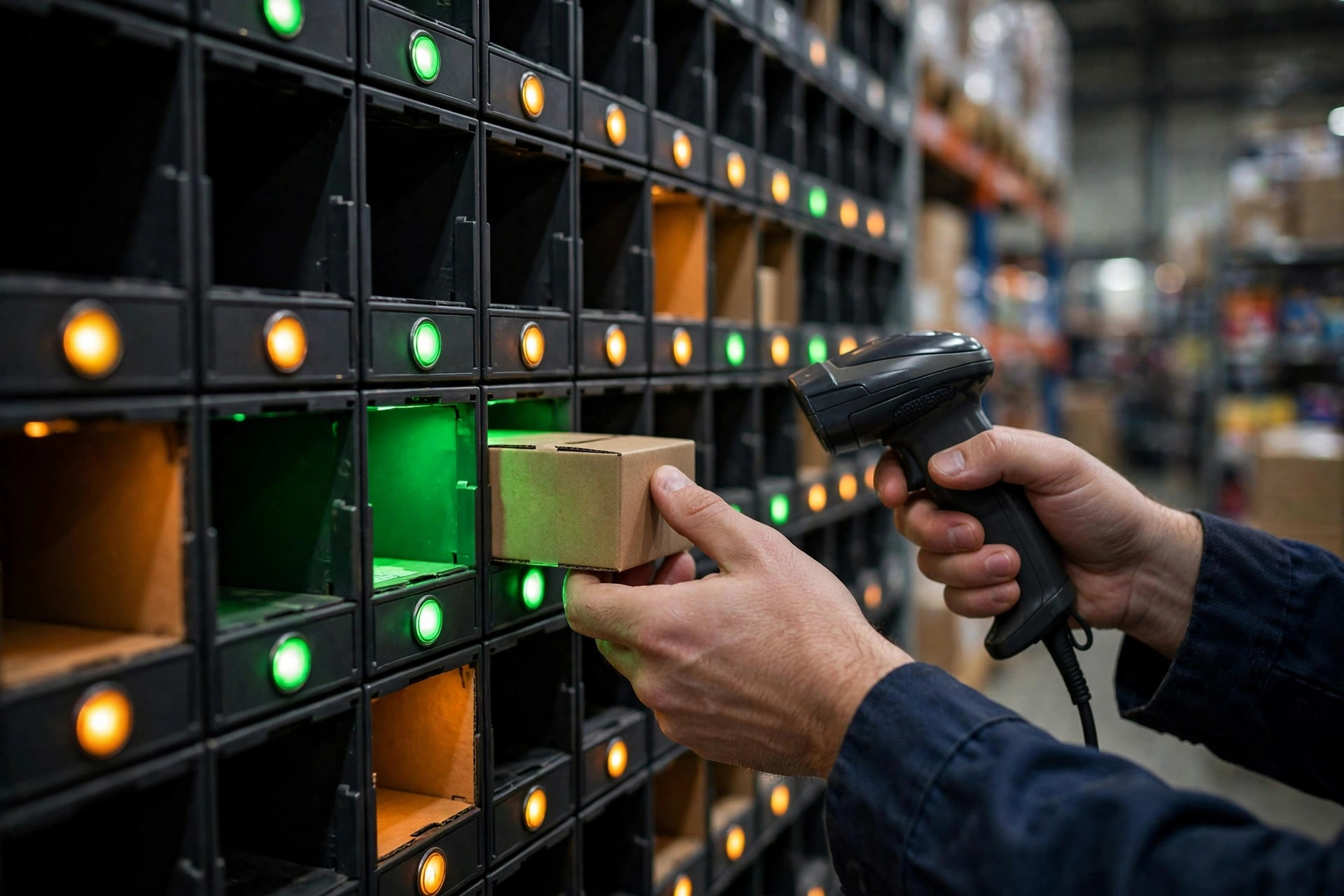
One put cycle breaks down like this: scan the item barcode, the light for that order's cubby comes on and the display shows the quantity, the operator drops the quantity into the cubby, confirms with a button press (or a second scan), and the light goes out. A trained operator runs this loop at 350 to 500 lines per hour — a range that light-directed picking vendors and integrators have validated over and over (Numina's published application data). Note the unit: lines, not units. One line might mean dropping five pieces; the rate is counted per line.
So what does the put wall actually save? Not the "sorting" motion — the walking. In discrete order picking, one worker pushes a cart across the whole building for a single order, and most of the shift goes into legwork. In wave-plus-put-wall operations, pickers only deal with SKUs: one visit per location, and the travel distance gets amortized across the entire wave. The sortation work doesn't disappear; it just changes from "sorting while walking" to "sorting while standing still."
The Efficiency Math: How Much Faster Is 400 Lines an Hour, Really
You have to compare against the same order set. Say a facility runs 1,000 orders a day at 4 lines per order — 4,000 lines total.
Option A, discrete picking: one person, one order, full travel. Travel dominates, and the rate is typically a fraction of put rates — it varies too much by building size and slot density to pin down honestly. Of the three options, this burns the most labor hours per 4,000 lines.
Option B, wave picking plus put wall: the front end picks by SKU — SKUs shared across the 1,000 orders get visited once, and travel distance collapses. The put stage runs at 350–500 lines per man-hour, so 4,000 lines take roughly 8 to 11 put-wall labor hours. Combined, the two stages typically cut labor by 30% or more versus discrete picking, depending on SKU overlap across orders.
Option C, pick-and-sort on the move (put carts / cluster picking): the cart carries a few dozen order compartments, and the picker sorts while picking — no secondary sortation step. But a cart can only hold so many orders, so this fits small orders at 1–3 lines each.
| Discrete picking | Wave + put wall | Pick-and-sort cart | |
|---|---|---|---|
| Logic | One worker, one order, full travel | Batch pick by SKU, secondary sort at the wall | Sort into order compartments while picking |
| Sweet spot (lines/order) | Any; actually suits high line counts | 2–8 | 1–3 |
| Key rate | Travel-heavy, lowest rate | 350–500 lines/man-hour at the wall | ~200–250 picks/man-hour, light-directed carts |
| Equipment | Near zero | Wall + light modules + WMS waving logic | Put carts + cart lights/terminals |
| Error control | Operator skill | Light + scan confirmation, high accuracy | Light-directed |
| Maintenance | None | Light modules, wave strategy needs care | Cart terminals, batteries |
On the sources for those rates: the 350–500 lines/man-hour put rate and the 200–250 picks/man-hour cart rate come from published light-directed picking application data (Numina, via industry press). I deliberately didn't pin down a discrete-picking rate — building size and slot density vary too much, and a hard number there would be fiction.
Two published cases put real numbers on this. Apparel retailer Next's distribution center (Dematic system, reported in the trade press): 20 light-directed put stations, each holding up to 24 order totes, serving roughly 500 retail outlets — up to 1,000 items per hour per station, a 300% lift in overall picking rates. Note that's per-station capacity: product arrives by conveyor, the operator only puts, walking is near zero.
The other is Radial's Louisville, Kentucky facility (trade-press site report): 500,000 square feet, 12 robotic put walls at 96 or 120 cubbies each, 450–500 units per hour per wall, an average order of eight units, 20,000 parcels a day with peak capacity of 50,000. Robots do the putting instead of people, but the logic is identical to a manual wall: batch pick first, secondary sort after.
The Selection Boundary: Three Cases Where a Put Wall Is a Pseudo-Need
Time to call it out. The most misused put-wall scenarios I see come down to three boundary lines — cross any one of them and the money is wasted.
First, single-line orders above 50% of volume. Here's the counter-intuitive part: most people assume more orders means more reason for a wall. Wrong. With single-line orders, each SKU was only ever going to one cubby — the put step creates zero consolidation benefit. You're just trading "walking to the slot" for "walking to the cubby," plus an extra scan confirmation. For that order mix, a put wall is a textbook pseudo-need. Discrete picking, or a put cart that sorts in one pass, wins.
Second, wave order count above cubby count. A 96-cubby wall fed 300-order waves has to turn over three-plus times per wave; putters spend half their time waiting on wall clears and wave changeovers, and the rate falls apart. My rule of thumb: cubbies should cover at least 1.2x the orders in a single wave, leaving headroom for big orders that hog multiple cubbies. If the cubbies don't fit, build a bigger wall — don't bet on "multiple turns," because every turn costs you rate.
Third, product that physically doesn't fit the cubby. Put walls assume small items — cubbies typically hold up to shoebox-sized product, varying by vendor. Oversized, irregular, or full-case picks don't belong here. The wall will teach you that lesson the hard way.
Clear all three, then check lines per order: 2–8 is the sweet spot. Below 2, see rule one. Above 8, watch out — big orders hog cubbies and take long put times, and discrete or zone picking may serve you better.
The Maintenance Pitfalls: On the Day the Lights Die, the Whole Wall Waits
The wall going live is the easy part. The pitfalls come later.
The biggest one is the cubby lights. LED lamps and light modules are consumables: a dead row means a dead row of cubbies, and putters just stand there waiting on maintenance. The light system looks simple, but it sits squarely on the critical path — when the wall stops, the entire wave stops shipping. Spare-parts policy in one sentence: keep common light modules in stock, prefer hot-swappable designs, and never wait on factory lead times.
Second is mis-putting and mixed orders. Button confirmation is fast but risks accidental or missed presses; scan confirmation is a beat slower but far more certain. It's a straight speed-versus-accuracy trade-off with no universal answer — my recommendation: force scan confirmation on high-value or easily confused SKUs, button-press for ordinary small items. One mis-put can force a full wave rework; price that rework into the business case up front.
Third is wave release out of sync with wall rate. If the WMS wave logic only cares about "enough orders" and not "can the wall digest this," the front end starves and putters idle in front of a dark wall. Wave strategy has to link to cubby count and put rate — that's WMS configuration work, not the equipment vendor's, and it must be tested at acceptance.
Finally, uptime. Don't buy the "light systems are maintenance-free" pitch. Anything on the critical path gets treated as critical equipment: scheduled inspections, spares, failure fallback plans. No exceptions.
Whether the money is worth it comes down to one number: lines per order. Between 2 and 8, with decent SKU overlap, a put wall usually earns its keep. Dominated by single-line orders, or waves that don't fit the cubbies — walk away before you sign. Equipment never lies; what lies is a solution looking at every problem like a nail.
By Da Liu, Automation Engineer