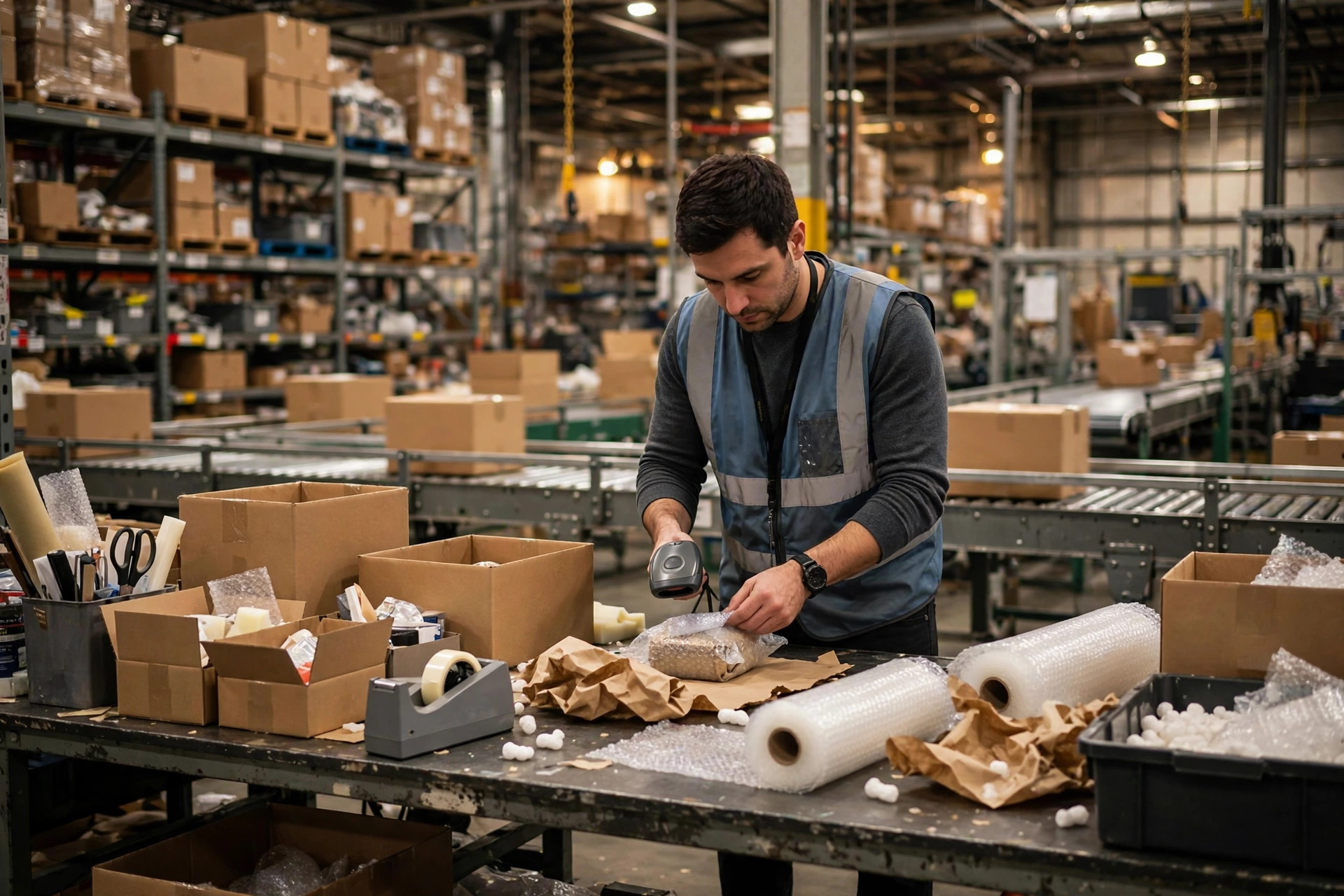
I will give you the verdict first: in warehouse packing station layout design, the sequence of verify, pack, and weigh decides your daily ceiling. Get it wrong, and peak season costs you two or three thousand orders a day. I have seen too many owners spend six figures on automation while refusing to fix fifteen meters of bad flow in the pack area.
Here is my dividing line: 800 orders a day. Below 800, forget the conveyor line — one fully equipped packing station per worker is the cheapest setup that works. Above 800, the single-station model breaks, and you have to split the three steps into a line. But this cuts two ways: a packing line does not actually beat single stations on per-person output. It wins somewhere else entirely. I will show you the math.
Search warehouse packing station layout design and the top results are thin vendor checklists — what equipment to buy, never how many stations, how to split single and multi-item orders, or how to survive the peak. This piece fills that gap: the math, with numbers.
The Most Expensive 12 Meters I Have Ever Seen
Fall 2022, Ontario, California. A 3PL, about 50,000 square feet, doing small-parcel e-commerce. Their pack area was a U-shape: verification at one end, packing in the middle, weighing and labeling at the other end. Looked clean on paper. On the floor it was a mess — the scale sat 12 meters away from the labeling station. Every carton got weighed, then carried 12 meters to get its label, then the worker walked 12 meters back empty-handed. Twenty-four extra meters per order.
Peak ran 12,000 orders a day. Twenty-four meters times 12,000 is 288 kilometers — walked daily, on human legs. Both ends of the U jammed; the owner threw 40 packers at it and the crowding made it slower.
The fix was two sentences: sink the scale into the pack station so weigh and label happen in one motion — 12 meters deleted — and straighten the U into one line, cartons riding conveyor, people standing still. Under $20,000 total: conveyor sections, stands, bench scales, zero "smart" equipment. Peak output per person went from 38 to 52 orders an hour. The money was not spent on equipment. It was spent on making people walk less.
Packing Station Layout Design for Small Warehouses: Three Steps, One Station
Below 800 orders a day, do not copy the big guys. Spring 2024, Rancho Cucamonga: an 8,000-square-foot self-run cross-border warehouse, 300 orders a day. The owner had heard "lines are advanced" and installed two conveyor sections. They switched categories three or four times daily; every changeover ate half a day of line adjustment. In the slow season volume fell to 150 a day, the conveyor sat idle eating floor space, and workers walked around it. Three months later they tore it out. Money burned for nothing.
The whole point of a single station is three-steps-in-one: one person verifies, packs, and weighs at one bench. Four layout rules:
Bench 1.8 to 2.4 meters wide: verify left, pack right, scale at the right hand. Cartons, void fill, tape, label stock — everything inside arm's reach. A packer seals hundreds of cartons a day; every extra reach is a cost.
Never verify with human eyes. Scan everything; the screen tells you whether the count is right. Eyes survive 300 orders; by 500, mistakes are guaranteed — physiology, not attitude.
Weigh right after packing. A weight exception usually means a wrong count — stop it on the spot.
A skilled packer does 40 to 60 orders an hour here. Do not expect more: when volume grows, add people, not pressure — the price of pressure shows up in the error rate.
Packing Station Layout Design at Scale: Splitting the Three Steps
Above 800 orders a day, the single station hits its ceiling. Split the steps: inbound, then verify (scan), then pack (box, fill, seal), then weigh, then label, then slide into sortation. Connect the stages with roller conveyor or chutes. Cartons never touch the floor; people never walk.
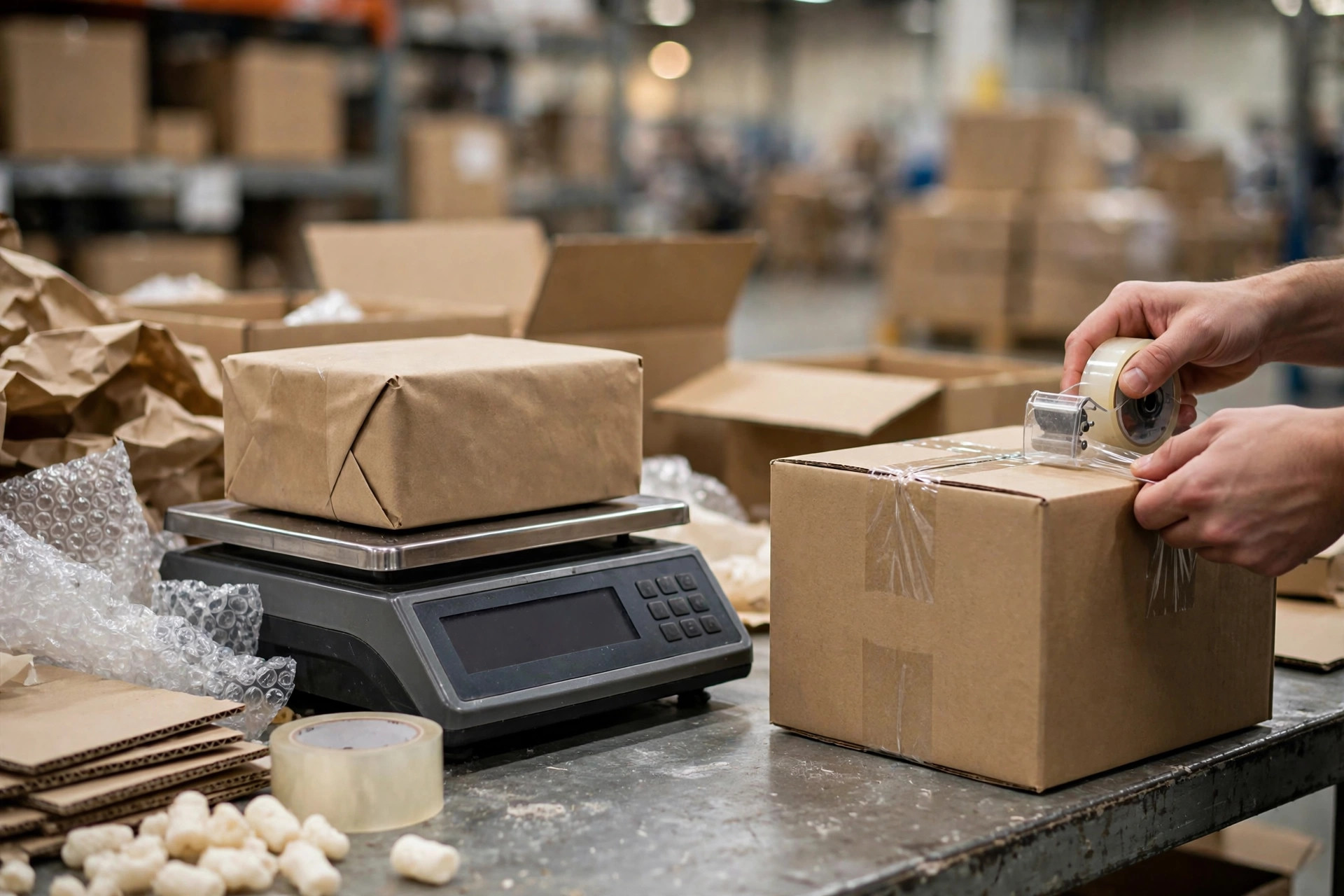
Three things matter.
First, the bottleneck is always pack. One verifier clears 120 orders an hour, weigh-and-label does 100, packing tops out at 60 to 70. Staff to the bottleneck: one verifier feeding two packers, or one person covering verify and weigh. Unbalanced, the fast stages idle while the slow one chokes — line output equals the slowest stage.
Second, weigh before labeling. Catch the exception before the label prints: reworking a labeled carton costs three times a normal pack. Pure waste.
Third, keep the line straight. U-shapes look space-efficient, but every turn is a jam point. Tight on space? An L still beats a U — one turn only.
The Dividing Line: The 800-Order Productivity Math
Single station versus packing line — where is the real difference? Here is the account, built from the warehouses I have walked through over the years:
| Single full-function station (small warehouse) | Segmented packing line (big warehouse) | |
|---|---|---|
| Fits daily volume | Under 800 orders | Over 800 orders |
| Skilled output per person | 40–60 orders/hour | About 50–70 orders/hour per head across the line (pack stage is the bottleneck) |
| Footprint | 6–8 sqm per station | 20–40 m of line |
| Equipment spend | A bench, a scale, a scanner | Conveyor/chutes plus stage benches |
| New-hire ramp-up | 1–2 weeks | 1–2 days (one repeated motion) |
| Error rate | Depends on the individual, swings | Stable and low: weight interception plus stage checks |
| Flexibility | Switch categories instantly | Changeover means re-tuning the line |
Two sides to this, and the table hides a counterintuitive call: the line's per-person output (50–70 an hour) barely beats the single station (40–60). Big warehouses do not run lines for labor productivity. They win on three other things: a new hire is productive in a day or two of one repeated motion — in peak season, hiring temps by the dozen, that is survival; error rates stay flat because weight checks and stage verification do not depend on anyone's feel; and the ceiling is high — double the volume, add a line section and a few people. With single stations, more people means more floor space, and floor space costs more than labor.
The price is flexibility: change the mix and the line needs re-tuning; in the slow season it idles while depreciation and floor space keep burning. That is why my dividing line is 800 — and it is 800 on the annual daily average, not the peak-season spike. Build for the peak and the slow season bleeds you dry. I have seen it too many times.
Sizing the Math: How Many Stations Does Your Volume Need
Directions are done; now the hard numbers. One formula:
Stations needed = daily orders ÷ (orders per person-hour × packing hours per day)
Example: a warehouse doing 2,400 orders a day, a skilled packer at 50 orders an hour, two shifts with 7 effective packing hours each (breaks and changeovers out) = 14 hours. 2,400 ÷ (50 × 14) = 3.4, so 4 stations.
But single-item and multi-item orders are different jobs — split them. Single-item (scan, bag, weigh) flies at 80 to 100 an hour from a simplified station; multi-item needs the full verify-pack-weigh at 40 to 60. With 70% single-item of 2,400: 1,680 ÷ (90 × 14) = 1.3 → 2 simplified stations; 720 multi-item ÷ (50 × 14) = 1.03 → 2 full stations. Same total of 4, two station types — that split is where experienced operators quietly win.
Conveyor or hand carry? A 3-meter roller section costs a few hundred dollars; a 20-meter line a few thousand. A California material handler runs about $150 a day — the carrying it eliminates pays for the line in roughly a month. Two triggers: above 1,500 orders a day with secondary handling in the pack zone, or a pack zone deeper than 15 meters — install conveyor. Below that, hand carts stay cheaper and more flexible.
Peak elasticity: size for average × 1.3, never for the peak. Peaks run 1.5 to 2× average; bridge the gap three ways — temps (a line station takes a day or two to learn), overtime (two extra hours a day), and pre-packing single-item orders before the spike. Build for the peak and the slow season bleeds you dry — said it before, saying it again.
The Counterintuitive Bit: A Scale's Real Job Is Not Shipping — It Is Free Second Verification
Most warehouses treat the scale as a pre-label formality and buy whatever is cheapest. Put plainly, the scale is your cheapest verification clerk: every SKU has a known standard weight, and a deviation of a few dozen grams usually means a wrong count or a missing insert. Set a weight tolerance with an alarm — it catches errors at a tenth of the cost of another verifier.
Buy a scale with data output that writes the weight into the system, not a dumb scale that only shows a number. Accumulate the data and it feeds back into tuning your tolerances. That is what data is for.
Next time you walk your pack area, skip the equipment. Count your people's daily steps — the longest stretch is the most expensive part of your layout.
By Lao Mi, Supply Chain Veteran (20 yrs)