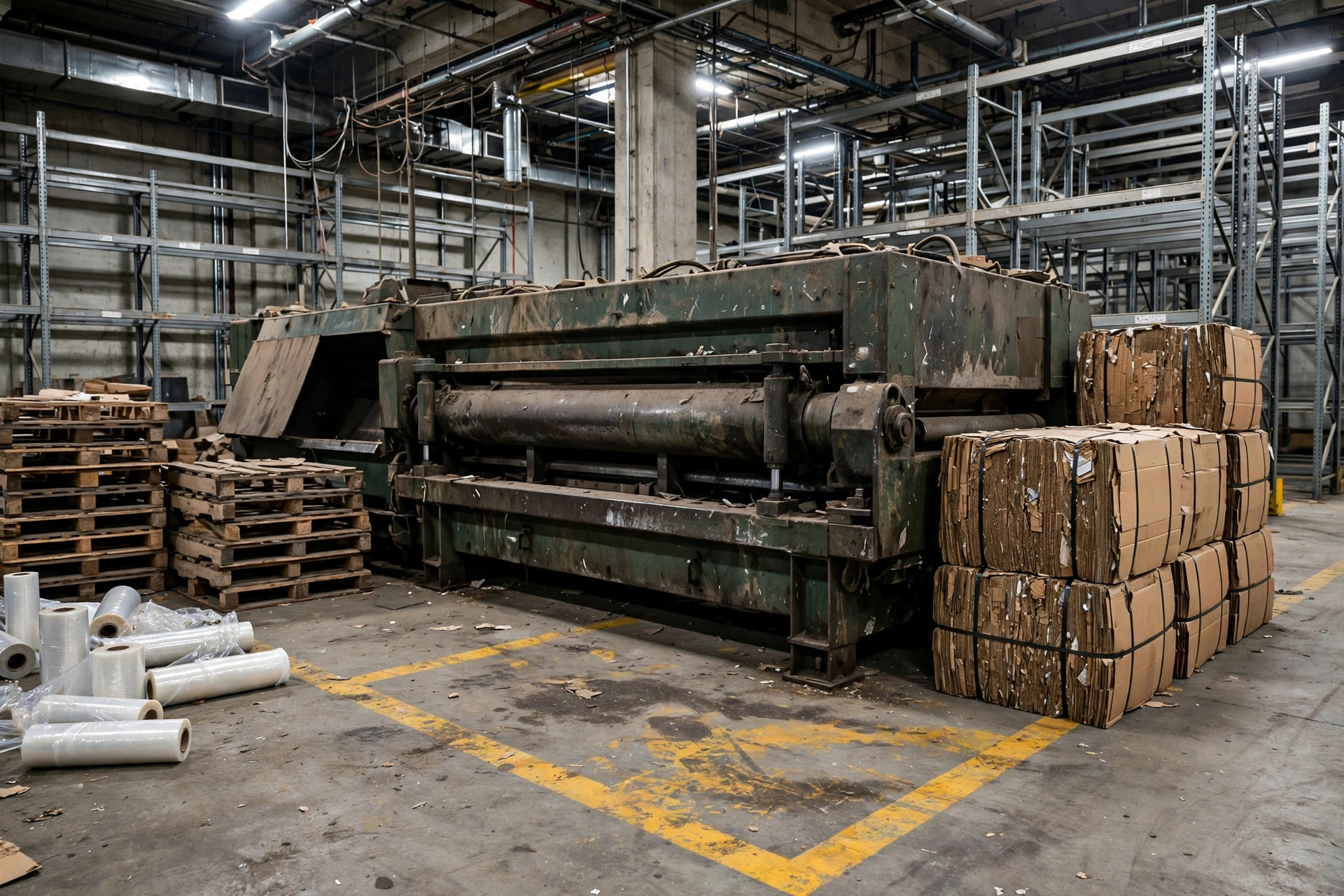
Think of a warehouse's waste flow as a building's plumbing. Nobody thinks about it — until it clogs. Then the whole building stops working. And the difference between a clog and a system is warehouse waste management area layout.
A warehouse produces three kinds of waste every day: cardboard, stretch film (plus assorted plastic wrap), and broken pallets. All three share the same traits: big volume, light weight, worth almost nothing — and absolutely elite at eating floor space. I've walked into too many warehouses where the slotting, aisles, and dock doors were engineered to the inch, while the waste zone was a box sketched in a corner labeled "waste staging." Six months later that box overflows — into the aisle, onto the dock, and eventually onto a fire marshal's citation.
Warehouse Waste Management: The Principle Is Volume, Separation, Hauling
Here's the principle. Waste handling is three jobs: compress the volume, separate the streams, haul on schedule. Cardboard's enemy is volume. Film's enemy is contamination. Pallets' enemy is fire. Completely different physics, completely different handling — pile them together and you're manufacturing your own problems.
Some numbers. A vertical baler runs a 3:1 to 5:1 compression ratio, spits out 50–300 kg bales, one or two bales an hour. A single-ram horizontal baler runs 8:1 to 10:1, with bales from 1,300 to 2,500 pounds. Translation: the same mountain of loose cardboard comes out at one-tenth the volume. You can think of it this way: without baling, the truck you're paying for is hauling air.
Now the money. OCC — old corrugated cardboard — averaged around $91 a ton nationally in the US this October, swinging between roughly $60 and $145 over the past year. Check your local recycler for today's number; it moves constantly. Clean stretch film (A-grade) was going for about 13 cents a pound. Remember: the rebate money is always the small part of the equation. The math later will show you why.
Two Warehouses, Two Mistakes
Late 2024, right before the holiday peak, I did a flow review at an e-commerce fulfillment center in eastern China. Their layout drawing showed a 30-square-meter waste zone tucked at the back of receiving. On site? Cardboard sprawled across nearly 200 square meters, one of two dock doors completely blocked, forklifts waiting on someone to move boxes before they could turn around.
I asked the manager how he got 30 square meters. "Estimated off-season, 8,000 orders a day." Peak was 30,000 orders a day. I told him: your cardboard quadruples, your 30 square meters handles what exactly? Three days later the fire inspector showed up: combustibles blocking the fire lane, clear it in 72 hours. They paid double for emergency hauling, on the eve of peak, with receiving looking like a battlefield.
The opposite mistake, 2023. A 3PL owner wanted a horizontal baler — six-figure budget, very excited. I asked his daily cardboard volume. "A little over a ton a day in peak." That's a textbook pseudo-requirement. A horizontal unit presses several tons an hour; his daily volume would run it one hour and idle it seven, while the hydraulic oil, floor space, and power bills kept coming.
He listened. Bought a vertical baler and two 8-meter bale-staging lanes instead. Three years now, running fine.
Waste Zone Layout: Where the Selection Line Sits
Baler selection has a brutally clear dividing line: daily cardboard volume.
| Daily OCC volume | Recommended setup | Footprint |
|---|---|---|
| Under 0.5 tons/day | Loose staging + scheduled recycler pickup | Near-zero capex, 20–30 m² staging |
| 0.5–2 tons/day | Vertical baler (3:1–5:1, 50–300 kg bales) | One vertical unit + 30–50 m² bale storage |
| Over 2 tons/day | Horizontal baler (8:1–10:1, 600 kg–1+ ton bales) | Horizontal unit + infeed conveyor + 80 m²+ |
One caveat: this table only solves cardboard. Stretch film gets collected separately and baled separately — film mixed into a cardboard bale downgrades the whole bale and the rebate gets cut in half. Think of film as a baler's hair: it wraps the press head, wraps the chains, and one repair visit will ruin your week. Give film its own small vertical baler, or accumulate it for a film buyer. Anything but mixing.
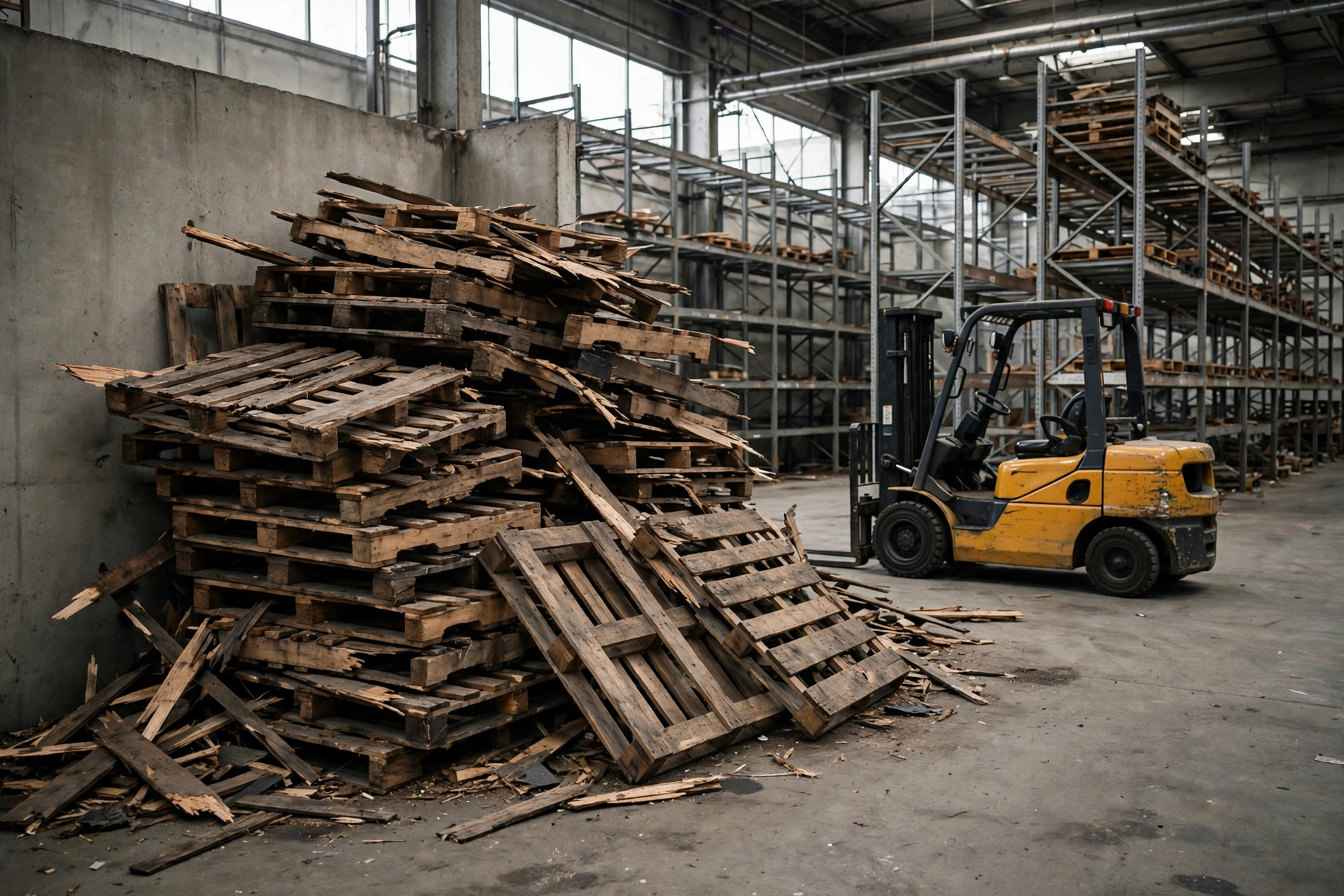
Broken pallets are their own animal. Good pallets get repaired — a replacement board costs a few dollars, a new pallet costs tens; even a kid can do that math. Dead ones get stacked separately, away from the cardboard. Why? Wood is exactly what the fire marshal cares about: stack height, footprint, and distance from the building are all spelled out in your local fire code. Look up your jurisdiction's numbers; don't guess.
The Math
Let's run the numbers for a warehouse producing one ton of cardboard a day with a vertical baler:
First, hauling. A truck fills up on volume at about 2 tons of loose cardboard. After 4:1 compression, the same truck carries 8 tons. Three pickups a week becomes one. Hauling is priced per trip, so long-term you save 60%+.
Second, rebates. One ton a day, 300 days a year, 300 tons. At $91 a ton, that's $27,000 a year.
Third, floor space. This is the big one. A 100-square-meter loose-staging zone becomes 30 square meters baled. Those freed-up 70 square meters, converted at your local warehouse rent, are worth far more per year than the cardboard rebates.
So the ledger reads: rebates are the small money; avoided hauling and reclaimed floor space are the big money. The guy obsessing over a $10 move in the OCC price is usually missing the five extra hauling trips he's paying for every month. Amateurs watch the unit price; professionals watch total cost.
The Maintenance Pits Nobody Warns You About
Right equipment, wrong maintenance — I've seen that movie too many times:
Pit one: never changing the hydraulic oil. A baler is like a car; hydraulic oil is its blood. Dirty oil wears the cylinders, pressure drops, and your 5:1 ratio quietly becomes 3:1 while you blame the cardboard. Oil and filters once a year. Non-negotiable.
Pit two: film contamination. Said it before — film is the baler's natural enemy. Separation has to happen at the source: film stripped at packing goes straight into film bins, never into the cardboard pile. Lose control at the source and your future is work orders.
Pit three: nobody owns the zone. Most waste areas are jurisdictional dead zones — cleaning crews think it's warehousing's job, warehousing thinks it's facilities' job. Assign a waste owner. Doesn't need to be full-time — one named person runs separation, baling, and hauling scheduling. Mis-sorted streams downgrade whole bales; late pickups flood the zone. That one person is the highest-ROI headcount in the waste equation.
Pit four: location. Waste zone layout lives under three constraints — flow, fire, and working space.
Flow: waste is born at outbound (unboxing and repacking happen at the pack stations), so the zone hugs outbound — without entering the dock working face. Ideal: pack station → waste chute or cart → waste zone → hauler truck. One direction, no backtracking.
Fire: cardboard and pallets are combustibles. Stack height, area, and setback from the building follow your local fire code. One iron rule: sprinklers must cover the zone, and an extinguisher within 15 meters.
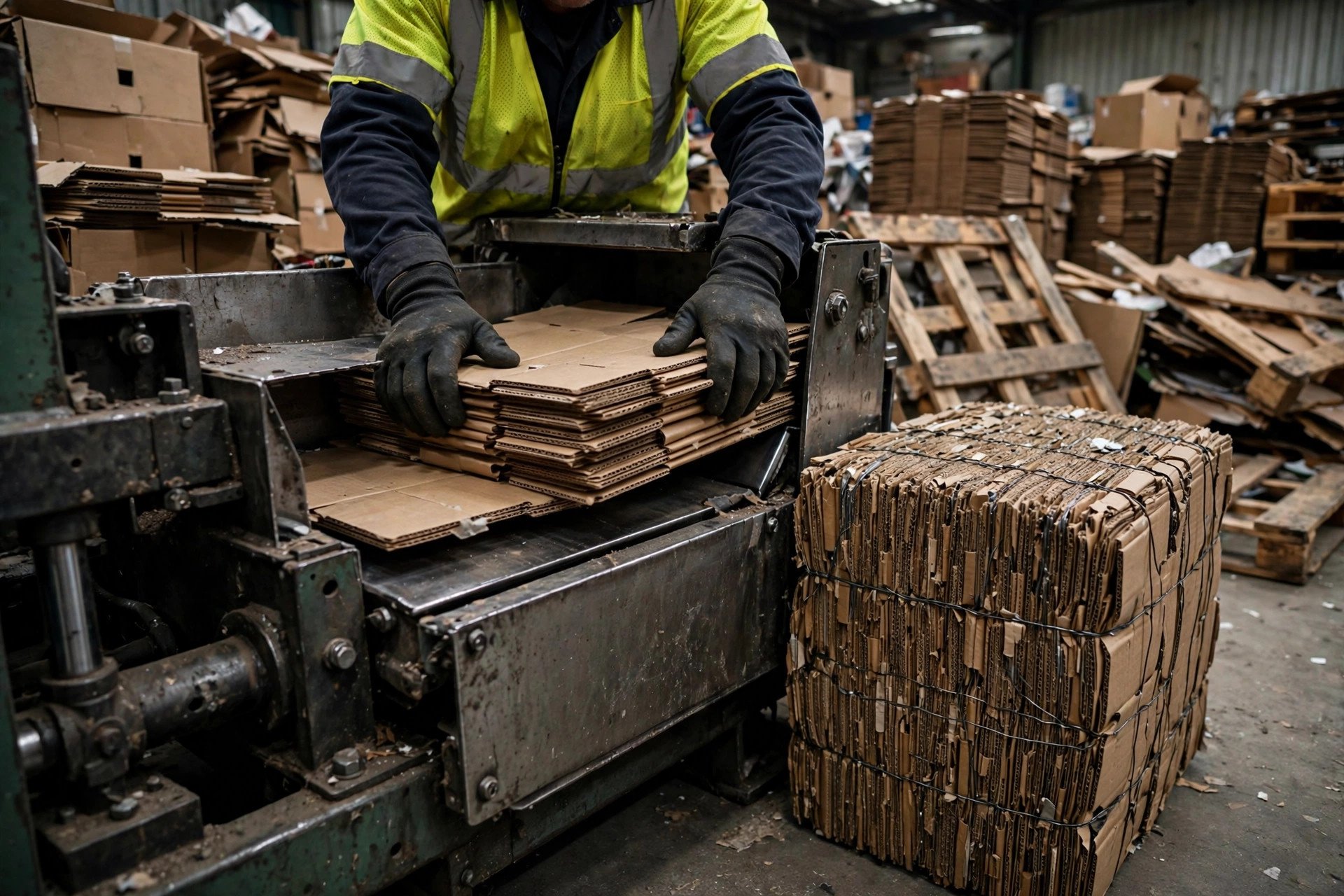
Working space: leave swing room in front of the baler for loading and bale discharge, and keep forklift access off the main aisle. A horizontal unit also needs 3-phase power and a real foundation — the machine weighs several tons. If your building is multi-story, kill the fantasy of putting it upstairs now.
Three things that sound wrong but aren't:
One: the waste zone has the easiest ROI math in the entire warehouse. Everyone agonizes over automation and high-bay racking ROI. Waste zone: small money in, big money out, math fits on a napkin.
Two: the "better" the waste zone's location, the more complaints it gets. Close to outbound is convenient — and also close to offices and fire lanes. The perfect waste zone has zero presence: there when needed, invisible when not.
Three: don't buy equipment for "green." Buy it for cost; green comes free. Anyone selling you equipment on environmental virtue alone — run the cost math first. If the math doesn't work, the green won't last.
Whether the money was worth it comes down to one number: total cost per ton of waste = (hauling + labor + equipment depreciation − rebates) ÷ tons of waste. Three straight months trending down means your waste zone layout is right. Trending up? Go check your sorting, your pickup frequency, and your equipment utilization.
Waste has its own flow. Respect it and it saves you money. Ignore it and it will clog you sooner or later — either the aisle, or the fire marshal's fine.
By Da Liu, Automation Engineer