After all these years driving a truck, let me tell you how I size up a warehouse: five minutes past the gate, I look at the floor. Floor markings sharp, forklift lanes and pedestrian paths clearly split — that warehouse is probably run right. Bare concrete, forklifts and people mixing it up — you unload with your eyes wide open. This warehouse traffic signage floor marking stuff sounds small, but it's the cheapest safety money in the business.
2022, a food distribution warehouse in Dallas, Texas. I was there for a pickup. No pedestrian walkway anywhere. A forklift brushed past my trailer and a pallet corner tore a meter-long gash in my side curtain. The claim dragged on for two months and ended split down the middle — they said I parked wrong, I said they never painted a travel lane. Lesson learned: now I photograph the floor before I back in anywhere without markings. Evidence first.
2024, an e-commerce warehouse in Fontana, California — 100,000 square feet. The owner repainted the whole building: forklift mains, pedestrian crosswalks, staging grids, plus convex mirrors at three blind corners. Their safety manager told me near-miss reports dropped from eleven a month to three within half a year. Total cost? Under $9,000, labor and materials. I'm telling you, that might be the best ROI in warehousing — one forklift-vs-pedestrian incident costs six figures easy, before OSHA fines and downtime.
Floor marking: three colors are enough
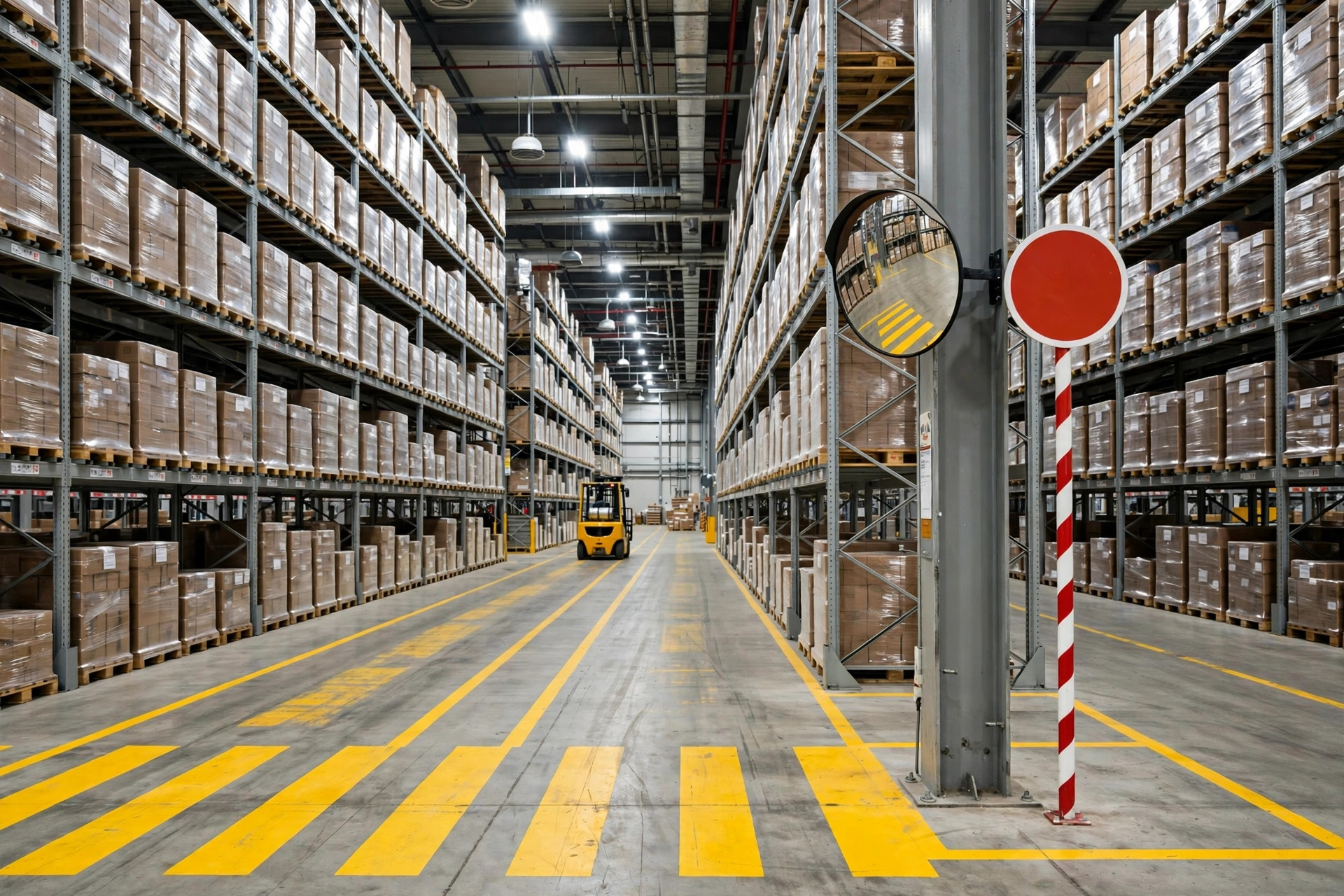
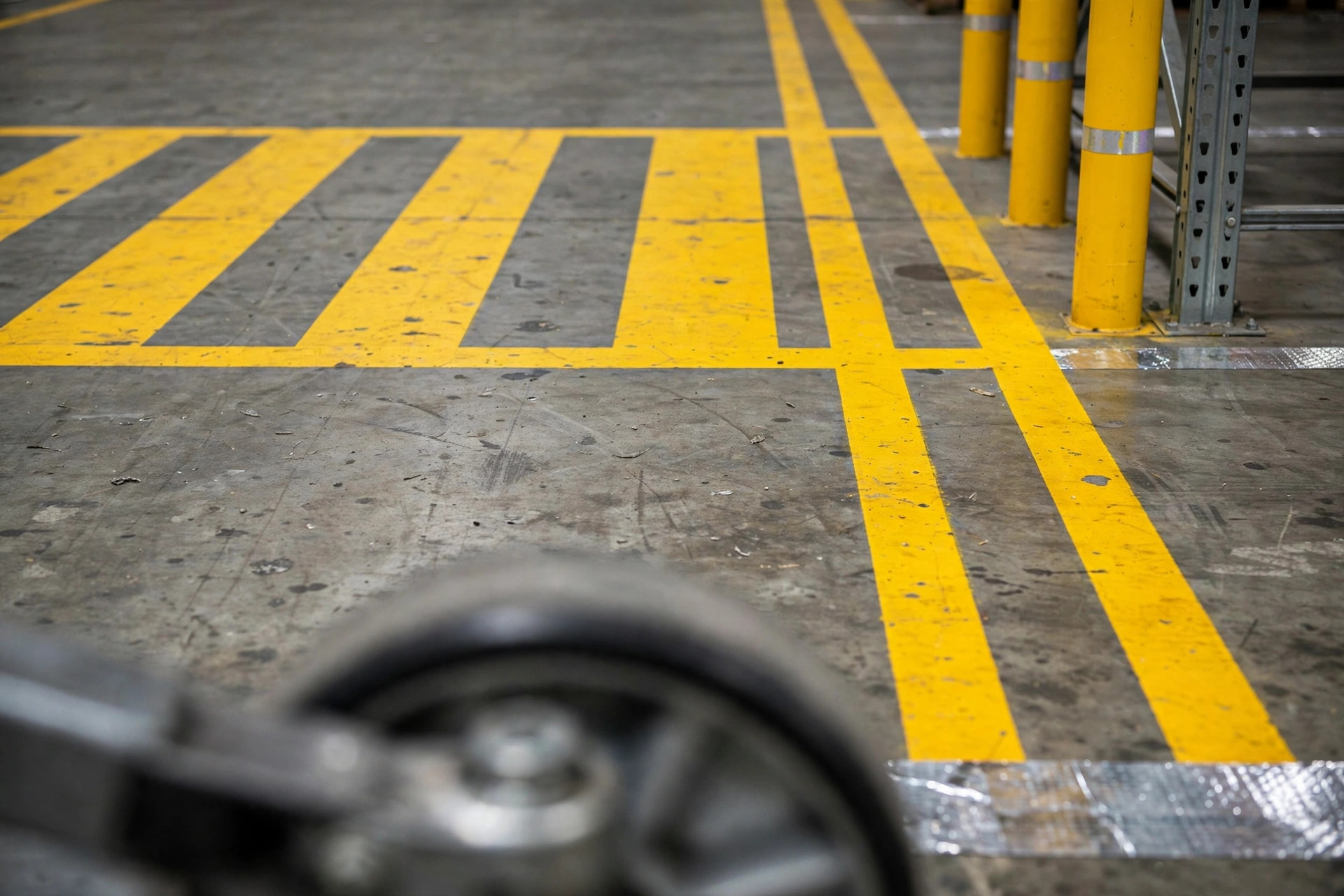
One principle: drivers and walkers should know where they belong without thinking. Don't get greedy with colors — three do the job. Yellow for vehicle lanes: forklift mains and branches. White for people: walkways and crosswalks. Red for no-go: fire hydrants, electrical panels, exit doors — red hatch, nobody's pallet touches it.
Widths matter too. Two-way forklift mains need at least 12 feet; single-direction 8 feet; pedestrian paths start at 4 feet. Paint turning radiuses at corners, not right angles — forklifts turn in arcs, so a right-angle line is just telling drivers the paint is decorative. That's from years of watching warehouses: the ones with square corners have all the paint scrubbed off at the turn within three months.
Two material choices: paint or floor tape. Paint is cheap — a gallon goes a long way, knock it out over a weekend. Downside: every layout change means repainting. Tape costs three to five times more but peels up and re-lays, which actually saves money in buildings that re-slot twice a year for peak. The trade-off: stable layout for three years, paint; layout that moves, tape. Don't mix them up.
One more detail: once you pick colors, keep them building-wide. I ran a warehouse where yellow meant forklift lane in Zone A and pedestrian path in Zone B — two different striping contractors. Drivers rolled straight from A onto B's walkway. That kind of rookie mistake gets caught with one walkthrough at acceptance. Don't wait for an incident to fix it.
Warehouse traffic signage: where the speed signs and mirrors go
Floor paint alone isn't enough; the vertical signs have to match. Speed limits: 5 mph for forklifts inside generally, 3 mph where pedestrians are dense. And don't just hang the sign at the entrance — drivers glance at it coming in and forget it going out. Hang signs at decision points: before every intersection, before every blind corner, at the dock-area entry. Mount them at forklift-driver eye level. Too high means invisible.
Convex mirrors are the blind-spot fix. Three spots: the T-junction at the end of a rack aisle, behind columns in the dock area, at the battery-charging room door. Twenty-four-inch diameter minimum — smaller and you can't read it. Cheap, too: mirror plus bracket runs under $100. But here's the thing I've seen: one warehouse installed mirrors at a blind corner and aimed them at the wall. Nobody adjusted the angle after mounting — pure decoration. After install, sit in the forklift and verify every approach is visible.
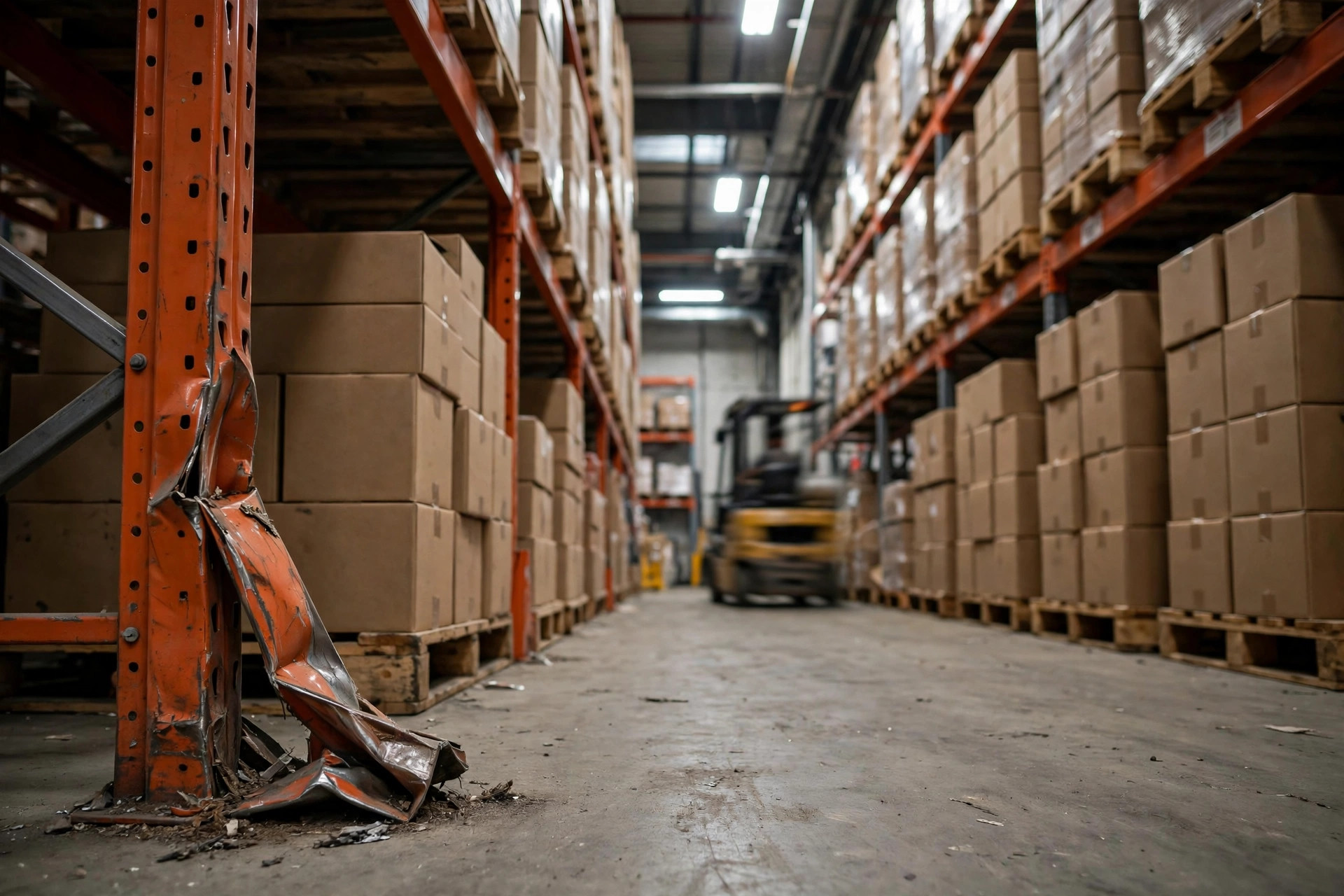
Bollards and guard rails count as signage in my book: rack ends, columns, charging stations — ring them in yellow. It's not decoration; it tells drivers "don't hit this." Columns tell on their owners — walk a warehouse with no bollards and every column base is chewed up with fork marks.
The dock area: where drivers and warehouses argue most
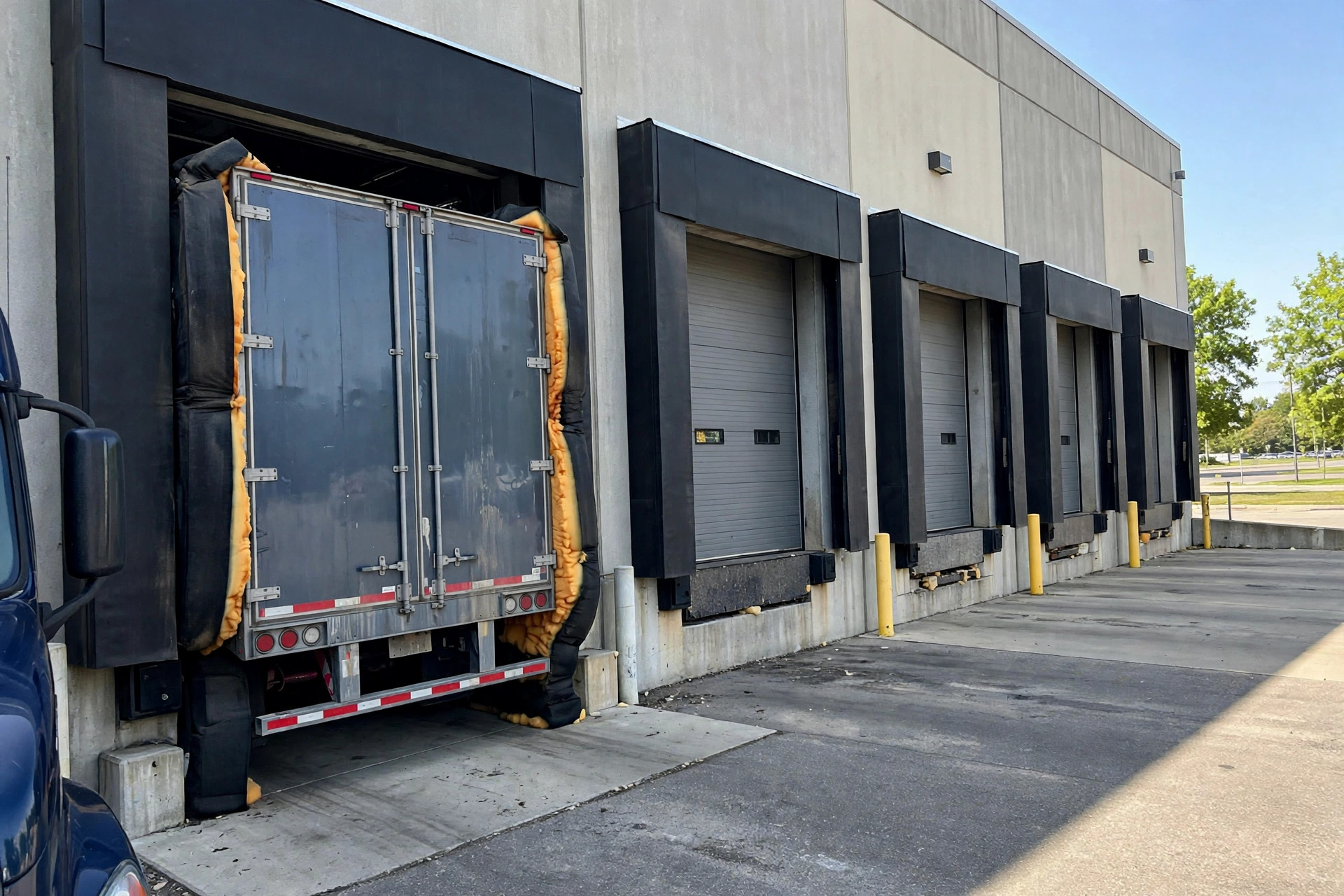
The dock is the wildest traffic zone in the building, and I live there, so listen up. The chaos has one root cause: it's where two speeds collide — trucks rolling in at 60 mph outside, forklifts creeping at 5 inside, people weaving between. Dock layout is about separation:
Truck queuing: paint queue lanes outside the dock so trucks come in single file. Without lines, tractors park every which way and backing in becomes a shouting match. The best-run site I know starts guide lines 200 feet out — drivers follow the paint straight to their door and back in one shot.
No-parking grids at the doors: red hatch in front of every door, and staging pallets stay out of it. Why? Doors open, forklifts cross, pallets in the way force detours, detours cause collisions. That red square looks like wasted space. It's life insurance.
A dedicated pedestrian route: the dock area needs a railed walkway from the parking lot to the warehouse entrance, fenced off from vehicle lanes. How many incidents start with "the worker cut across between the trailers"? Put up the rail, kill the shortcut, kill the incident. Worth it? One willful OSHA violation starts around $160,000 (check OSHA's current schedule) — that buys a lot of guard rail.
Nights and peak season, add two things: reflective road studs and temp cones. Night shifts dim the paint's value; studs reflect and drivers see them. Peak brings temporary staging zones — cone them off, pull the cones when peak ends. Flexible, but the rule never changes: vehicles get lanes, people get paths.
The bill: what this costs for a 100,000-square-foot building
When budgeting warehouse traffic signage floor marking, go straight to the numbers — for a 100,000-square-foot e-commerce warehouse (labor plus materials; get local quotes):
| Item | Reference quantity | Cost range |
|---|---|---|
| Floor marking (paint) | Mains + walkways + staging grids | $4,000–$6,000 |
| Floor marking (tape) | Same scope | $15,000–$25,000 |
| Speed / warning signs | 15–20 signs | $500–$800 |
| Convex mirrors | 6–8 units | $600–$800 |
| Bollards / guard rail | Rack ends + columns | $2,000–$4,000 |
| Total (paint option) | — | Under $12,000 |
Now the other ledger: a forklift striking a person — medical, settlement, OSHA fines, downtime — starts at $100,000. A collapsed rack row — product loss plus rack replacement — $50,000 floor. Next to that, twelve grand isn't even an insurance premium. It's pocket change.
Maintenance belongs in the budget too: painted lines need annual touch-ups — forklifts grind them down within six months; tape gets replaced every two to three years; mirrors get wiped quarterly because dusty equals blind. Put it on the daily inspection sheet. Don't wait for OSHA to remind you.
The counterintuitive part: more paint isn't better
Last thing, and it's counterintuitive: I once walked a warehouse painted like a spiderweb — vehicle lanes, walkways, inspection zones, exception zones, seven or eight colors. Drivers ignored all of it. Information overload equals no information. Markings work when you can follow them without thinking; the moment they require thought, they've failed — the most ignored lesson in warehouse traffic signage floor marking.
So my advice: paint the minimum first — mains, walkways, no-go zones. Three things. Watch for three months, then add paint wherever near-misses cluster. Signage should grow out of the operation, not be designed in one shot. The places that paint the whole building at once are usually painting for the inspector; the workers walk wherever they want anyway.
There's an old saying among drivers: the paint is on the floor, but the scale has to be in your head. Signs, lines, mirrors — they're all reminders that people walk here and speed kills here. After all these years, my deepest takeaway: the safest warehouse isn't the one with the most paint. It's the one where everybody knows whose lane is whose.
By Shifu Zhao, Trucking Veteran (15 yrs)