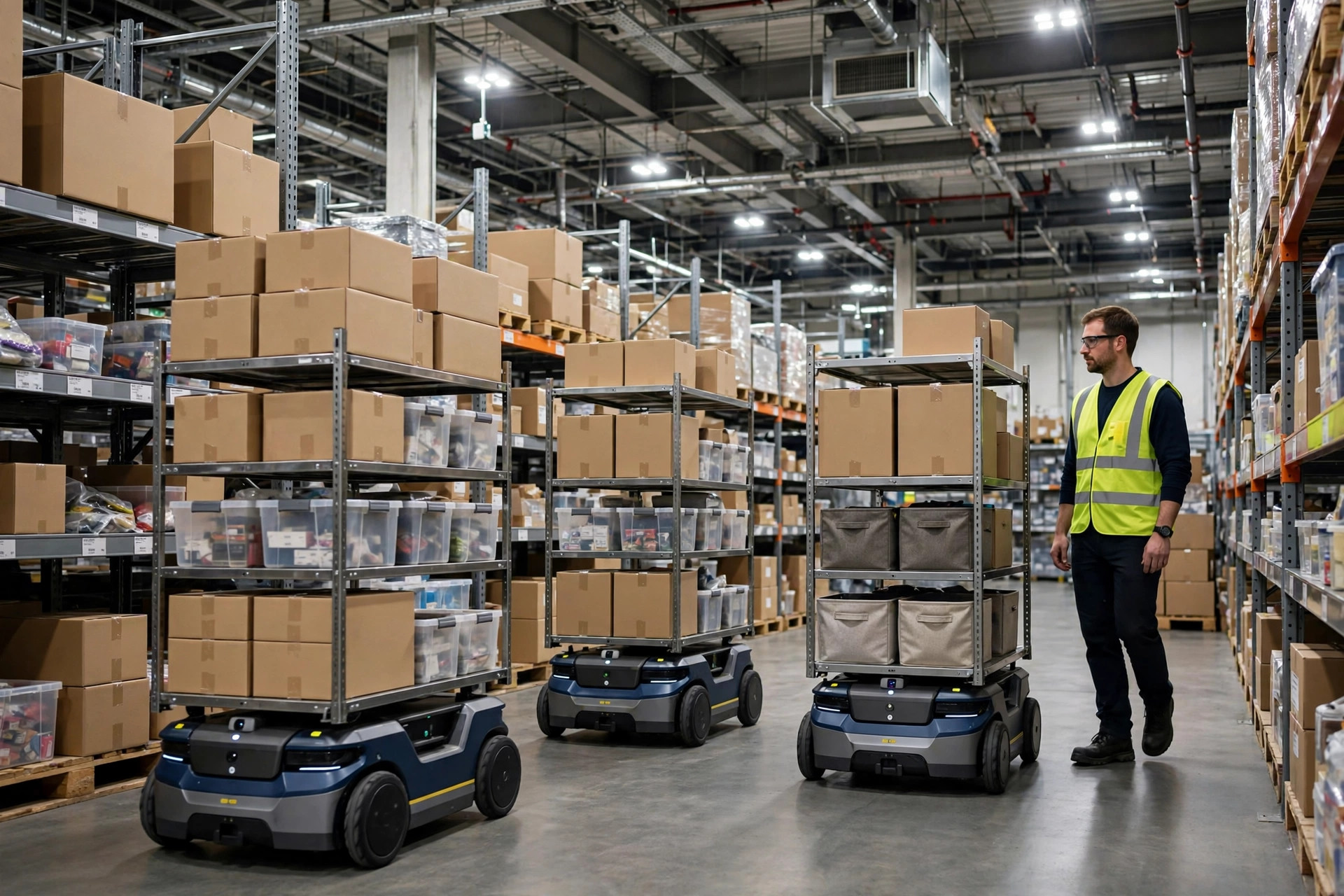
In the fall of 2023, I walked into a newly commissioned narrow-aisle warehouse outside Suzhou. Twelve-meter racking, a turret truck at full mast, forks swaying like a pendulum. The driver refused to run at full speed. The owner had spent serious money on equipment — and the problem was under his feet. The floor wasn't up to it.
Since that job, I have a habit: I look at the floor before I look at anything else, and I ask for two numbers — FF and FL. This is the one-page explainer I wish every warehouse tenant and developer had: what the numbers mean, the ACI 117 grade table, and what belongs in your lease.
FF Is the Wrinkles, FL Is the Posture
FF and FL are defined in ACI 117 and measured per ASTM E1155. They quantify two different kinds of "flat" in a concrete slab.
FF — face floor flatness — covers short-distance waviness. FL — face floor levelness — covers long-distance elevation change. Think of it like this: FF is skin texture, FL is posture.
A floor with bad FF is a washboard — every vehicle shudders across it. A floor with bad FL can be perfectly smooth and still be wrong, like a bathroom floor sloped toward the drain: water runs off fine, but an AGV will drift off course all day. In measurement terms, FF looks at curvature over spans of tens of centimeters, FL at elevation change over spans of several meters (see the latest ASTM E1155 for the exact procedure). In practice, a technician walks the floor with a rolling profiler, taking an elevation reading every foot along each measurement line, and the software computes both numbers. Test both. Testing one is testing half.
The Spec Table: Which Grade Your Warehouse Actually Needs
ACI 117 defines five grades. Bigger numbers mean flatter:
| Grade | FF | FL | Typical use | | Conventional | 20 | 15 | Standard pallet warehouse, pallet jacks and counterbalance trucks | | Moderately flat | 25 | 20 | Conventional high-bay racking | | Flat | 35 | 25 | Narrow aisle, racking over 6 m | | Very flat | 45 | 35 | Turret trucks, AGV main aisles | | Superflat | 60 | 40 | Automated high-bay stacker cranes, laser-guided AGVs |
Two caveats. First, these are the Specified Overall Values; there are also Minimum Local Values at roughly three-fifths of the overall numbers — check the latest ACI 117 for exact figures. Second, FF and FL come as a pair. A contractor who only talks FF is selling you half a floor; a slab that tilts as a whole will still throw an AGV off.
My rule-of-thumb dividing lines: racking under 6 meters with ordinary forklifts — "Flat" (FF35/FL25) is the ceiling, and spending more buys you nothing you can feel. Narrow-aisle turret trucks — "Very flat" (FF45/FL35) is the starting point, not an option. AGVs or an automated high-bay — start at superflat, and note that stacker-crane rail installation has its own civil requirements from the equipment maker; the floor is only step one.
One line I hear from contractors all the time: "We used laser screed, so it's flat." Laser screed is a method, not a result — between the screed and the numbers sit bleeding, trowel timing, and curing, and any one of them can sink the readings. Acceptance should trust the profiler, not the process name.
Why Turret Trucks and AGVs Are Obsessed With Your Floor
Think of it as a lever: the floor is the fulcrum, the mast is the amplifier.
Grade-school math: assume a 2-meter wheelbase on the turret truck and a 5 mm height difference under the left and right wheels. The truck body tilts about 0.14 degrees. At 10 meters of mast, the fork tip moves sideways by roughly 10,000 times tan(0.14°), about 25 mm. What does 25 mm mean? The side clearance for a pallet entering a rack slot is typically a few dozen millimeters — one sway eats half of it. No wonder the driver won't go fast. And the taller the rack, the bigger the multiplier: in a 12-meter building, a 1 mm dip in the floor becomes centimeters of sway at the top.
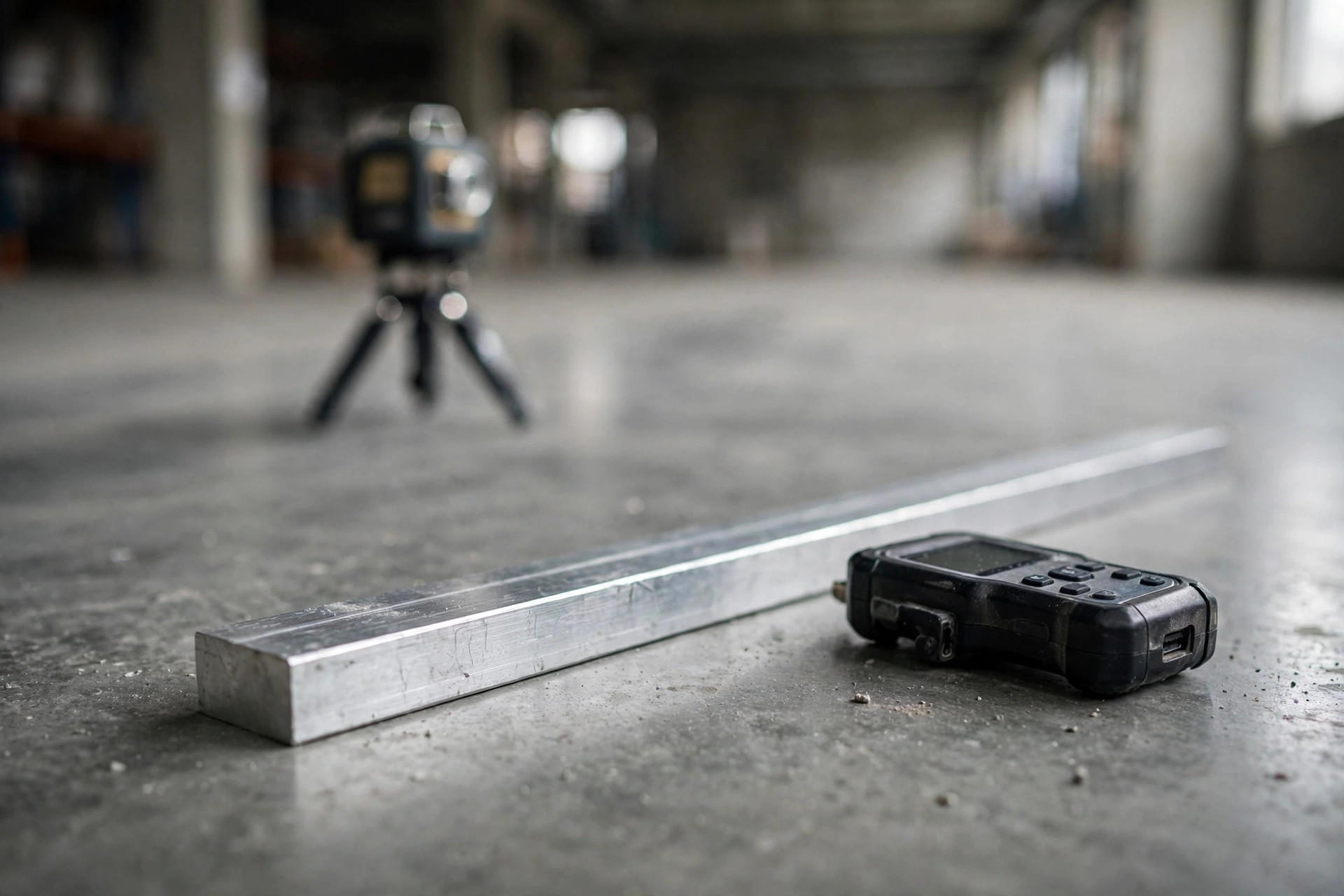
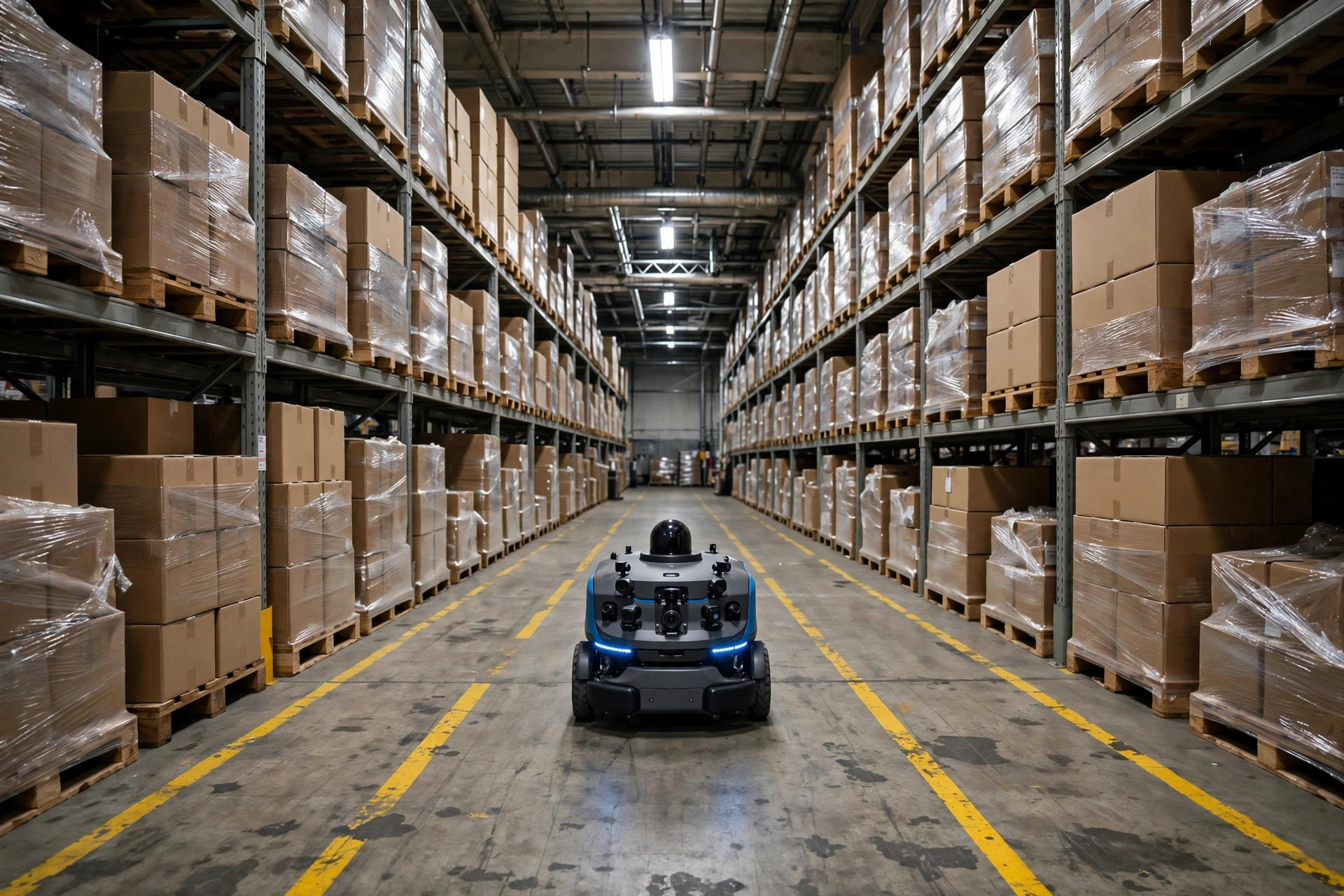
AGVs are sensitive in a different way. Laser-navigation AGVs fuse floor reflections with odometry to estimate position; a tilted floor biases the whole estimate and the drift accumulates. Wheeled AMRs feel it directly — a wavy floor shakes the load, and a hard stop can shift it. Even AGVs navigating by QR codes or magnetic tape care: the tape is laid assuming a level floor, and a sloped slab throws the deviation right back at you. That's why the floor grade is always line one in an AGV project's civil requirements.
And now a rant, because somebody needs to say it: some salespeople push "superflat" for plain pallet warehouses running reach trucks that never lift past 4 meters. Superflat exists for stacker-crane rails and laser AGVs. Ordering FF100 for that building is paying an intelligence tax — like putting racing suspension on a grocery getter. Money spent, nothing felt, schedule delayed.
Leasing and Acceptance: Contracts, Arguments, and the Real Bill
In 2024, a client leased a brand-new 20,000-square-meter warehouse near Tianjin. The lease said six words about the floor, roughly: "floor flat, no cracks." On handover day we laid a 2-meter straightedge down and found a 5 mm gap. The landlord shrugged: "Looks flat to me." Two months of arguing ended in a split — the landlord paid for localized grinding, the client burned two months of rent-free fit-out time on the dispute.
A warehouse lease needs three things on the floor, no exceptions: the actual FF/FL numbers, the test method (cite ASTM E1155), and who pays for remediation plus how the schedule shifts if it fails. Writing "flat" in a lease is the same as writing nothing.
Three acceptance traps: first, testing FF but not FL — as discussed, that's half a test. Second, testing once at handover and never again — floors settle, especially over backfilled soil and in heavy-traffic aisles; re-measure yearly and compare against last year's numbers. Third, getting the grinding math wrong: laser screeding in one pass during construction is by far the cheapest option; grinding an existing floor flat afterward costs several times more per square meter, plus downtime. Like a home renovation — getting the plumbing right the first time is cheap; tearing up walls later is not.
Whether the money is worth it comes down to one number: your highest pick height. Under 8 meters, "Flat" (FF35/FL25) is enough. Over 8 meters, go "Very flat" (FF45/FL35) or don't bother with the tall racking. Running AGVs or a high-bay — superflat or stay home. Money saved on the part you can't see gets lost every single day in the part you can.
By Da Liu, Automation Engineer