title: UPLH (Units Per Labor Hour) Warehouse Benchmark: How We Set Targets and Keep the Numbers Honest slug: warehouse-uplh-benchmark-units-per-labor-hour-guide excerpt: Our night shift hit 131 UPLH on Black Friday and my boss was thrilled — I was terrified. Warehouse manager Chen Feng on setting a units per labor hour warehouse benchmark that actually works: a standard numerator/denominator definition, targets segmented by zone, shift and order type, and four hard rules against gaming the metric. section: ops subcategory: people tags: ['uplh','labor-productivity','performance-management','order-picking','warehouse-operations'] region: common
UPLH (Units Per Labor Hour) Warehouse Benchmark: How We Set Targets and Keep the Numbers Honest
It was 7 AM on Black Friday. I had just walked into the office — coffee not even brewed — when my boss slapped yesterday's daily report on my desk: "Chen Feng, look at this. UPLH hit 131! Up almost 50 units from last week!"
He was grinning ear to ear. I stared at that 131, and my stomach dropped.
Here's the honest truth, folks: when you've run warehouses long enough, a productivity number that spikes too fast doesn't make you happy. It scares you. UPLH — units per labor hour — is the most common warehouse labor benchmark out there. It sounds simple: units per person per hour. But the traps hiding behind that number? I paid for those lessons with real returns and real customer complaints.
No big theories today. Just how our warehouse turned UPLH from "a number the boss dreamed up" into "a number the floor actually believes in."
The boss came at me with 140: "Why are we only at 85?"
Last October, my boss came back from an industry conference and called me in. "That other warehouse runs UPLH 140. We're at 85."
I asked: what kind of warehouse? What product category? What picking method? What order profile? He couldn't answer any of it. Just: "Anyway, they're at 140."
That's where most UPLH disasters begin: comparing one lonely number against another lonely number, with completely different definitions behind each. I didn't argue — I just asked for a month to nail down our definition first.
The first wreck: one UPLH number for the whole warehouse
In that first month, I did something that looks pretty dumb in hindsight: I set one warehouse-wide target — UPLH 100 — posted it on the bulletin board, and hammered it at every pre-shift meeting.
The eaches pickers went all out, and the number climbed. But Lao Zhao from the full-case area came to find me, face dark: "Brother Feng, I ship full pallets and full cases. One order is 8 cases. Each case means a forklift run and stretch wrap. You want me to hit 100? I'd run my legs off and never get there."
He was right — like asking a weightlifter to race a sprinter. Wrong metric; no amount of effort fixes it.
Worse, to juice the number, people started cherry-picking: easy orders first, hard ones pushed back. The number looked great while difficult orders piled up and our on-time shipping rate dropped 6 points that month.
That's when it hit me: UPLH was never one number. It's a set of numbers — slice it by zone, shift, and order type.
The second wreck: the number went up, and the error rate exploded
During Black Friday week, picking-zone UPLH climbed from 82 all the way to 131. The boss was sending bonuses in the group chat every day. I was happy too.
Three days after Black Friday, our customer service lead stormed into my office: "What's going on? Over 200 returns this week — all mispicks!"
We dug in, and it was ugly. Chasing the number, some pickers had gone "blind": no barcode verification, grabbing by memory. Others mixed similar SKUs together to save trips. At least twenty percent of that 131 was bought with accuracy.
The returns, reshipments, and service labor that week cost more than three times what the "productivity gain" saved. The boss never mentioned 131 again.
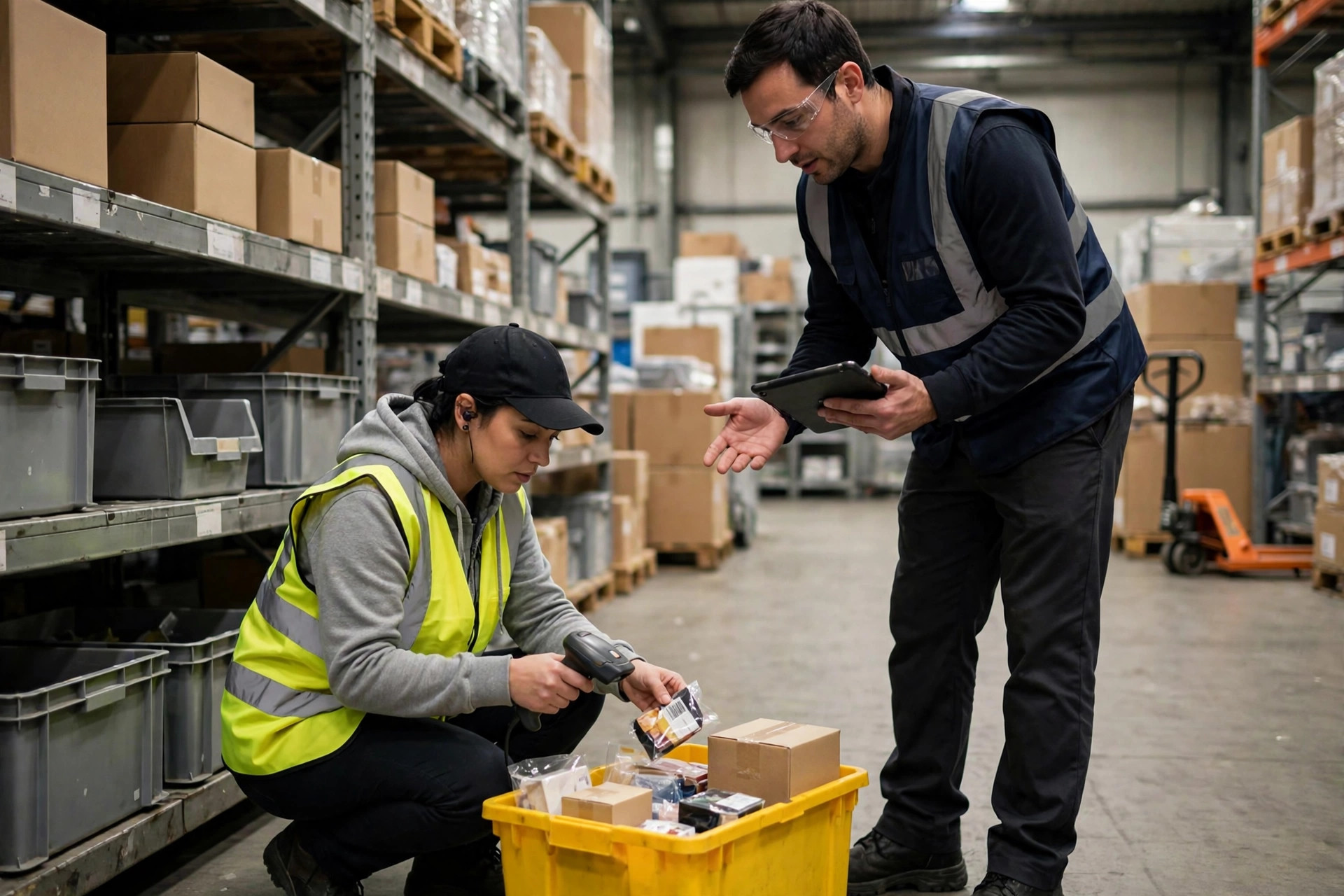
After that, we put an iron rule on the picking zone wall: a rising UPLH isn't always good news. A labor number without accuracy attached is just cheating. Every UPLH report must include accuracy. Below 99.5%, the number is void, no matter how high.
Old Wang and Young Wang: the slowest guy might be the most right
One more story, about people. Our veteran Old Wang — 12 years on the floor — mentored a kid, Young Wang, last year. The kid works slowly and methodically. His UPLH sat around 45 for months, dead last. People joked he'd never pass probation.
Old Wang pulled me aside: "Don't let the speed fool you. He scans and verifies every order, then double-checks his own work. His 45 units are all correct. Go check the error slips of those guys hitting 110."
I checked. He was right. Young Wang ran three months with zero errors; the 110-crew averaged 3 to 5 mispicks per person per month. Young Wang passed probation and is now the quality checker for his line.
That settled it: UPLH is a management tool, not a judgment tool. Squeeze people with it and they'll fake it; use it to find problems and it's gold.
What we do now: define the metric first, talk numbers second
After half a year of wreckage, here's our fixed practice. First, the definition — the foundation.
Our UPLH definition table (current version)
| Item | Our definition |
|---|---|
| Numerator | System-confirmed completed units, counted at scan-off-the-shelf — not at task assignment |
| Denominator | Direct labor hours for that zone: picking, verification, packing. Excludes meals, breaks, meetings, equipment-downtime waiting |
| Exclusions | New-hire mentoring hours, system outage windows, and cycle-count periods don't count |
| Accuracy tie-in | Always reported with same-period order accuracy. Any period below 99.5% accuracy has its UPLH voided and recalculated |
| Case vs. eaches | Full-case and eaches flows tracked separately — never merged into one number |
| Data source | WMS system timestamps only. Manual timesheets are reference only, never used for evaluation |
A consistent definition matters more than the number itself — that's what two wrecks bought us. Post it on the wall; otherwise a new supervisor changes the formula in three months and you won't know if things got better or worse.
Segmented targets: there is no warehouse-wide price for units per labor hour
Definition done. Then targets, segmented three ways:
By zone. Receiving, picking, verification/packing, outbound loading — four zones, four numbers. Picking gets the finest granularity.
By shift. Night shift runs leaner, lighting is worse, and there's no management on the floor. Same work, night-shift targets run 10–15% lower. That's not coddling — it's honesty. We used to use one target; night shift felt cheated daily, morale sank, and every resignation came from nights.
By order type. Single-unit single-SKU orders are fastest; multi-unit multi-SKU slowest; full-case calculated on its own. Peak and off-peak separate too: peak-season UPLH runs naturally 10–20% higher. Holding off-peak to peak numbers is just bullying.
So what's "normal"? Honestly, here are the reference ranges commonly seen in the industry — "common ranges," not standard answers:
- E-commerce eaches picking: 60–120 units per labor hour, at 99.5%+ accuracy
- General-purpose warehouse: 60–80 units per labor hour
- Above 120: usually batch picking (dozens of orders per trip) or a watered-down definition — raise an eyebrow first
- Wholesale full-case flow: calculate separately, never compare against eaches
What are these ranges for? Calibrate your definition with them, not your people. Far above the range, check whether the definition is inflated. Far below, check whether the process is clogged. The number is a thermometer, not a report card.
Four hard rules against gaming the UPLH numbers
Definition and targets in place. Last step: stop the gaming. Tie evaluations to a number and the number will get "optimized." Our four rules:
One: single source of truth. Evaluations only recognize WMS system timestamps. A "completion" with no scan record doesn't count. Period.
Two: spot checks. Twice a month, at random, I walk the floor with a stopwatch and time a picker's full trip by hand. Within 10% of the system number is fine; beyond that, we trace it back. Everyone knows the boss might walk the floor — so nobody touches the definition.
Three: accuracy veto. Drop below 99.5% personal accuracy and your UPLH ranking goes to zero for the month. Blind-picking your way to a big number? Not a chance.
Four: re-baseline every year. Processes change — new pick carts, a re-slotted layout — and targets move with them. Measuring this year's work with last year's ruler only produces resentment.
One reminder for fellow operators
After all these years, I've learned the hard part of UPLH was never the arithmetic. It's the people.
Set the target too high and the floor fakes it. Set it too low and the boss thinks you're incompetent. Everyone in this business knows that squeeze.
My experience boils down to one sentence: write the definition down first, segment the targets second, and tie accuracy in third. Do those three and UPLH is your best management tool. Skip them and it's a landmine — and it always blows up sooner than you expect.
So, fellow operators — how does your warehouse set UPLH? Drop a comment and let's compare whose definition holds up in the real world.
By Chen Feng, Warehouse Operations Manager