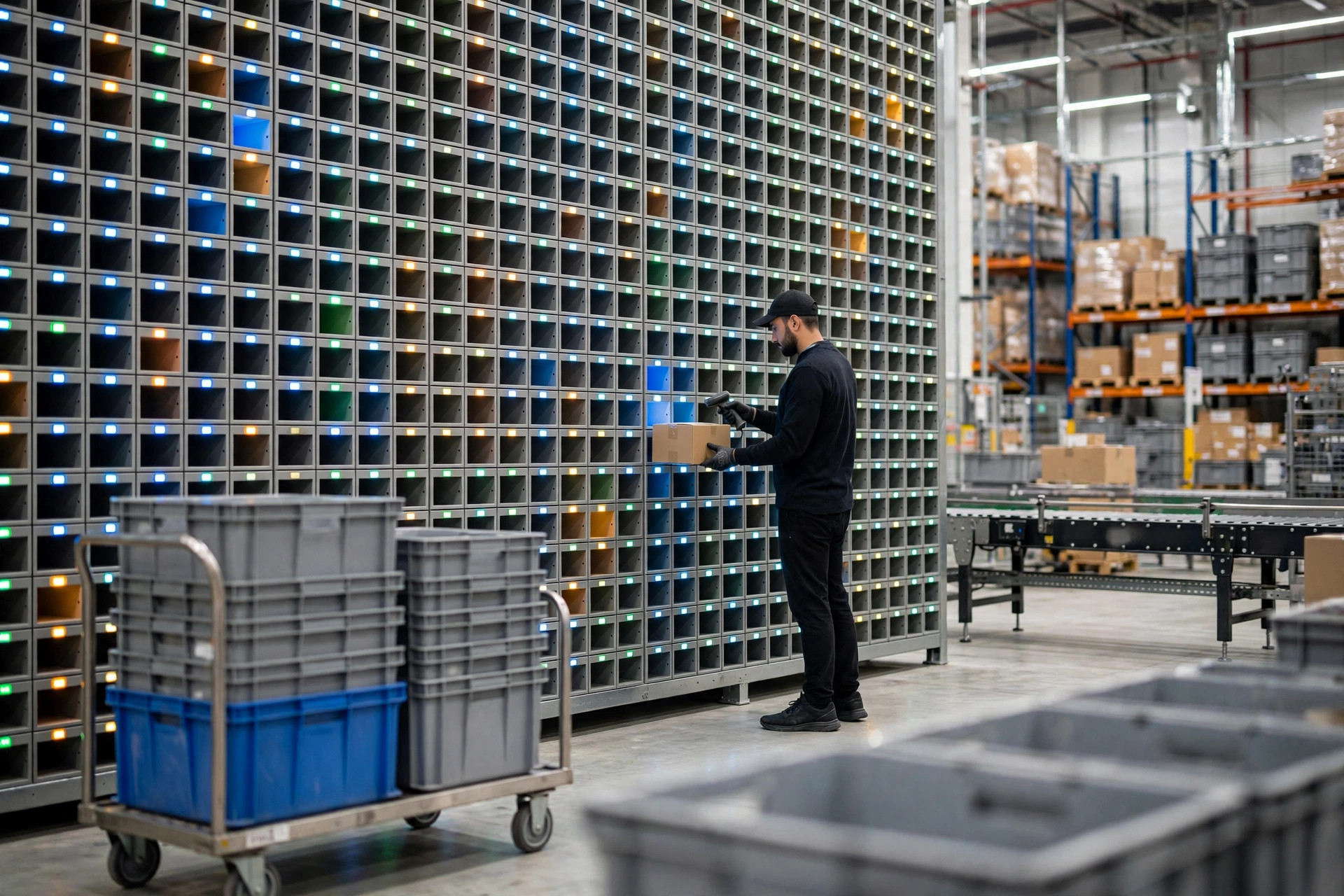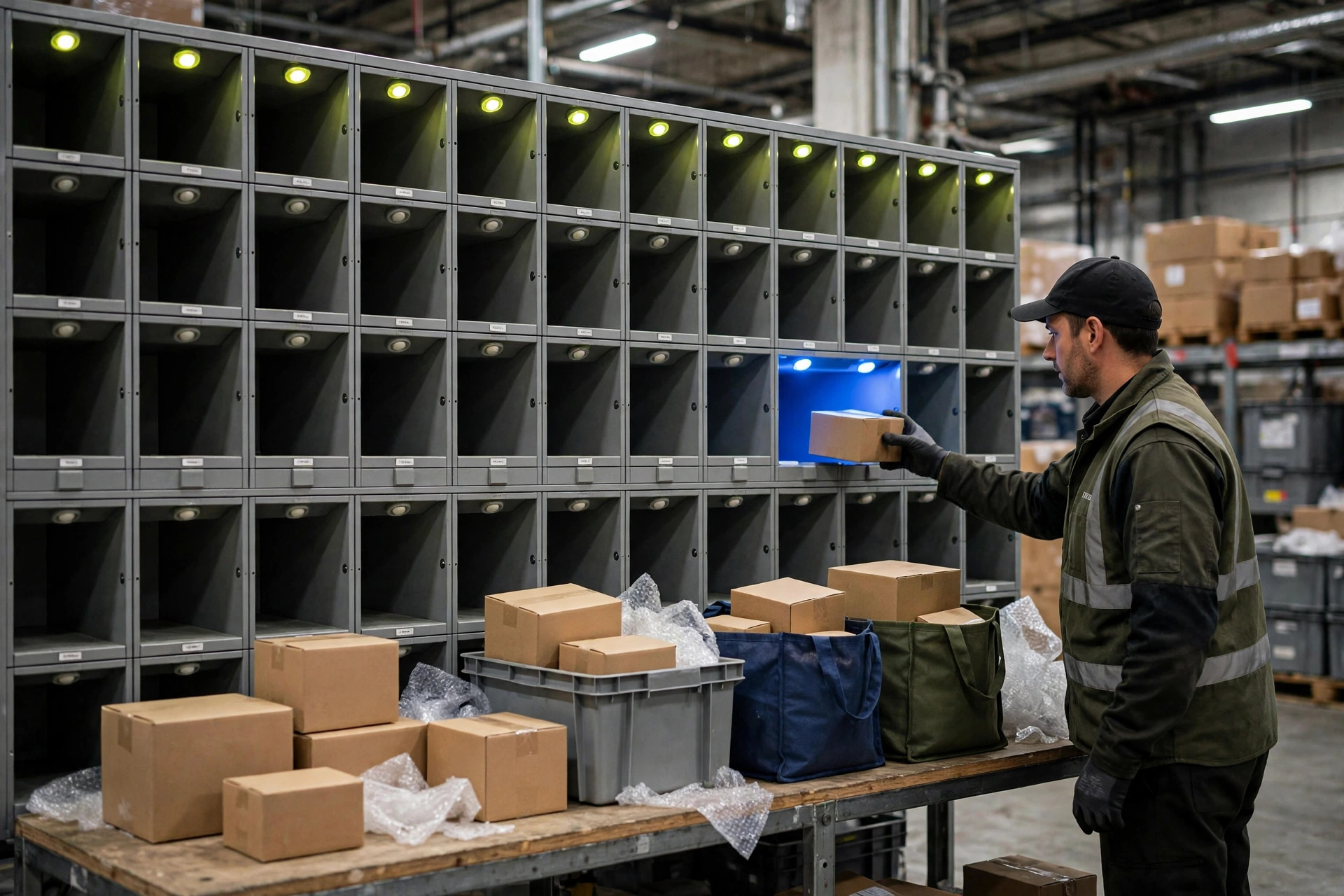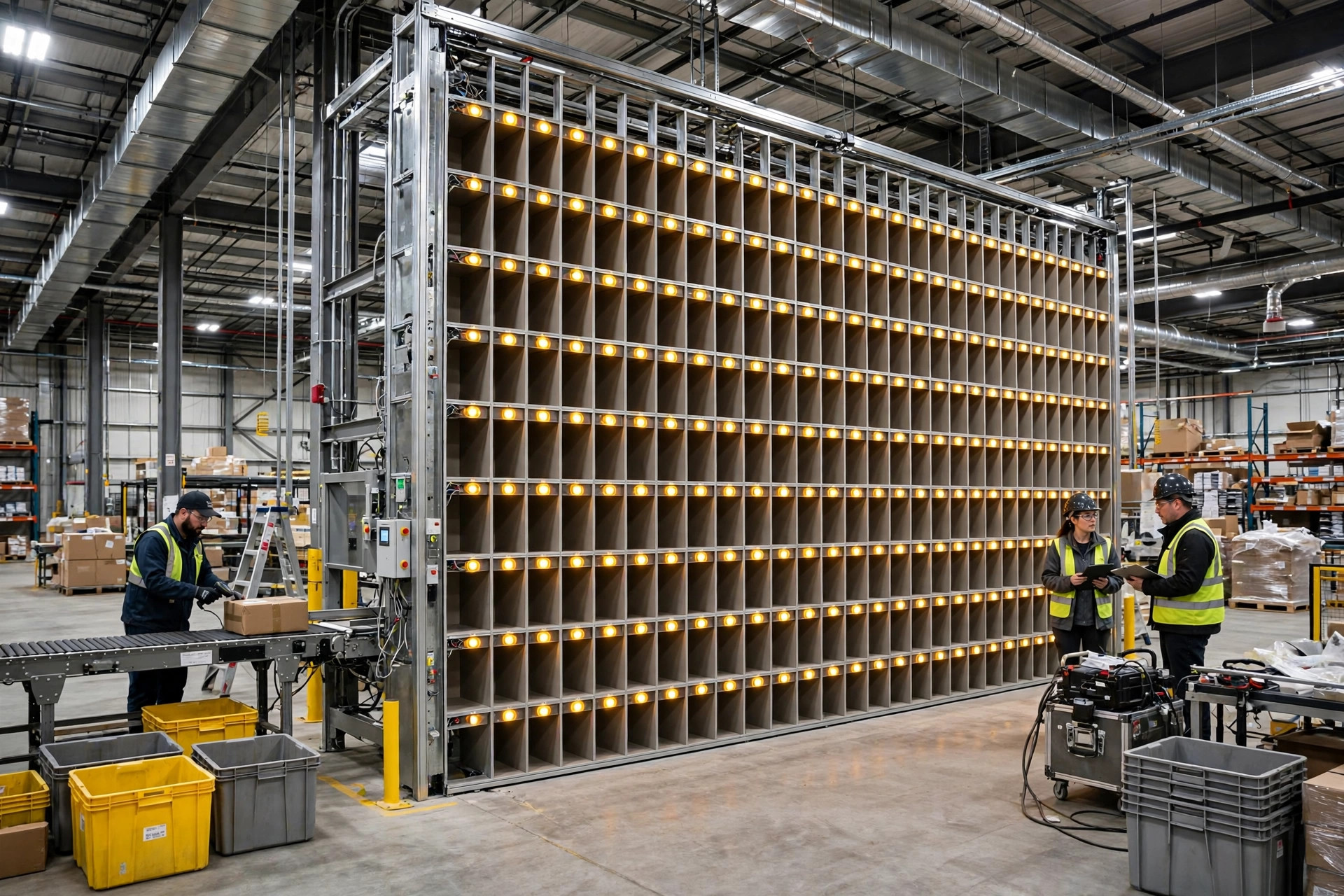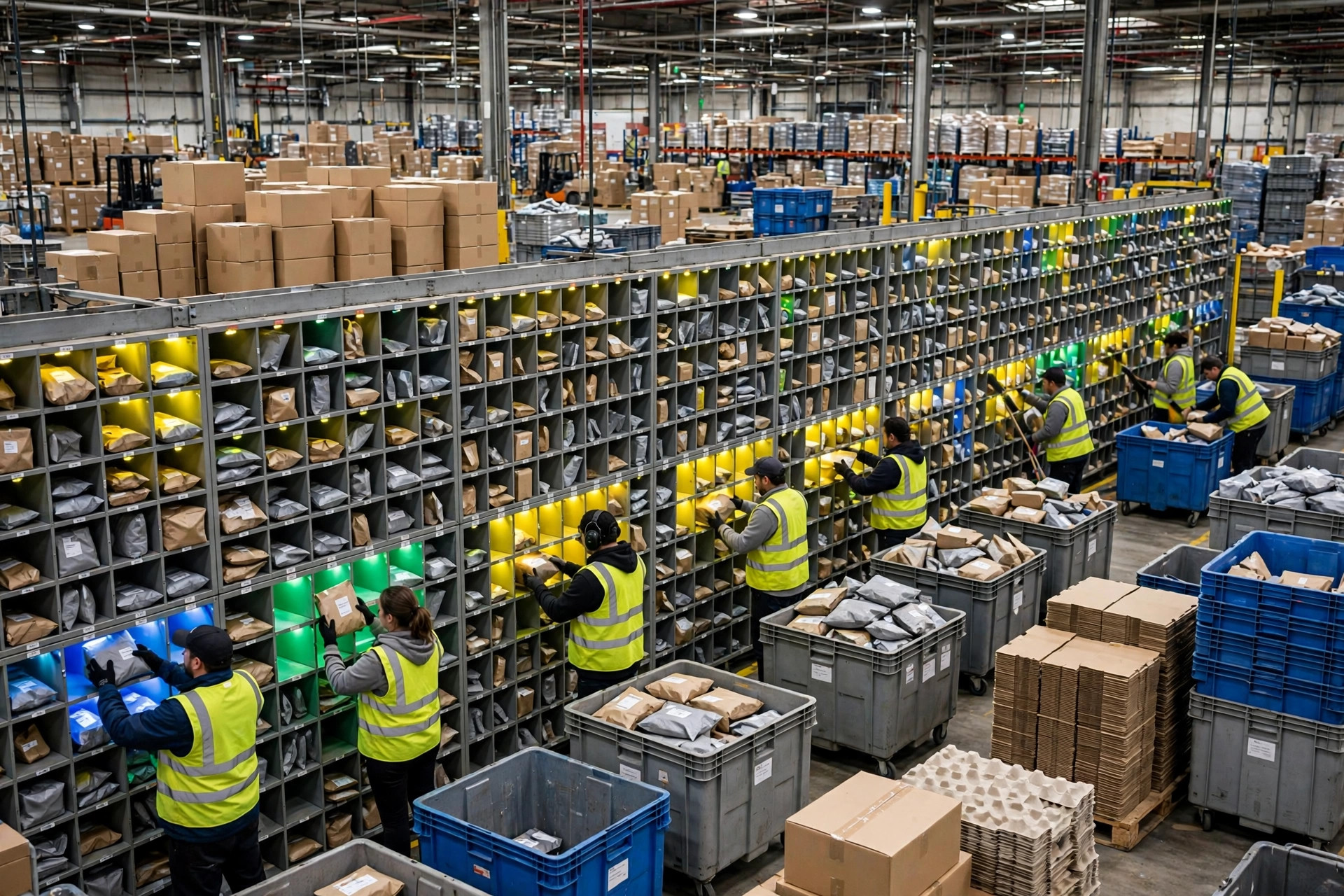
Warehouse sorting wall hardware gets bought backwards more often than anyone admits. A team asks vendors for quotes first, then tries to fit its real orders into whatever wall shows up. That order guarantees trouble. The wall looks impressive on installation day and starts fighting the operators a week later. The fault is rarely one bad component. It is the combination that was never worked out: cells, lights, scanners, weighing checks, and the system interface have to behave as one machine, not five separate purchases.
Warehouse Sorting Wall Hardware: Get the Cells Right First
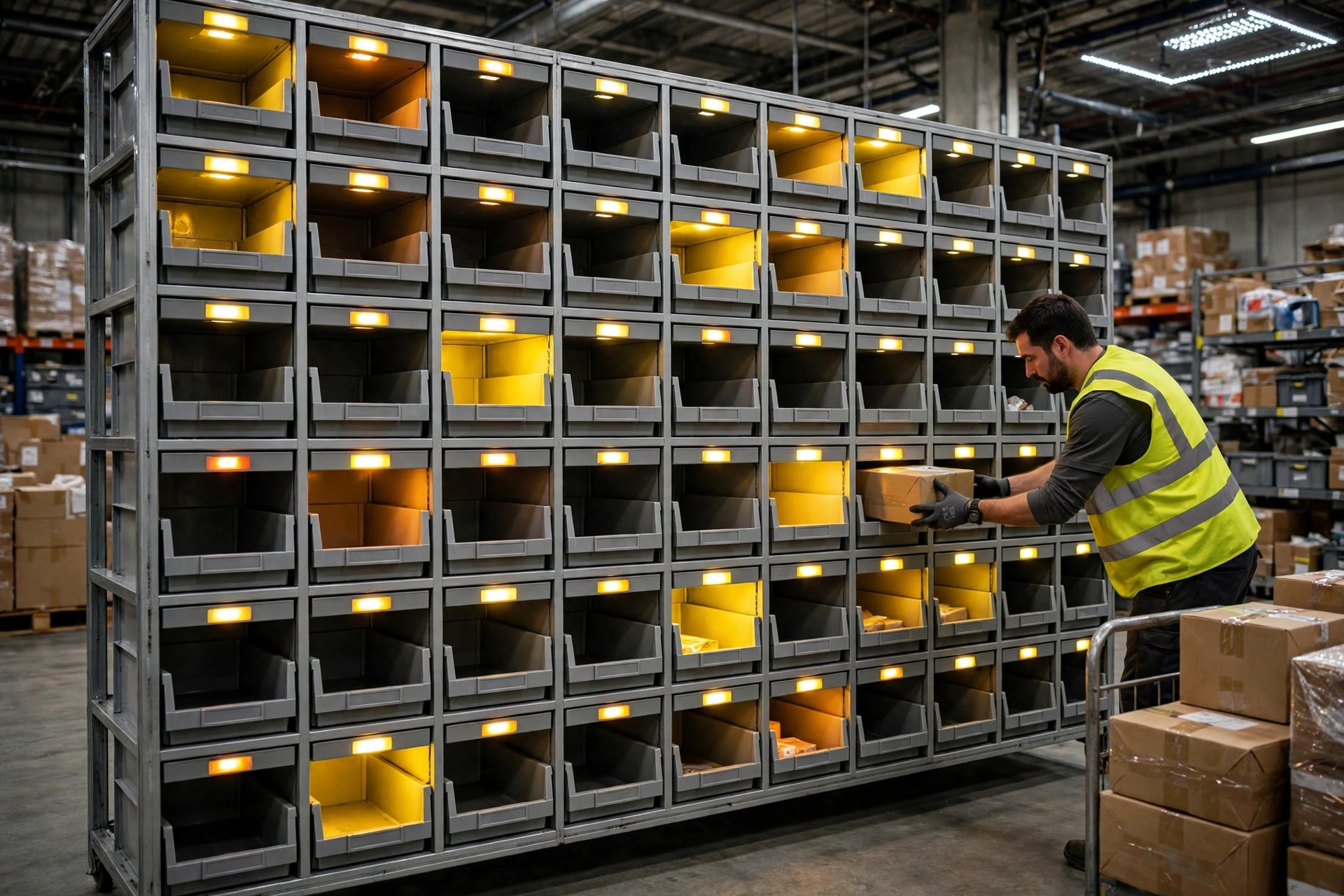
Cells are the skeleton of the wall. Get their size wrong and every later fix is a patch. Think of it like building shoe cubbies: a cubby too small will not take the box, and a cubby too large turns into a hiding place where two small items share one slot and nobody can find either one quickly. Before ordering, pull three months of orders and look at three facts: the largest item dimensions you actually ship, the average pieces per order, and how many orders sit open in one wave. Without those three facts, the cell count is a guess dressed up as a specification.
An apparel warehouse in Hangzhou learned this in autumn 2024. It installed a 96-cell wall with uniformly small cells. Shoe boxes squeezed in, but boxed sets did not. Operators had to break sets apart to put them away and rebuild them at verification, adding two extra touches to every affected order. The fix was not a bigger wall. It was a mixed wall, with roughly three in ten cells made larger for sets and bulky items, and put-away immediately smoothed out. More cells are not automatically better, either. Every extra cell lengthens the distance an operator must scan with their eyes to find the lit cell, and a lit cell that takes three seconds to locate is a lit cell that slows the whole wave.
Material matters in a quieter way. Light goods do fine on standard board. Heavy or sharp-edged goods need thicker cell bases and dividers, or the edges collapse and goods snag within a couple of months. Depth is another trap. A cell so deep that goods disappear inside it invites reaching errors, because the operator cannot see what is already there. Deep enough for one normal item, shallow enough to grip it directly, is deep enough.
| Cell approach | Works well for | Common failure |
|---|---|---|
| Small, dense cells | Small, light, low piece-count orders | Bulky items do not fit and must be split |
| Mixed large and small cells | Mixed sizes and boxed sets | The mix ratio is guessed, so large cells sit empty or run out |
| Deep cells | Single-specification, full-case put-away | Goods hide inside and operators pull the wrong cell |
Lights and Displays: Bright and Legible Beats Fancy
Vendors love to sell light shows: rainbow cycles, chasing patterns, animated effects. I will be blunt about that. A put wall is not a stage. The operator needs one instant answer: which cell, and how many pieces. A light bright enough to see from the working position, colours clearly separated, and a quantity display that does not glare is a good light system. A chasing pattern impresses a new hire for a day and produces nothing after that.
Display choice splits into two practical tiers. Quantity-only display suits single-item put-away with an experienced crew. A short product hint suits mixed put-away and crews with many new hires. A cosmetics warehouse in Guangzhou in March 2025 showed the failure mode: lights alone, no quantity display, and operators worked from memory. Small samples of the same product in different variants were the classic mix-up, and adding a quantity display cut those errors visibly. Test any display standing where the operator actually stands, not square in front of the wall admiring it.
Scanners: Test With Your Worst Barcode, Not the Lab Sample
Scanner selection is where specification sheets do the most damage. Read distance and read speed look wonderful until the warehouse hands the scanner a wrinkled shipping label, a barcode shining through clear film, or a code wrapped around a curve. Those are the real test cases. Before choosing, run your hardest barcodes through the candidate scanner: the crumpled label, the reflective pouch, the curved surface. If those three read reliably, the numbers on the sheet start to mean something.
Fixed scanners and handheld scanners are not a religion to defend. Fixed scanning at the induction point suits fast, single-item flow where barcode position is fairly stable. Handheld suits mixed goods where barcode position wanders. Many warehouses buy fixed scanners everywhere to look automated, then operators waste the saved seconds turning every item over to find the code. That is like installing an automatic door and then bending down to find its sensor every time. Choose the scanning method by where the barcode actually sits on your goods, then argue about brand and price.
Weighing Checks for Sorting Wall Hardware: The First Budget Line Cut, and the Last One I Would Cut
Weighing checks are usually the first line cut when the budget tightens, and they are the last line I would cut. Lights and scans confirm an action happened. They do not confirm it happened correctly. Weight is the one check that does not rely on human eyesight: one piece too many, one too few, or one item in the wrong cell shows up on the scale. Without it, a put-away error waits until verification, or worse until a customer complaint, and rework then costs several times what a correction on the spot would have cost.
Precision is not the goal. Stability and speed are. A scale that takes too long to settle forces the operator to wait and breaks the rhythm of the wave. A scale too sensitive jumps before the hand leaves, floods the operator with false alarms, and teaches the crew to ignore the check altogether. When evaluating, watch two things during a half-hour live trial: how quickly a stable reading appears after the item lands, and how often false alarms appear during continuous put-away. Those two observations beat a stack of specification sheets.
Weighing also has to talk to the lights. When a weight alarm fires, the light system must point at the exact cell in trouble, not flash the whole wall.
The System Interface: Agree It Before You Sign
Good hardware connected badly to the warehouse management system is decoration. Before signing, put four items in the technical appendix: how quickly the wall lights after an order is released, how put-away completion is reported back, how an exception order is held and released, and how data is reconciled after a network break and reconnection. Leave any of those vague and the argument after go-live is almost guaranteed.
Hardware selection also has to leave room for the process it serves. The put-to-wall secondary sortation process, for example, may put more than one sub-order into a cell during a second sort. If the light display only supports one order per cell, even a sound process cannot run on that wall. Hardware and process are two legs of the same walk; buy the hardware with the process in mind.
Doing the Combination Math
Do not judge a wall by its purchase price alone. My method is crude and it works. Spread purchase and installation cost over the expected service life, add annual maintenance and replacement parts, and divide by the orders put away each year. That gives a hardware cost per order. Then set the money saved on rework and verification labour against it. The comparison tells you whether the wall genuinely saves money or merely looks like it does.
Here is the counterintuitive part: a wall with every option maxed out — most cells, fanciest lights, fastest scanners, finest weighing precision — is often not the best-value wall. If volume has not reached that level, utilisation stays low and cost per order stays high. If volume has already arrived and you still buy the cheapest configuration, mis-sorts and rework will eat the purchase saving several times over. Fit beats excess. Fit beats austerity, too.
Whether the money was worth it comes down to one number: three months after go-live, has cost per order put away genuinely fallen compared with before the wall? If it has, the combination was right. If it has not, do not blame the operators first. Go back to cells, lights, scanners, and weighing, and find which one of the four is dragging the rest down.
By Da Liu, Automation Engineer