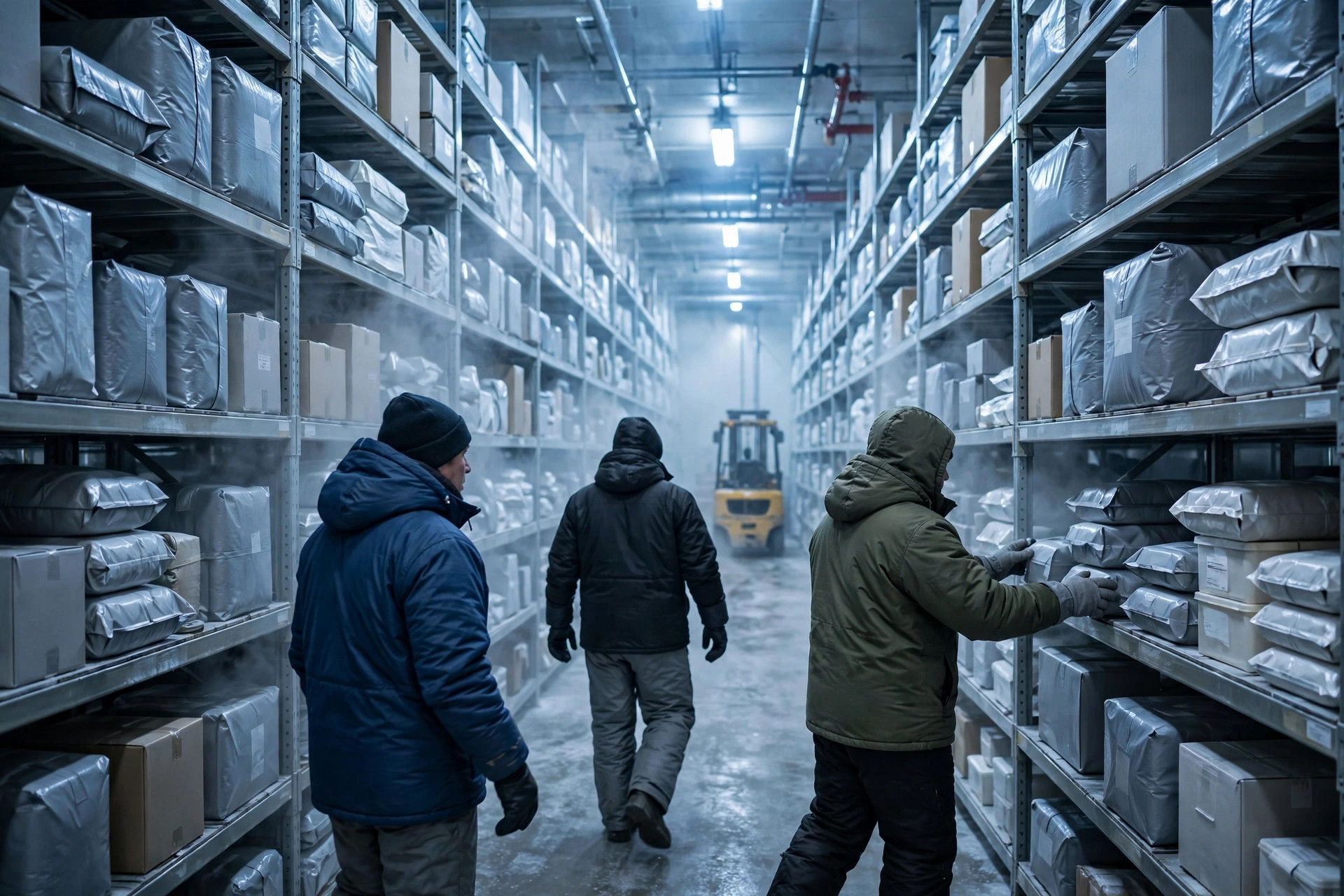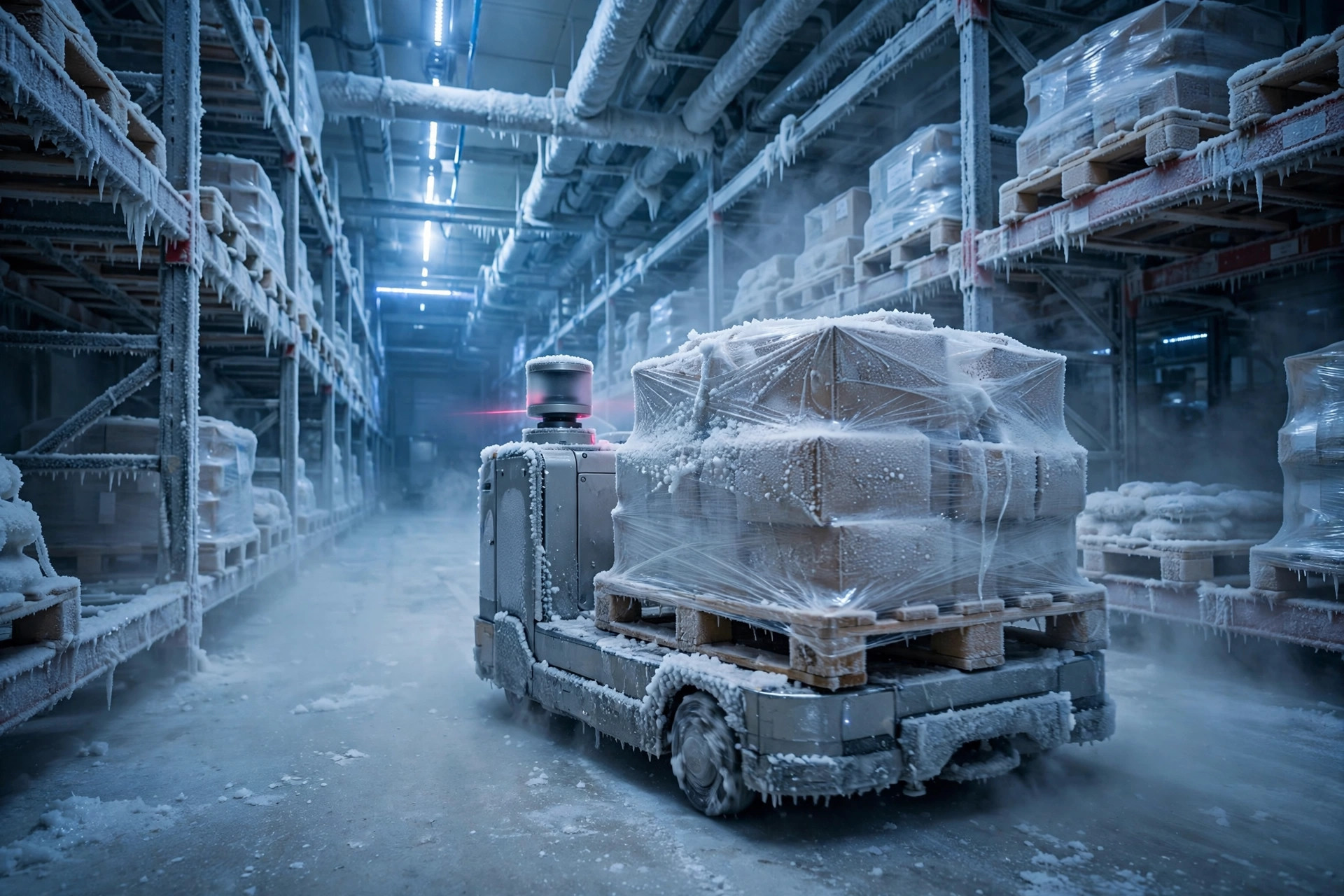
At -25°C, a fully charged AMR rolls into the freezer and reports low battery before the shift is half over, dying in the middle of the aisle. Don't blame the battery maker — this is the opening lesson of the low-temperature challenge in cold storage automation: temperature grabs electrochemistry, lubricants, and optics all at once.
Here is the counterintuitive part: a steady -25°C is not the real enemy. Equipment that lives permanently at -25°C, once properly specified, can run 24/7 without drama. The killer is the dock door — every time a vehicle crosses from -25°C into +20°C air, condensation blooms on every cold surface within minutes, and rolling back inside flash-freezes it into an ice shell. Sensor lenses, charging contacts, drive wheels — all entombed. So the low-temperature challenge in cold storage automation has a number-one killer, and it isn't the cold. It's condensation.
Ranked by downtime damage, the three gates are: batteries, lubrication, sensors. One at a time.
Gate One: Batteries — the Most Expensive Lesson of the Cold Storage Low-Temperature Challenge
The principle is simple. Think of the electrolyte turning into syrup. As temperature drops, lithium ions can barely swim between the electrodes; internal resistance climbs, the discharge voltage plateau sags, and the BMS sees the cutoff voltage and declares the pack empty — the energy is still in there, it just can't get out. It's like asking someone to sprint on a freezing morning: stiff muscles, pulled hamstring within 400 meters.
The numbers: for LiFePO4 cells, capacity loss in the -20°C to 0°C band can reach 50%, a figure that published battery test data broadly agrees on; below -20°C, usable capacity can fall to around 40% of rated. For a -25°C freezer, size your duty cycles on "range cut in half." Conservative, but you won't get burned. And one iron rule: no charging below 0°C. Cold charging plates metallic lithium onto the anode — permanent damage. The BMS low-temperature charge cutoff isn't decoration; when it trips, your whole charging plan falls apart. One vendor's published data shows cycle life collapsing from 4,000 cycles at room temperature to around 1,200 at -20°C — cold doesn't just shrink today's range, it eats the battery's lifetime.
From the field: in the fall of 2024, a frozen-food e-commerce cold store in eastern China running at -25°C put eight latent AMRs to work on in-freezer transport. On the third morning of commissioning, six vehicles reported low battery and died in the aisles. Two root causes: the vendor's range figure was measured at 25°C, and at -25°C the usable range was roughly halved — while task scheduling assumed full range. And the chargers had been placed inside the freezer to "save wiring," so the BMS kept tripping low-temperature charge protection below 0°C; the fleet was effectively charging on paper only. The fix: chargers moved to the ambient-temperature zone outside, battery packs got insulation plus heating, and duty cycles were re-planned on halved range — charging went from "once a day" to "full charge before every shift entry." Three days later, uptime was back above 98%.
My selection boundaries — three questions, nothing else: First, ask "continuous" or "intermittent." Dematic's freezer AGV is rated for continuous operation at -25°C and intermittent operation at -30°C, with a 1,100 kg payload; JBT's freezer forklift AGV is rated from -10°F (about -23.3°C) up to 110°F. Watch the word "intermittent" — some vendors print a giant "-30°C wide-temperature" on the brochure for what is really an intermittent rating. Run it continuously at -30°C and it will show you its temper within days. "Continuous operating temperature" goes in the contract; verbal promises don't count. Second, does the battery need active heating? Above -18°C with vehicles that rarely cross the condensation zone, insulation is enough. At -25°C and below, or with vehicles cycling through dock doors daily, you need battery heating — and the heater's own energy draw goes into the range calculation, or you'll discover your range shrank another notch after adding heat. Third, don't pay extra for "wide-temperature cells" before asking one question. Some integrators sell so-called wide-temperature cells at a 20% markup; the cells are ordinary LiFePO4, they just changed a temperature threshold in the BMS. Ask for the discharge curve at -25°C. If they can't produce it, it's a pseudo-need — call it out, no politeness required.
Gate Two: Lubrication — When Grease Turns to Paste, the Machine Quits First
Lubrication is the easiest gate to ignore because it never alarms — it just makes everything quietly miserable. Think of honey in a refrigerator. Grease consistency climbs steeply as temperature falls; at -25°C, ordinary lithium grease barely pumps, bearings run half-dry, motor current creeps up, gearbox noise grows, and service life bleeds away month by month.
The selection boundary is exactly one: don't read the "-40°C" printed on the tube — read the measured low-temperature torque per ASTM D1478. Dozens of greases print "-40°C" and perform twice as differently at -25°C. My rule: the grease's rated low-temperature limit must sit at least 10°C below your store temperature. For a -25°C store, pick -40°C or lower; if equipment also crosses dock doors through condensation, start at -40°C as the floor.
Three maintenance pits, each one a 3 a.m. phone call: first, regreasing intervals in a freezer must be shorter than at ambient — condensation moisture emulsifies grease, and emulsified grease is no grease. Second, polyurethane drive wheels harden in the cold and slip; on a laser-guided vehicle a slipping wheel means the odometer lies, and localization starts drifting. Third, the first commissioning inside the freezer must happen after temperatures stabilize — every zero point calibrated at ambient temperature has to be re-calibrated at -25°C.
Gate Three: Sensors — the Most Superstitious Gate of the Low-Temperature Challenge
Sensors are the spooky gate: intermittent, unreproducible, always fine when you're watching. Two mechanisms: first, frost — on photoelectric sensor lenses and reflector windows, any surface below the dew point grows frost, the beam attenuates, and the PLC reads "pallet present" or "pallet absent" depending on the frost's mood. Second, condensation at the dock door — water beading directly on the lens, worse than frost.
In the winter of 2023, a -22°C high-bay store at a prepared-food plant in northern China saw its stacker crane's slot-detection photoelectric sensors throwing false positives every few days — four night-shift line stops in a single month. Engineers went in during the day, doors cycling, frost melted, everything normal; at night, stable cold, frost back on. The fix copied the deep-freeze playbook used by vendors like Elettric80: heating and defrost elements on critical photoelectric sensors, all PLCs and control electronics inside heated cabinets, and low-temperature-flexible cabling — at deep-freeze duty (around -30°C), ordinary cable jackets go brittle and crack, and that's money you don't skip.

The maintenance checklist, copy it directly: wipe critical sensor lenses at the start of every shift; put defroster heater current on the inspection sheet — a dead heating element never alarms, it just calls you at 3 a.m.; use stainless brackets, because condensation plus plain carbon steel seizes solid within months and then nothing adjusts.
Doing the Math: Three Routes, and the One Number That Decides
| Route | Approach | Cost scale | Fits | Winter risk |
|---|---|---|---|---|
| A Full low-temp spec | Heated batteries + insulation + low-temp grease + sensor heating + heated control cabinets | Roughly 10% on top of vehicle cost | Permanent -25°C duty | Lowest |
| B Charge outside + rotate | Chargers in the ambient zone, vehicles rotate in and out | Lowest spend | Above -18°C, short shifts | High condensation risk |
| C Run ambient equipment naked | Change nothing, drive it straight in | Zero | Don't do it | Winter uptime cut in half |
I see Route C every year, and the ending is always the same: first winter, uptime drops below 90%, and everything saved goes into line stops and emergency repairs. Route B is the value pick — but only with short shifts and controlled crossing frequency, or condensation water will teach you a lesson.
Whether the money was well spent comes down to one number: before and after the retrofit, at the same -25°C and the same shifts, completed transport tasks per vehicle per day. If it's back above 85% of the ambient-temperature level, the money was well spent. If it's still halved, one of the three gates wasn't really passed — most likely the sensor gate, because it never makes a sound; it only moves when you're not looking.
By Da Liu, Automation Engineer