Verdict first: when you put conveyors in a food warehouse, belt material selection is maybe 30% of the job. The other 70% — the part that decides whether you survive an audit — is whether your sanitation SOP leaves a trace in a system. I've watched clients buy the priciest food-grade conveyor belt and still get written up, because when the auditor asked for 90 days of cleaning records, all they had was a paper log with 11 days missing. This is a field playbook: how to pick the belt, how to clean it, what compliance paperwork to keep — and why a WMS consultant like me obsesses over your cleaning logs.
Two war stories: how clients shot themselves in the foot
Fall 2023. A 3PL cold-storage food distributor outside Los Angeles, 20,000+ square feet, four conveyor lines. I was there for the WMS rollout; the conveyors were already in — white PU belts, certificates on file. Looked compliant.
Then a surprise FDA audit asked for three things: compliance docs, the SOP, 90 days of cleaning records. They had the first two. The third was a paper sign-off sheet — 11 days missing, signatures not matching the shift roster. Two observations, six weeks of remediation, one client lost. The belts were fine. The records killed them. I've seen this exact failure three times: a dairy warehouse, a bakery commissary, then this one. Same pattern — "belts compliant, records a mess."
The mirror image: 2024, a bakery-ingredients client running greasy product. To save money they picked PVC belts — food-grade formulations exist, so the logic was "food-grade is food-grade." Three months in, edges cracked, grease wicked into the fabric plies, and no wash got it clean. Swab tests kept failing. They scrapped a 30-meter belt and lost a day and a half of production. The purchase-price savings didn't cover a fraction of the downtime.
Material gets you selected. Sanitation and records keep you alive.
Picking a food-grade conveyor belt: one table, no fluff
| Material | Best for | Grease resistance | Cleaning effort | Cost | Biggest trap |
|---|---|---|---|---|---|
| PU (polyurethane) | Meat, bakery, dairy — the generalist | Strong | Low (smooth) | High | Knockoffs with compliance docs for a different SKU |
| PVC | Dry goods, cased product | Weak | Low | Low | Cracks on grease or heat exposure |
| Modular plastic (acetal/PP) | Meat, poultry, seafood — wet product | Strong | Medium (hinges need blasting) | Med-high | Hinge joints harbor residue without washdown |
| Stainless slat | Baking, freezing, high-temp | Strong | Low | Very high | Heavy, loud, expensive — overkill for a small DC |
| Silicone | Bakery release, hot product | Strong | Low (non-stick) | Very high | Niche high-temp use only |
Three notes. First, "food-grade" is a compliance status, not a material — two PU belts can comply very differently. Match the file to the exact SKU, never the material family. Second, the sanitation gold standard is seamless extruded PU (one piece, zero crevices); modular belts are tougher and repairable module-by-module, but their hinges live or die by washdown. Third, the frame matters: rounded welds, minimal fasteners, stainless in food zones. A spotless belt on a grime-trapping frame is theater.
The five-step selection checklist: skip nothing
Step 1: Classify the contact level. Direct food contact, or packaging only? Direct means full rigor — seamless PU or modular belt. Packaging-only means PVC is fine. Get this wrong and everything downstream is wrong.
Step 2: Assemble the three-piece compliance file. (1) Supplier declaration with the SKU matching exactly what you bought. (2) Mapping to the applicable FDA regulation — 21 CFR Part 177 for polymers, 177.2600 for repeated-use rubber articles; confirm against current FDA guidance. (3) If the supplier cites an FCN, know it's valid only for that supplier, substance, and conditions of use — change suppliers, start over. Selling into Europe? Add EU 10/2011. Missing any piece, you're exposed.
Step 3: Build the temperature-plus-chemicals matrix. List every temperature extreme and every grease, cleaner, and sanitizer the line will meet; check each against the supplier spec. Watch the sanitizer column: chlorinated sanitizers attack some PU formulations. Belts get washed to death more often than worked to death — I've seen this exact failure three times.
Step 4: Let cleaning capability choose the belt. High-pressure washdown on site? Modular belts are fair game. Wipe-down only? Seamless PU — you'll never clean a hinge joint with a rag. Outsourcing sanitation? Put the SOP in the contractor's scope. Cleaning capability first, belt second.
Step 5: Run the TCO math. True belt cost = purchase + changeout labor + downtime + cleaning hours. A modular belt costs more, but swapping two modules takes ten minutes versus half a day of downtime for a full belt. Multiply by your hourly downtime cost and re-rank — the answer flips more often than you'd think.
The sanitation SOP: a go-live-night checklist
Written at the granularity I'd demand on go-live night:
- Lock out / tag out — the line cannot start unexpectedly.
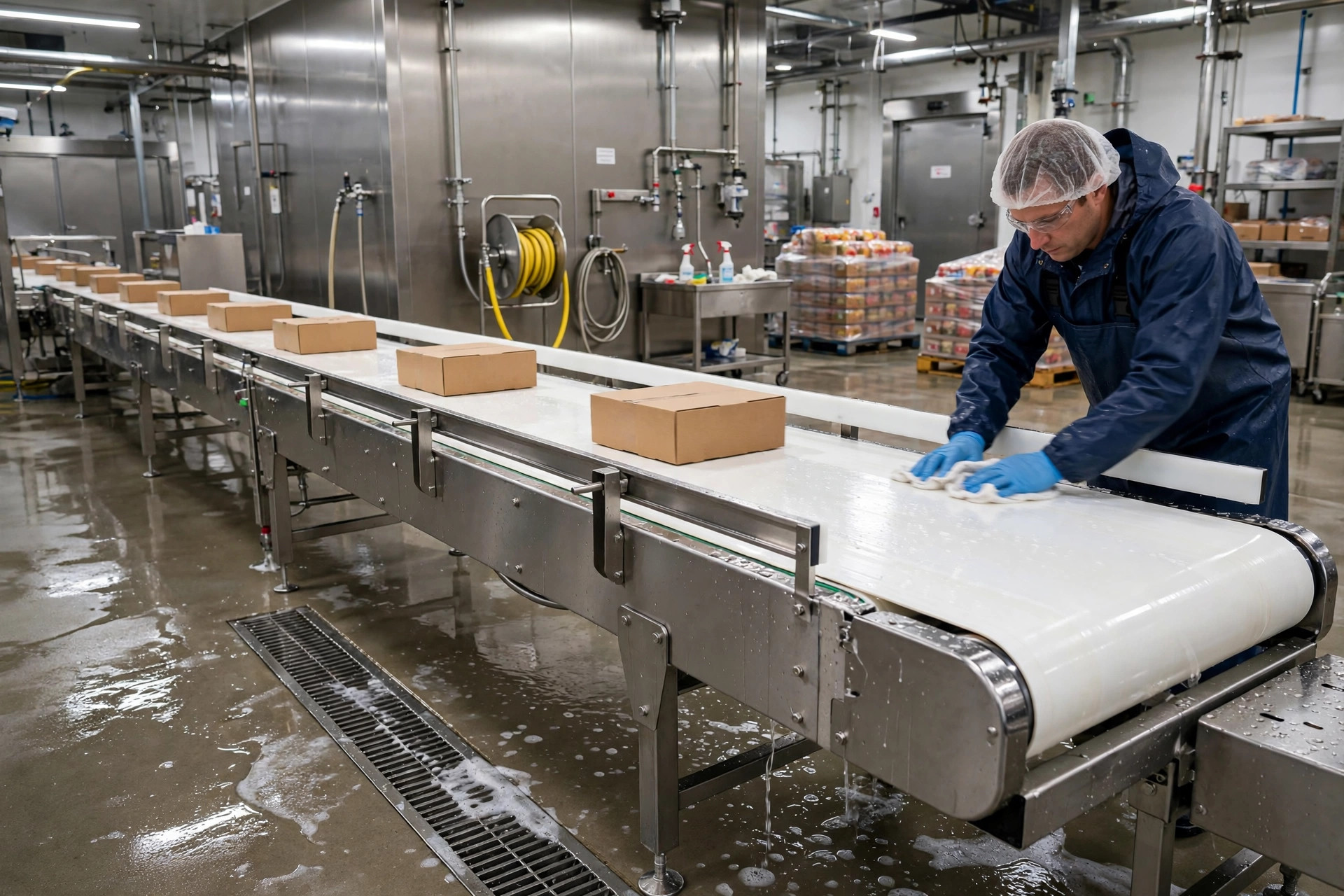
- Dry clean first — debris off before water touches it. Wet-washing over dry soil makes mud.
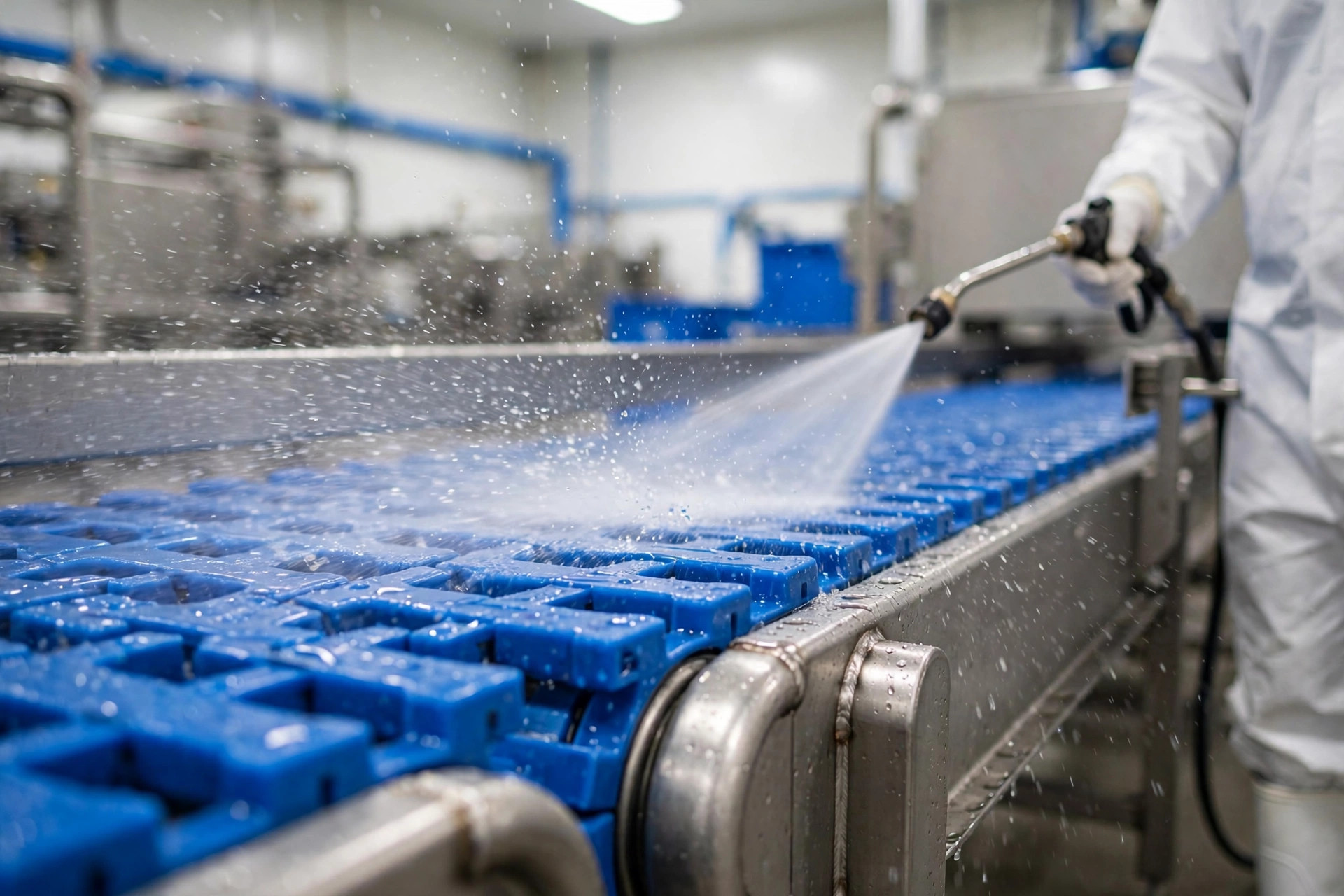
- Pre-rinse toward the drain.
- Apply food-grade cleaner at the supplier's dilution, not "a little extra for luck."
- Scrub everything: belt face, frame, rollers, guards, hinge joints.
- Rinse fully — residual cleaner is itself a contaminant.
- Sanitize for the full labeled contact time. Short time = no sanitize.
- Dry and verify against your lab's acceptance criteria.
- Log it: who, when, which line, which chemicals, result. Into the system — next section.
The crossover: why cleaning records must live in a system
I'm a WMS consultant — hardware is outside my lane, but this section is home turf, and it's the most important one here.
The paper log dies exactly the way story one showed. Manage sanitation like production work instead:
- Digitize the cleaning work order. Each conveyor gets an equipment record; the plan auto-generates orders by frequency, dispatches to the tech's phone, and requires photo + sign-off. Overdue orders escalate.
- Interlock with the WCS/PLC. Before startup, controls verify today's cleaning order is closed. Not cleaned, not running. The night shift can't skip it — physically impossible.
- Let sensors write the record. Run hours, belt speed, motor current — your WCS already collects it. X run hours auto-triggers a cleaning order. Hard to fake what a sensor wrote.
- One-click audit export. Ninety days to timestamped PDF in thirty seconds. The client from story one rebuilt this way; their follow-up audit took twenty minutes.
- Tie it to batch traceability. Which line, cleaned when, which batches ran after. A foreign-material complaint gets scoped precisely instead of triggering a full recall.
The belt is hardware; compliance is data engineering. Auditors don't believe "I remember washing it." They believe timestamps.
Three failure modes I've seen three times each
1. Certifying the category, not the SKU. "All our PU belts are FDA-compliant" — but the certificate names a different SKU. An FCN covers one supplier's substance; Supplier A's FCN doesn't cover Supplier B's belt. At receiving: certificate SKU = belt SKU, to the last letter.
2. The sanitizer eats the belt. Over-concentrated chlorinated sanitizer turns PU tacky and cracked. The client blamed belt quality for two weeks before finding their own dilution error. Validate chemical compatibility before any new sanitizer hits the floor.
3. Stocking full belts but no modules. You paid extra for modular belts to swap two modules instead of a whole belt — then stocked zero spare modules. Two damaged modules, three-week lead time anyway. The spares list must match the selection logic.
One counterintuitive take
Auditors don't start with your material certificates. They start with your cleaning records.
Everyone has certificates — suppliers hand them out, they sit in a binder. But 90 continuous days of records with timestamps, named operators, and verification data is nearly impossible to fake; it's the only proof the work happens daily. So on a tight budget: buy a mid-range compliant food-grade conveyor belt, and put the savings into the sanitation SOP and system traceability. Material is the floor of compliance. Records are the ceiling.
Three things to do tomorrow
- Tonight: does the SKU on your belt certificate match the belt on the floor?
- Pull 30 days of cleaning records; look for gaps. Fix the SOP before the audit — never backfill records. Backfilling is fabrication, and getting caught is worse.
- Ask your WMS/WCS provider: can cleaning orders live in the system and interlock with line startup? If yes, schedule it. If no, start with a standalone inspection app.
A conveyor belt is hardware; food-warehouse compliance is data engineering. The right belt is the starting line; complete records are the finish.
By Lin Xiao, WMS Implementation Consultant