It was a Tuesday morning last October, around 7:10. I had just parked when Lao Chen from receiving came running over, looking pale. "Feng, two people at the gate. Flashed their credentials. FDA. They want to inspect the warehouse." That was my first up-close encounter with FDA 483 observations — the pages the investigator leaves on your desk before walking out.
Folks, in all my years running warehouses, I'd dealt with the fire marshal and customer audits, but an FDA investigator walking through my door was a first. Two of them, polite, credentials out. You could tell by the way they carried themselves: nobody was leaving early today.
Let me get one thing out of the way so nobody panics: a 483 is not a fine. Before leaving, the investigator is required by Section 704(b) of the Federal Food, Drug, and Cosmetic Act to hand you a written report — the 483 form — listing conditions that, in their judgment, may indicate violations. Observations, not convictions. But here's the thing: your brand customers get more nervous seeing a 483 than seeing a fine, because a warning letter can follow. So once you get one, you fix everything on it, fast.
And there's a misconception I need to clear up: plenty of warehouse folks think "we don't manufacture anything, we just store boxes — the FDA can't touch us." It can. 21 CFR 117.93 says it plainly: storage and transportation of food must be under conditions that protect against contamination and deterioration. Warehousing is named.
So what defect categories do inspectors write up most in food warehouses? From our own inspection and years of talking with peers, I've put together a warehouse version of the FDA 483 observations list — five categories. Honestly, they barely change year to year. According to a food-safety consultancy's review of recent FDA inspection data, roughly nine in ten food-facility 483 observations relate to good manufacturing practices, with pest control sitting at the top of the list year after year. (Check FDA's published inspection observation data for the official rankings.) For warehousing, it always comes down to these five.
The perennial No. 1 FDA 483 observation: pest control
Pest control — 21 CFR 117.35(c) — is the permanent chart-topper, and I get why inspectors are obsessed with it. You can't see mice and roaches, but that doesn't mean they're not there. Inspectors specialize in looking where you don't.
We learned this the hard way. Two summers ago, our pest control vendor came once a month, and the report always said "no issues found." We just signed off. Then the investigator crouched down, pried open a mousetrap in the corner — cobwebs inside. Walked outside: the dumpster sat less than ten feet from the receiving door, lid wide open. He didn't say much. One observation: failure to take effective measures to protect food from pest contamination.
Here's what we changed — three things, non-negotiable now.
First, a new vendor, with it written into the contract: weekly inspections, photo reports, trap location maps that match the floor — mismatches mean deductions. Second, every morning before startup, ten minutes: the shift lead takes two people on a "pest walk" — doors, windows, drains, the trash area. Any gap gets a same-day work order. Third, a new rule at receiving: wooden pallets get checked for bore holes and mold before they enter the building. Bad ones get rejected, with photos on file.
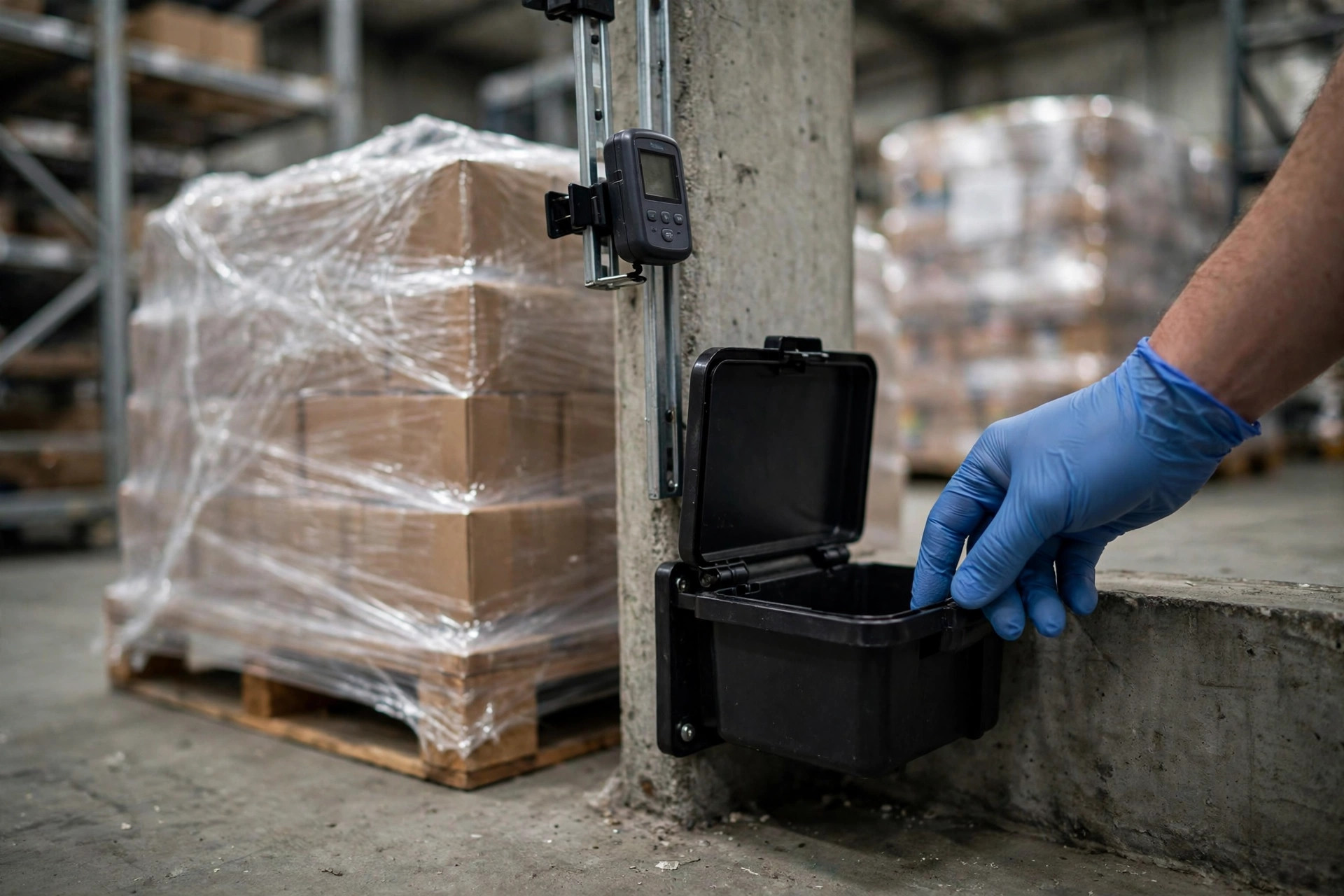
Honest truth: on pest control, your own people beat the vendor. The vendor shows up once a month. The mice clock in every day.
The building and the basics: what an inspector sees in the first ten minutes
These two — plant maintenance (21 CFR 117.20(b)) and sanitary operations (21 CFR 117.35(a)) — are the walk-in kill. No records needed. One look tells the inspector how you run the place.
The building first. Water stains from an old roof leak, cracked walls, broken flooring that ponds water, dock doors that don't seal and leak daylight — none of this reads as "minor" to an inspector. A warehouse next to ours had a roof leak one rainy season; they threw a plastic sheet over the pallets and kept working. The investigator pointed at the ceiling stain: "How many times has this leaked? Was it repaired? Where's the record?" Three questions, one observation. Remember: inspectors don't just care whether it's leaking now — they care whether past problems were fixed and documented.
Then sanitation. Does the hand sink have hot water and paper towels? Are the restrooms clean? Are cleaning tools stored by zone? Your crew goes numb to this stuff from seeing it daily; the inspector walks in with fresh eyes. Our observation that year: the mop head in the cleaning closet was black with grime, piled next to the food-area broom. The fix was simple: color-coded tools by zone — food area, office, restroom — three sets, locked in a cabinet, shift lead signs off weekly.
The two most unfair FDA 483 observations: temperature logs and people
I say "unfair" because nine times out of ten, it's not that you didn't do the work — it's that the records were sloppy or the people weren't managed.
Temperature first. We have a cooler. One night shift, the chart recorder ran out of paper — two days of gap, nobody thought it mattered. The investigator flipped to those two blank days. One observation. Another time, worse: the logs existed, every day filled in — but he held them up and asked, "Same handwriting, same time every day, same temperature every day — were these recorded or copied?" My back went cold.
That taught me something counterintuitive: inspectors aren't scared of a deviation in your logs. They're scared of logs that look too perfect. One spike with a corrective action written next to it — say, "temperature excursion overnight, product moved, unit serviced" — means your system works. Identical numbers in identical handwriting means, to an inspector, fabrication. What we do now: automatic loggers on every critical cooler, over-limit alerts straight to the shift lead's phone. Paper logs are backup only, signed, with times to the minute. The loggers cost money. Compared to a 483 followed by customer re-audits and lost business, it's cheap.
Then personnel hygiene — 21 CFR 117.10. Xiao Wang, one of our forklift drivers, wore his gloves to the restroom and came back handling product without changing them. Caught red-handed. Then there's eating — a picker munching bread by the rack, crumbs on the cartons. The rules were all in the handbook. Nobody enforced them. Our fix: veteran workers train every new hire, and lesson one isn't driving the forklift — it's handwashing and glove changes. Shift leads do a random check monthly. One strike docks that month's performance points. Low-tech. Works.
The one-page checklist we run every week
After that 483, we built a weekly self-inspection sheet. The shift lead walks it every Friday before clocking out, signs it, and I spot-check. Five defect categories, one row each:
| Defect category | How the inspector usually writes it up | What we check weekly | Corrective action |
|---|---|---|---|
| Pest control | Failure to take effective measures against pest contamination of food | Traps, door/window gaps, trash area, vendor report | Weekly vendor visits with photo reports; our own daily pre-shift pest walk |
| Sanitary operations | Sanitation operations failed to prevent food contamination | Hand sinks, color-coded tools, restrooms | Zone-coded tools under lock; weekly sign-off |
| Building maintenance | Facility not maintained in good repair | Roof, walls, floor, door seals | Same-day work orders; repair records filed |
| Temperature records | Failure to maintain proper storage conditions or missing records | Logger status, record completeness, alarm tests | Auto loggers plus phone alerts; paper backup signed to the minute |
| Personnel hygiene | Personnel hygiene practices not in compliance | Handwashing, glove changes, no eating in work zones | Hygiene-first onboarding; monthly spot checks tied to performance |
The sheet costs nothing. The word "weekly" is what costs — and what pays. The investigator's favorite question: "When was your last self-inspection?" If you can't answer, everything else was for nothing.
One reminder for fellow warehouse folks: don't wait for the investigator to read your logs. Once a month, take half a day, play inspector yourself, and walk the building from the front gate with a fault-finding mindset. What you find yourself becomes a corrective-action record. What the investigator finds becomes a line on a 483. Same problem, two very different outcomes.
By Chen Feng, Warehouse Operations Manager