Verdict first: an FDA inspector can tell whether your food warehouse pest management is real or theater within 15 minutes of walking in. They look at five spots: dock door gaps, the trash area, rodent station placement, floor drains, and the raw-material zone. Nail those five and the next two hours go smoothly. Blow one, and every question after gets three times harder.
I'm a WMS implementation consultant — pest control isn't my job. But in 2023, while implementing a WMS at a 60,000-square-foot food 3PL warehouse in Ontario, California, the client pulled me into their pre-inspection walkthrough a week before the FDA showed up. Inspectors read IPM the same way I read a go-live checklist: they don't care what you say, they care what you can prove.
Dock Door Gaps: The Number-One Entry Point
The first thing many inspectors do is crouch down and look at the dock door seals. A mouse can squeeze through a gap of about half an inch. If your finger fits, a mouse fits.
At that Ontario warehouse, we tested all 12 dock doors with a business card. Three had gaps wide enough to slide a finger through — six days before the inspection. The fix was unglamorous: rodent-proof door sweeps and new bottom seals, all 12 doors, under $900, done over a weekend. On inspection day, the inspector crouched at the very first door, looked, nodded, and said, "Let's continue."
I've seen this exact failure three times now, always the same script: nobody checks the seals until the week before inspection. My standing checklist: test every dock door monthly with a business card, keep door sweeps at least 12 inches high, replace weather seals the moment they crack — and log it with a photo.
The Trash Area: Fly Headquarters
In the summer of 2022, a food warehouse near Los Angeles kept its dumpster zone less than 15 feet from the dock doors. Open-top bins, summer heat, flies everywhere — the inspector glanced outside and wrote it down. The fix: move the trash area 100 feet out, switch to lidded sealed bins, haul daily. Pickup went from twice to three times a week, an extra $180 a month.
$180 a month to take the trash area off the inspector's radar. The checklist: far from docks and raw materials, sealed lids, hauled daily. In summer: hose down the pad weekly so no organic residue builds up.
Pest Monitoring: Why the Station Map Matters More Than the Catch
Here's a misconception I see everywhere: more bait stations must be better, so people line the walls with them. Wrong. The inspector doesn't count your stations. He picks one station number at random and asks for its inspection log. If the number, the placement map, and the log don't line up, that's a finding on the spot.
Do it right: number every station, put the numbered map on page one of your pest management binder, check weekly, and log "catch" or "no catch" — no-catch is data too. Have your PCO sign the log at every visit.
And here's the contrarian take: in a warehouse with good IPM, the stations are often empty. Complete placement, complete logs, and solid exclusion are the evidence chain. The warehouse that worries me reeks of pesticide with sticky boards on every wall — heavy chemical use tells the inspector your prevention failed. Prevention first, chemicals last. Declining pesticide usage year over year is your proof the system works.
Floor Drains: The Cockroach Highway
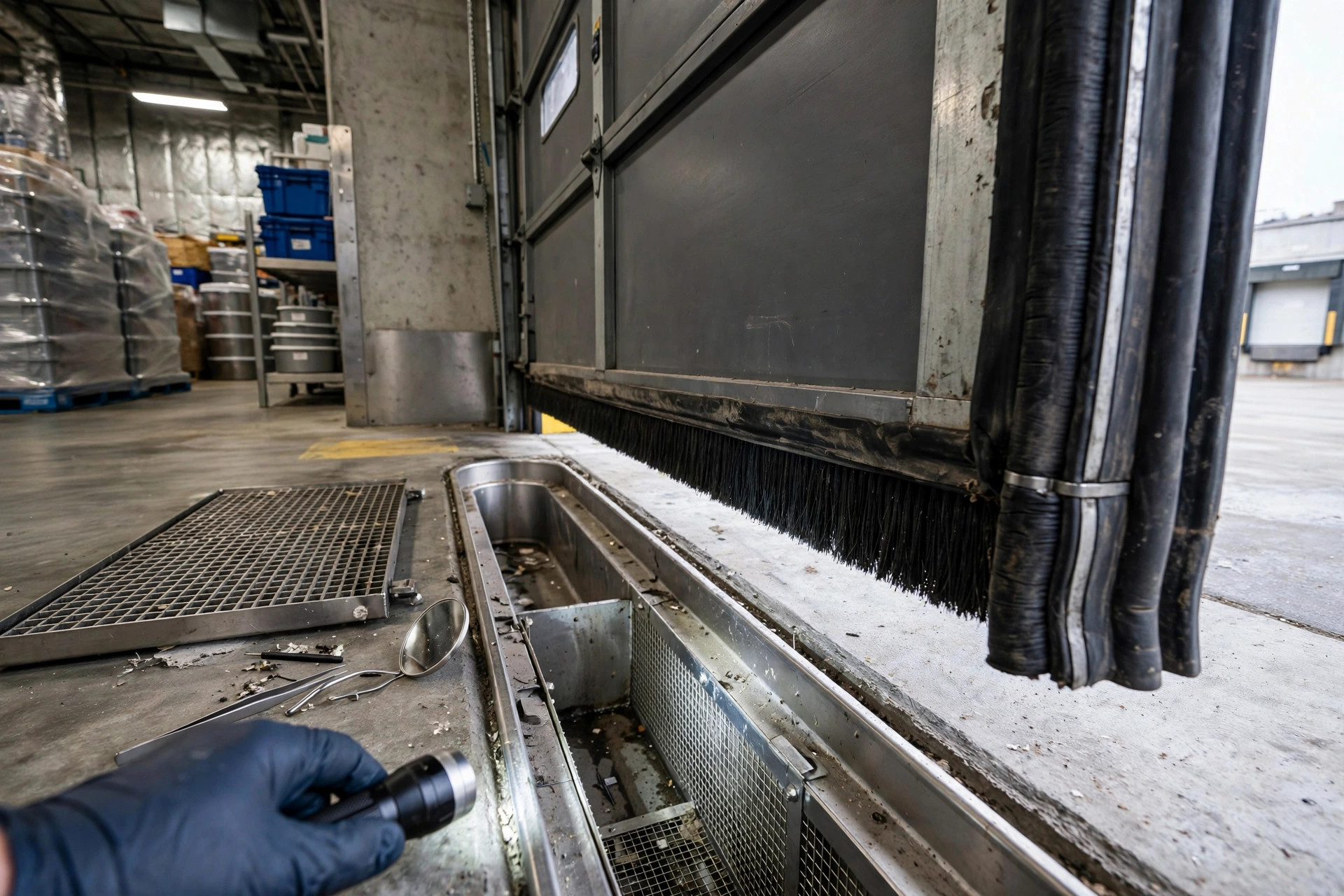
Inspectors lift drain covers. Standing water plus organic residue is a cockroach cafeteria. This one falls through the cracks because facilities owns the drains and QA owns pest control, so nobody owns the drains for pest purposes.
Pop every drain cover monthly: clear standing water, scrub residue. Watch the trench drains at the dock doors hardest — truck traffic drags in mud and food debris, and it all collects there. Photo with a date stamp, filed.
The Raw-Material Zone: Where Eggs Wait
Keep raw materials off the floor, away from the wall, and dry. Many warehouses follow the 18-inch rule (about 45 cm) — an inspector checks it at a glance by whether a broom fits underneath. Confirm the current requirement on the FDA website, but the hard standard never changes: if you can't clean under and behind it, the inspector assumes something is hiding there.
What FDA Actually Requires: Check the Current 21 CFR Text
FDA's pest requirements for food facilities sit in 21 CFR's current good manufacturing practice and preventive-controls rules: take effective measures to exclude pests and prevent harborage, inspect regularly, keep records. I won't pin down clause numbers — they've been reorganized over the years. Pull the current pest-control provisions from the FDA website and self-audit against them line by line before an inspection.
The inspector writes up the Form 483 (inspectional observations). A pest observation typically reads "failure to take effective measures to exclude pests" — and your corrective-action report then has to prove not just "we fixed it" but "we changed the system." That's when your placement maps and logs become defense exhibits.
The Four-Step IPM Checklist: Inspect, Prevent, Monitor, Respond
IPM — integrated pest management — is four steps, and every step leaves a paper trail:
- Inspect. Draw a floor plan marking every risk point (doors, drains, trash, raw materials). Walk a fixed route weekly, phone photos with date stamps. Log anomalies the same day, not next week.
- Prevent. Exclusion first, chemicals second. Seal door gaps, pipe penetrations, vents, and wall cracks. Trash hauled daily with lids on. Raw materials off the floor and off the wall. Get prevention right and your monitoring data takes care of itself.
- Monitor. Numbered stations, map on the wall, checked weekly and logged. Glue boards replaced monthly and logged. Fixed log template: date, station number, inspector name, catch/no-catch, notes. PCO signs off at every visit.
- Respond. When pests are found, close the loop within 48 hours: isolate, trace the entry point, correct (seal plus treat), file the record. Slower than that and the inspector will ask whether your response procedure exists only on paper.
Keep all of it in one binder — paper or digital. When the inspector asks, produce it within five minutes. If you can't produce it, it doesn't exist.
Pest Control Contracts: Four Clauses to Lock Down Before You Sign
I've watched this blow up twice. One client paid $650 a month for a PCO. Eight months in, he'd never seen a trend report, and the pesticide log for every visit just said "sprayed." The inspector wants four things: what product, what concentration, at which station, applied by whom. Missing any of them means eight months of money down the drain.
Write these four clauses into the contract:
- Frequency in writing. Visits per month, hours per visit, which weekday. Verbal promises don't count.
- Pesticide log per visit. Product name, EPA registration number, concentration, amount, station, applicator, date. Miss one field, deduct that month's fee — put it in the contract.
- Quarterly trend report. Capture counts per station over time. A downward curve proves the system works; an upward curve justifies spending more on exclusion.
- Response SLA. When live pests are found, how fast the PCO is on-site. I'd write 48 hours or less.
One more: get a copy of the PCO's license and insurance every year and file it in the binder. When the inspector asks, you hand it over in under a minute.
The Math: Outsourced PCO vs. Doing It In-House
| Outsourced PCO | In-house (staff side-task) | |
|---|---|---|
| Monthly cost | $600–900 | $200–300 (chemicals + labor) |
| Licensing | Licensed applicators | Usually none |
| Pesticide records | Enforceable by contract | Depends on discipline, gaps happen |
| Trend reports | Can require quarterly | Basically never |
| Inspector perception | Third-party backing, helps | Inspector digs deeper |
| Fits | Food warehouses facing FDA inspection | Small, non-food warehouses |
My call: for a food warehouse, don't cheap out. In-house saves maybe $5,000 a year; one extra 483 observation without third-party records to back you up, and the corrective-action labor alone costs more than that.
The trade-off: chemical treatment works fast, but every application adds to your record burden — and heavy use makes the inspector doubt your prevention. Physical exclusion costs more up front and works slowly, but it's permanent and scores points in an audit. That's why it's called integrated: spend the money on sealing, not on spraying.
One thing you can do tomorrow: grab a business card and test your dock door gaps. If it slides through, get door sweeps installed this week — you'll at least survive the first checkpoint.
By Lin Xiao, WMS Implementation Consultant