Warehouse conveyor belt height sounds like a footnote nobody reads, but it decides whether your sorters' backs survive peak season. Our 3,000-square-meter warehouse learned this the expensive way — about $4,000 in turnover and chaos — before fixing it for $300.
I'll admit something embarrassing. In September last year, the day our first 60-meter belt sortation line went live, I stood there with my hands on my hips feeling like a proper big shot. "We've got automation now," I told everyone. The installer's technician patted the frame and said, "800 millimeters. Industry standard. Same everywhere." I nodded like I understood. I did not understand.
Three months later, the romance was dead.
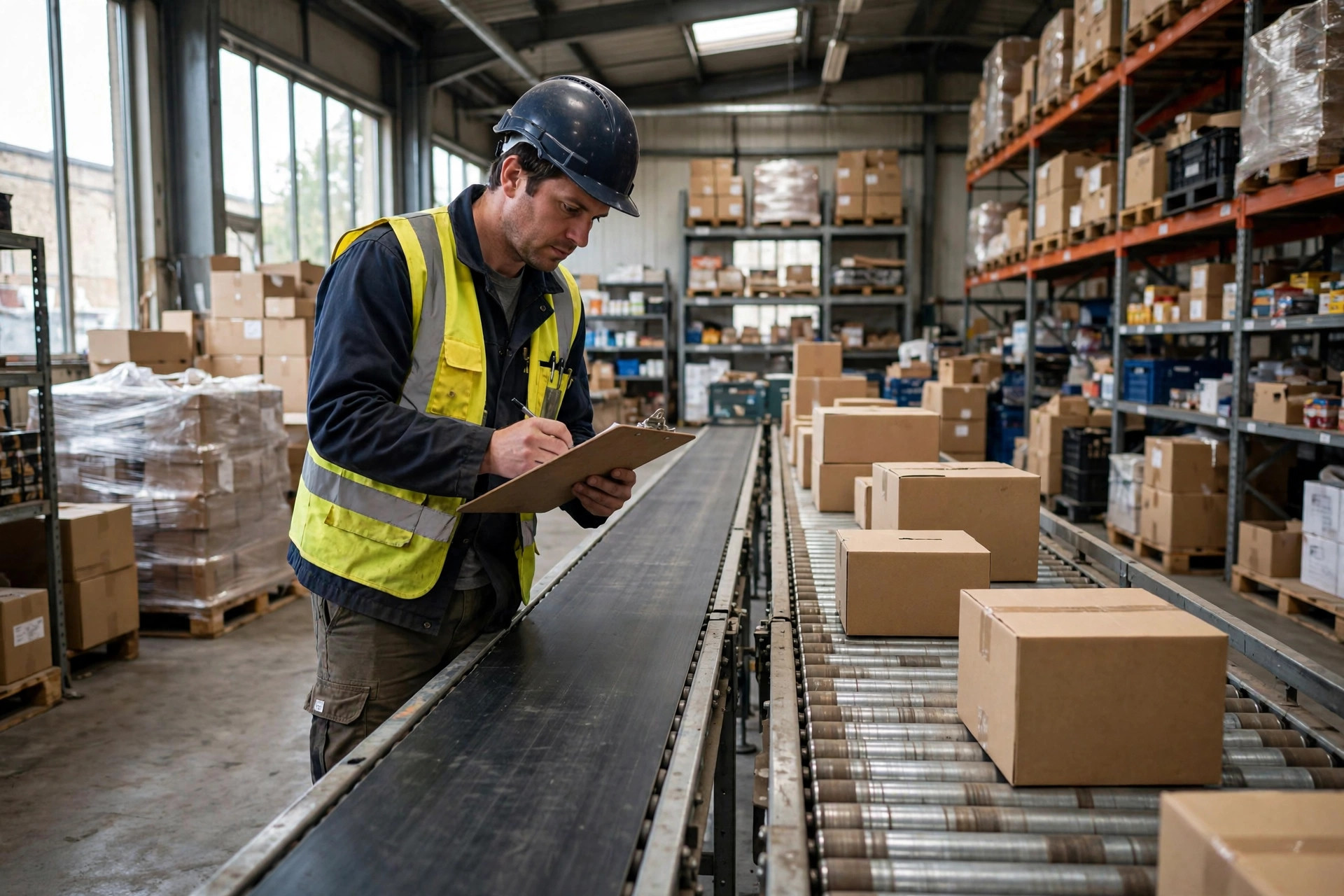
Two sorters on the divert stations — one about 5'1", the other 5'4" — spent ten hours a day bent over the belt, pulling 2,000+ parcels each off it. After six weeks, the shorter one quit. Her resignation reason was brutally honest: "My back can't take it." We posted the job. Candidates heard "ten hours bent over a belt" and walked out of the interview. One kid lasted half a day on trial, then told me, still in his work vest, "Boss, I can't do this." A month before peak season, we'd lost three sorters. I stopped sleeping well.
The kicker: the line itself was fine. Good motor, good speed. It was that "same everywhere" 800mm warehouse conveyor belt height quietly wrecking us. I called the manufacturer about adjusting it. "Sure," said sales, "add a powered lift section, $11,000, three days of downtime." Three days of downtime right before peak? I'd rather close the doors. Between recruiting, training, and the pre-peak scramble, that "standard" cost us the better part of $4,000. Tuition paid.
The "standard" height is designed for an average human. You don't employ those.
Here's what I eventually figured out. That 800mm standard assumes a "standard person." But my warehouse has no standard people. A 5'1" woman and a 6'1" guy standing at the same 800mm belt — one bends double, the other hunches. Both miserable.
My neighbor Lao Chen runs an auto-parts warehouse. His roller line sits at 900mm, and his 6'1" sorter spends all day shrugging over it, running about 20% slower than everyone else. Chen gritted his teeth and paid $11,000 for a powered lift section. I went to look: yes, it lifts — but one section, one height at a time. Put a shorter worker there and you're back to square one. That $11,000 hurt me just watching it.
So I did something deeply unglamorous. Tape measure in hand, I had every sorter stand straight, arms hanging naturally, and measured from floor to the heel of the palm. Five people, five numbers: 720, 760, 790, 830, 860mm. A 140mm spread.
That's the truth nobody tells you: one fixed warehouse conveyor belt height for a whole line is a fiction. Big companies solve it with powered adjustable sections at every station. We can't burn that kind of money — and honestly, we don't need to.
The redneck fix: $300, every section at its own height
What we ended up doing would make the manufacturer shake his head. It works.
We cut the 60-meter line into four zones by workstation: scan, two divert stations, check-and-pack. Each zone got its own height. Heavy-duty leveling feet under the legs (a few dollars each online), rot-proof wood shims where we needed more lift, a spirit level, anchor bolts to lock it all down. Use treated lumber — plain wood swells with moisture and your line goes crooked. We learned that one for you.
How did we set the heights? Right off that palm-heel measurement: divert stations = palm-heel minus 50mm, scan station = plus 50mm (eyes level with the screen, no stooping), pack station = minus 100mm (sealing boxes needs downward force, lower is better). One tip: level the middle section first, then work outward — too much slope and small parcels jam.
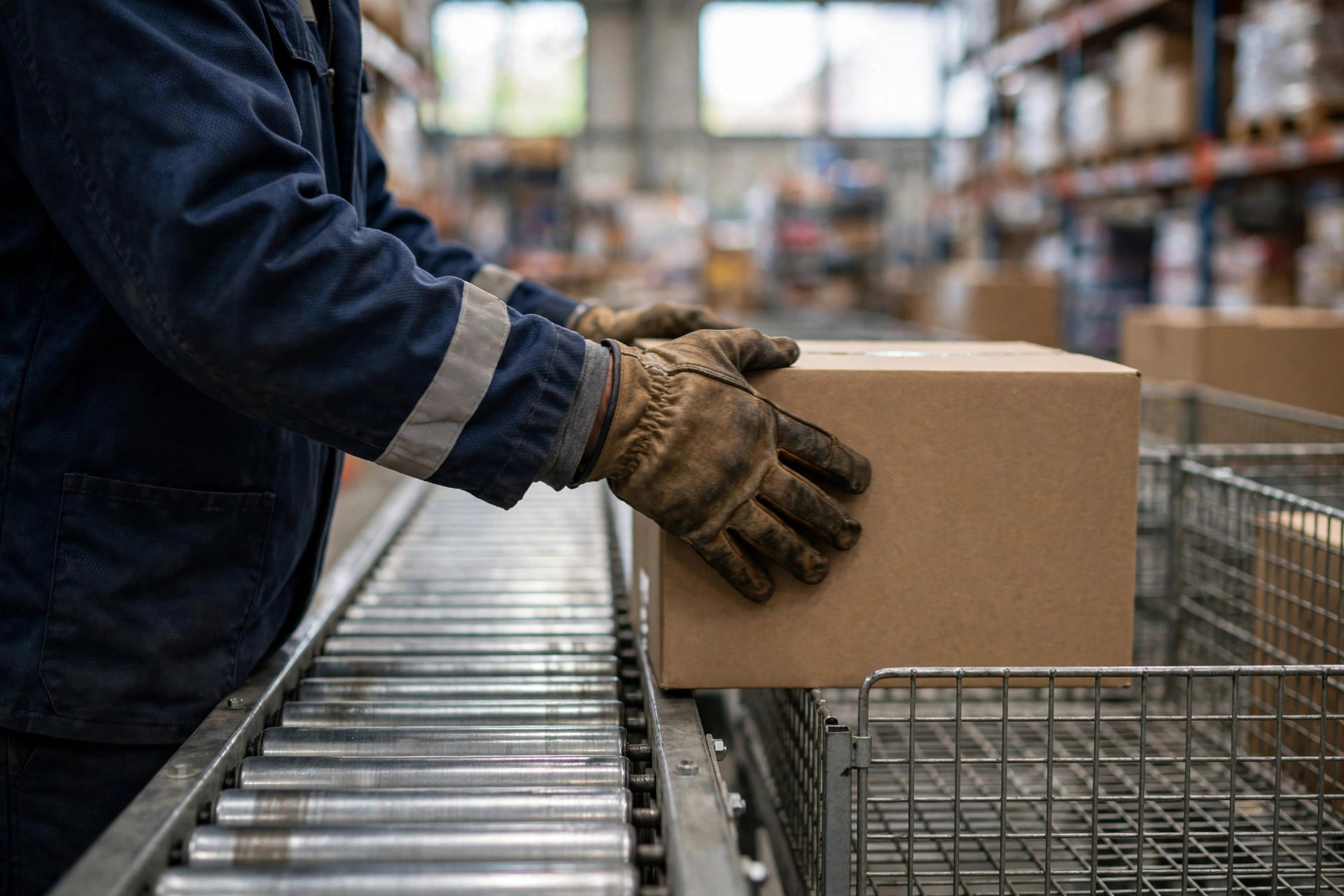
Total damage: forty-odd leveling feet, a truckload of shims, two old hands for two days — under $300. Chen's $11,000 solution, done our way for $300. And here's what happened next.
After we fixed the height: backs stopped hurting, cartons moved faster
First week after the adjustment, my sort lead told me: "Boss, the girls stopped complaining about their backs." I figured, fine, no complaints — just don't let throughput drop.
Then the numbers slapped me. In a good way. We'd been running 350–400 pieces per person per hour. After the fix: a steady 450, spiking past 500 on peak days. Last Singles' Day, five people held that line and peaked at 26,000 pieces in a day — a volume that used to take seven people on rotating shifts. Same headcount, no broken backs, and we clocked out on time.
Why? No more bending. The divert motion went from a four-step "bend-grab-stand-place" to a two-step "reach-push." Saving a second or so per piece across 2,000 pieces a day buys you more than half an hour.
The real money was retention. Three quitters in three months before the fix; zero in the six months after. Training a decent sorter takes at least two weeks, and having nobody trained right before peak is the stuff of nightmares. Mis-sorts dropped too — bent-over workers get bleary-eyed by hour eight and mis-divert; standing upright, they don't. Do your own math on that.
| Option | Upfront cost | Install | One height per person | Real-world result | | Manufacturer's fixed standard | $0 (comes with the line) | None | No | Luck of the draw — comfortable only if you're the "right" height | | Redneck zone-by-zone adjustment | ~$300 | 2 days | Yes | No more back pain, throughput up a notch | | Adjustable feet ordered with a new line | A few hundred per meter | None | Yes | Same as the redneck fix, best for new lines | | Full powered lift retrofit | $11,000+ | Line shutdown | One height per section | Expensive, and still can't serve five heights at once |
The counter-intuitive part: fix warehouse conveyor belt height before you touch speed
Here's a judgment that might ruffle feathers: most small warehouses obsess over raising belt speed from 1.0 to 1.5 m/s when they should fix the height first.
We ran the comparison with the same crew. Speed 1.0, height 800, old setup: 380 pieces per person-hour. Height fixed, speed untouched: 450. Height untouched, speed raised to 1.3: barely 400 — and jams went up 20%. The data doesn't lie: that speed gain isn't worth the jam-clearing it costs you.
And the starker comparison: the big-company powered lift, $11,000, adjusts "one section." Our $300 redneck job adjusts "every person." Automation solves the line's problem; height solves the human's problem. A small warehouse can't out-spend the big players on equipment. But out-caring them on the humans? That we can afford.
The big-company playbook — ergonomic assessments, custom lift stations — isn't for us, and that's fine. Small warehouses have their own way of surviving: a tape measure, some shims, leveling feet, $300 solving an $11,000 problem. That's our lane.
Four things I'd tell any fellow small-warehouse owner: first, if you're ordering a new line, spec adjustable feet — a few hundred per meter beats retrofitting later, the classic spend-a-little-save-a-lot. Second, don't put up with an old line; two days of zone adjustment in the slow season cures both back pain and hiring pain. Third, measure the palm-heel, don't eyeball it — that 140mm gap hides inside "feels about right," and measuring takes ten minutes. Fourth, recheck quarterly; shims and feet loosen, and a half-hour retighten beats starting over. And fifth — expensive isn't the same as right. What's right is what fits your crew.
By Xiao Ma, Small Warehouse Owner