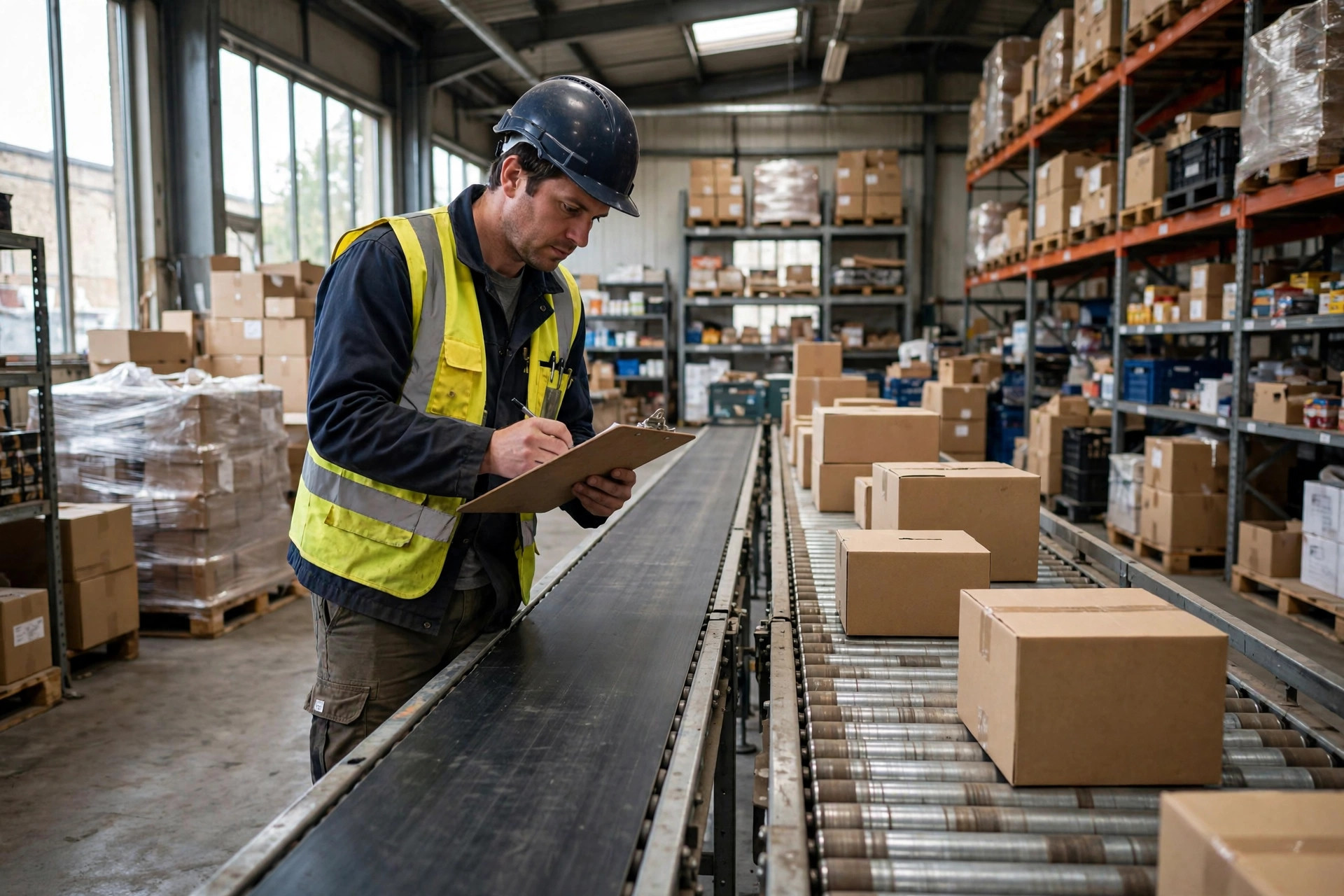
Here's the uncomfortable truth: nine times out of ten, when a conveyor line goes down, the motor isn't dead. It's one of three things — a jammed carton, a drifting belt, or somebody hit the E-stop. And most of the time, the fix isn't a repair. It's resetting in the right order, or having designed the line so the fault couldn't happen in the first place. Your conveyor isn't losing to failures. It's losing to people.
Think of it like a flat tire on a road trip. An experienced driver swaps it in ten minutes; a rookie stands on the shoulder calling for rescue. The difference isn't the car — it's whether anyone knows the drill. Here are all three faults: why they happen, how to reset them, and how to mistake-proof them.
Jams: The Carton Was Doomed Before It Ever Got Stuck
Start with the physics. A carton on a roller conveyor moves on friction between the rollers and the box bottom — you can think of it as the carton being nudged forward by the rollers underneath. Flat bottom, even weight, and it tracks beautifully. Give it a collapsed bottom, an oversized box, or cartons packed nose-to-tail, and the script is written. It will jam at a 90-degree transfer, a merge, or an incline — always one of the three.
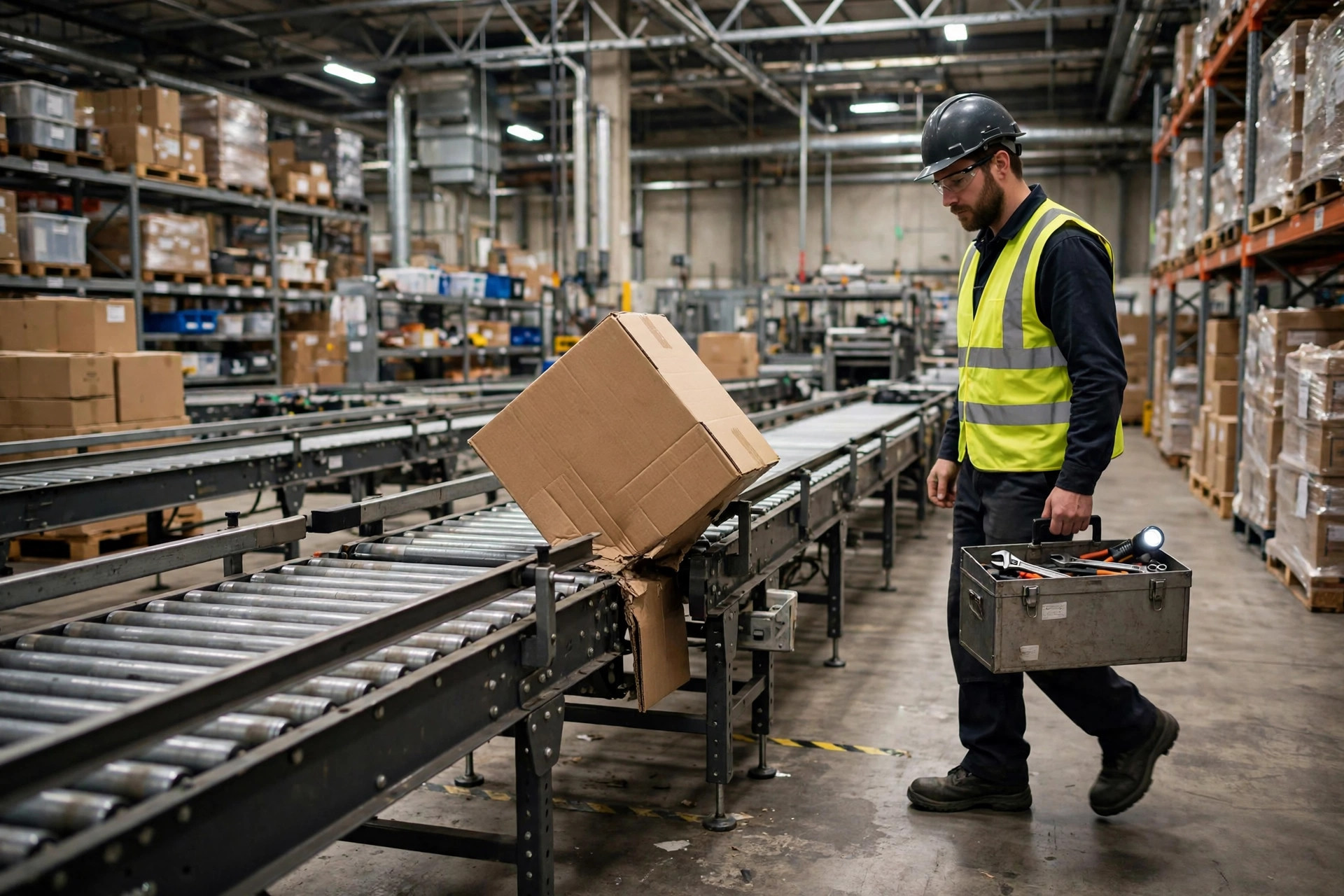
Fall 2023, a 3PL warehouse outside Dallas handling home goods, mid peak-season prep. A 24-by-16-by-20-inch carton jammed hard at a 90-degree transfer — the corner wedged into a roller gap, and the harder the rollers turned, the tighter it locked. The sort line sat dead for over 40 minutes; that shift shipped 600-plus fewer orders. The post-mortem found three root causes: the carton had gotten damp and its bottom caved in; someone had desensitized the upstream photo-eye after false trips, squeezing carton spacing from one full carton length to half; and the transfer had no flared guide plates, so a slightly skewed carton went straight into the roller gap.
A jam is never bad luck. It's three conditions lining up. The reset drill, in order:
- Hit the nearest E-stop and lock out the section. There may be a dozen cartons stacked behind the jammed one — reaching in under power is sticking your hand in a tiger's mouth.
- Clear cartons downstream to upstream, one at a time. Reverse it and they wedge tighter.
- Find the cause, not just the carton. Deformed box? Swap it. Debris in the gap? Clean it.
- Jog the section empty, listen for anything abnormal, then restart in normal sequence.
Remember: resetting isn't getting the carton out. It's getting the cause out.
Belt Drift: It Warned You Two Months in Advance
Belt drift is simpler physics. A belt runs straight only when tension is balanced on both sides. One side goes slack, buildup cakes onto a pulley, a return roller tilts — and the belt walks toward the slack side. Like a bicycle with a crooked handlebar: don't correct it, and it steers itself into the ditch.
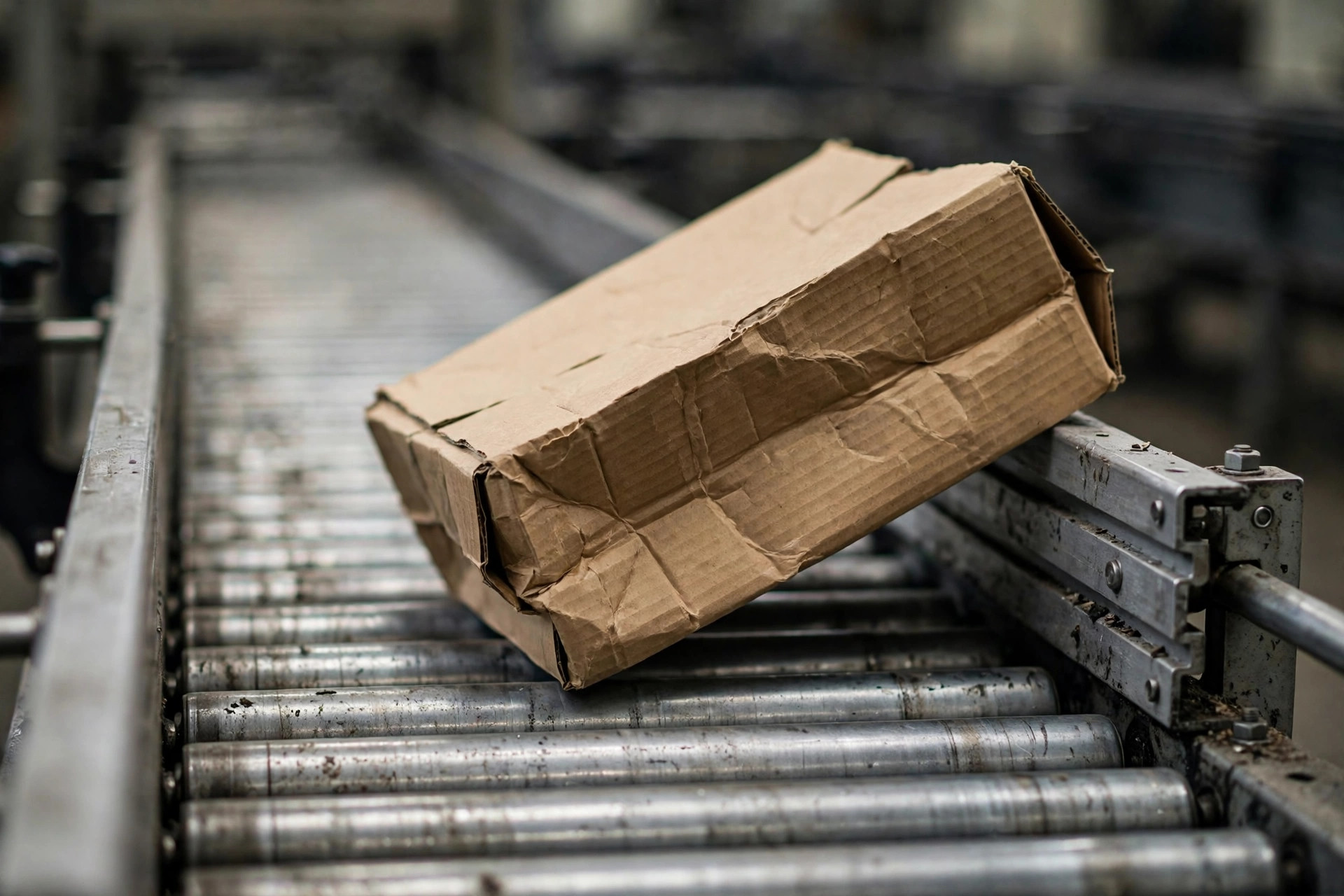
Early 2024, an apparel e-commerce warehouse in Ontario, California. A 100-foot belt conveyor started drifting, and the operators' fix was to jam a pry bar against it daily to nudge it back to center. They ran it like that for two months. Then the belt edge frayed through and the whole belt was scrap — new belt plus a vulcanized splice, one full shift of downtime, damage in the low tens of thousands. A pair of belt misalignment switches would have cost a tenth of that.
Drift never happens suddenly. It gives you a two-month warning window, and five minutes a day adjusting return rollers and scraping pulley buildup would have closed the case. The floor check: look at the gap between belt edge and frame. If one side's gap is visibly half the other's, adjust it today.
Mistake-proofing: one misalignment switch at each end of every belt section, wired to alarm and stop the line when drift exceeds a few centimeters. The Ontario story tells you whether that money is well spent.
After an E-Stop, Don't Just Hit the Green Button
The E-stop is the most misunderstood device on the floor. Someone hits it, the problem gets cleared, someone else walks up and slaps the green start button — and bang, a second incident.
Why: an E-stop is a hard brake. The drive locks, motors drop power. But the cartons don't vanish. Boxes sit stalled on the incline, cylinders freeze mid-stroke. Starting cold is like dumping the clutch on a loaded truck halfway up a hill.
I watched it happen in 2022 at a food distribution warehouse in Phoenix during a project I was leading. An operator hit the E-stop to pull a foreign object; the shift lead hit start directly. Cartons on the incline slid downhill and smashed a set of photo-eye brackets. A five-minute recovery became a two-hour repair.
The reset sequence, five steps, in this order: confirm ("clear" called out loud, not eye contact), twist out the E-stop to reset it, walk the line (no tools, no people, cartons where they belong), jog each section empty, then restart downstream-first so upstream cartons have somewhere to go.
A design-side dividing line: if your line runs longer than about 100 feet or crosses two work zones, don't wire one "slap stops everything" circuit — zone your E-stops. Why should pack-out die because sortation hit a button? Zoned E-stops cost almost nothing at design time; retrofitting starts in the thousands.
And when people ask about "AI vision jam prediction," my answer is blunt: fix your photo-eye spacing, install the guide plates, wire the misalignment switches first. If the mechanical and electrical fundamentals aren't done, no AI saves you. That's a textbook pseudo-requirement — high-tech vocabulary covering low-level problems.
Mistake-Proofing and Maintenance: Make Faults Rare, and Cheap When They Happen
Mistake-proofing in one sentence: don't test people — take human hands out of the failure chain. The math I walk customers through:
| Measure | One-time cost | Loss it prevents |
|---|---|---|
| Flared guide plates at transfers/merges | A few hundred dollars | One 40-minute jam shutdown |
| Jam current monitoring + auto-stop on timeout | A few hundred dollars | A burned-out motor, a damaged section |
| Misalignment switches, both belt ends | One to two thousand dollars | One scrapped belt + a full shift down |
| Zoned E-stops (at design time) | Almost nothing extra | Half the line dying for one mistake |
| Infeed height limit + oversize photo-eye | One to two thousand dollars | Cascading losses from a locked sorter |
On jam physics: a stalled motor pulls several times its rated current, and heat builds exponentially. A current module that stops the drive after a few seconds of stall means the motor can't burn out — like the breaker in your house, which trips so the house doesn't catch fire.
Maintenance — three things you don't cheap out on. Clean roller and pulley buildup monthly; caked rollers are where drift starts, and half a day of cleaning beats a new belt by two orders of magnitude. Check belt tension quarterly — belts stretch, slack belts drift, and the take-up adjustment takes ten minutes. Test E-stops and safety circuits monthly: press it, confirm the stop; reset it, confirm the run. Cost is zero, five minutes of time — and it keeps you clear of OSHA fines and injuries.
So is the money worth it? Look at one number: your unplanned downtime hours over the past 12 months, times your cost per hour — idle labor plus late-order penalties — against the left column of that table. If the retrofit costs less than half a year's downtime losses, it's worth it. Every warehouse I've run that math for, nine times out of ten the answer is "you should have spent it already."
By Da Liu, Automation Engineer