
At 7:40 on a Tuesday morning, a parcel sort line in an e-commerce warehouse in eastern China stopped dead half an hour into the shift. Operators had reported a rhythmic clunk for two days. Nobody acted. When the covers came off, one roller bearing had seized, the roller had stopped, and the belt had ground against it for two days until it wore a groove and tore at the splice. If you have ever searched for a conveyor preventive maintenance checklist warehouse teams can use, this is the problem it is supposed to prevent: maintenance is not about fixing what already broke, it is about catching what is about to break.
What a Conveyor Actually Wears Out: The Physics First
A conveyor looks simple, and wear happens in exactly four places: belt, roller, bearing, motor. Think of it like a car tire and wheel bearing. The tire wears against the road, the bearing wears in the turning itself, and when one seizes, the whole vehicle pays.
The belt wears on two surfaces: the friction face against rollers and pulleys, and the splice. Too loose, and the belt slips while cartons stand still. Too tight, and you load the bearings and motor with extra force that shortens their lives. Rollers wear in rotation: a roller is supposed to turn with the belt, and the moment one stops, it becomes sandpaper grinding one spot for hours. Bearings wear in the raceway and the grease: grease ages, dust and water get in, and the bearing runs hot, then noisy, then seizes. Motors wear through load: a gearbox short on oil, an overloaded line, constant stop-start cycling, current climbing with temperature.
You can think of it this way: conveyor preventive maintenance is not about keeping equipment clean. It is about converting wear from a surprise into a forecast: hearing the bearing two weeks before it seizes, spotting the groove a month before the belt wears through.
A Conveyor Preventive Maintenance Checklist Your Warehouse Will Follow
Most checklists fail because they read as pious generalities. What does check the belt mean? Looking for fraying at the edge, splice separation, and tracking drift past a finger-width. Every line item needs a pass-fail test, or the inspection is theater.
| Interval | Inspect | How to judge | If it fails |
|---|---|---|---|
| Daily | Belt tracking and damage, unusual noise, wrap-around debris on rollers, dust on photo-eye sensors | Walk the line before startup, eyes and ears | Stop and re-track if drift is out of limit, clear debris immediately, wipe sensors |
| Weekly | Roller rotation, belt tension, splice condition, chain tension, guard fasteners | Spin every roller by hand, flag any that do not turn; check tension against the deflection figure in the manufacturer manual | Replace seized rollers the same week, set tension to the manual figure, never by feel |
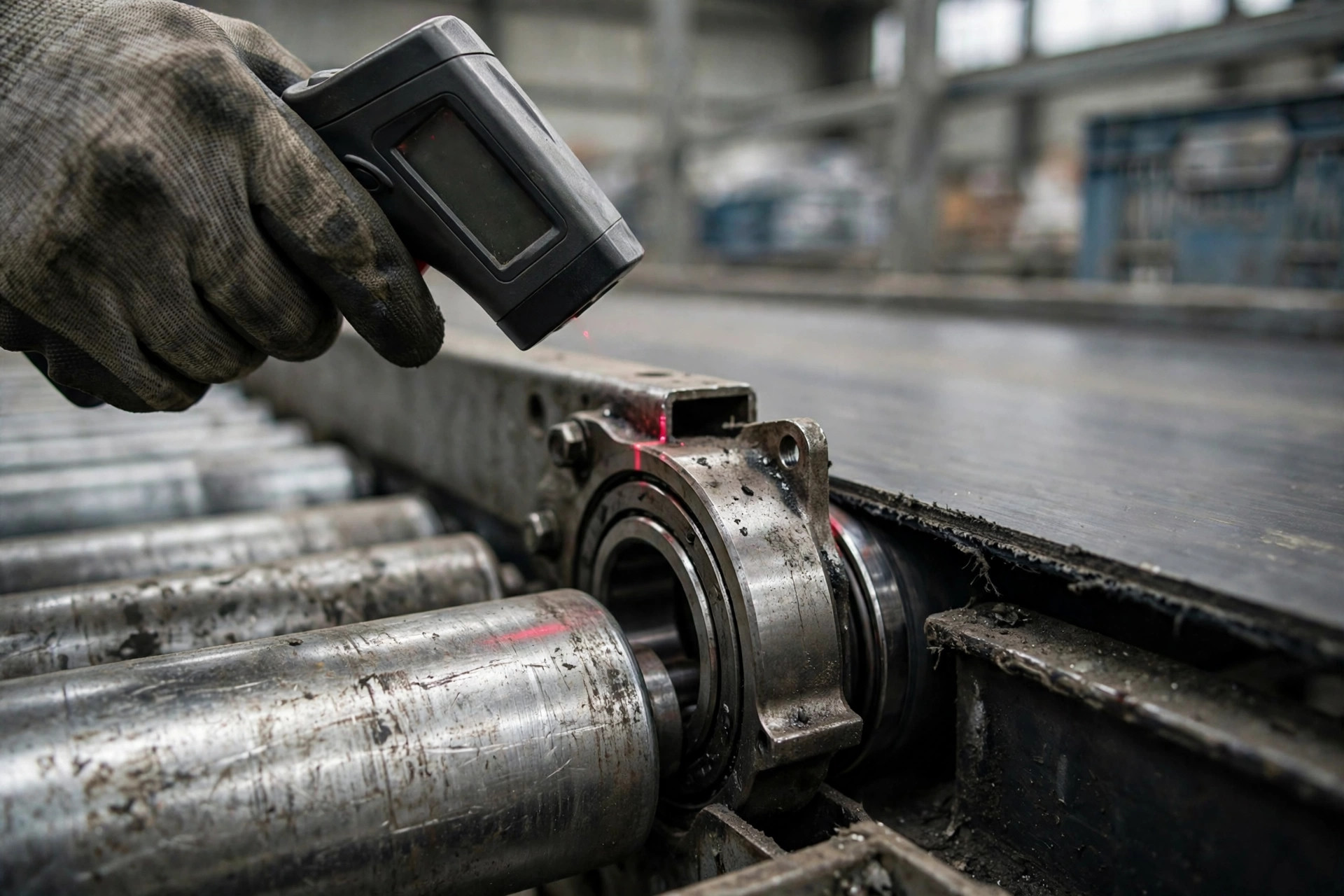
| Monthly | Bearing temperature and noise, motor current, gearbox oil level, full-line cleaning | Compare temperatures roller to roller in the same section, any outlier gets flagged; read current against the motor nameplate rating | Hot bearing means check lubrication and seals first, abnormal current means check load and gearbox first |
| Quarterly | Belt wear measurement, roller runout, motor insulation, full-line no-load run | Measure belt thickness loss, watch roller wobble, test insulation per the manufacturer manual | Replace at the manufacturer wear limit, do not wait for a break |
The dividing line: daily checks catch emergencies, weekly catch trends, monthly catch hidden defects, quarterly catch end of life. Plenty of warehouses run daily checks only, which is how small problems walk all the way to a line-down event. Daily checks find problems by luck; weekly and monthly checks find them by system.
Conveyor Preventive Maintenance: Replacement Standards for Belt, Roller, Bearing, and Motor
Belt: splice separation, edge fraying, surface cracks joining into a network, or tracking that drifts again right after adjustment. Any one puts the belt on a replacement countdown. Tracking gets one mention here and no more: it is an inspection item, and if adjustment will not hold, the root cause is usually a roller or tension problem. A new belt alone will not fix that.
Roller: will not turn by hand, makes noise when it turns, has a worn groove in the shell, or has a loose bearing cap. One strike and it goes. Rollers are the cheapest part on the line and the most likely to be deferred. One seized roller can destroy a belt, and that math never works in your favor.
Bearing: runs noticeably hotter than its neighbors in the same section, makes a gritty sound or a periodic click, or shows axial play you can feel by hand. One strike puts it on the replacement list. Judge against the upper limit in the manufacturer manual; the back of your hand is a screening tool, not a verdict.
Motor: current persistently above the nameplate rating, abnormal temperature rise, gearbox leaking or oil gone dark, or a visible shudder on startup. Half of motor problems are really load problems: check load and gearbox before blaming the motor.
Two Real Lessons, Both Bought With Two More Days of Waiting
Lesson one comes from an e-commerce warehouse in eastern China, a week before a peak sale. Operators reported a rhythmic clunk from one section three times. Each time the shift lead listened, shrugged, and said it could wait until after the peak. On the fourth morning the bearing seized, the roller stopped, the belt ground in one spot for hours, wore through, and tore at the splice. The line stopped for most of the shift while the crew replaced more than a dozen rollers and a section of belt, and backlogged orders moved by hand. After that, the warehouse moved roller checks to twice a week and changed roller spin checks from sampling to every single roller.
Lesson two comes from a 3PL warehouse in northern China, last winter. A lift motor drew more current than usual. The electrician blamed the cold and heavier loads, tweaked a drive parameter, and moved on. Two weeks later a gearbox oil leak showed up. Inside, the oil was dark and down to roughly half its level, and the gears were badly worn. The overhaul took days, during which the line ran at reduced speed. The lesson is blunt: abnormal current is not a parameter problem, it is the load sounding an alarm. In a monthly check, current is about the trend, not just whether anything tripped.
Three Pitfalls That Eat Maintenance Budgets
Pitfall one: replacing the belt without checking the rollers. This is the classic pseudo-fix: the belt is worn, so you buy a pricier imported belt, while the seized roller stays exactly where it was, and the new belt wears a groove in no time. I will say it straight: if you do not replace the rollers, any belt you buy is wasted money. Spin every roller in the section before you hang a new belt.
Pitfall two: treating grease as a cure-all. A noisy bearing gets grease, too much grease squeezes past the seal, picks up dust, and accelerates wear. Some bearings are sealed and maintenance-free, with no grease fitting at all, and forcing grease in only damages the seal. Before greasing, read the manual: does this bearing take grease, which grease, how much.
Pitfall three: a filled-out checklist mistaken for an inspection. The classic fake: every roller row checked off, and nobody ever bent down to spin one. The cure: the checklist must record criteria and actual readings, failed roller numbers, temperature comparisons, current readings. A sheet of checkmarks does not count.
The Counterintuitive Part: Downtime for Maintenance Is Not a Cost, It Is the Price of Uptime
Most people cost maintenance by what goes out the door: spares, labor, half a shift of downtime. They skip the other side: during peak, half a shift of downtime means manual carrying of backlogged orders, late penalties, customer complaints, usually an order of magnitude larger than the maintenance itself. And there is a difference in kind: maintenance downtime is downtime you choose, at a low point you pick. Breakdown downtime is downtime the equipment chooses, usually the day before peak.
The decision framework is one line: grade each line by importance. Lines running at full load on a high-frequency cycle get the full weekly and monthly treatment, no shortcuts. Low-frequency backup lines can fold the monthly check into the quarterly one. The grading standard is not how new the line is, it is whether you have a fallback when it stops. No fallback means top-grade maintenance.
Is the money worth it? Look at one number: unplanned downtime hours. If maintenance is working, that number falls and the money is well spent. If it does not move, your inspection sheet is theater.
By Da Liu, Automation Engineer