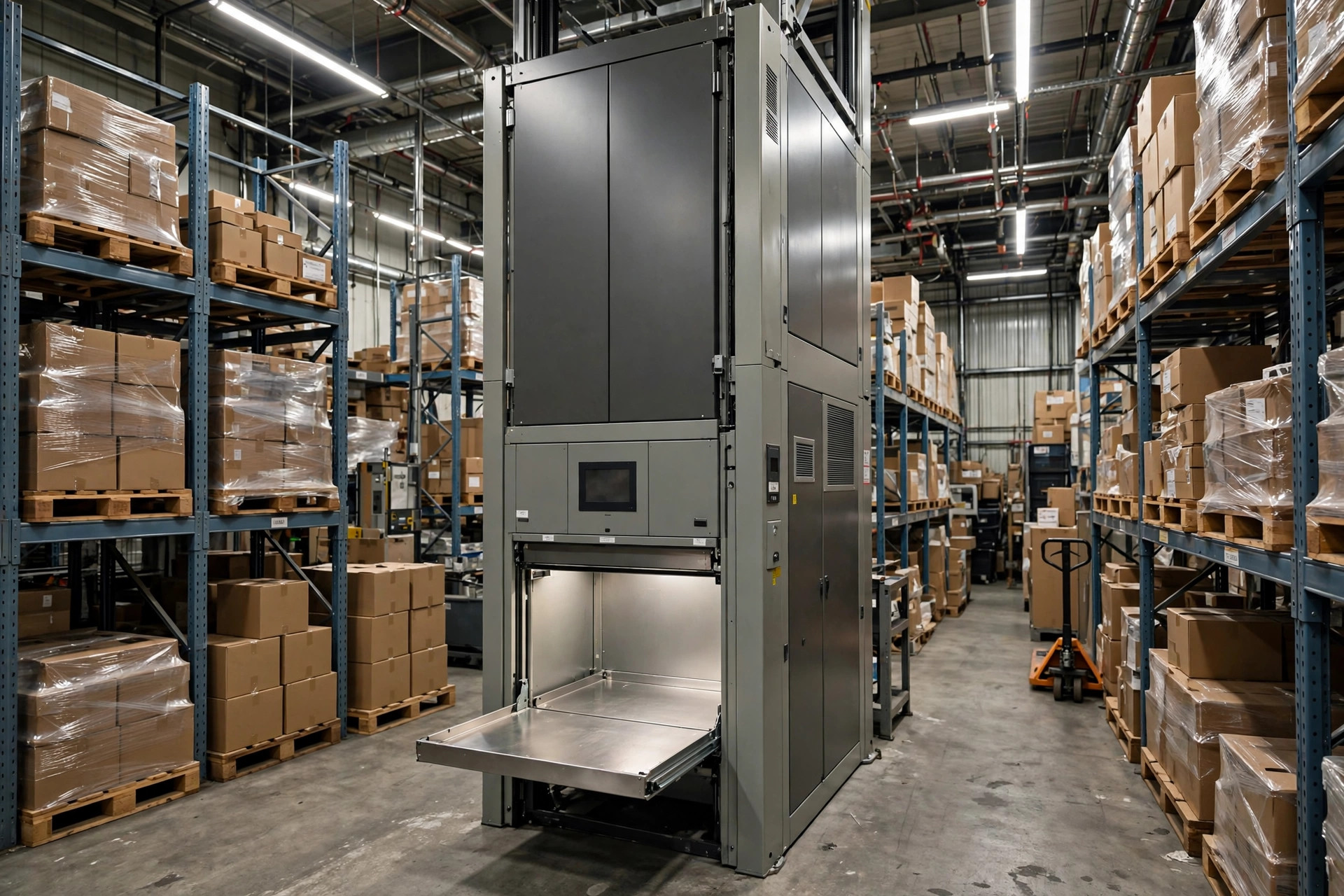
Principles first, money second. A stacker crane's wire rope is the elevator cable of your warehouse: the carriage — several hundred kilos of platform plus payload — hangs on a few ropes running up a 20-plus-meter mast. Elevator cables have safety gears; if a crane carriage drops, it takes out the racking and the goods below. In June 2025, a big e-commerce warehouse in eastern China lived it: a hoist rope snapped on a double-mast stacker crane, the carriage fell from 14 meters, crushed three rack bays, and the aisle sat dead for 11 days. Direct losses topped ¥1.2 million — not counting peak-season orders that never shipped.
The post-mortem was brutal: the rope had been due for replacement months earlier. Inspection logs showed 14 broken wires within a 6-diameter length two months before the failure — past the discard line. The call at the time: "looks okay, let's push through peak season." Wire-rope fatigue is invisible. By the time you can see it, you're already late.
A word on rope construction, so the standards make sense. In 6×36WS, "6" is six strands, "36" is 36 wires per strand, and "WS" is Warrington-Seale (mixed thick and thin wires) — flexible, bend-tolerant, the default for crane hoist ropes. The core comes in fiber (FC) or steel (IWRC): fiber is lighter and cheaper but crushes under sustained pressure; steel costs 20–30% more and buys a higher breaking-force grade. For tall, fast cranes I generally recommend steel core — past 20 meters of lift height, the rope's own weight starts rivaling the payload, and fiber cores collapse under it. Think shoelace versus climbing rope: both are "rope," completely different load logic.
Discard Criteria: When a Stacker Crane Wire Rope Must Go
Discard standards aren't gut feel — they follow the ISO 4309 / GB 6067 logic, and every crane maker's manual repeats it. Three hard lines to remember:
First, broken-wire count. For the common 6×36WS construction, regular lay: 10 visible broken wires within 6 rope diameters (6d) — discard. 19 within 30d — discard. "Visible" means exposed wire ends you can count with a chalk mark in a 5-minute inspection.
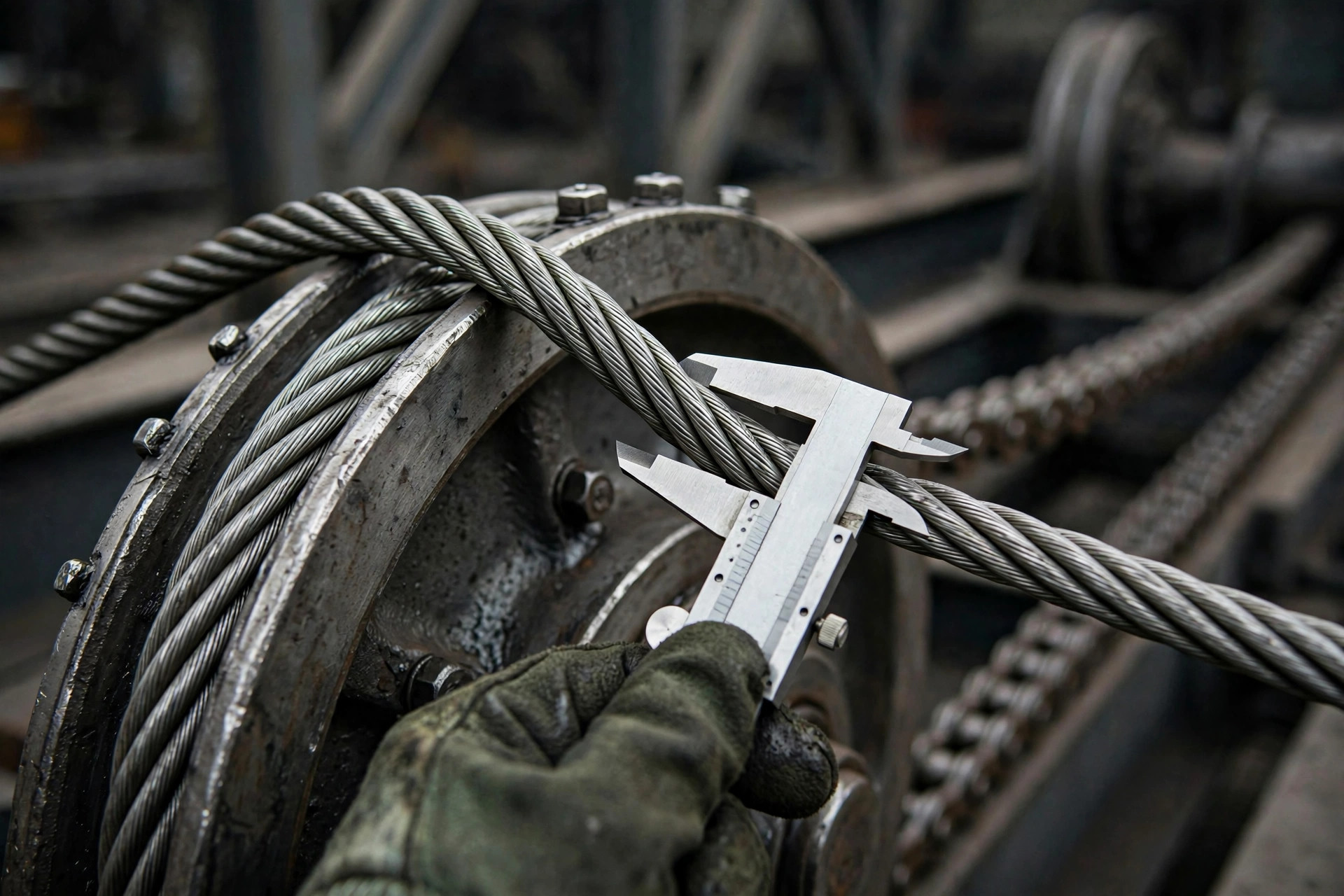
Second, diameter wear. If the rope measures 7% under nominal diameter — discard. A 16 mm rope reading 14.8 mm or less goes straight to scrap. At that wear level the breaking force is already down ~20%, while your load calculations still assume factory values. That's gambling.
Third, deformation. Bird-caging, kinks, strand extrusion, severe corrosion — discard immediately, regardless of wire count. Deformation means the internal structure is already gone; broken-wire counts lag behind it.
Inspection cadence: monthly for high-speed cranes (hoist speed above 60 m/min), quarterly for slow ones. Log three numbers every time: broken-wire count, rope diameter, lubrication state. Plenty of warehouses use inspection sheets with just "OK / not OK" checkboxes — that inspection is theater. Numbers you don't write down can't show you a trend.
Learn to read the three broken-wire morphologies: fatigue breaks have flat, flush ends and cluster at sheave contact zones — the "end of life" signal. Wear breaks look polished flat — check the sheave grooves and spooling when you see them. Corrosion breaks are blackened and crumble at a touch — lubrication has failed or the environment is attacking the rope; change the lubrication program. My rule of thumb: count the wires for quantity, read the fracture faces for cause. Counting without reading faces is taking a temperature without asking about the disease.
A positive case for balance: in November 2025, another crane at the same 3PL warehouse showed broken-wire counts climbing from 2 to 7 over three months — a clear trend. We scheduled a night-window replacement six weeks out for ¥18,000. Had it failed, we'd have been looking at 60-plus times that, going by the eastern China case. The real value of inspection isn't "discovering it's dead" — it's "watching it get worse." That's what trend management means.
Zero-Downtime Replacement: How to Schedule the Wire Rope Replacement Window
The real cost of rope replacement isn't the rope — it's the downtime. One aisle crane down for a day means ~800 pallets not moved; in peak season, a one-day shipping gap takes a week to catch up. So "zero-downtime replacement" is really about compressing the work into a night window.
In March 2026 we replaced hoist ropes on 4 stacker cranes for a 3PL warehouse in northern China using the new-rope-pulls-old-rope method: temporarily join the new rope to the old, inch the crane slowly, and let the old rope thread the new one through every sheave. No sheave disassembly. Six hours per crane — shut down at 10 PM, back online by 4 AM, warming up before the 6 AM shift. Four cranes, four nights, zero daytime impact.
Three prerequisites: one, sheave and drum groove wear must be within limits, or the new rope just wears out faster — measure the grooves before you start. Two, the temporary joint gets a pull test; a joint failing mid-thread is worse than not replacing. Three, post-installation trials: 10 no-load cycles plus 10 full-load cycles, run the full load spectrum, confirm the rope spools evenly.
On spares: wire rope is a spare part, not a consumable — don't order it the day you need it. Lead time runs 3–4 weeks, longer for imported rope. Keep one or two cranes' worth in stock, stored dry and ventilated, standing on end — never stacked flat under pressure, which deforms the strands. On arrival, measure the diameter at three points; out of tolerance goes straight back, no compromises. And don't sell the old rope for scrap immediately — keep a section for fracture analysis first. Fatigue versus wear tells you where to focus the next inspection round.
The Math: Planned Replacement vs. Rolling the Dice
One 16 mm, 120-meter 6×36WS hoist rope runs about ¥2,000–3,000 in material. Four ropes per crane, plus labor, window time, and testing — roughly ¥15,000–20,000 per crane all in. Sounds steep? Compare it to a failure:
| Cost item | Planned replacement (per crane) | Rope failure (eastern China case) |
|---|---|---|
| Direct cost | ~¥20,000 | Racking + equipment repairs over ¥800,000 |
| Downtime | Zero (night window) | 11 days, ~8,800 pallets unmoved |
| Goods damage | None | Full carriage load lost |
| Safety exposure | None | Injury risk, regulatory shutdown |
Planned replacement costs a rounding error next to a failure. And here's the counter-intuitive part: "the rope hasn't snapped, so it's fine" is exactly wrong. Wire-rope life is counted in bending-fatigue cycles, not in "snapped or not." A crane running 16 hours a day with 4 bends per cycle racks up over 500,000 bending cycles a year — the manufacturer's life curve is right there in the manual. Replace on count, like a car timing belt. You wouldn't wait for the timing belt to snap before thinking about the engine, would you?
One more trap: more lubrication is not better. Over-oiled rope collects dust, and dust plus oil becomes grinding paste that accelerates inter-strand wear. The right way is thin and even — twist the rope between your fingers during inspection; you want an oil film you can feel, not oil that drips.
One last shot at a pet peeve: the "smart wire rope" pitch going around lately — sensors embedded in the rope streaming break data live, at 5x the price of ordinary rope. Sounds great, except a crane hoist rope gets replaced once a year and a manual inspection costs five minutes of labor — paying 5x to solve a 5-minute problem is a pseudo-need. Spend that sensor money training your inspectors to read fracture faces instead. Reliable people make for reliable ropes.
So is the money worth it? Watch this one number: your cranes' broken-wire-count-to-discard-line ratio. Above 70%, schedule the replacement now. Above 100% and still running — stop the crane first, then talk. Go pull your inspection logs today. If that ratio isn't in them, your inspections have been theater all along.
By Da Liu, Automation Engineer