Automatic strapping machine selection starts with a number: on the same semi-automatic strapping machine, a skilled operator straps a carton in 6 seconds. A new hire takes 15. Same machine, 2.5x difference. On a packing line, a fully automatic arch machine does one strap in just over 2 seconds. The machine didn't change — the human did. And yet most people's first instinct is "buy a better machine." That's treating a selection problem like a purchasing problem. Most content on automatic strapping machine selection starts with a product catalog. Let's start with your daily carton count instead.
How an Automatic Strapping Machine Works: Three Actions, That's It
Every strapping machine — semi-auto or full-auto — does exactly three things: feed, tension, seal. Think of it as tying a shoelace for a cardboard box: loop the strap around (feed), pull it tight (tension), tie the knot (seal).
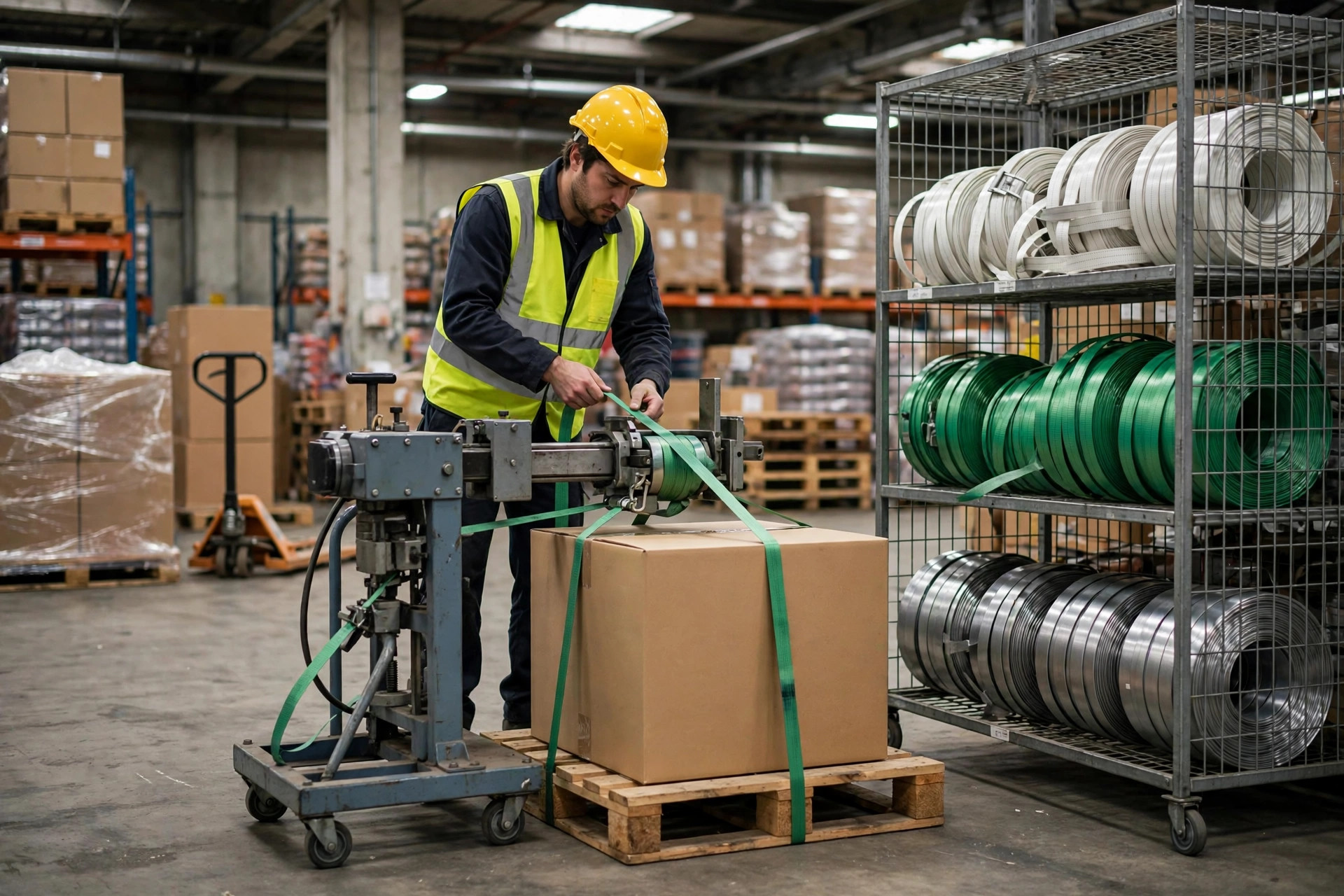
Feed: feed wheels drive the strap into the track. Think of the track as a preset rail the strap follows around the package and back to the sealing head. Tension: the motor reverses, pulls back the slack, cinches the strap. This is where strap tension is set, usually in kilograms — common machines adjust across roughly 5–70 kg, but check the manufacturer's latest specs. Seal: a heater blade (or friction head) melts the overlapped strap and presses it together, then a cutter trims it. Three variables decide the weld: temperature, pressure, time. Miss one and the joint fails.
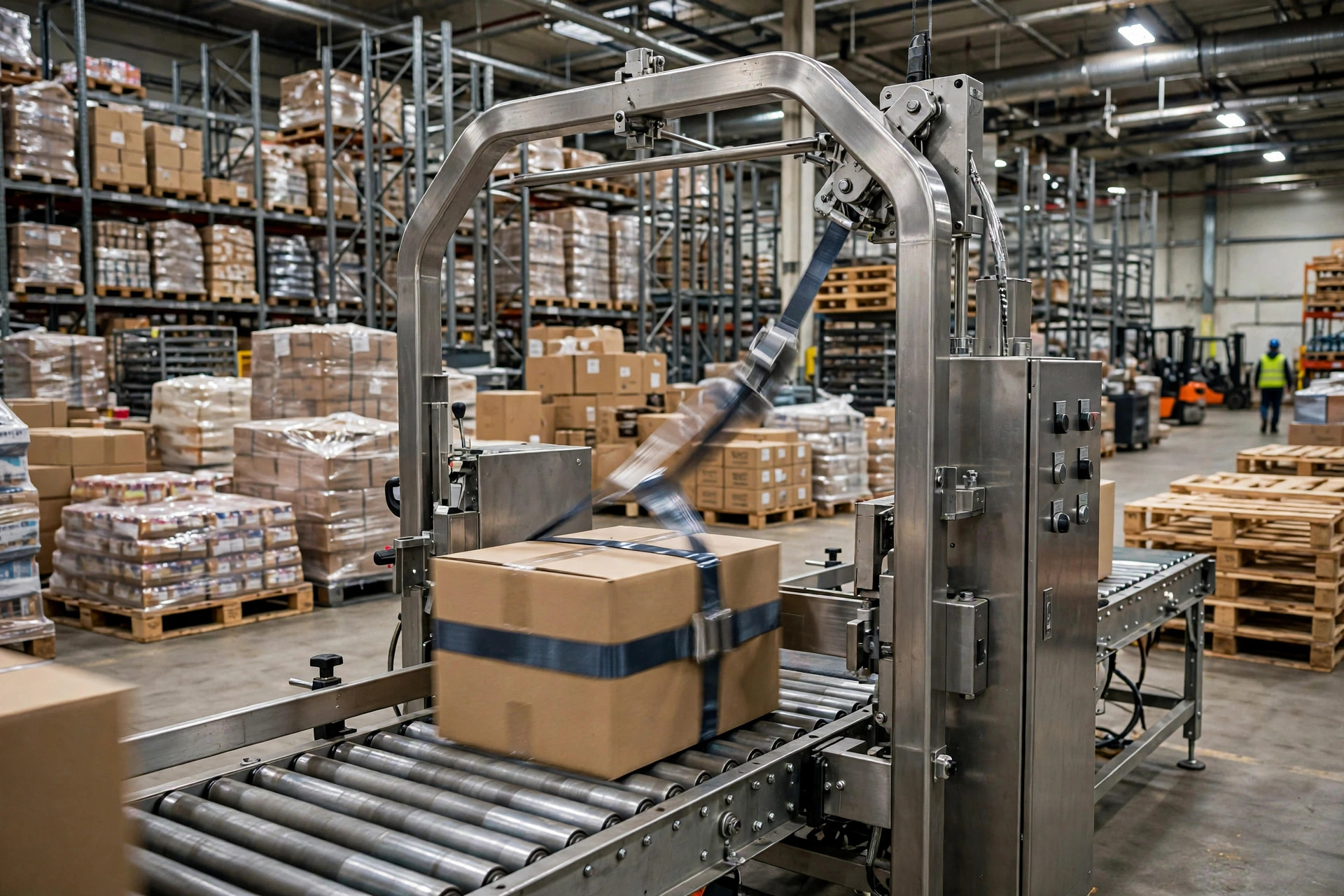
The only real difference between semi-auto and full-auto is whether a human does the "loop the strap around" step. Semi-auto: you thread the strap end around the package and back into the head; the machine tensions and seals. Full-auto (arch machine): strap sits pre-loaded in the arch track; the package arrives, the track opens, the strap cinches automatically. Hands never touch it.
Automatic Strapping Machine Selection: Where the Line Falls — 300 Cartons a Shift
Think of it like buying a car: commuting vs. driving for a living — the job decides the spec, not the budget.
My line in the sand: under 300 cartons per shift, semi-auto is plenty. 300–800, it depends on your shifts and labor plan. Over 800, full-auto is a must. I didn't guess this — I calculated it.
The math (2 straps per carton, typical industry figures): semi-auto, with manual threading plus machine tension and seal, runs about 6–10 seconds per strap. Two straps means 15–20 seconds per carton — one operator does 180–240 cartons an hour. A full-auto arch machine: place the box, tap the pedal (or let the photo-eye trigger), about 2–2.5 seconds per strap. Two straps, about 5 seconds — over 700 cartons an hour.
At 1,000 cartons a day: semi-auto burns roughly 1,000 × 2 × 8s ÷ 3,600 ≈ 4.4 hours of pure strapping labor. Full-auto: about 1.2 hours. That's 3+ labor hours saved daily. Against a fully loaded strapping-station worker costing roughly $8,000–12,000 a year (varies by market), the $2,000–4,000 premium of a full-auto machine pays back in months, not years.
| Semi-automatic | Fully automatic (arch) | |
|---|---|---|
| Cycle per strap | 6–10 s (incl. manual threading) | ~2–2.5 s |
| Throughput per operator | 180–240 cartons/hr | 700+ cartons/hr |
| Machine price | A few hundred dollars | $2,000–5,000 (standard Chinese-built models) |
| Footprint / install | Tabletop, plug and play | Needs conveyor or roller table; arch size must be specced |
| Best for | <300 cartons/day, mixed sizes | 800+/day, stable carton sizes |
Three Counterintuitive Calls
First: more tension is not better. Nine out of ten strap breaks come from the tension knob cranked to max. People fear a loose strap, so they max it out. Result: crushed carton edges, frayed strap edges, and the seal becomes the weakest point on the whole strap — one bump in transit and it snaps. Start at mid-range: after tensioning, you should be able to nudge the strap 1–2 mm with a finger. The strap's job is to hold, not to strangle.
Second: oversizing the arch wastes money. Arch size = largest package diagonal + 10–15 cm clearance. Done. Go one size up and every strap travels farther — 0.3–0.5 s extra per cycle, tens of minutes a day at volume, plus more strap consumed per box. Measure your biggest carton; don't guess.
Third: cheap strap is the most expensive saving. Off-spec strap with sloppy width tolerance is the #1 cause of jams. Whatever you save on strap, you pay back in downtime clearing the track. Uniform width and clean edges beat 10% cheaper, every time.
Case: A Kunshan 3PL That Went From Daily Breaks to Almost None
Fall 2023. A 3PL outside Shanghai doing fulfillment for a small-appliance brand, 800–1,200 cartons a day. Two semi-auto machines, three operators rotating. The shift lead told me straps broke daily — seven, eight jam-clearing stops a day, 5–8 minutes each. Over an hour of capacity gone, every day, to a single problem.
I walked the line and found all three classic mistakes: tension knob maxed out ("afraid it'll loosen"), heater running so hot the seals came out blackened and brittle, and bargain-bin strap with wandering width.
Three fixes: tension down to just below mid-range, heater down one notch with seal time unchanged, and a switch to dimensionally consistent strap. A week later: breaks dropped from seven-plus a day to two or three a week. They later moved to full-auto, and breaks all but vanished — not because full-auto is magic, but because once the parameters are right, a machine is more consistent than a human.
The Maintenance Pits: 90% of Jams and Breaks Are These Five
Every automatic strapping machine selection conversation should end here, because what breaks in the field decides what you should have bought. Ranked by how often I've actually fixed them:
- Debris in the track (most common). Cardboard dust and strap fragments build up until the strap can't feed. Fix: blow out the track with an air gun weekly. Beats replacing any part.
- Bad strap. Wide tolerance, ragged edges — the feed wheels slip and it jams. When buying strap, check edge consistency first.
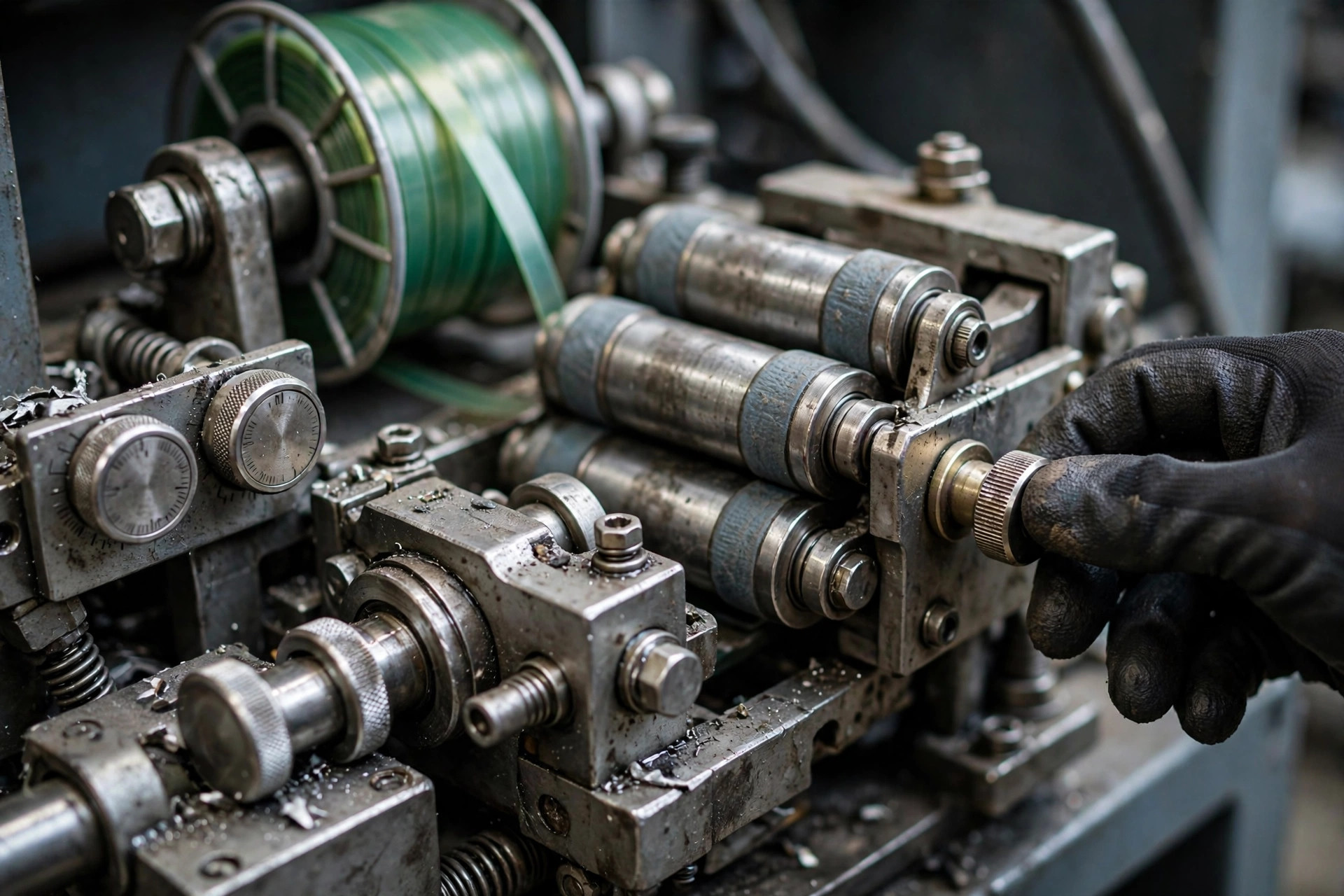
- Worn feed wheels. They're consumables; once the tread goes smooth, they slip. Symptom: strap feeds short or intermittently. A new pair costs next to nothing — don't let it become a rebuild.
- Seal triangle out of balance. Too hot = brittle; too cold = weak bond; wrong pressure or dwell time = peel-apart. Change one variable at a time, never all three.
- Spool loaded backwards. Strap has an inside/outside wind direction; load it wrong and feeding fights you. New operators trip on this constantly. Glance at the threading diagram — thirty seconds.
One more people miss: PET strap hates moisture. Damp strap goes soft, stretch behavior changes under tension, and seal strength falls off a cliff. Don't stack strap by the dock door; use opened coils within the month.
Calling Out a Fake Need: Full-Auto for 200 Cartons a Day Is a Gift to the Sales Rep
Early 2024. A small e-commerce warehouse in Yiwu, ~200 orders a day. The owner insisted on a full-auto arch machine — "looks professional." Machine plus conveyor rework ran over $4,000. Reality: two busy hours each morning, then the machine idled. A year later the feed wheels were dusty and the belts cracking from age, not use.
My math for him: 200 cartons, one operator, two hours on a semi-auto that costs a few hundred bucks and lasts five years. The labor "saved" by full-auto wouldn't cover depreciation in a year. That's buying the sales rep a bonus, not an upgrade.
Flip side: running 1,000 cartons a day on semi-autos to "save money" is fake frugality too — you save on the machine and pay three salaries plus daily jam downtime. Selection follows one formula, not feelings.
Whether the Money Was Worth It Comes Down to One Number: Cost Per Strapped Carton
That's the whole of automatic strapping machine selection in one formula. Ignore the brochure's "300% efficiency boost." Run this: cost per strapped carton = (machine depreciation + strap consumed + allocated labor + downtime losses) ÷ total cartons.
Run it for your current semi-auto setup and for the full-auto you're eyeing. If full-auto comes in 20%+ cheaper per carton, buy it. If it's within 10%, tune your parameters and buy better strap first — squeeze your current machine dry before spending. Machines exist to cut cost, not to look impressive.
By Da Liu, Automation Engineer