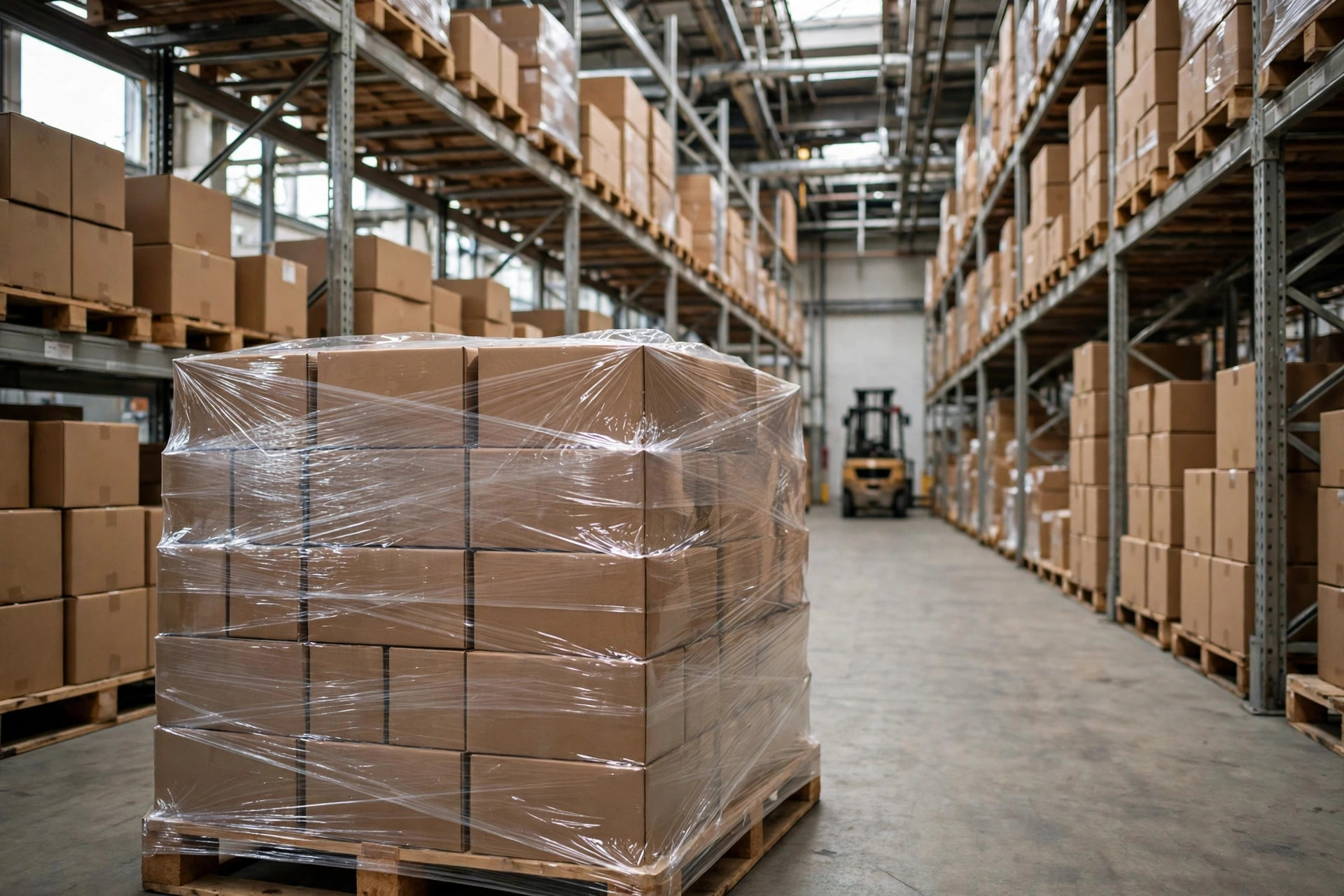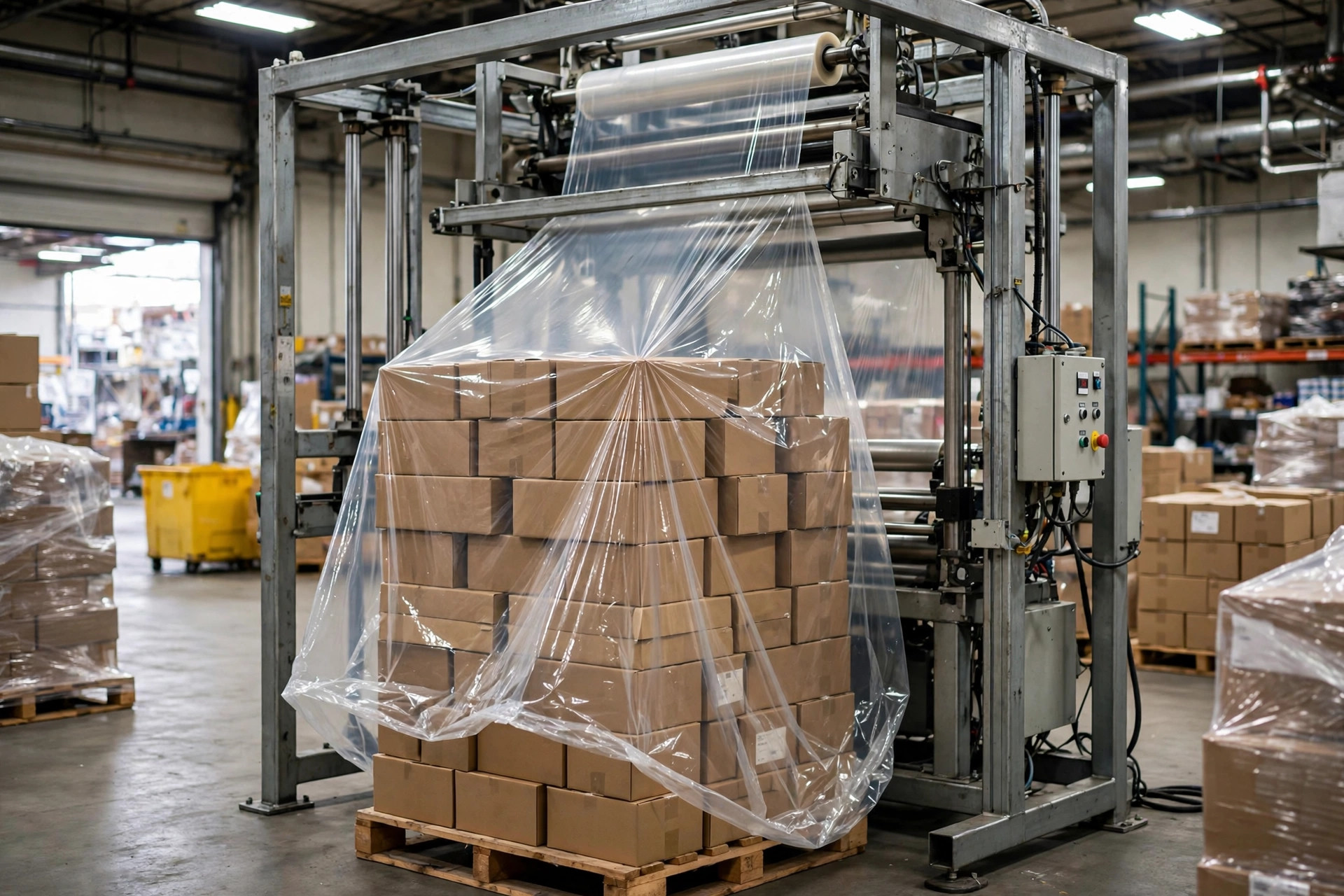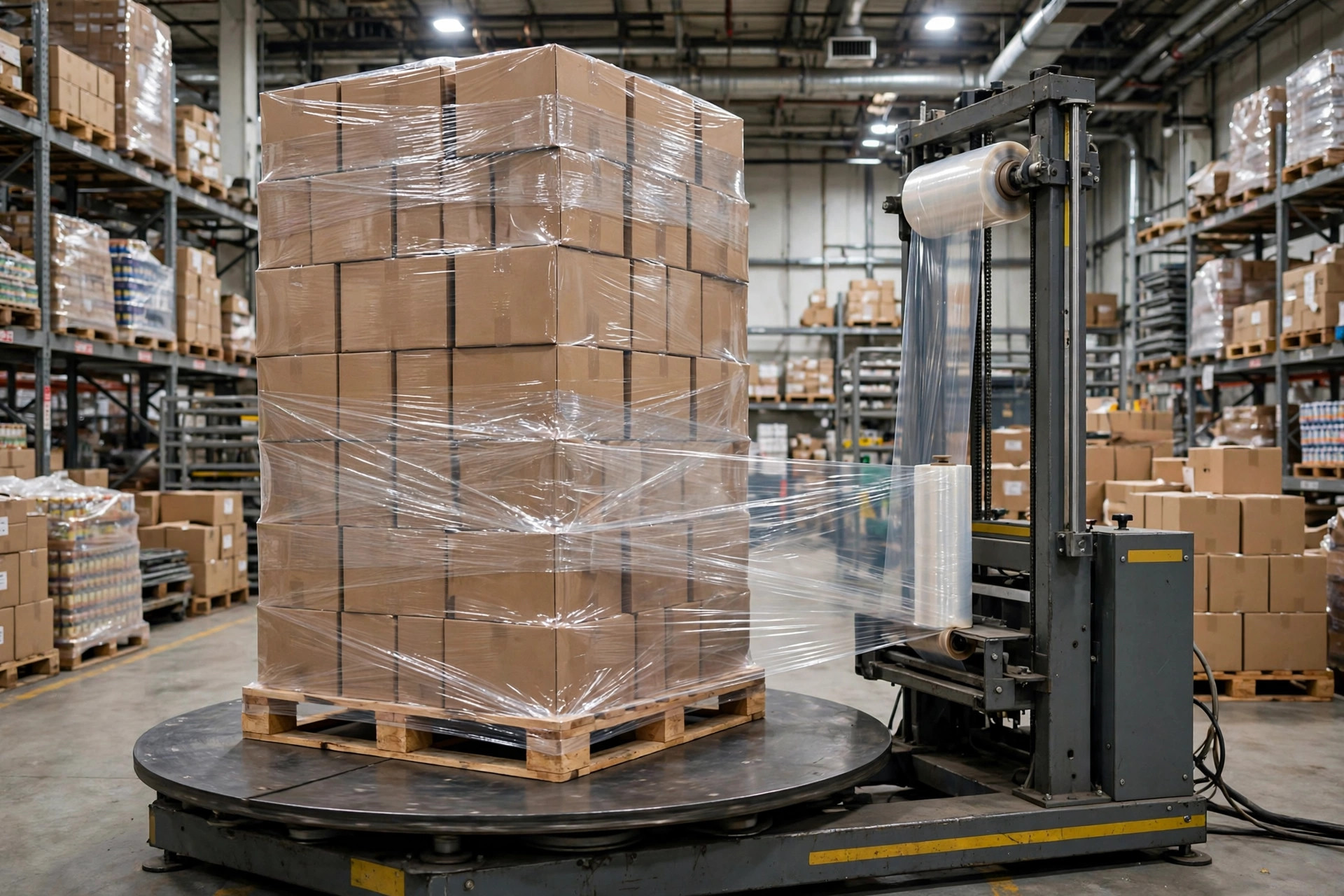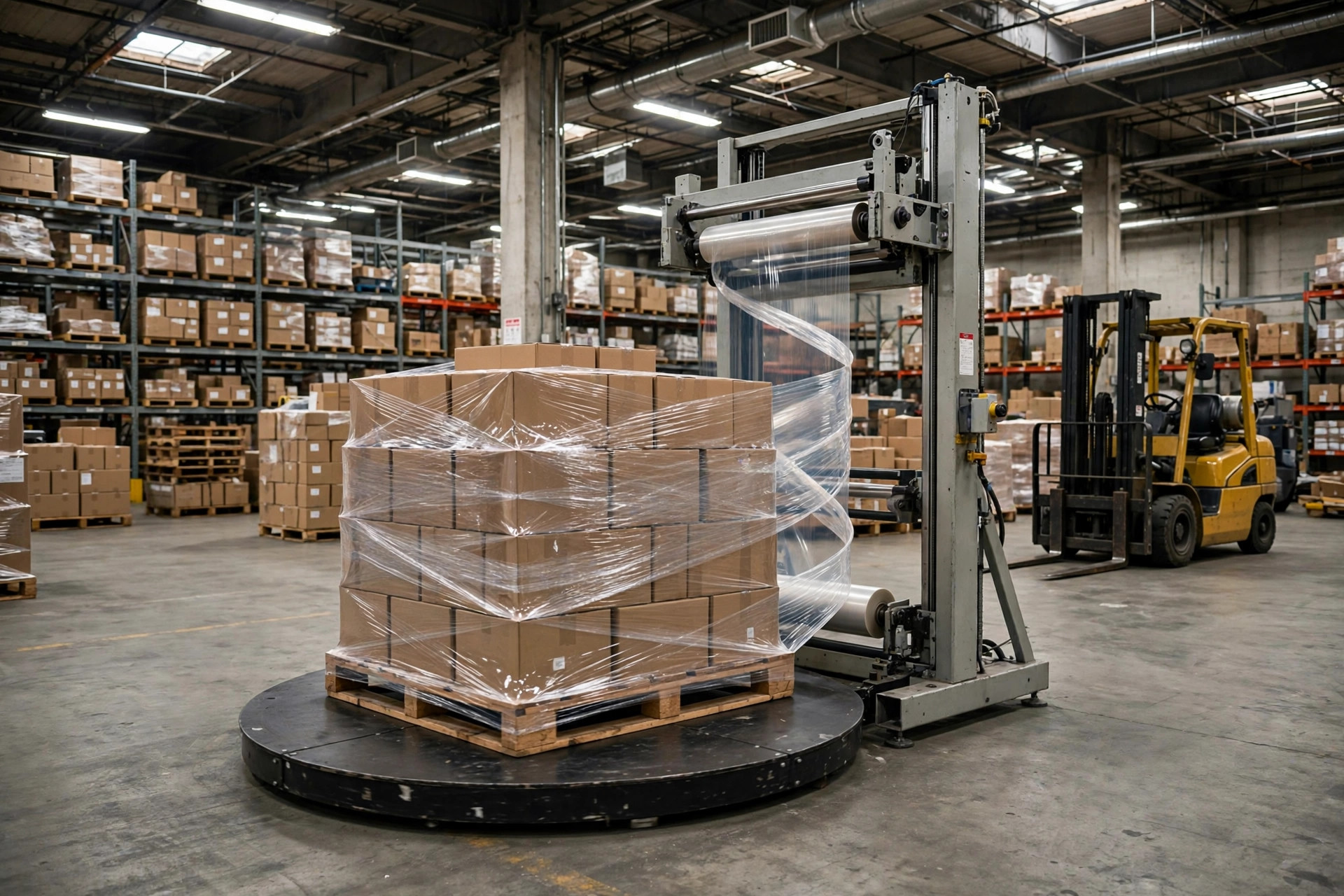
On a research visit to a 3PL warehouse in Foshan, Guangdong, in the fall of 2024, I found myself watching a scene I couldn't walk past: two workers, each holding a roll of stretch film, circling pallet after pallet by hand, about three minutes per pallet. The site manager told me that during peak season the building ships roughly 400 pallets a day, and these two people do nothing else from morning to night. When I returned three months later, a turntable stretch wrapper had appeared in that same corner. Pallet on, button pressed, ninety seconds, and the wrap was visibly more uniform than the hand work.
The stretch wrapper may be the lowest-profile automation device in the warehouse. It lacks the spectacle of a sortation system and the novelty of AMRs, yet according to published estimates from equipment vendors and packaging consultancies, end-of-line wrapping automation is frequently among the shortest payback investments in a facility. This article addresses three questions: how manual wrapping, turntable machines, and straddle (rotary-arm) machines actually differ; where the selection boundary between turntable and straddle lies; and one counterintuitive finding — the money saved on film often exceeds the money saved on labor.
The Three Stretch-Wrapping Options, Side by Side
Let us put the three approaches in one table. The figures below combine published specifications for common machine classes with field-measured values; treat them as representative ranges rather than any single vendor's data sheet.
| Manual wrapping | Turntable wrapper | Straddle (rotary-arm) wrapper | |
|---|---|---|---|
| Time per pallet | ~2–4 min | ~60–90 sec | ~60–120 sec |
| Daily output (8-hr shift) | ~120–200 pallets | ~300–400 pallets | ~250–350 pallets |
| Floor footprint | Near zero | ~4–6 m² | ~8–12 m² |
| Film pre-stretch | ~100% (by feel) | Up to 200–300% | Up to 200–300% |
| Film per pallet (illustrative) | ~120–180 g | ~50–80 g | ~50–80 g |
| Max pallet weight | Unlimited | Typically ~2,000 kg | No turntable limit |
| Max pallet height | Unlimited | Typically ~2–2.2 m | Customizable beyond 2.8 m |
| Capital cost (illustrative) | $0 | ~$4,000–$8,000 | ~$11,000–$20,000 |
The turntable's logic is straightforward: the pallet sits on a rotating platform while the film carriage stays fixed. Simple structure, low price, small footprint — which is why it dominates the installed base. The straddle machine inverts the logic: the pallet stays still while an arm carrying the film roll orbits around it. More complex and more expensive, but it removes the turntable's two physical constraints: the weight limit and rotational inertia.
That inversion is precisely where the selection boundary sits.
Stretch Wrapper Selection: When a Turntable Is Not Enough
Reviewing selection cases, turntables tend to fall short in three scenarios.
The first is overweight pallets. A building-materials distributor in northern China runs pallets at 2,400–2,800 kg, while most mainstream turntables are rated around 2,000 kg; chronic overloading kills the turntable bearings ahead of schedule. In 2023 the site chose a straddle machine — the pallet simply sits on the floor, and the machine imposes no hard weight ceiling.
The second is tall or irregular pallets. Turntable film carriages typically cover up to 2–2.2 meters; beyond that, extended-mast customization gets expensive fast. Straddle machines offer far more room to customize mast and arm travel, and handle pallets above 2.5 meters with ease.
The third scenario is the most overlooked: light but unstable loads. A pallet of empty cartons or foam packaging might weigh only a few hundred kilograms, yet the inertia of a turntable's start and stop is enough to throw the load apart. A straddle machine never moves the pallet, so the problem disappears by design. An e-commerce fulfillment warehouse in Yiwu learned this in 2023: after installing a turntable, light-and-bulky pallets had to run at reduced speed, eating half the throughput advantage. The lesson generalizes — the more varied your pallet profiles, the more important it is to validate the machine against your hardest pallet, not your average one.
The Counterintuitive Math: Film Savings Beat Labor Savings
Most warehouses start this calculation with labor. The data points elsewhere.
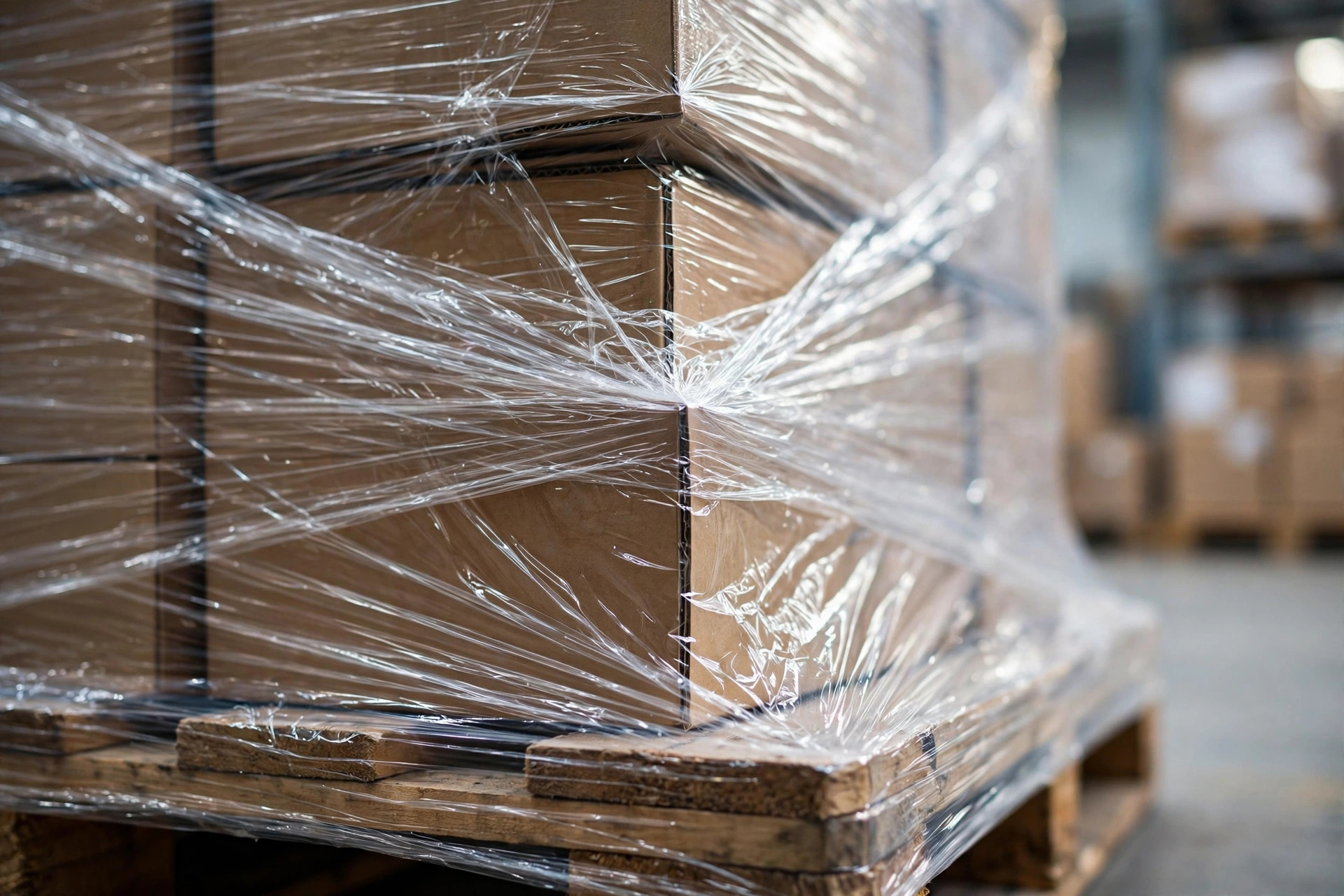
The key variable is film pre-stretch. Hand wrapping stretches film by muscle power, roughly 100% — one meter of film becomes two. A machine's pre-stretch rollers can reach 200–300%, turning one meter into three or four. Consider a mid-size operation as an illustrative model (figures are modeled, film priced at the prevailing purchase price at the time):
- 200 pallets per day, ~150 g of film per pallet by hand → ~7.8 metric tons of film per year;
- At an illustrative film price of about $2.50/kg, annual film spend is roughly $19,500;
- With a turntable running 250% pre-stretch, film per pallet drops to ~60 g, and annual film spend falls to roughly $7,800;
- Film savings alone: about $11,700 a year — more than the $4,000–$8,000 price of an entry-level turntable.
In other words, at 150–200 pallets a day, the machine can pay for itself in under a year on film savings alone, with the labor savings as a bonus. One caveat determines whether this holds: the pre-stretch function must actually be used. I have seen warehouses buy pre-stretch-capable machines and run them for years on the factory-default low stretch setting — paying automation prices for manual-level film consumption. Whoever owns the operation should write "who tunes the parameters, and how often they are rechecked" into the standard operating procedure.
A Decision Framework: When the Upgrade Pays
Synthesizing the data and cases above, here is a coarse decision framework (single-shift operation, standard 1.2 m × 1.0 m pallets; special cases need their own math):
- Under ~30 pallets/day: manual wrapping wins. Capital cost amortized per pallet exceeds labor cost, and hand work stays the most flexible option when pallet profiles vary wildly.
- ~30–150 pallets/day: the turntable sweet spot. By the math above, payback typically lands under a year — the "just buy it" zone.
- Above ~150 pallets/day: turntables still work, but look at mid-range models with automatic film attach and cut, or evaluate whether two machines are warranted; for continuous-flow outbound rather than batched waves, run a time study before deciding.
- Evaluate a straddle machine directly if any of these apply: single pallets exceed ~2,000 kg; pallet height exceeds ~2.2 m; loads are light and vulnerable to turntable inertia; or pallets must enter the wrap station by pallet jack at floor level with no appetite for a turntable ramp.
One more constraint that gets ignored: footprint. A straddle machine needs roughly 8–12 m², about twice a turntable. In an older building with a cramped outbound area, draw the machine footprint on the floor plan before deciding — it avoids the embarrassment of discovering, after delivery, that the turning radius doesn't fit.
The Trend: End-of-Line Packaging Is Being Re-priced
Zooming out: packaging consultancies' published analyses in recent years show the film itself is changing — thinner, higher-strength films paired with high-pre-stretch machines keep pushing film-per-pallet downward. That means the "film saves money" logic strengthens over the next 3–5 years rather than fading.
The other variable is labor supply. Frontline workers willing to do repetitive wrapping long-term are getting scarcer; in interviews, several 3PL operations managers have called the wrap station one of their hardest positions to keep staffed. As the labor supply curve tightens and the film technology curve bends down, the decision weight of this "small machine" is quietly, structurally rising.
So I will end with an open question rather than a conclusion: does anyone in your warehouse know, to the dollar, what you spent on stretch film last year? If that number has never been pulled out and examined on its own, then the whole debate over "whether a wrapper is worth it" may be missing its most important card from the start.
By Dr. Chen, Supply Chain Researcher