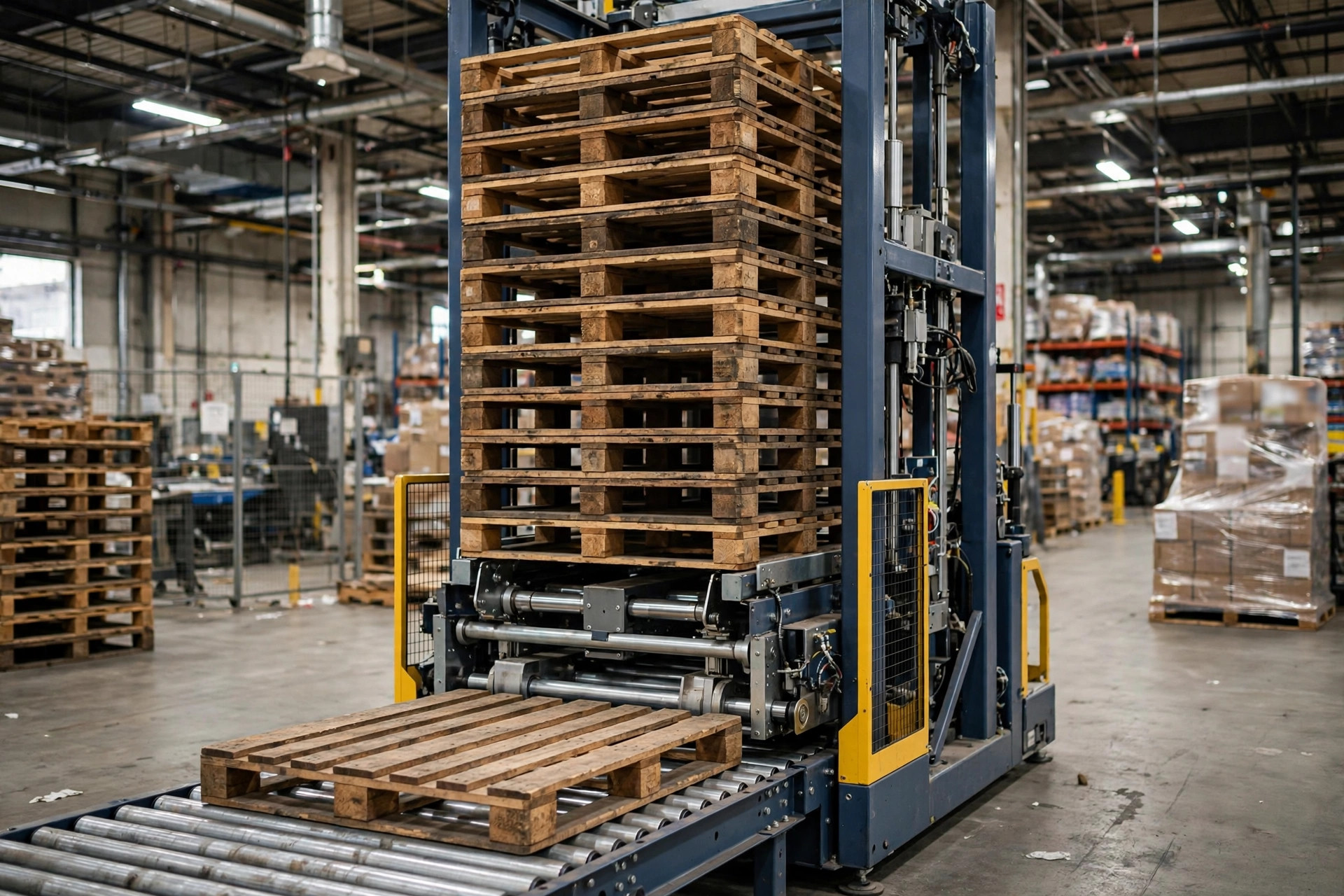
Is a pallet dispenser worth it? I won't make you wait for the answer. Twenty years in U.S. warehouses, and I've seen these machines hailed as game-changers and gathering dust in the corner. The short version: it's a box that spits out empty pallets one at a time from a stacked pile. Whether it's worth it comes down to one number: how many empty pallets you dispense per day. Over 150 a day — roughly 10 full stacks — and the machine usually pays for itself. Under 50 a day, keep doing it by hand. Everything in between, do the math below.
One clarification before we start: this is about empty pallet dispensers, not palletizing robots. A palletizing robot stacks product onto pallets. A dispenser does the reverse — it breaks down stacks of empties, one pallet at a time. Same word "pallet," completely different job. Don't buy the wrong one.
What a Pallet Dispenser Actually Solves
Two problems, neither of them glamorous: breaking down stacks by hand is slow and back-breaking, and tall stacks of empties are dangerous.
I've seen too many warehouses where empties get stacked higher and higher — twenty layers, ten feet tall, leaning like a small tower. In 2019, a 3PL in Indiana running a consumer-goods outbound operation had a forklift driver rush a pickup. His forks clipped the bottom of a 20-high stack, and a dozen-plus pallets slid off like dominoes. A picker nearby couldn't get clear in time. Broken foot, six weeks off. The OSHA fines plus the workers' comp settlement ran into the hundreds of thousands. After that, the warehouse installed its first dispenser — and here's the kicker: the machine only holds 15 pallets at a time. You physically can't build a dangerous stack anymore, because the machine won't take it. The safety problem solved itself by design.
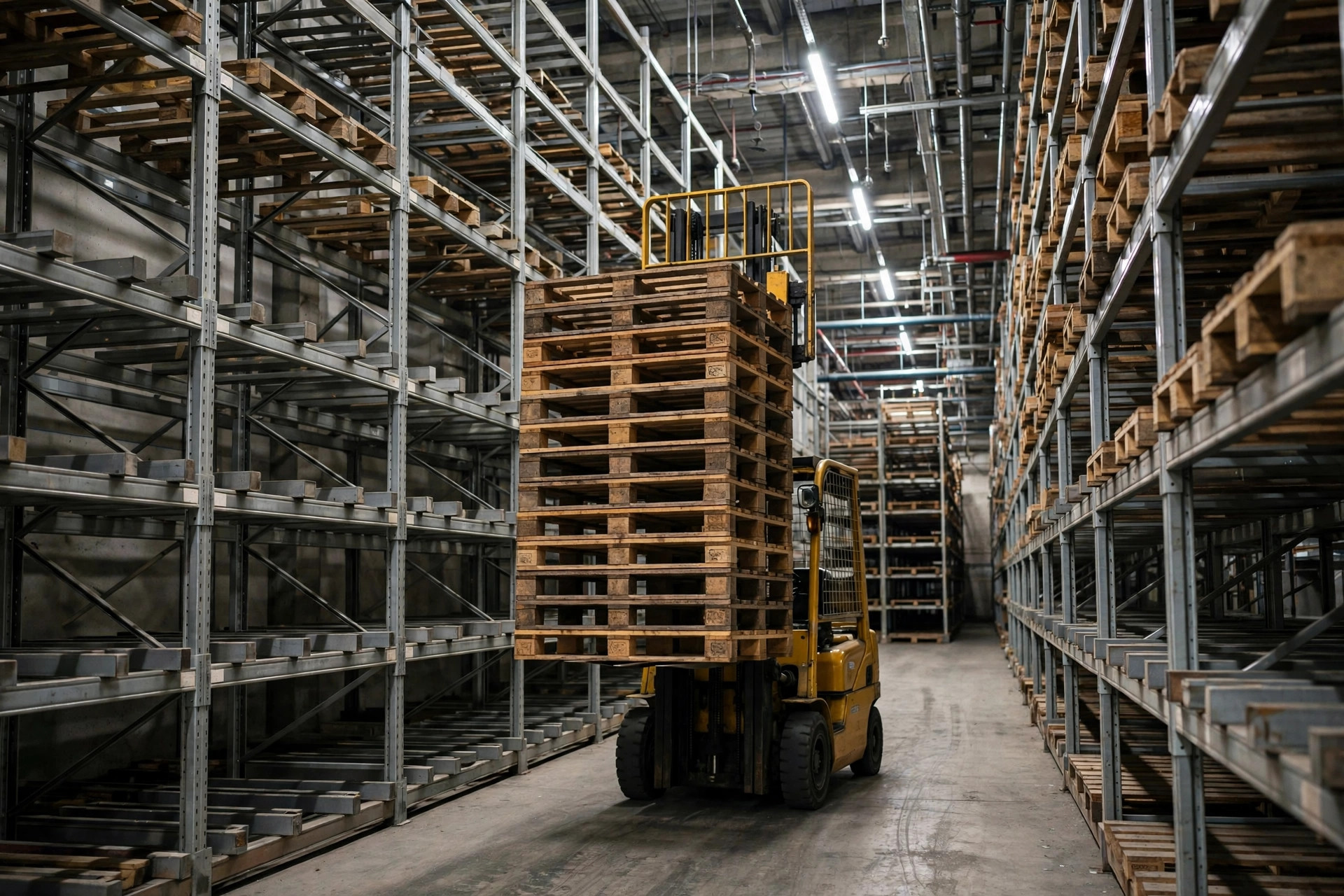
The other problem is labor math. In 2022, a food distribution center in California was dispensing over 300 empty pallets a day during peak season — about 20 full stacks. Two workers did nothing but break down stacks: bend, pull, turn, restack, 25 to 30 pallets an hour each. After a month, one of them quit — backs don't lie. The warehouse bought two semi-auto dispensers. Now a worker just slides a full stack in, and the machine feeds pallets out one at a time. One person runs both machines and still has time for other work. Turnover stopped, and hours dropped.
How Many Pallets a Day Makes a Pallet Dispenser Worth It
Let's run the numbers, using typical U.S. Midwest 3PL rates from the last couple of years:
| Item | Manual / forklift breakdown | Semi-auto dispenser |
|---|---|---|
| Upfront cost | $0 | $20k–$35k (depends on spec and brand) |
| Labor to dispense 200 pallets/day | ~40 sec per pallet (walk 50 ft, return), 200 pallets ≈ 2.2 hrs | One worker covers it, ~0.5 hr actual |
| Loaded labor rate | $25/hr (wages + benefits) | Same |
| Annual labor cost (250 working days) | 2.2 × 25 × 250 ≈ $13,750 | 0.5 × 25 × 250 ≈ $3,125 |
| Annual savings | — | ~$10,600 |
At a $28k machine price, that's a payback in under 3 years — and that ignores injury costs and forklift time. Push volume to 300 pallets a day and payback drops under 2 years. But at only 80 a day, you're looking at 5+ years — the machine ages out before it pays off. Not worth it.
Two sides to this, as always: run it with your numbers, not mine. Your labor rate, your daily pallet count, your operating days. Plug in three numbers and the answer writes itself.
The Contrarian Take: It Saves Forklift Hours, Not Headcount
Most owners buy one to "cut a headcount." I'll be blunt: the real money a pallet dispenser saves is forklift time.
The most expensive single resource in a warehouse isn't labor — it's the forklift. Truck, driver, maintenance, depreciation: $40–$60 an hour all-in. Having a forklift make dozens of trips a day just babysitting empty pallets — shuttling full stacks to staging, dragging leftovers back — is like using a BMW to haul bricks. The dispenser takes that chore off the forklift so it can do its real job: receiving, putaway, outbound. That line item is bigger than the labor savings. And it's why volume is the whole ballgame — the more pallets you move, the more forklift hours get eaten by empties, and the stronger the case for the machine.
Semi-Auto vs. Fully-Auto: The Messier Your Pallets, the Dumber the Machine Should Be
Two sides to this too, and I've seen too many buyers learn it the hard way.
- Fully-auto: spits a pallet every 10–15 seconds, but it's picky. Damaged, warped, or mixed-spec pallets jam it. In a 3PL with pallets coming from everywhere, two or three jams a day means the labor you saved goes right back into unjamming the machine.
- Semi-auto: roughly half the price, and when it jams you just pull the pallet out by hand. Much more forgiving of beat-up pallets. The catch: you still need a person nearby — it saves backs, not headcount.
The lesson that stuck with me: an e-commerce warehouse bought a fully-auto unit, but all their pallets were recycled, with dimensions varying by half an inch. It jammed daily. They ended up running it as a semi-auto and the premium they paid was money down the drain. The decision rule is simple: 2 or fewer pallet specs, low damage rate, high volume → go fully-auto. Mixed specs, lots of recycled pallets, tight budget → semi-auto. The messier your pallet pool, the simpler your machine should be.
When to Just Skip It
There are cases where I'd tell you to keep your money:
- Under 50 pallets a day: that's half an hour of manual work. A machine just buys you a maintenance chore.
- More than 3 pallet specs in mixed use: you'll spend all your time reconfiguring. Standardize your specs first.
- No floor space: the machine needs about one pallet position plus an operating zone. If your aisles are already tight, forcing one in makes things worse.
So — is a pallet dispenser worth it? It's an arithmetic problem with a safety problem attached. Go ask your shift lead one question: how many forklift hours a day go to babysitting empty pallets? Multiply that by your loaded hourly cost, then by your operating days. The answer comes out by itself. The math won't lie to you.
By Lao Mi, Supply Chain Veteran (20 yrs)