Fall 2023, a cosmetics plant in Riverside. The owner had just bought a shrink tunnel at a trade show — over thirty grand — and was thrilled that multipacks would no longer be hand-bagged. First trial run: the POF film either wouldn't shrink tight or burned straight through, and a whole pallet of gift sets went to scrap. I asked what film spec he'd bought. "Whatever the distributor recommended," he said. "The thickest one. Safer." That's the first thing I want to say today: in shrink wrap packaging, thicker film as insurance is an illusion.
The principle: why film shrinks at all
Shrink film is stretched during manufacturing, then locked in that stretched state. You can think of it as a rubber band coated in glue while stretched — add heat, the glue softens, and the rubber band tries to snap back. That's the entire mechanism: pre-stretched molecular chains release stored internal stress when heated.
Two consequences follow naturally. First, the shrink ratio is decided at the factory; tunnel temperature only determines how much of it gets released — you can never release more than the rated amount. Second, the faster and more violently it shrinks, the more unevenly that stress releases, and the more likely you get wrinkles, thin spots, or burn-through. That's why temperature, line speed, and film gauge are a triangle — touch one and you have to adjust the other two. More on that below.
POF vs PVC vs PE shrink films: what actually differs
Three mainstream materials. The table below uses manufacturer-published spec data (shrink temperature ranges from film technical datasheets; shrink rates are typical published values):
| POF (Polyolefin) | PVC | PE (Polyethylene) | |
|---|---|---|---|
| Typical shrink rate | 60–80% | 40–60% | 70%+ |
| Shrink temperature | 130–170°C | 110–130°C | 150–180°C |
| Clarity | High, low haze | High but stiff/brittle | Low, matte |
| Common gauges | 15/19/25µm | 20–60µm | 60–200µm |
| Cost | Highest | Lowest | Mid |
| Food contact | Yes (FDA/EU compliant grades) | Mostly no | Not recommended for direct food contact |
| Typical use | Retail multipacks, cosmetics, gift sets | Stationery, books, non-food small items | Beverage trays, full-pallet water packs, heavy items |
Some straight talk. POF is today's default answer: even shrinkage, good toughness, handles cold well (fine for frozen food, won't go brittle at -50°C) — and it's the most expensive. PVC is cheap but fussy: strong shrink force that's uneven, so it distorts light boxes; it turns brittle in winter and cracks in transit; it contains chlorine, releases toxic gases when incinerated, and many European buyers reject it outright — that Riverside plant switched from PVC to POF precisely because of export orders. PE is brute force: thick, tough, cheap, built for pallet-scale jobs. But don't expect to see what's inside.
The dividing line: heat gun vs shrink tunnel
The question I get most. Here's my line in the sand:
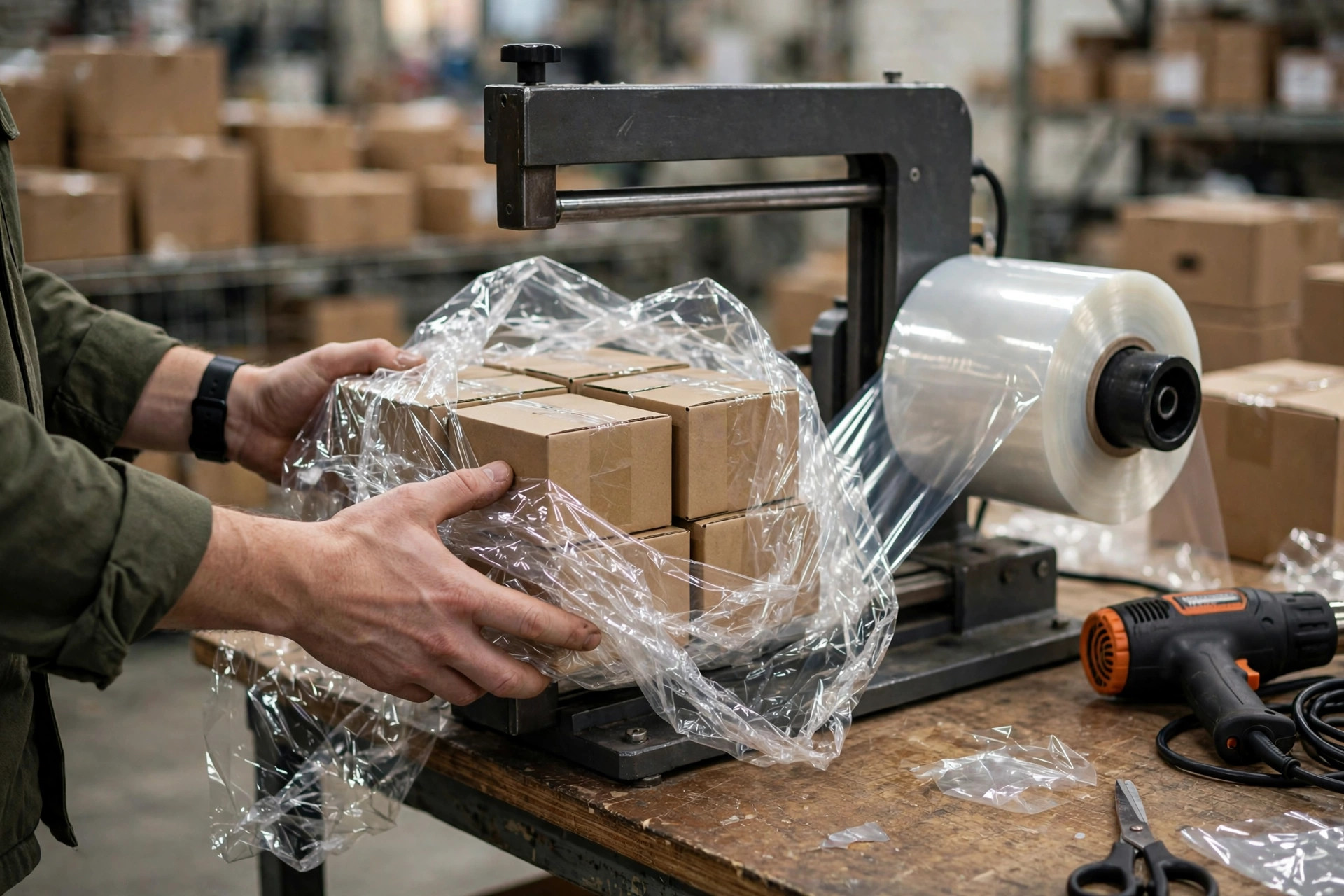
Under ~500 units a day, an L-bar sealer plus a heat gun is enough. A couple thousand dollars in equipment, quick changeovers, an operator learns it in two days. The downside is speed and consistency — the same operator's shrink quality in the morning and the afternoon can differ.
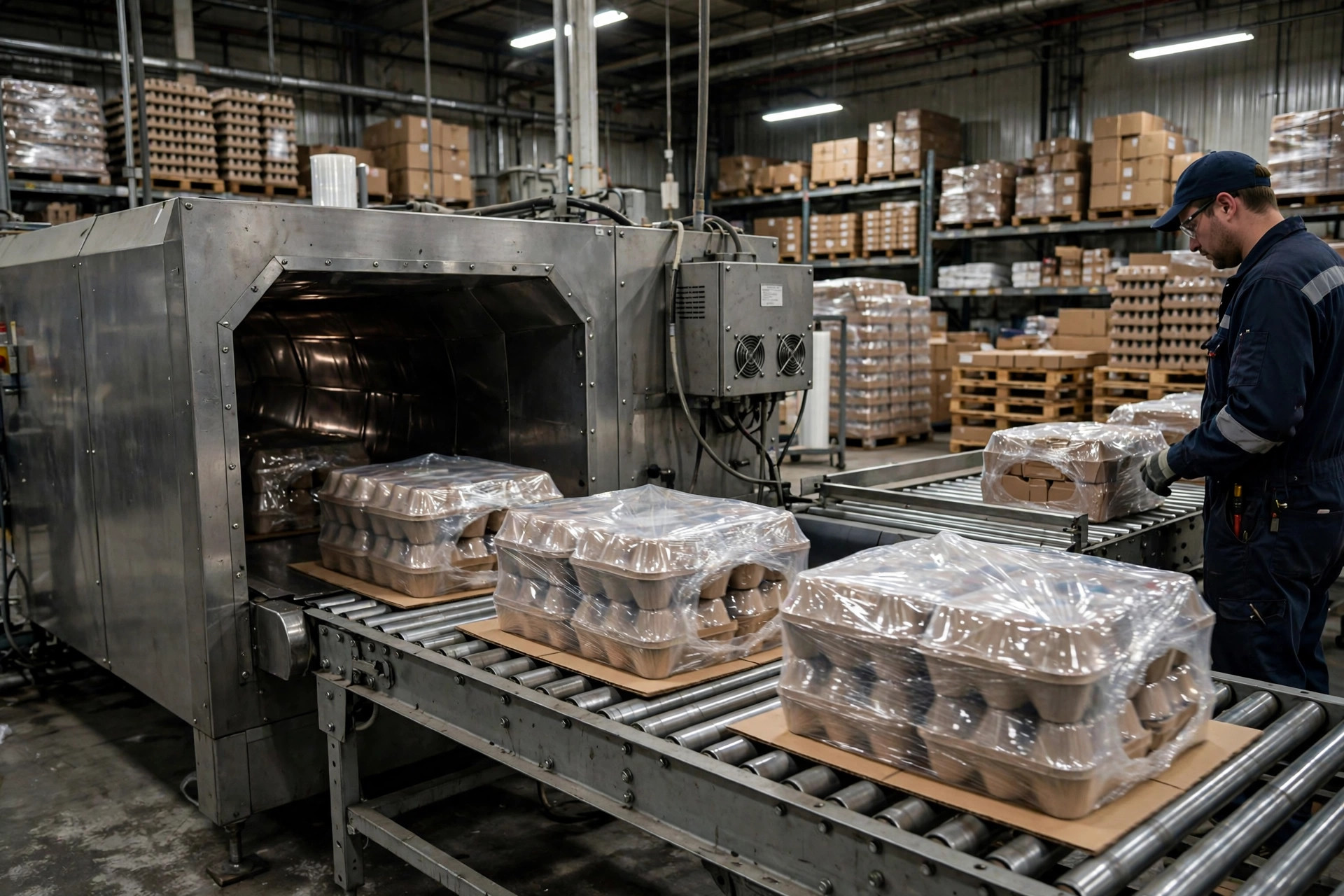
Over ~2,000 units a day with a stable product mix, get a tunnel. The dividing line isn't "do I want automation," it's "can manual consistency keep up." The classic case is promo-season multipacks: three operators rotating on heat guns, 5% defect rate over a week, and rework costs more than the equipment depreciation would have.
Tunnel selection comes down to three parameters: chamber size (each dimension 10–15 cm bigger than your largest pack, to leave room for hot-air circulation), belt speed (typically 0–10 m/min, variable-speed drive is standard), and temperature zoning (dual-zone costs more than single-zone, but thick or irregular packs need it — otherwise the top face shrinks fine and the bottom stays loose).
The temperature–speed–gauge triangle
Back to the principle: shrinking is stress release. High temperature releases it fast, but the film surface shrinks before the core has heated through — wrinkles. Slow the belt, give heat time to penetrate, quality improves, but throughput drops. Thicker film needs more heat to penetrate evenly, so temperature and time both go up, and energy and cost climb together.
So the Riverside problem was obvious: they were running 25µm thick film with the tunnel at the distributor's suggested 150°C low end. The film core never got hot enough while the outer layer was already shrinking — loose packs. Workers cranked the heat to compensate, hit 170°C, and burned through the outer layer. The fix was the opposite of intuition: drop to 19µm film, lower the tunnel to 145°C, slow the belt 15%, and shrinkage went uniform. Defect rate fell from 4% to 1.2% after tuning (that's my measured result from that commissioning, not a universal number).
Another one: a beverage plant in Ontario, 2024. They were pallet-wrapping 24-bottle water trays with 80µm PE film, 3.5% burst rate, and the owner's first instinct was "go thicker." I had him try the reverse: 60µm film, tunnel from 190°C down to 175°C, one notch slower on the belt. A month later the burst rate was 1.1% and film cost was down about 20%. Same physics: thick film demands more heat for even shrinkage; insufficient heat means localized overheating and burst-through. Gauge is a heat requirement, not an insurance policy.
Shrink film vs stretch film: when NOT to use shrink wrap
These two get confused constantly, but they do different jobs.
Heat shrink film is "shape + display": it cinches several items into one sales unit, hugging the product surface, high clarity, ready for the retail shelf. Dust-proof, moisture-resistant, tamper-evident — open with scissors.
Stretch wrap is "transport lock-down": elastic rebound holds the whole pallet to the skid. No heat involved, and the film sits loose around the load. It doesn't care about display; it cares that nothing falls off the truck.
The dividing line is clean: retail multipacks and shelf-ready packs → shrink film; full-pallet transport, anti-toppling → stretch wrap; need both display and long-haul shipping → shrink for shape, then a pass of stretch over it. Don't ask shrink film to survive transport on its own — its puncture and tear resistance are designed for "display," not for forklift vibration. Same logic for cartons: if you need stack strength or large-area branding, shrink film can't replace a box. But for small multi-SKU combos, promo packs, and trial sets where carton tooling and die-cut samples are slow and expensive, shrink film is the cheaper tool.
Maintenance traps: three things people ignore
First, seal-bar carbon buildup. L-bar sealer blades collect film residue; seals turn yellow and leak. Hit it with a brass brush at end of shift — not steel wool, which scratches the blade coating and makes sticking worse.
Second, tunnel temperature drift. Thermocouples drift after about six months; the display says 150°C but the chamber is 165°C. Keep a handheld infrared gun and check the chamber monthly; replace the thermocouple when drift exceeds 10°C. It costs tens of dollars. Don't cheap out.
Third, film storage. POF hates sun and heat. Three months in a 40°C warehouse corner and the shrink rate measurably drops. Store rolls upright, away from light, first-in-first-out. Sounds like a platitude, but half the small plants I've seen stack film rolls right next to the tunnel "for convenience."
Is the money worth it? Watch this one number
Don't compare equipment prices. Compare total cost per wrapped unit: film + energy + labor + rework. Run your current setup and the candidate setup through that math, and the answer usually walks out by itself. The Riverside plant's per-unit cost dropped 11% after the film swap and tuning — the equipment paid for itself in about six months.
Shrink wrap is a one-sentence principle with all the pitfalls hiding in parameter matching. Right film, right temperature, no worship of thickness — and it's a cheap, honest tool. Get the parameters wrong and it's just an expensive oven.
By Da Liu, Automation Engineer