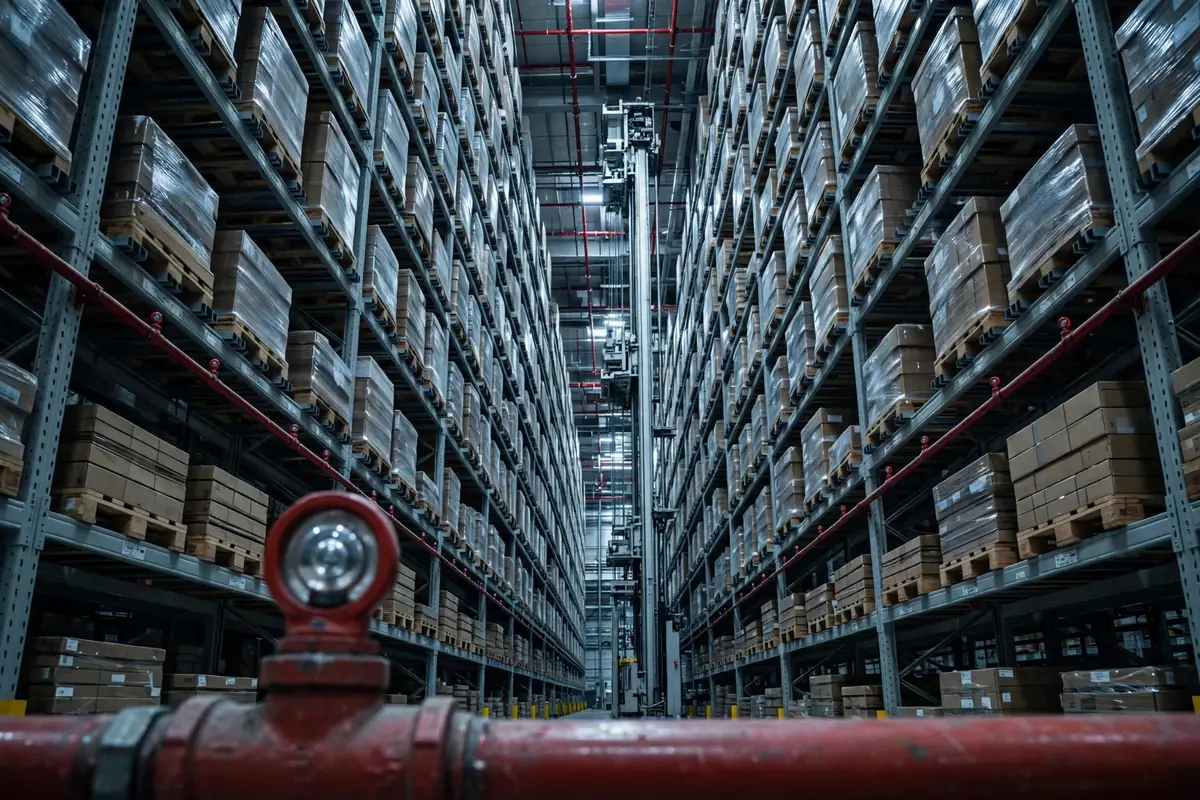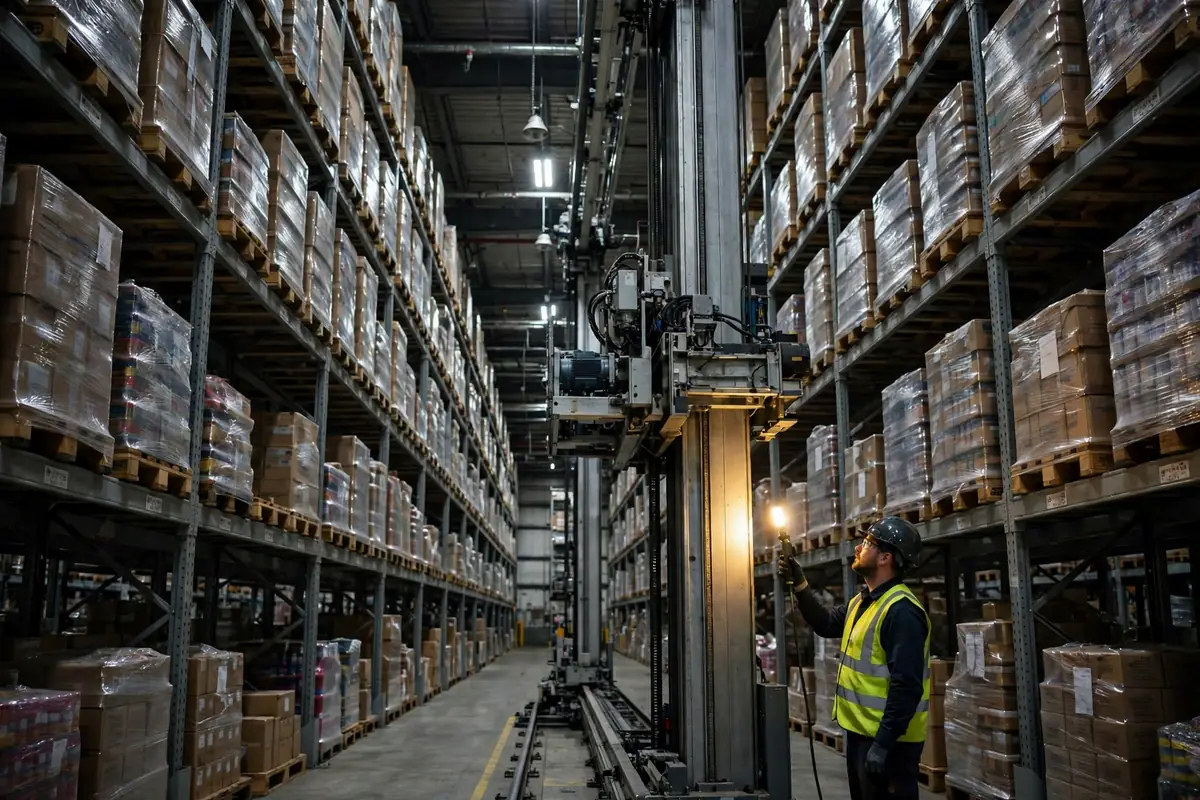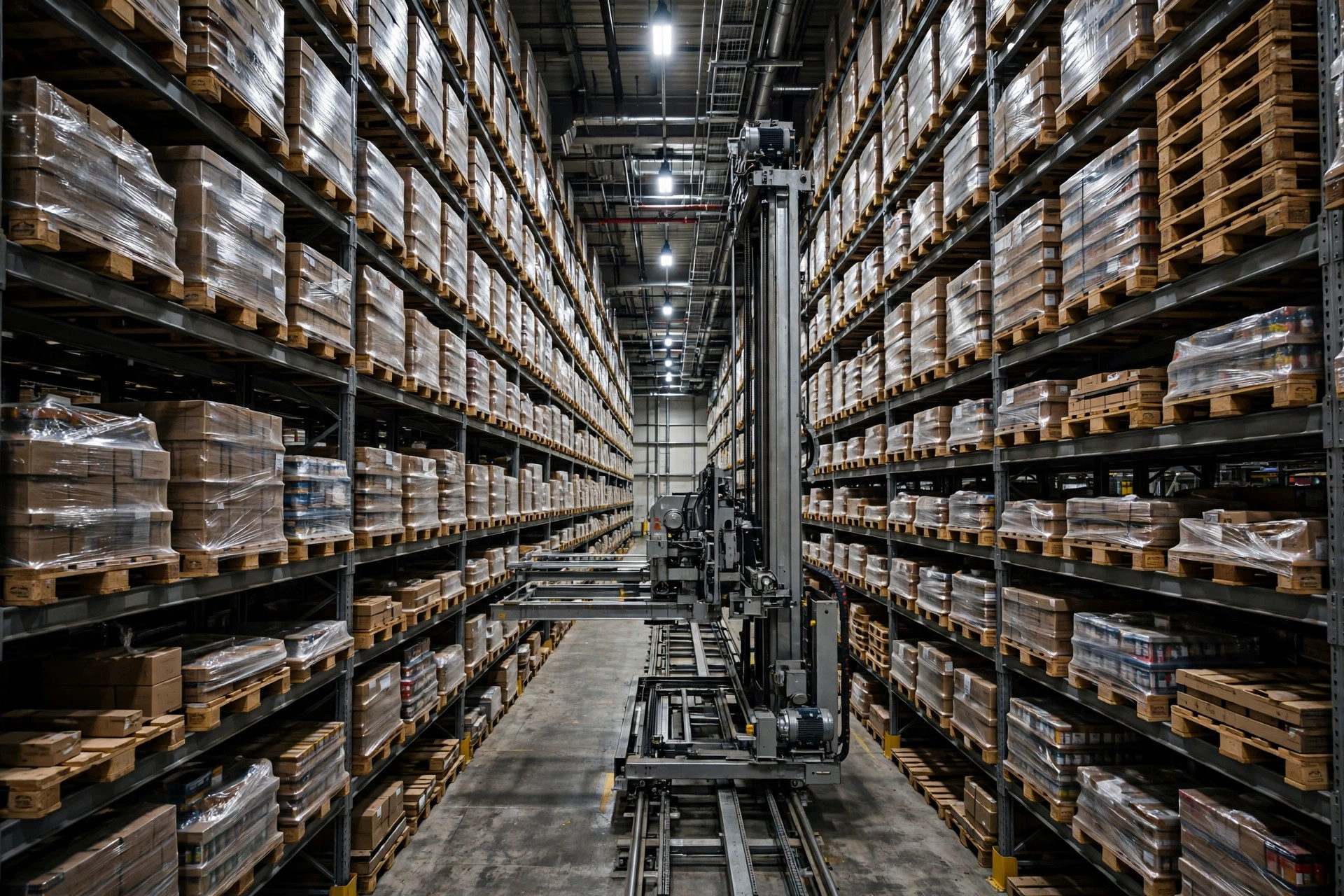
Choosing between AS/RS double-deep and single-deep storage usually starts with a layout drawing, and that is exactly where it goes wrong. On paper, double-deep wins by a mile: the same aisle holds almost twice as many pallets, so the cost per position looks lower and the warehouse looks bigger without adding a square foot. But an automated warehouse is not a drawing. Every position on that drawing has to be reached by a crane, and in a double-deep rack the rear pallet cannot be reached without moving the front one first. Think of it like cars parked nose to tail in a narrow lot. In a single-deep layout, every car can pull straight out. In a double-deep layout, the inner car only moves after the outer car has been shuffled somewhere else. More positions mean more moves, and those moves have to be paid for every single day.
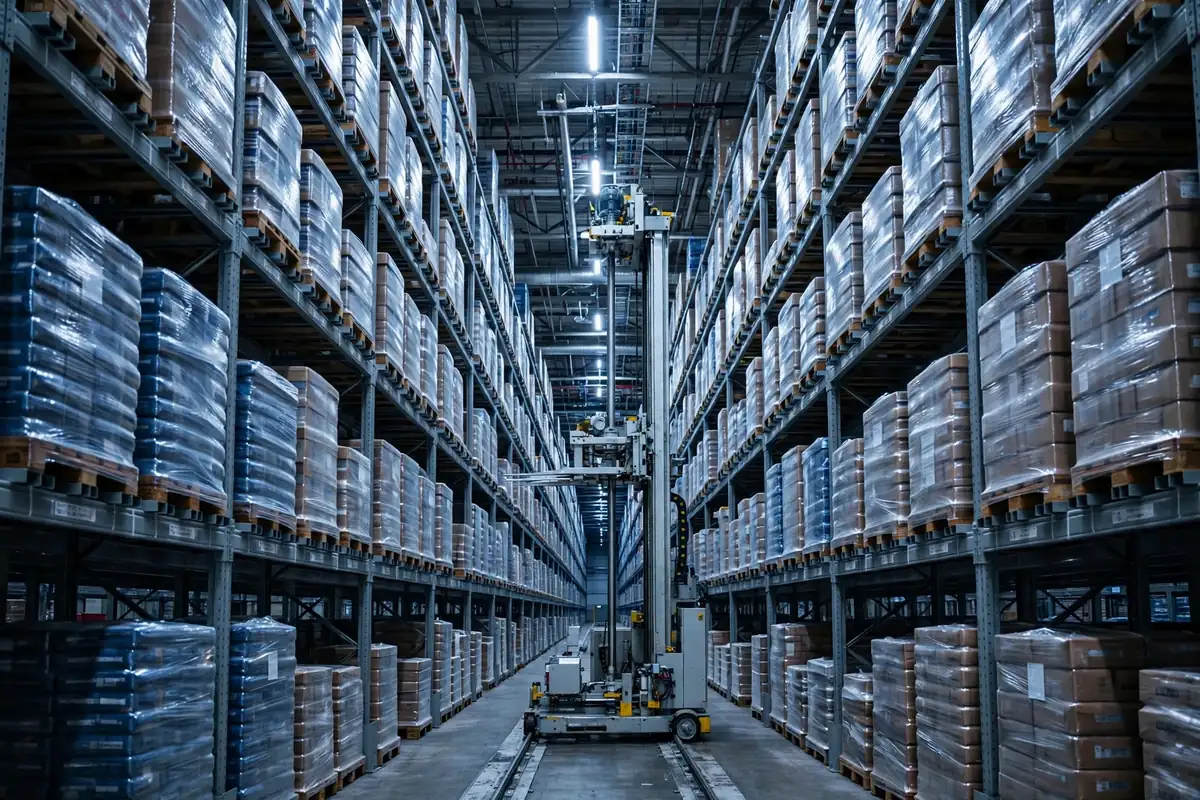
The mechanics are simple once you picture the fork. In a single-deep rack, there is one pallet depth on each side of the aisle. The crane extends its fork one pallet deep, picks the load, and leaves. No pallet blocks any other pallet. In a double-deep rack, there are two pallet depths on each side, and the fork is long enough to reach the rear position. The gain is obvious: fewer aisles for the same inventory, and less floor space burned on aisle travel. The price is just as obvious: to retrieve a rear pallet, the crane first removes the front pallet, parks it in a spare slot, retrieves the rear pallet, and then puts the front pallet back. Operators call that a reshuffle, and one reshuffle can cost two or three extra crane cycles. If rear pallets are retrieved often, those extra cycles quietly consume the crane capacity you thought you had bought.
A project in eastern China taught me how this plays out when the product mix is wrong for double-deep. The warehouse handled auto parts, with a long tail of slow-moving variants and many small orders every day. The first proposal was double-deep, and the position count looked excellent. When the customer modeled a normal day of outbound work, the picture changed. Rear pallets were needed constantly, reshuffles piled up, and the crane spent a large share of its day moving pallets it did not need to ship, just to get to the ones it did. The project switched to single-deep. It stored fewer pallets in the same footprint, but every pallet could be picked directly, and the outbound peak stopped queuing. Position count had promised capacity; direct access actually delivered it.
The opposite story comes from a consumer goods warehouse in northern China that went live in 2024 with double-deep racking. Its profile was the mirror image: few product variants, large quantities per variant, and outbound moves that were mostly full pallets. The warehouse paired front and rear positions by product, shipping the front pallet first and the rear pallet second, so a rear pallet rarely had to be dug out on its own. Double-deep behaved, in practice, like a deeper single-deep slot. The floor space saved on aisles turned into real storage, and the reshuffle penalty stayed low because the inventory structure cooperated. Same racking concept, different inventory, opposite result. That is the whole selection problem in one contrast.
How Much More Does Double-Deep Really Store, and What Does It Cost
Do not judge this choice on position count alone. Run three separate accounts. The first is storage: in the same aisle length, double-deep holds far more pallets, and that saving is real. The second is throughput: take daily outbound pallets, estimate the share that sit in rear positions, and multiply by the extra cycles each reshuffle requires. That tells you how much crane capacity disappears before a single customer order is even picked. The third is time: during the peak window, does the added reshuffle work push orders past the cut-off time your customers were promised? If any of these three accounts fails, the extra positions are decoration.
The table below is the one I put on the screen in selection meetings, because it forces the conversation away from price per position and toward the operating reality:
| Factor | Single-deep | Double-deep | | Storage density | Baseline | Nearly double in the same aisle | | Direct access to any pallet | Yes | No, rear pallets need a reshuffle | | Sensitivity to product mix | Low | High, worse as variety grows | | Fork and control complexity | Lower | Higher, longer fork and tighter positioning | | Best inventory shape | Many variants, small quantities | Few variants, large quantities |
When Single-Deep Wins Anyway
The dividing line is not in the vendor quotation. It is in your inventory. Two numbers settle most cases: the average number of pallets per product variant, and the number of times per day a rear pallet must be retrieved on its own. When the first number is large and the second is small, double-deep is worth a serious look. When the first number is small and the second is large, single-deep is the default answer, and anyone pushing double-deep should have to explain why. A warehouse with many variants, many order lines, and constant interleaving of replenishment and picking will suffer under double-deep. A warehouse with few variants, full-pallet movements, and a first-in-first-out discipline that can be managed by lane will usually benefit from it. There is also a discipline cost that rarely appears in proposals: double-deep demands accurate pairing of front and rear positions. One misplaced pallet corrupts the logic that follows, and cycle counting and system housekeeping both get heavier.
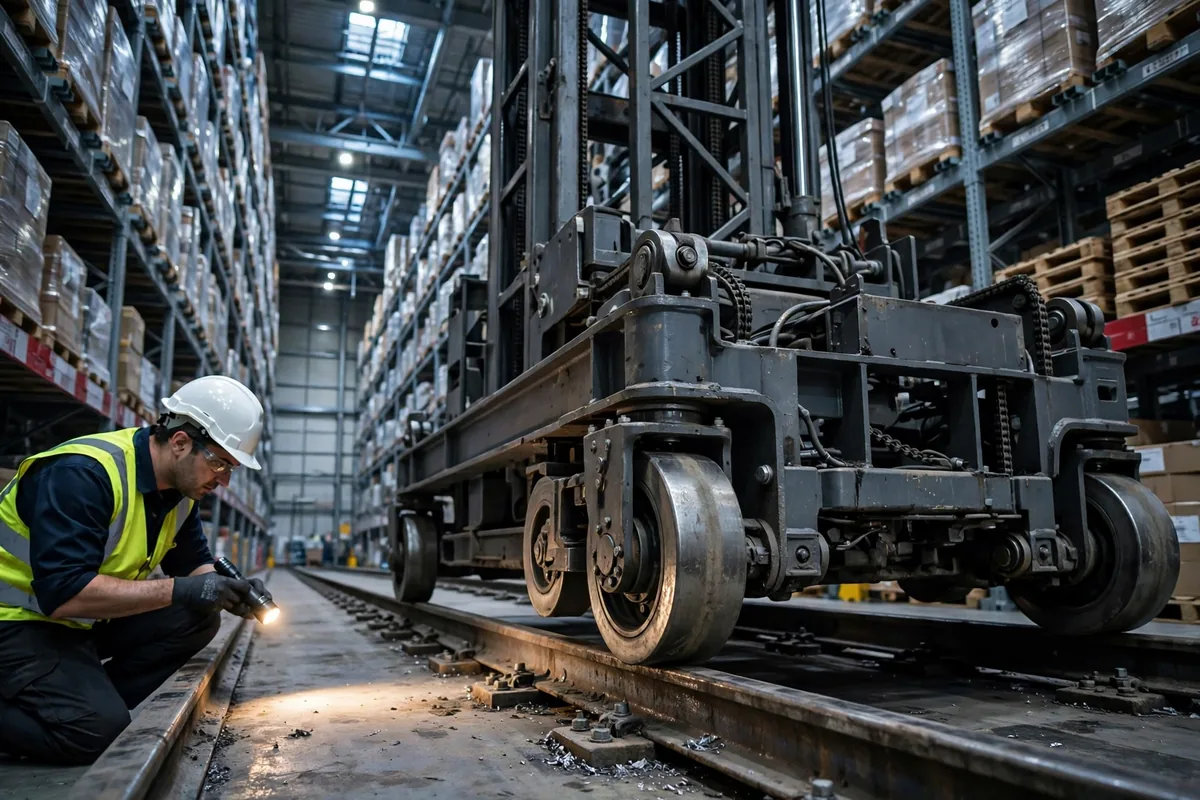
Maintenance is where double-deep quietly charges a second fee. The fork is longer, so it is more sensitive to rack vertical tolerance, deformed pallets, over-height loads, and barcodes applied crookedly. Small defects that single-deep tolerates can become failed retrievals in double-deep. The telescopic fork mechanism also wears faster, so the maintenance contract should name its inspection interval and spare parts explicitly, not just cover the crane in general terms. And there is the empty-slot problem: reshuffling needs somewhere to park the front pallet, so the system must always hold a reserve of empty positions. A warehouse run at maximum occupancy leaves nowhere to put a displaced pallet, and an aisle can seize up at exactly the wrong moment. Those reserve slots are not waste. They are the breathing room double-deep needs to function at all.
Here is the counter-intuitive part that surprises most buyers: the densest warehouse is often not the cheapest warehouse to run. Double-deep pushes space utilization up and pulls time utilization and simplicity down. Single-deep looks wasteful on space and generous on throughput and fault tolerance. Automated storage is not a contest over who packs the most pallets into a building. It is a contest over whose system keeps moving under the real order profile, on the worst day, not the average day. I have watched projects where the extra racking cost was modest, while the real expense arrived after go-live, when the team had to add capacity and rework processes to cover a throughput gap the layout drawing never showed.
Before you sign, run the vendor proposal against your last three months of real data, not against a generic profile. List pallets per variant, list retrieval frequency, and simulate front-rear pairing. If reshuffles eat a fifth or more of effective crane capacity in that simulation, the position advantage is already gone. Ask the vendor to state, in writing, what inventory profile the quoted peak throughput was measured against: full pallets or mixed small quantities make a very large difference. And ask how many reserve slots the system holds when it is fully loaded, because a shortage there will show up in the first peak season.
Whether this money is worth it comes down to one number: how many extra crane cycles you will pay every day for reshuffling, as a share of the crane capacity you actually have. Calculate that, and double-deep versus single-deep stops being an argument.
By Liu Da, Automation Engineer