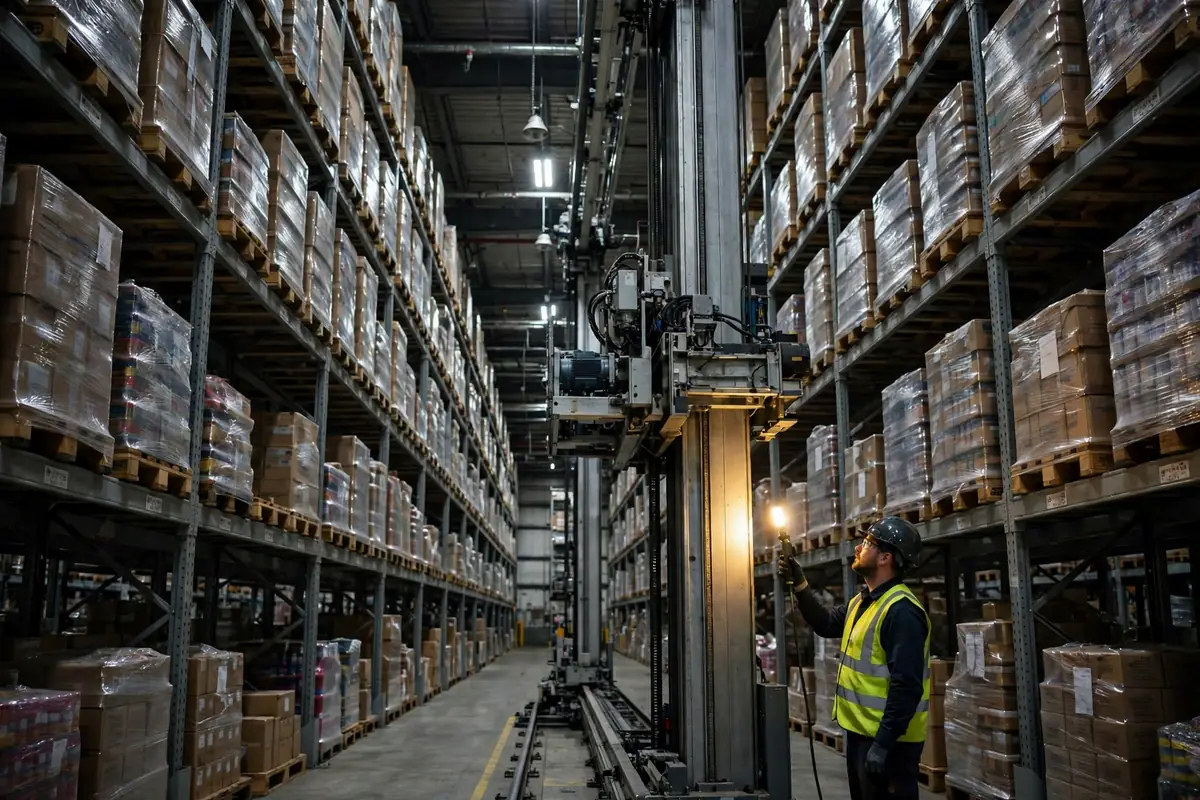
Stacker crane annual maintenance comes down to one rule: fix it while it still runs. A stacker crane spends the year sprinting up and down a narrow aisle at travel speeds of about 120–240 metres per minute and lift speeds of about 54–66 metres per minute, carrying a single load of about 500–1,500 kg or a double load of up to about 3,000 kg, in racking up to about 45 metres high. Under that kind of duty, a small defect never heals on its own. It waits until the crane sticks at height, and then the whole aisle stops with it.
Stacker Crane Annual Maintenance Starts With What Actually Wears Out
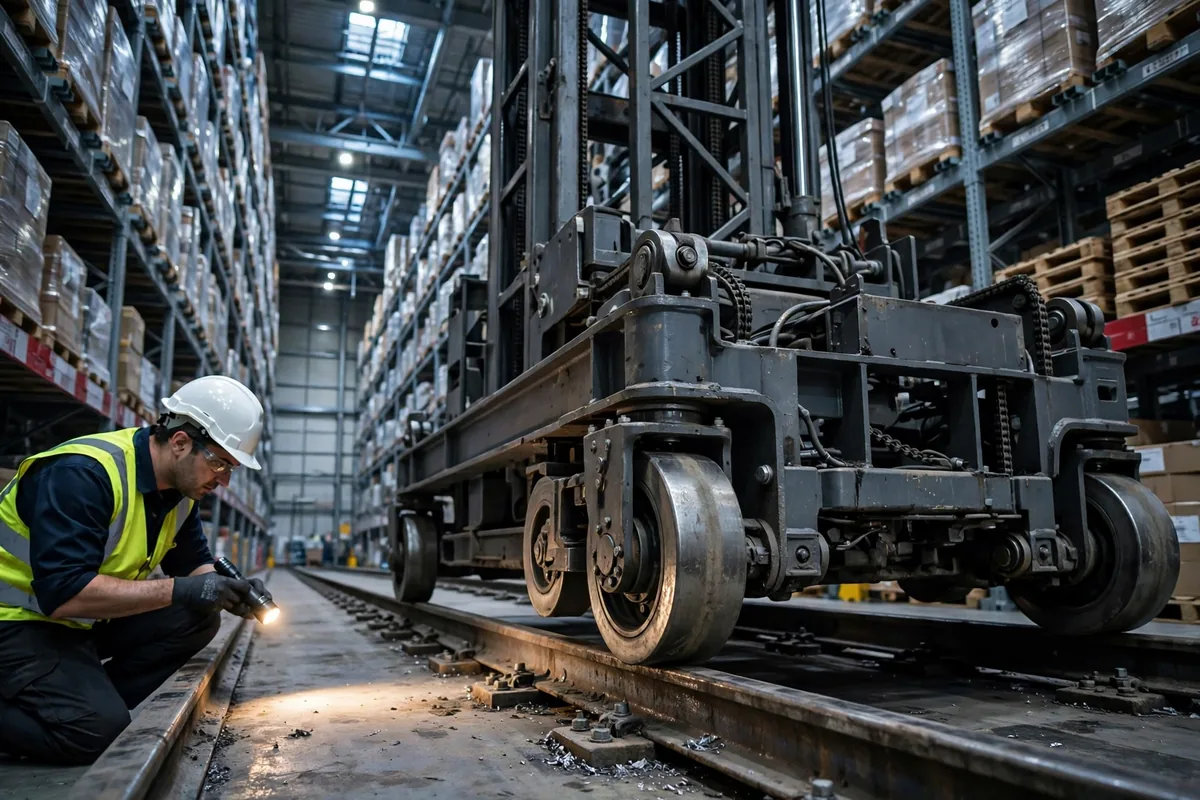
Think of a stacker crane as a forklift that traded steering for rails, then turned the speed and height up past anything a forklift would dare. The rails lock its direction, so all the energy goes into going faster and lifting higher. Wear concentrates in three places: the contact surface between travel wheels and rail, the lift chains and wire ropes, and the gears and oil inside the reducer. There is a fourth kind of wear you cannot see: drift in the encoder and the laser distance measurement. A small positioning error means the fork misses the pallet, and a miss at height can drag goods off the rack.
It is the same logic as a long-haul truck. Tyres and brake pads are consumables, and a speedometer that reads wrong is just as dangerous as worn brakes. A stacker crane works the same way: mechanical parts wear down, measurement references drift, and the parameters in the control program fall behind the real state of the machine. Annual maintenance has to deal with both kinds of problem. Replace parts without recalibrating, and you have given a short-sighted person new shoes. The walk is still crooked.
The Stacker Crane Annual Maintenance Checklist: One Pass, No Shortcuts
The annual overhaul, under applicable standards such as EN 528, should cover at least the items below. Every job runs under lockout/tagout: power isolated, lock and tag fitted, voltage verified dead, and a named person watching the isolation. Skip one step and the job does not start.
| Item | What to do | Replace or repair? |
|---|---|---|
| Bearing lubrication and replacement | Inspect travel, guide and lift wheel bearings, regrease and measure play | Play beyond limit, or rough rotation, means replace — grease will not save it |
| Chain and wire rope inspection and replacement | Check every chain link for stretch and wear, check ropes for broken wires and corrosion | Broken wires, corrosion pits or excess stretch mean replace; there is no repair option here |
| Reducer oil change | Drain the old oil, clean, and refill as specified | Metal particles in the oil mean opening the gearbox and inspecting the gears as well |
| Encoder and laser ranging calibration | Run the full travel loaded and unloaded, compare position readings with actual positions | If the error keeps returning after calibration, check mechanical play before blaming the sensor |
| Weld inspection | Test critical welds on the mast, beams and fork roots | Any crack found means stop the crane; weld repair must pass re-testing before release |
| Control program backup | Back up the control program and parameters, and keep a second copy off the machine | A backup that has never been read back is no backup at all |
| Third-party safety system inspection | Have an independent party test the safety circuits and protective devices | Any failed item stays open until fixed and re-tested |
Spare parts must be on the shelf before the shutdown starts. Chains, wire ropes, common bearings, reducer oil and fork sliders all have long lead times. Discovering a missing part on shutdown day means the aisle stays down an extra day. Check the spares list item by item against this machine's model. Parts borrowed from another crane do not count.
Planning the Shutdown Window: Three Ways to Schedule It
Scheduling the shutdown is a trade: a known stop now against an unknown stop later. The three common patterns each carry a price. The figures in the table below are a hypothetical example — use your own warehouse data.
| Pattern | How it works | The price | Fits warehouses that |
|---|---|---|---|
| Whole-aisle shutdown | Stop the whole store at once and service every aisle together | One long stop; outbound orders must be moved out first | Few aisles and a quiet season to use |
| Aisle-by-aisle rotation | Stop one or two aisles at a time, keep the rest running | Longer total programme, and the crew must mobilise several times | Many aisles and orders that cannot stop |
| Night-shift segments | Run by day, inspect and calibrate at night without dismantling | Heavy strip-down work cannot be done; the job stretches over two years | Full daytime load with free nights |
Which pattern to pick depends on two conditions: whether orders can be moved away, and whether the crew can finish the work in one visit. Orders that cannot move, plus a crew that wants to finish in one visit, ends with the crew waiting on goods and the goods waiting on the crew. The counterintuitive part is that a shorter window is not always cheaper. Squeeze the window too tight and the crew can only do the light jobs. Chains and welds, the slow items, slide to next year. That means this year's maintenance did half the job, the money was spent, and the risk stayed.
Where Annual Maintenance Goes Wrong
Scenario one, for illustration: an e-commerce warehouse in eastern China shut every aisle for one weekend of annual maintenance before the 2025 peak season. When the crew reached the lift chains, two aisles had chains stretched past the limit, but the spares store held only one replacement chain. The second had to come from another city, which cost an extra day, and outbound orders were pushed onto manual picking to cover the gap. The fault was not the chain. It was the spares count: nobody had checked the physical stock against the list before the shutdown, and the system quantity did not match what was actually on the shelf.
Scenario two, for illustration: a cold-chain warehouse in northern China did its annual maintenance in the winter of 2024. The crew changed the reducer oil, calibrated the encoder and laser ranging, and the report looked clean. In the first week after restart, the crane missed the pallet twice at high level. Re-checking showed the calibration had been done unloaded. Under load the mast flexed slightly, so the loaded position did not match the unloaded calibration. A second calibration, run loaded, fixed it. Calibration has to be done loaded and unloaded. Unloaded only is half a test.
The third trap is the idea that taking more apart is better. Annual maintenance is not a rebuild. If a bearing has not reached its replacement threshold, leave it alone — the mating surfaces rarely go back together as well as they came apart. If the control program works, do not upgrade it on a whim; a version change means re-verifying every protective function, and there is no time for that on site. The rule is simple: replace what has reached the limit, measure what has not, keep what measures well, and anything dismantled on a hunch is work you gave yourself for free.
Was the money well spent? Watch one number: unplanned stops after the maintenance compared with the year before. Fewer means the money went to the right places. No change means something on the checklist was theatre, and next year's list should be rewritten against that number.
By Da Liu, Automation Engineer