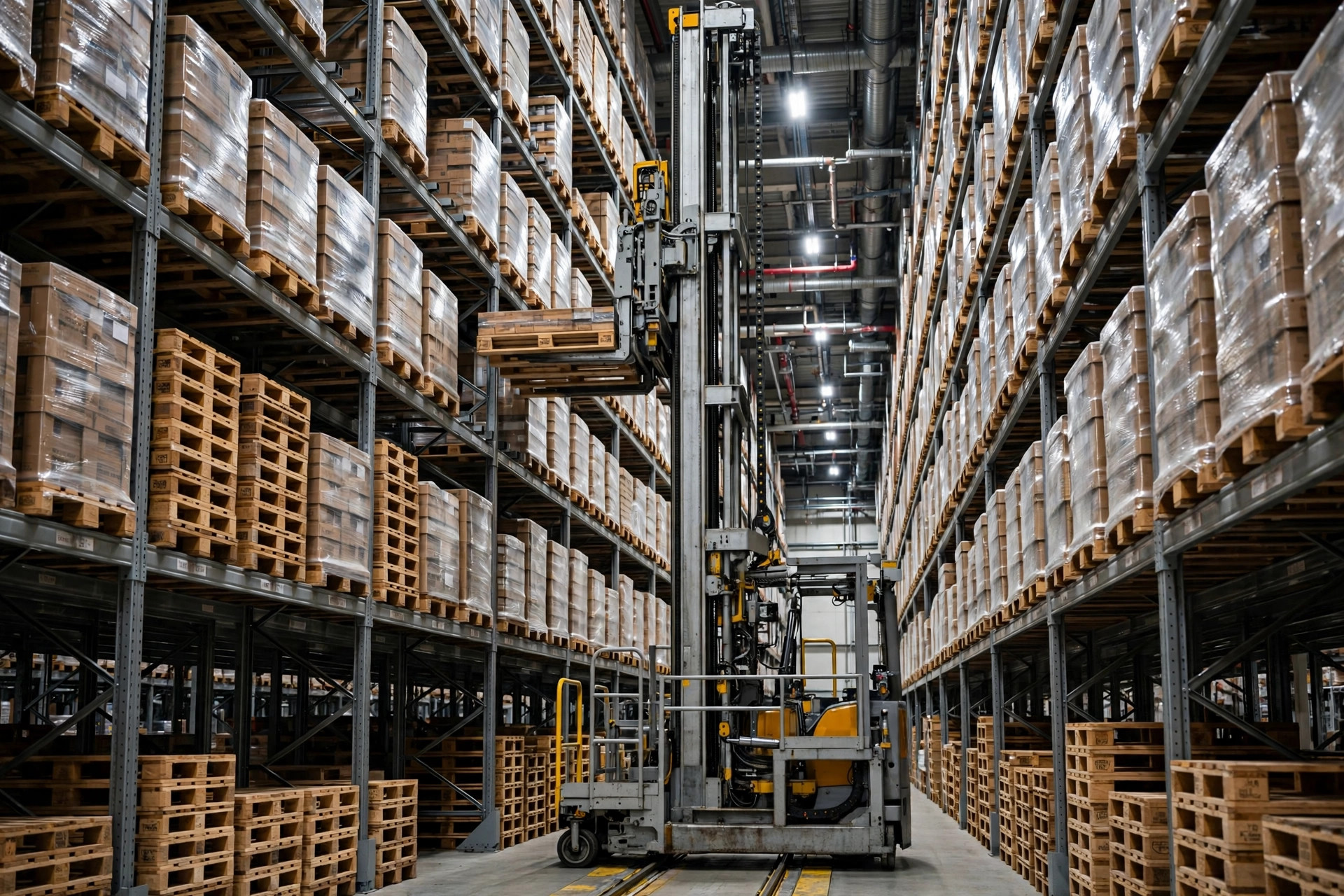
How much power does an ASRS system use? Less than you think. A 10,000-pallet automated warehouse with six aisle stacker cranes runs about $3,000–$3,500 a month in equipment electricity. That number surprises almost everyone who asks me, because "automated high-bay warehouse" sounds like it should be an energy hog. Let me show the math, then tear it apart layer by layer.
Here are my assumptions, stated up front so you can plug in your own: 10,000 pallet positions, six cranes, 3,000 pallet moves per day, 26 operating days a month, two shifts (16 hours). Field data from the cold-storage industry puts the energy cost of one automated crane cycle at roughly $0.03 per pallet at $0.10/kWh. So: 3,000 × 26 × $0.03 = $2,340. Add standby draw, WCS servers, control cabinets, and lighting — another $700–$1,000 a month. Total: $3,000–$3,500 a month.
For perspective, move the same 3,000 pallets a day with counterbalance forklifts and the energy alone costs $0.48 per pallet — $37,440 a month, more than eleven times the crane. And that is before driver wages. The first verdict: the ASRS is not the power hog in the building. The forklift fleet is.
Where the Power Goes: ASRS Energy Breakdown
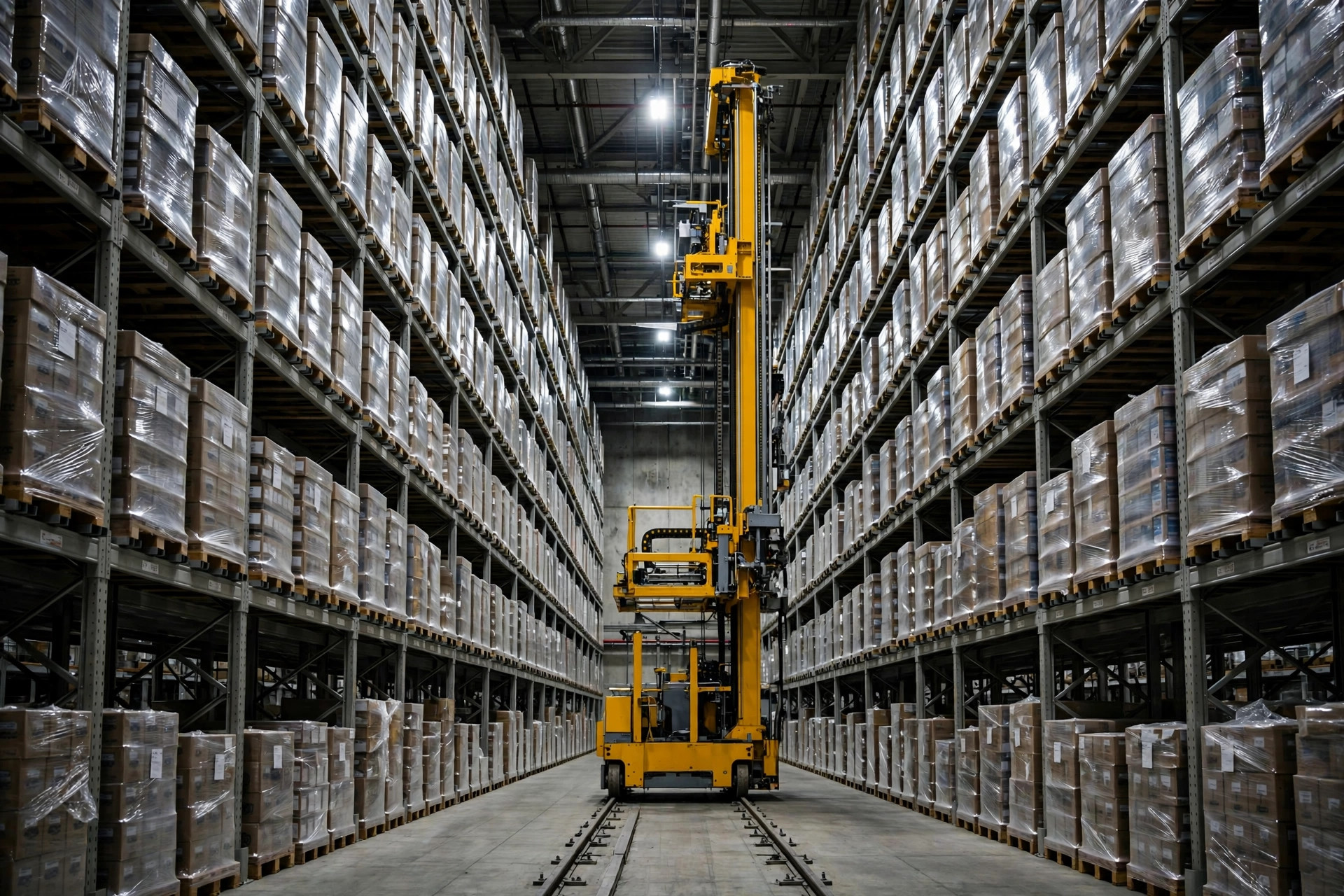
A stacker crane spends electricity in three places. The travel motor runs the horizontal axis — high-speed models hit 200 meters per minute, and constant acceleration and braking is the biggest single draw. The hoist motor lifts the load — the most expensive single move, but also the source of payback: on the way down, the motor runs in reverse as a generator, and regenerative braking plus lowering recovers 25–40% of total consumption, pushing overall efficiency past 90%. The fork extension motor is small but cycles constantly.
Then there is the power you spend standing still. Drives, control cabinets, safety scanners on standby; WCS servers and network gear that never sleep. In a two-shift operation, if six cranes sit at full standby for the 8 hours between shifts, several hundred dollars a month leak out quietly. Plenty of warehouses pay that bill without ever seeing it itemized.
Shuttle systems have a different shape. Dozens of four-way shuttles run on onboard batteries — charging losses are real, and battery degradation every 3–5 years is a replacement line item, not a rounding error. Add the lift motors on each level. A single shuttle looks frugal; at system level, with charging losses, battery replacement, and lifts, total consumption lands in the same ballpark as cranes. The crane, meanwhile, feeds straight off the 480V bus — no battery consumable to maintain, a cleaner long-term ledger.
One more line item people forget: lighting. If you are still wondering how much power an ASRS system uses once you count everything, lighting is the swing factor. The storage zone can run dark — nobody goes in, so the lights stay off. A documented freezer-industry case: in a 150,000 sq ft facility, killing the lights in the ASRS zone saved $35,000 a year in lighting electricity alone, plus another ~$14,000 a year in refrigeration because lights that are off produce no heat to remove. Most TCO models never count the lights at all.
Here is the counter-intuitive part: an ASRS is usually the most energy-frugal warehousing option available. The real energy hogs in any warehouse are refrigeration and lighting — and the ASRS happens to minimize both, with dark aisles and a small building envelope. The "power hog" reputation comes from people attributing the whole building's electric bill to the equipment.
Stacker Crane vs Shuttle: Per-Pallet Energy Compared
Straight to the table — every number below has a published source behind it:
| System | Energy per pallet move | Source |
|---|---|---|
| Aisle stacker crane (double-deep, automatic) | ~$0.03/pallet at $0.10/kWh | Freezer-industry field data |
| Four-way shuttle | ~0.02 kWh per cycle | Equipment vendor published data |
| Crane with energy recovery | 25–40% of consumption fed back | Vendor field data |
| Counterbalance forklift | $0.48/pallet | Same field data |
| Reach truck | $0.33/pallet | Same field data |
| Narrow-aisle VNA | $0.18/pallet | Same field data |
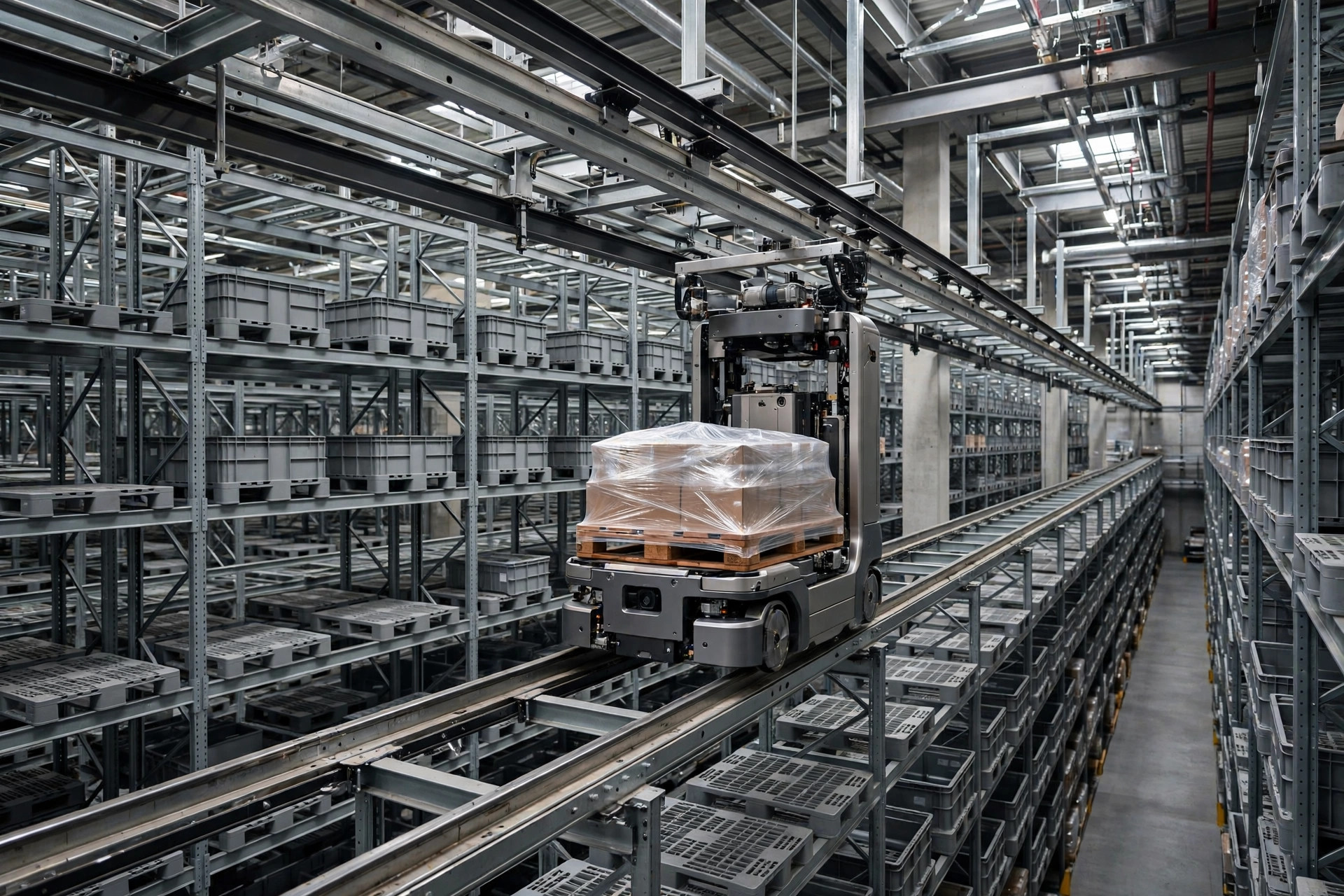
The table tempts you to conclude "shuttles win" — 0.02 kWh per cycle is a pretty number. That is exactly the trap I want to flag. The 0.02 kWh is one vehicle, one cycle. The system has dozens of vehicles charging at once, plus charging losses, plus battery decay, plus lift motors. Measure at the system meter and the gap with cranes mostly closes. Never let a per-vehicle number decide a per-system purchase.
One more measured detail worth knowing: transfer-point energy. Research data shows a forklift handing a pallet to a stacking crane costs 70–120 Wh per pallet at the handoff, while a conveyor feeding the crane directly costs only 50–90 Wh. The more automated the chain and the fewer manual handoffs, the more you save at this joint — one more reason fully automated layouts beat semi-automated ones on energy.
Four Levers to Cut the Power Bill, Cheapest First
One: wave combining. Free. Pair put-aways and retrievals into dual cycles — the crane carries a pallet in and picks one up on the way out, killing empty travel. The math: at 3,000 moves a day, lifting the dual-cycle rate from 40% to 70% eliminates roughly 900 empty runs a day; at ~0.05 kWh per empty run that is nearly 12,000 kWh a year, plus the labor time saved. It is a WCS policy change. It costs nothing. Highest ROI of anything on this list.
Two: standby policy. One parameter. Let cranes sleep between shifts and on weekends instead of idling hot; keep only essential controls alive. Standby draw per crane looks trivial until you multiply six cranes × 8 hours × 30 days.
Three: time-of-use rates. Shift the clock. US industrial electricity averages about 9.8 cents/kWh nationally (EIA, July 2026), but it varies wildly by state, and in places like California the peak/off-peak spread can exceed 2×. Move heavy replenishment and cycle counts to off-peak hours and the bill thins out directly. Check your utility's current published tariff — rates move.
Four: regenerative drives. Spend money. Drives with energy feedback or supercapacitors recover 25–40% from braking and lowering. Lightweight crane designs (one Swiss vendor's Vectura line publicly claims ~20% lower consumption than conventional cranes) belong here too. But do the payback math: saving 20% ≈ $700/month ≈ $8,400/year. Paying $100,000 extra for the efficient crane needs 12 years to break even — not worth it. My ordering stands: exhaust the three free levers before spending a dollar on efficient hardware.
The Verdict: Power Is a Rounding Error in TCO
Here is the calculable conclusion — the short answer to how much power an ASRS system uses, in formula form. Monthly power estimate:
Monthly power ≈ monthly pallet moves × $0.03–$0.05 + $700–$1,000 fixed standby (the $0.03–$0.05 range floats with your local rate; verify against your utility's current tariff.)
And the TCO share, as an annual table you can reuse with your own numbers (model assumptions stated):
| Cost line | $/year | Basis |
|---|---|---|
| Equipment depreciation | 200,000 | $2M investment, 10-year straight line |
| Maintenance and spares | 60,000 | ~3% of capex; verify against service contract |
| Electricity | 36,000–42,000 | $3,000–$3,500/month |
| Forklift labor + energy avoided | −450,000 and up | 8–10 driver crew, order of magnitude |
Electricity is the smallest line in the table. It typically lands in the low single digits of total cost of ownership. Paying a large premium for "energy-efficient" equipment is usually a miscalculation. Watch two things instead: the free levers (wave combining, standby policy) and the peak/off-peak structure when you sign the power contract. Put the rest of your attention where the money actually is — throughput and uptime.
By Lao Zhou, Logistics Cost Analyst