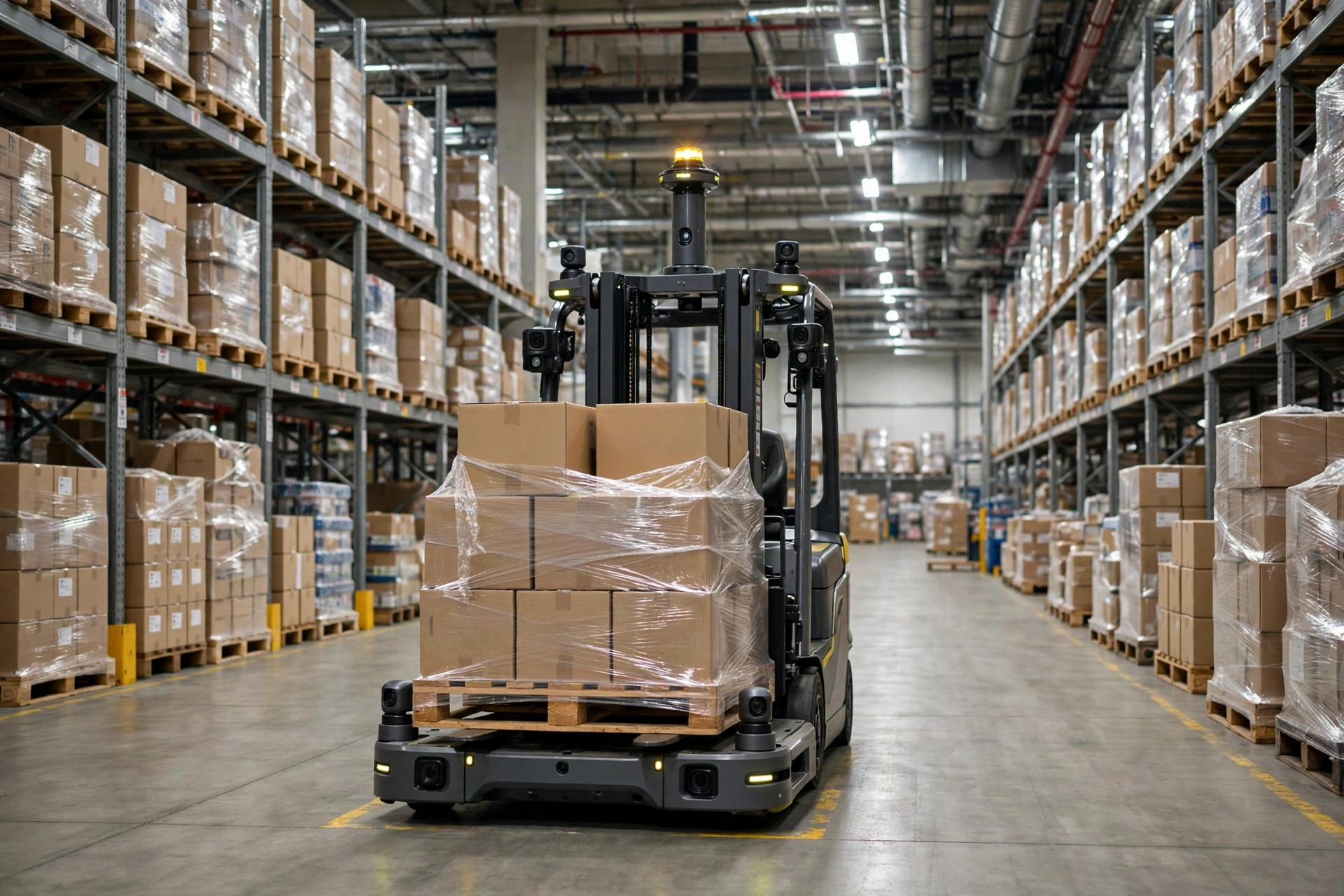
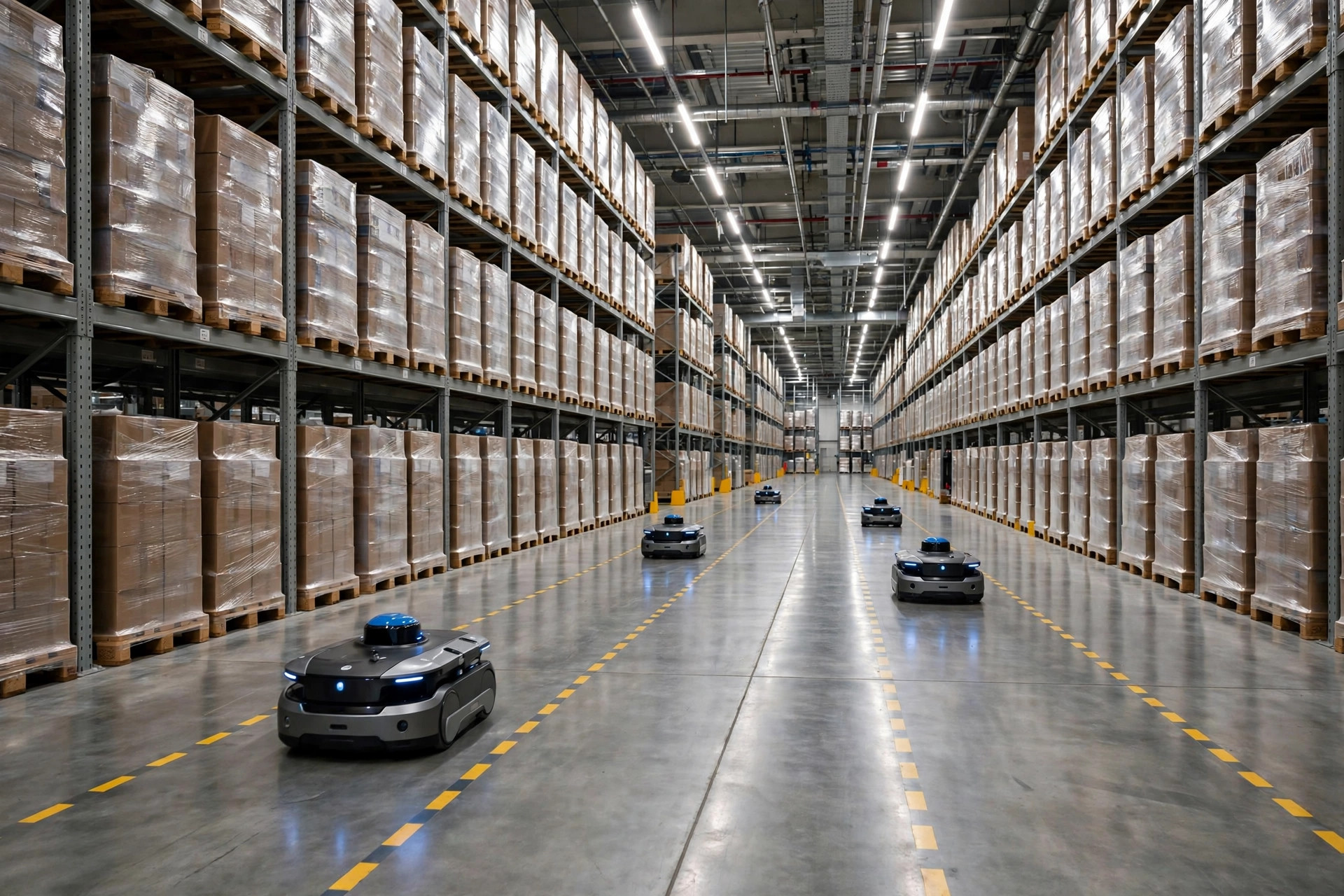
Your AMR rolls down a rack aisle, then suddenly stops dead. On the fleet dashboard its position jumps, twitches, and finally reports "localization lost." If you have run laser-navigation AMRs, you have seen this movie. Here is the spoiler: nine times out of ten, the robot is not broken. Its eyes are being fooled by the environment.
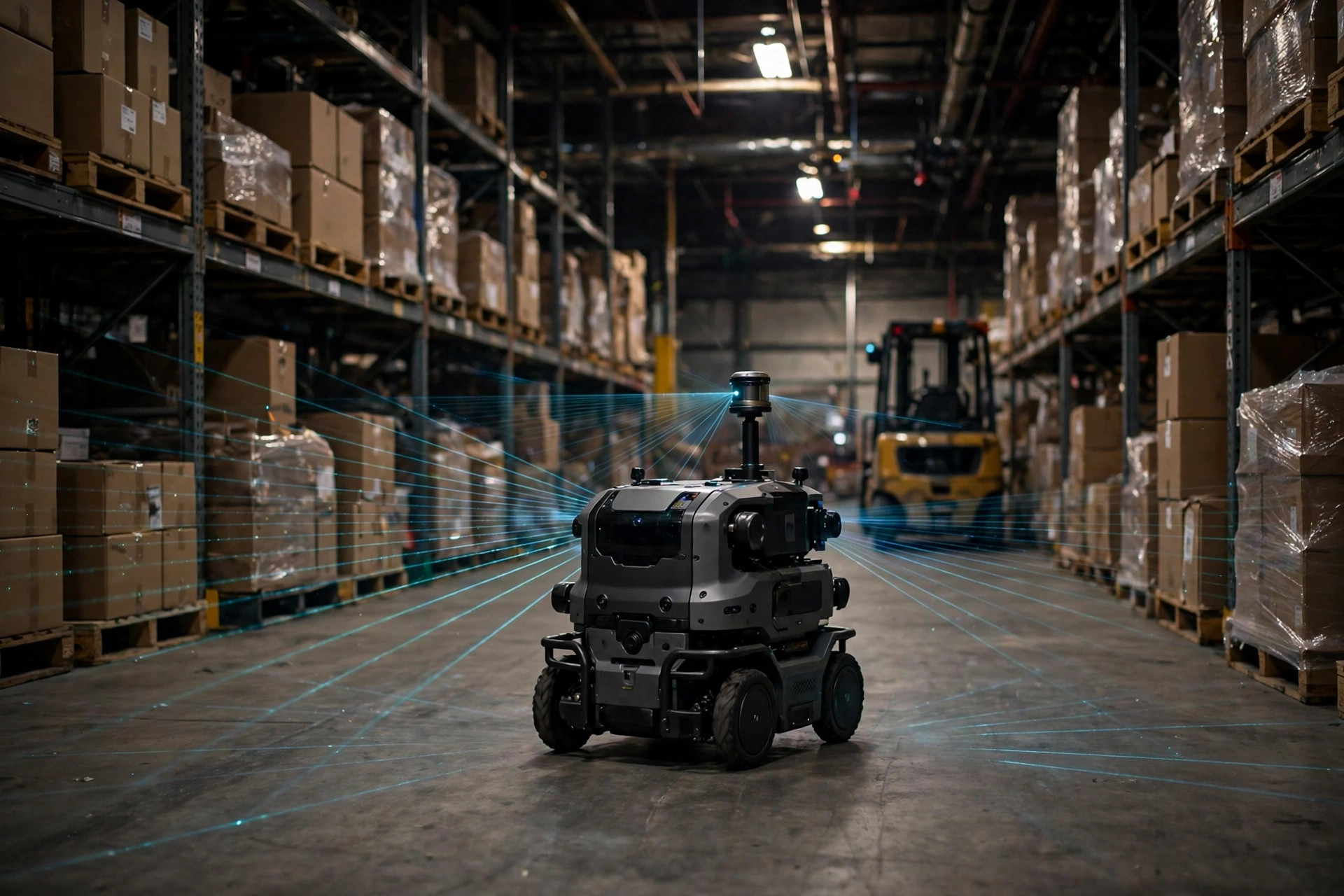
Think of LiDAR SLAM like this: the spinning sensor on top of the AMR fires tens of thousands of laser beams per second, measures how long each one takes to bounce back, and builds a live point cloud. It then matches that cloud against a pre-built static map to figure out where it is. It is like walking through a dark room with your eyes closed, feeling for doorframes and corners to confirm you are still on the right path. The problem: if someone moved all the doorframes overnight, everything you touch is a hallucination.
A rack aisle is that room.
Four ways the environment lies to your AMR
First, the rack contents changed, but the map did not. This is the number-one cause of localization loss in rack areas. On mapping day, the racks were fully loaded, so the point cloud saw solid walls of pallet faces. A month later, inventory turned over and a whole row sits empty — now the cloud sees only sparse uprights and beams. The AMR tries to match the two: no deal. Warehouses with big day-night swings (fully loaded during the day, picked empty at night) are the worst; a map built at 7 a.m. describes a different world by night shift. Think of it as finding someone from an old photograph — the person in the photo gained sixty pounds, and even you would hesitate to say it is the same person. So does the AMR.
Second, long straight aisles have almost no crosswise features — the "corridor effect." Longitudinal localization (along the aisle) is where laser SLAM is weakest: the racks on both sides are parallel surfaces, so the match along the driving direction depends on a handful of sparse features. Past a certain aisle length, the longitudinal error accumulates like a snowball, the matching algorithm lets go, and the AMR's position drifts. It is like driving through a highway tunnel with continuous walls on both sides: you are clearly moving forward, but your eyes insist you are standing still.
Third, reflective surfaces and plastic wrap mess with the laser. Mirror-finish stainless doors, glass partitions, and the stretch film wrapped around pallets are mirrors to a laser. Beams bounce off to somewhere else, or pass clean through the film — the point cloud grows walls that do not exist, or loses walls that do. The worst case I ever saw: the AMR was convinced there was a wall five meters ahead. The floor was completely empty. The whole "wall" was a ghost image reflected off pallet wrap.
Fourth, wheel slip corrupts the odometry. Wet floors, thin frost, overly slick epoxy coatings — the wheels spin while the robot barely moves. The encoder says "I went five meters," the reality is three. SLAM uses odometry as the initial guess for matching, and the worse the guess, the more likely the match converges on the wrong answer. This is a systematic error that no algorithm fully eats.
Diagnosis: plot the confidence curve first, then replay the point cloud
When an AMR loses localization, do not reboot it first. Look at the data. Almost every navigation stack exports some localization quality metric — a confidence score, a match score, whatever the vendor calls it. Plot that value over time. In normal driving it sits high and steady; before a localization loss, it always shows a clear degradation first. That curve is your patient chart: when the loss happened, how long it lasted, how many times it recovered — all written there.
Next, replay the live point cloud overlaid on the static map for a few seconds before and after the event. Look at two things. First: is the mismatch global or local? Global mismatch means the environment changed (rack contents, seasonal layout changes); local ghosts or missing patches point to reflections or occlusions. Second: where does the robot keep dying? If it always loses localization at the same aisle, the same upright, the problem is almost certainly that stretch of environment, not the robot.
There is also a crude but effective field test: take a big cardboard sheet, stand it on one side of the suspect aisle, and run the AMR once. Remove the sheet, run it again. If the match score drops noticeably the second time, that segment was surviving on one or two features — fragile. That is where you add landmarks.
Countermeasures: three tiers, cheapest first
I am a firm believer in spending money where it matters. Fixing localization loss in rack areas comes in three tiers of investment, lowest first.
Tier one: add landmarks. Cheap and effective. Reflective tape, reflective posts, and floor QR codes are the classic laser-navigation reinforcements. Reflective tape on rack uprights or walls at a fixed height returns far stronger reflections than ordinary surfaces — in the point cloud, they are natural lighthouses. Floor QR codes paired with a downward camera give absolute position corrections. The cost is negligible — a roll of reflective tape costs next to nothing, and taping up one aisle can eliminate half your localization losses. Now the counterintuitive take: plenty of people treat landmarks as "going back to magnetic tape," a loss of face. Wrong. SLAM plus sparse landmarks is currently the most robust setup for rack areas. Pure natural-feature navigation in long aisles is born with a deficiency. That is a trade-off, not a regression.
Tier two: change your mapping strategy. Free. Build your map when inventory is at an average level — not full, not empty. If day-night differences are extreme, consider maintaining two maps and switching by shift (some vendors support this). Drive slowly during mapping and run the route twice for fusion; accuracy steps up a level. And one badly underestimated operation: re-map regularly. A map is not a one-time asset. Once the rack layout changes or a new row of high-bay racking goes in, the old map should retire. I have seen a warehouse that had not re-mapped in three years — its AMRs were running on inertia, and localization losses were measured in weeks.
Tier three: multi-sensor fusion. Costs money, but cures the root cause. A single LiDAR in a rack area is a one-eyed navigator. Add UWB or vision-assisted positioning and you get an independent localization source for cross-checking, which can cut localization loss by an order of magnitude. Watch the lighting with vision setups — when the warehouse lights go off, vision goes blind, so vision can only ever assist, never lead. This is the trade-off: laser fears reflections, vision fears darkness, UWB fears occlusion. There is no silver bullet — only combinations.
And a rant about a fake need: someone's AMR loses localization and their first instinct is to buy a more expensive LiDAR — double the channels, double the range. Let me be blunt: in a warehouse where rack contents change a lot and long aisles lack features, no sensor, however pricey, will fix a matching problem. A better LiDAR sharpens the point cloud; localization loss is rooted in "the environment changed and features are scarce" — a map and strategy problem, not a sensor-tier problem. Tape the reflectors, rebuild the map, and only then talk about upgrading the sensor.
Decision framework: is it worth the money? Look at uptime
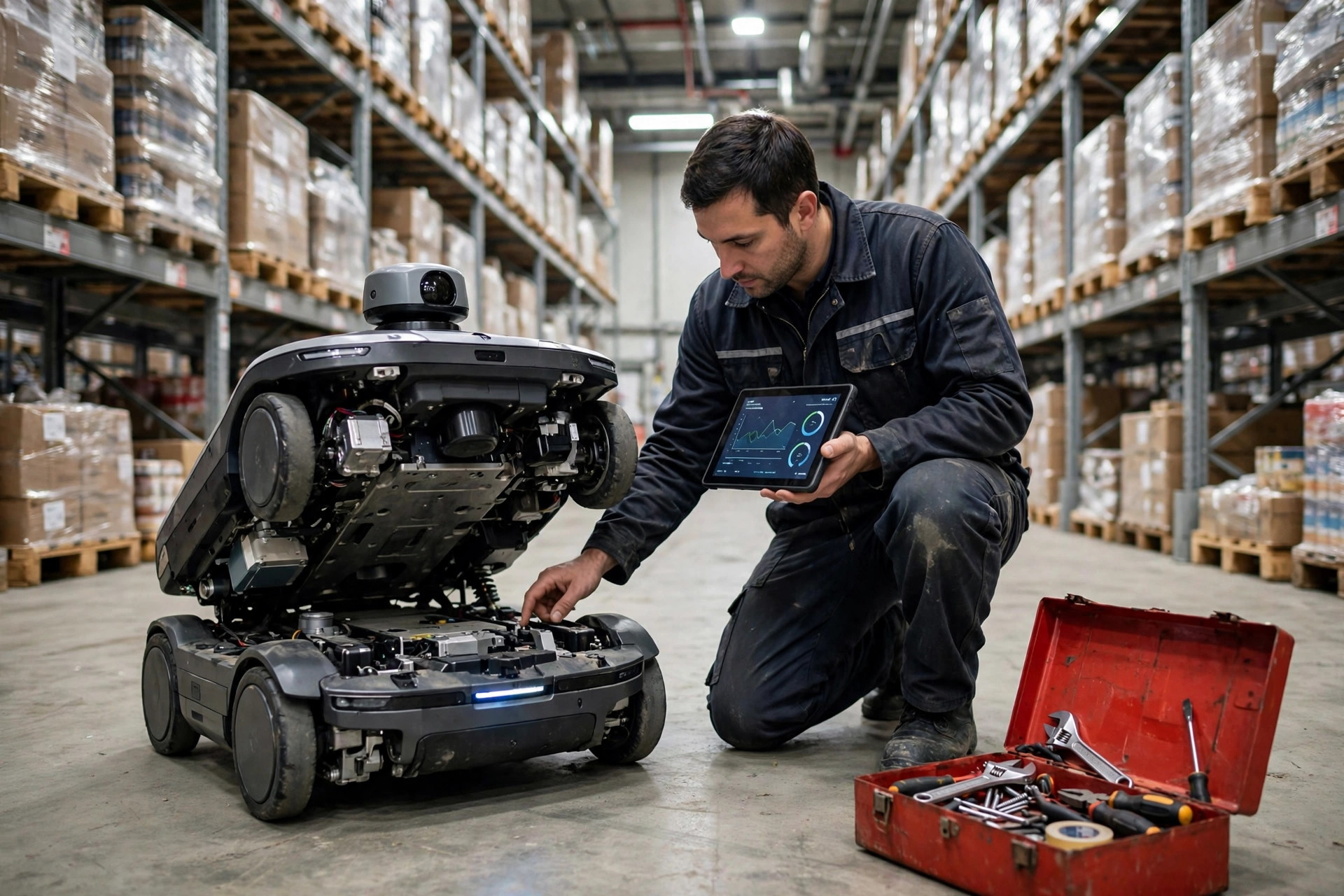
Finally, the maintenance trap. The scariest part of AMR fleet localization loss is not a single event — it is the cascade: one robot freezes in an aisle, everything behind it queues up, someone walks over to move it by hand, and the whole line's takt time collapses. Do the math on this: count last month's localization events, the average recovery time, and the machine-hours of other robots blocked in the pile-up. Convert that into "effective uptime loss" — the one language management understands.
In my experience the line is clear: if localization-driven downtime exceeds 1% of total monthly operating time, do tiers one and two immediately — the payback is measured in weeks. If it is still over the line after that, consider tier three sensor fusion. Reflective tape and re-mapping are investments that almost never turn out to be wasted money.
Is this money well spent? Watch one number: average localization losses per robot per month. Write it down, put it on the wall. After any countermeasure goes in, whether that number drops is all you need to know. AMR maintenance is just this — no mystery, just counting.
By Da Liu, Automation Engineer