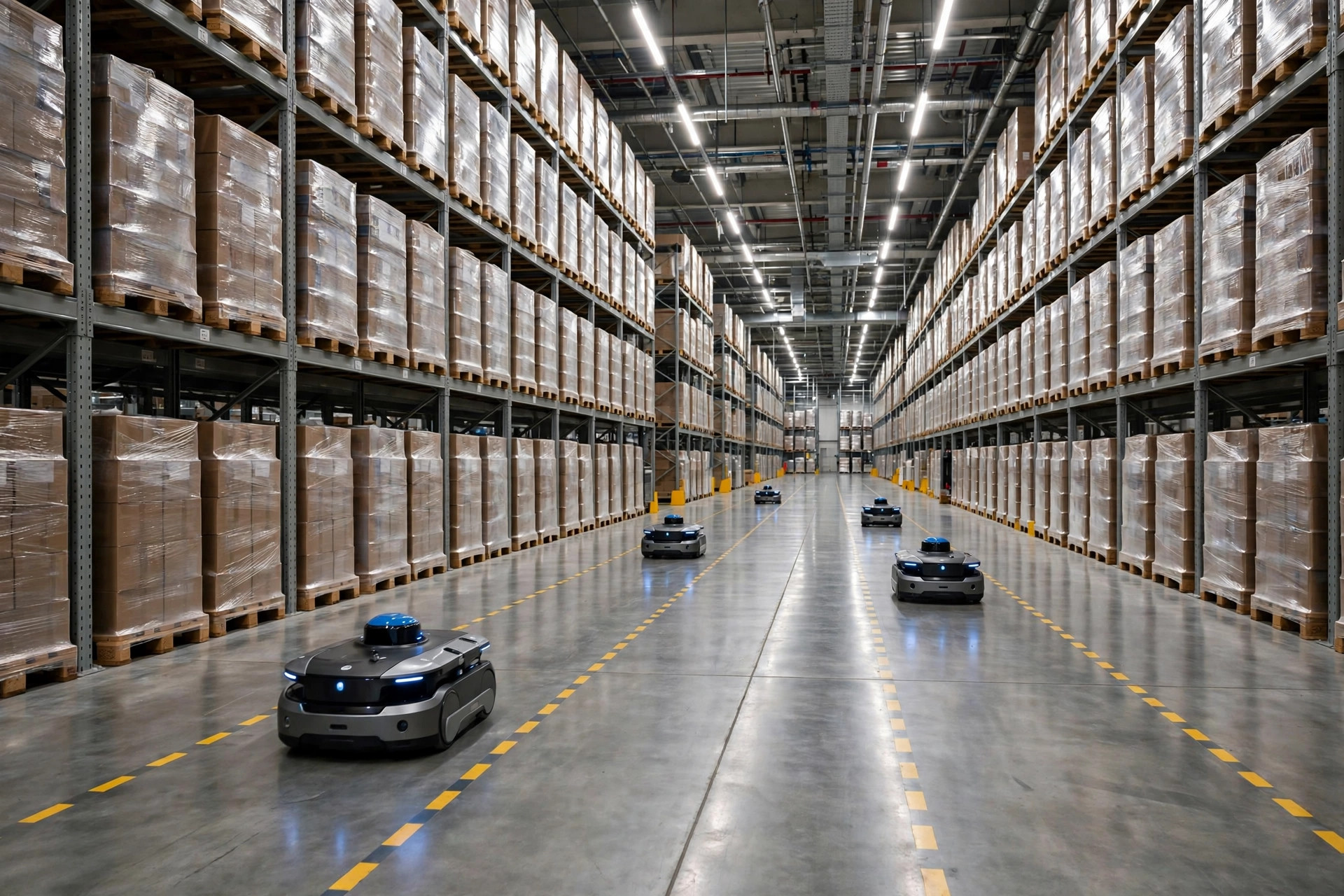
Let me tell you something. A few weeks back I was waiting to pick up a load at an auto parts warehouse outside Langfang. My rig was parked by the dock, paperwork wasn't ready yet, so I sat in the cab watching the floor through the glass. There must have been a dozen of those little yellow AMRs buzzing around hauling bins. Fun to watch, honestly. Then came the comedy: at a cross-aisle in the middle of the warehouse, four robots rolled in from four directions at almost the same moment, all stopped dead, and just sat there facing each other. Nobody yielded.
They sat like that for a good two or three minutes. One of them finally got "impatient" and crept forward half a meter; the one across from it crept forward too, and they nearly kissed bumpers. In the end a forklift driver walked over and physically shoved one of them aside, and traffic flowed again. The dispatcher next to me just shook his head and said it was the third time that day.
I've been driving trucks for fifteen years, and my first thought was: this is rush hour at an intersection with no traffic lights.
Intersections: Decide Who Yields Beforehand
Every trucker knows the real danger on the road isn't too many vehicles — it's no rules. Highways work at 70 miles an hour because the lanes are painted and everybody knows who yields to whom. An AMR is basically a miniature highway system running inside a warehouse. It needs traffic rules too.
I chatted with the engineer at that warehouse, and he knew his stuff. He told me the rules they'd finally written down, and I understood every word, because it's the same logic we live by on the road:
| Situation | Who goes first | Plain-English explanation |
|---|---|---|
| Robots meet at an intersection | Loaded robot goes first; empty one yields | The loaded one is the "heavy truck" — heavy goes first, oldest rule on the road |
| Narrow aisle, two robots face off | Whoever entered first goes; the other backs to a passing bay | Same as a single-lane road: first in has the right of way |
| Charging queue | Lowest battery charges first; move out the moment you're full | Don't hog the charger — top up and get out of the way |
| Hot shipment about to miss cutoff | Jump the queue | The fire truck goes first. Everybody respects that |
Nothing in that table is rocket science. The point is that someone has to write it down and enforce it. Plenty of warehouses buy smart robots but leave the rules blank, so at every intersection the robots try to "negotiate" — and when the negotiation fails, they just freeze. Here's what that taught me: traffic rules are better written down clumsy than left to improvisation.
Narrow Aisles: Look Before You Enter
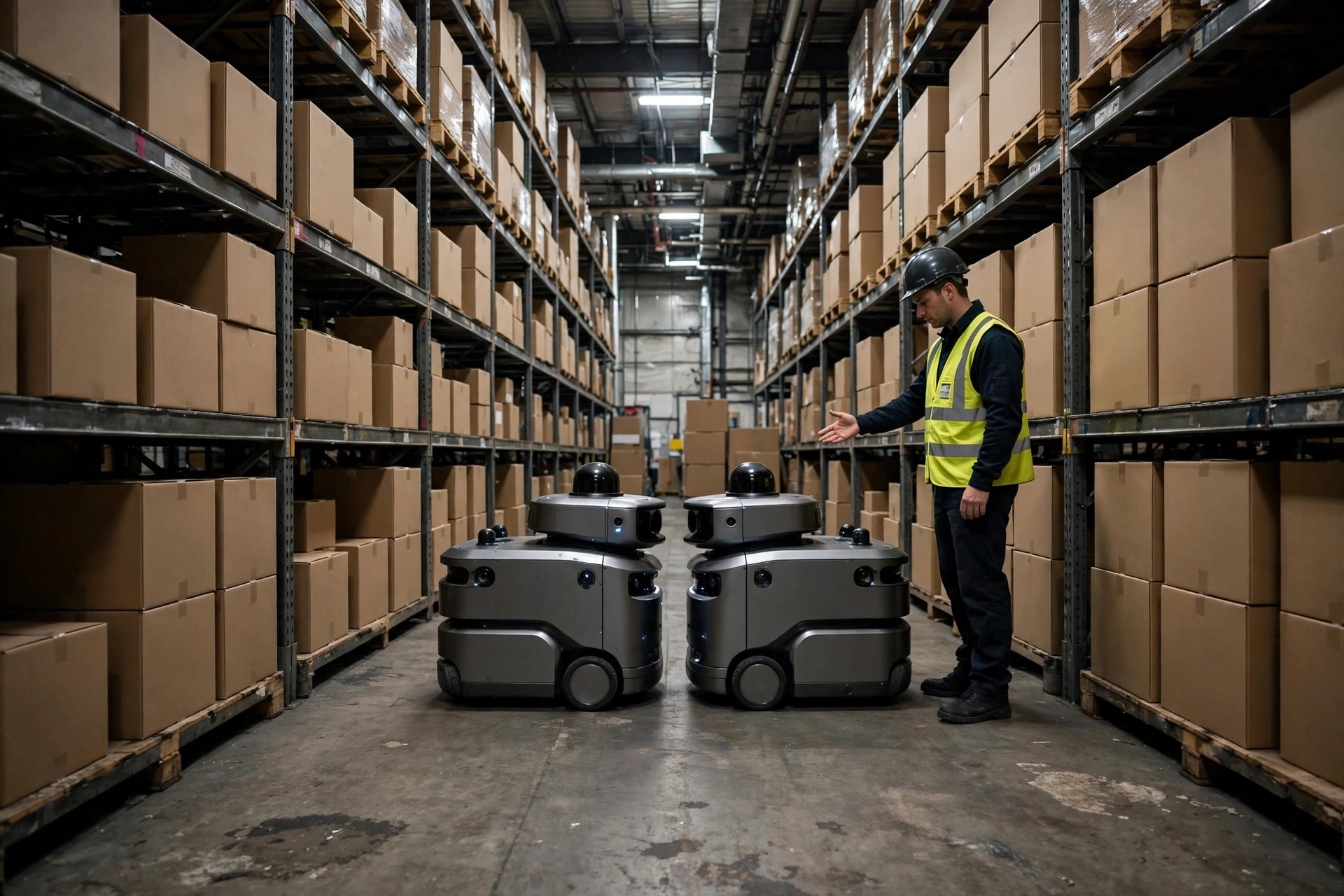
Then there are the narrow aisles. Last November, right before the big Singles' Day rush, I was delivering to an e-commerce warehouse in Tianjin and saw it with my own eyes. An aisle between two racks, barely wide enough for one robot. Two AMRs entered from opposite ends at the same time and met in the middle, nose to nose. The system ordered one of them to reverse — a good forty or fifty meters back to a wider junction before it could pull aside. Ten minutes gone, and the supervisor was hopping mad.
When I take my rig down a narrow village road, do I check whether someone's coming out before I go in? Of course I do. AMRs should do the same: before entering a narrow aisle, the system checks whether another robot is already inside. If yes, wait. That wait costs maybe thirty seconds — a lot cheaper than a ten-minute reverse.
Let me run the numbers for you. One AMR moves about 8 to 10 pallets an hour on a medium-distance loop (my estimate). A three-minute deadlock with four robots is 12 robot-minutes, roughly two pallets that never moved. Multiply that by a dozen deadlocks a day, and over a month you've lost enough pallets to fill several trailers. And that's before you count the missed shipping cutoff and the drivers like me sitting at the gate burning daylight — truck waits, people wait, and in the end the shipper pays for all of it.
Charging: Don't All Eat at the Same Restaurant
Then there's charging, the part everybody ignores. I once visited a warehouse running thirty-some AMRs: they ran all day and charged all night. Sounds tidy, right? Problem was, they had 8 chargers. At ten o'clock at night, twenty-plus robots lined up waiting for a plug. A few ran so low they died right in the middle of the aisle. Next morning the dispatcher spent the first hour hunting down dead robots and dragging them out of the way, like moving illegally parked cars during morning rush.
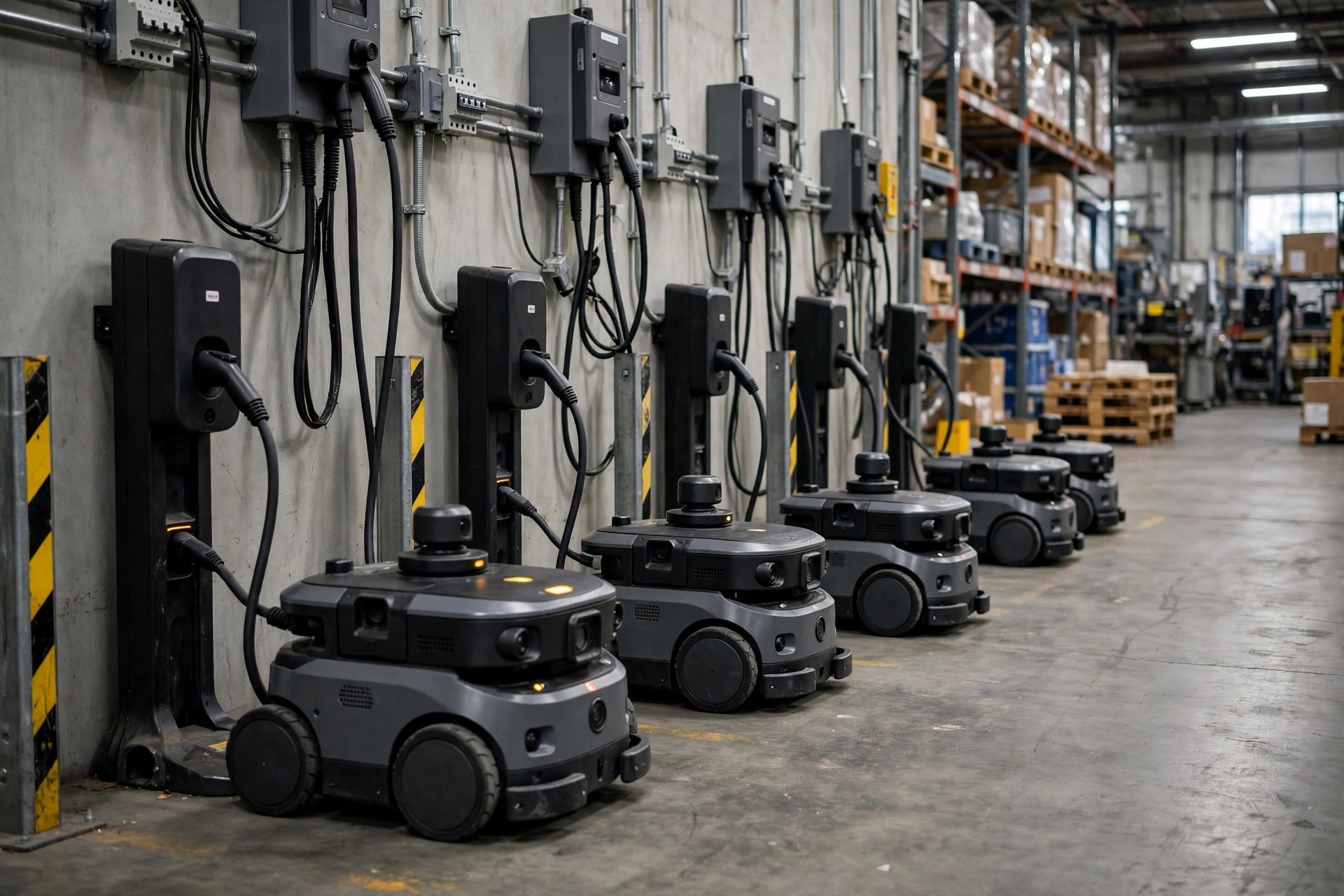
What does that tell you? Charging needs a schedule too — you can't have everybody show up at "dinner time." My advice is dead simple: when a robot drops below 30% battery, send it to the nearest charger for a top-up instead of waiting until 10%; size your chargers at roughly one plug per four robots (estimate); and program the system to move a robot off the charger the second it's full. No squatting.
Now here's the counterintuitive part. Most people think AMR dispatch is about making each robot go faster. Wrong. Yielding at an intersection looks like every robot slows down half a beat, but the whole fleet moves faster. Same as driving: four cars bullying each other at an intersection with no lights means nobody moves; add a yield rule and each car loses half a second while the whole intersection gains. Dispatching isn't about top speed per robot — it's about never letting robots stop.
Three Pieces of Honest Advice for Warehouse Folks
Road stories told. Here's the practical part — three things I'd tell any warehouse manager:
One, mark the intersections, both on the floor and in the system. Paint yield lines on the concrete and set virtual yield rules in the fleet software. Don't count on the robots to "work it out" — write the rules down in advance.
Two, put passing bays in the narrow aisles, a wide spot every so often. First in, first out; the latecomer backs up. And check the aisle before entering — that thirty-second wait is worth it.
Three, keep a human override. If robots deadlock at an intersection for more than two minutes, the system should page a person automatically. Don't let them sit there "thinking about life" — a human walks over, shoves one aside, ten seconds, done.
We old truckers have a saying: better to stop for three minutes than to rush for one second. Managing AMRs works the same way — that half-beat of yielding saves the whole shift's worth of time.
By Shifu Zhao, Trucking Veteran (15 yrs)