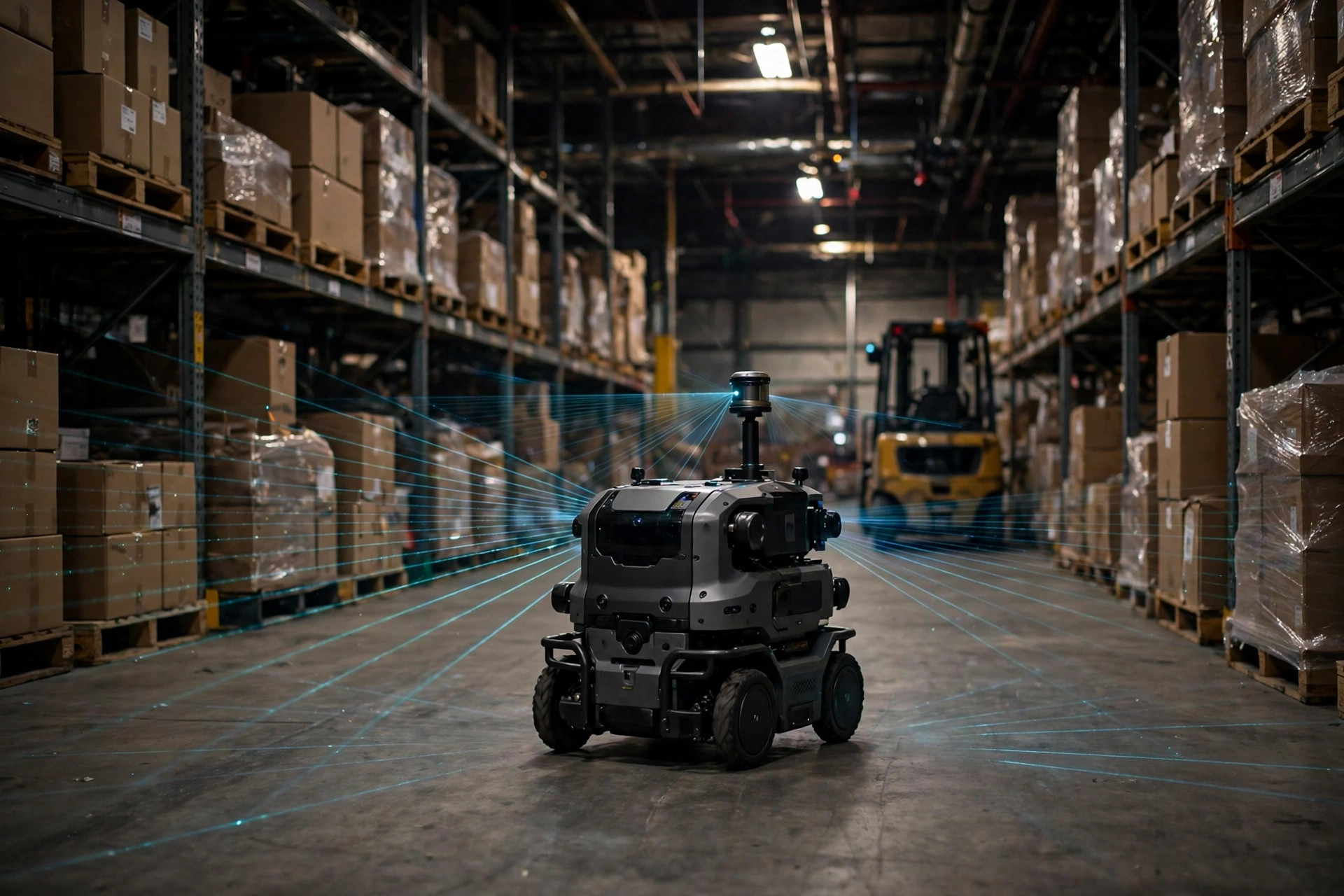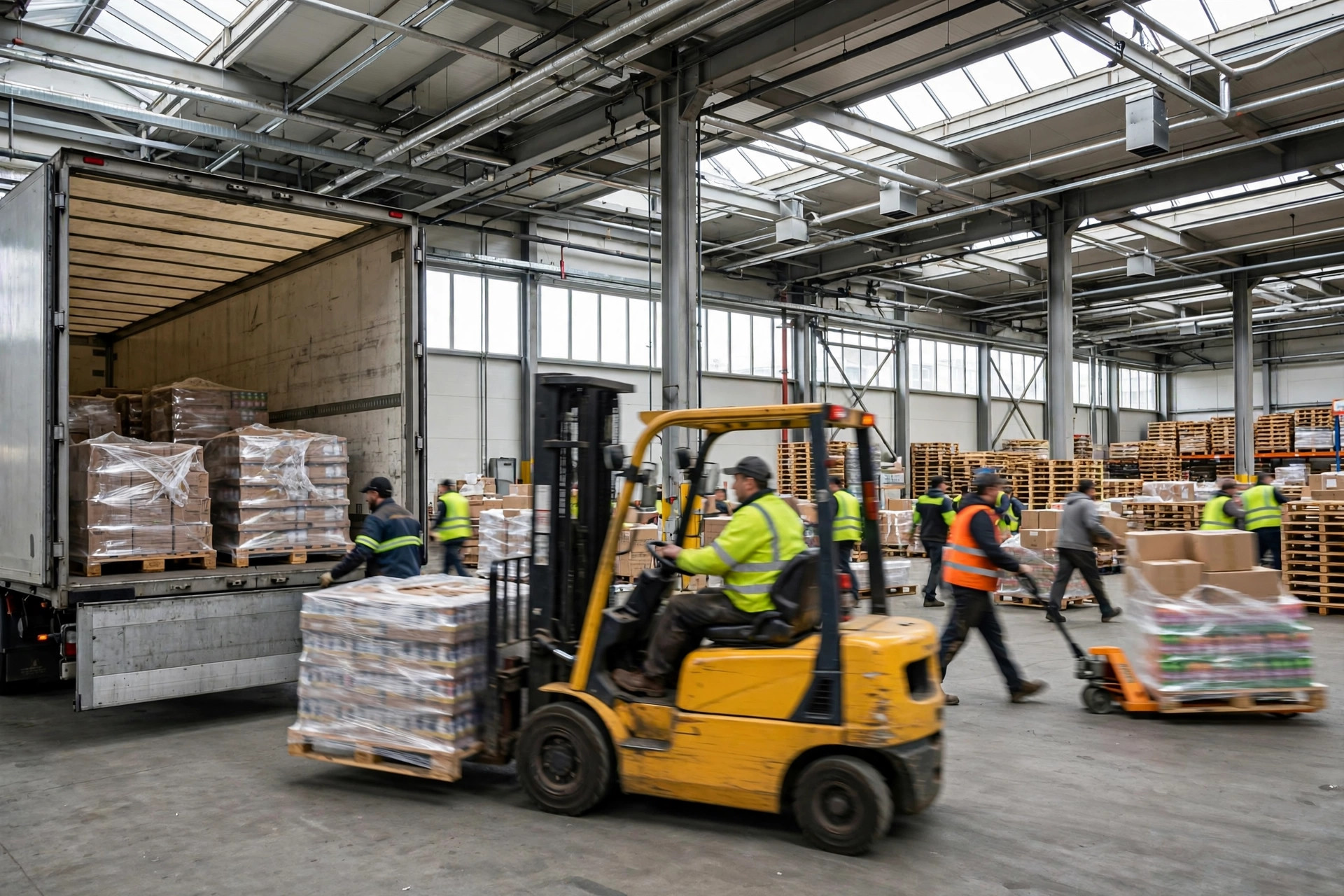
During Black Friday week in 2024, the operations director of a Midwestern US 3PL said something in the post-mortem that stuck with me: "We were defeated by our own wave plan." Daily order volume was more than triple the norm. The WES released a wave every 90 minutes like clockwork, six waves neatly lined up — yet during the third and fourth waves, pickers queued at the mouth of Zone A while totes piled up in front of the put wall waiting for verification. The data later showed walking distance had risen only about ten percent; the real killer was overlapping waves and downstream congestion. That is why AI wave optimization keeps surfacing in warehouse conversations: the problem was never just "how to group orders," but a set of mutually constraining decisions made under hard constraints.
Why AI wave optimization matters: picking is where the money goes
A 2025 warehousing case study in Applied Sciences puts order picking at 50 to 75 percent of total warehouse operating costs and roughly 55 percent of total labor time. Figures vary across studies, but the conclusion holds: picking is the most expensive activity in the building, and wave planning determines its structure.
Wave optimization, in other words, operates on the single largest block of the warehouse cost structure — which is why nearly every major WES vendor has added "intelligent wave planning" to its roadmap in the past three years. But between roadmap and results lies the complexity of constraints.
The algorithmic logic of AI wave optimization: three generations
To see what AI actually does here, restate wave planning as an optimization problem. Input: a pool of orders awaiting fulfillment. Output: a set of waves, each a group of orders plus a release time. The objective is typically to minimize total picking travel or labor hours while beating carrier cutoffs — subject to at least four constraint families: cutoff and pickup windows, location distribution and hot-zone congestion, labor availability and skill mix, and equipment takt time.
The first generation was rules engines: hard cuts by cutoff time, stacking by carrier, order type, and priority. This was standard WMS practice before 2015 — human experience encoded as code: explainable, controllable, and completely inelastic when order profiles shifted.
The second generation brought heuristics and clustering: orders with nearby pick locations get clustered together, routes are approximated with traveling-salesman heuristics, and simulated annealing or genetic algorithms search for a near-optimal balance of wave size and release cadence. This is today's commercial WES mainstream, and the real core of most "AI wave planning" products — the name says AI, but the engine is usually operations research.
The third generation uses machine learning and reinforcement learning: predicting arrival patterns and per-order pick times from history, then deciding dynamically whether to release now or wait ten minutes. Many papers, few production deployments.
A counterintuitive finding: timing beats grouping
Most discussions of AI wave optimization focus on grouping orders more cleverly — finer clusters, shorter routes. But a 3PL I studied in late 2024 — a roughly 50,000-square-meter Midwestern facility handling home goods — pointed to a different conclusion.
After fixed 90-minute waves in the 2023 peak, the site added a wave module with arrival prediction in 2024. The biggest improvement was not "smarter grouping" — it was the system dynamically answering when to release each wave. When the model predicted a large batch of same-carrier orders arriving within 30 minutes, it would deliberately delay release, merging what would have been two picking trips into one. Per the operations lead I interviewed, average picker walking distance fell roughly twenty percent during peak — more than half of that gain from release-timing decisions, not grouping logic.
The logic is straightforward: wave planning is fundamentally a decision in the time dimension, and every grouping optimization rests on a prior judgment — wait for the next batch or not? Waiting buys consolidation but compresses fulfillment time; releasing now protects service levels but may waste a trip. The value of AI is turning that trade-off from gut feeling into something computable: given arrival forecasts and remaining capacity, find the release point with the lowest expected cost.
The other trade-off: the faster you pick, the harder you jam
There is a harsher reality. A cross-border e-commerce warehouse in eastern China cranked up batching before the 2024 peak: wave sizes doubled, picker productivity genuinely improved. Two weeks later the bottleneck moved downstream: verification queues at the put wall exceeded 40 minutes, and staging totes spilled into borrowed aisle space. The site retreated to "looser waves plus pre-sorting," and overall dock-to-ship lead time ended up better than in the aggressive phase.
The lesson vendors rarely volunteer: an objective function that only minimizes picking travel can easily produce a systemically suboptimal solution. The real constraints sit downstream — verification, packing, staging, and loading capacity. An AI batching model must ingest downstream takt time as a hard constraint; otherwise every minute saved in picking gets repaid with interest at the staging area. This is also the most common failure mode of second-generation deployments: beautiful in simulation, schooled by queuing theory on the production floor.
Before you deploy: does your warehouse qualify?
Not every warehouse deserves AI wave optimization. The framework below synthesizes vendor cases and published research; figures are order-of-magnitude estimates:
| Warehouse profile | Daily order volume | Recommended approach | Expected gain (order of magnitude) | Data prerequisite |
|---|---|---|---|---|
| Micro warehouse, single zone, <5,000 SKUs | Under 2,000 orders | Fixed waves plus operator judgment | AI investment likely net-negative | None |
| Mid-size, single zone | 2,000–10,000 orders | Rules engine plus simple clustering | 5–15% less travel distance | 6+ months of order history |
| Large, multi-zone | Over 10,000 orders | Heuristic optimization plus dynamic release | 15–25% less travel distance | Order, slotting, and labor data all complete |
| Automated (AMRs, sorters) | Any | Joint optimization with equipment scheduling | System-level throughput gain | Real-time equipment data streams |
Note the first row: under a few thousand orders a day, ROI is very likely negative — not because of the algorithm, but because of the denominator. Data cleansing, integration, and tuning carry fixed costs while a small order pool offers limited headroom. Getting ABC slotting and wave discipline right pays more. That is the first boundary of honest AI ROI accounting.
Data preparation for AI wave optimization: three datasets, none optional
This echoes an earlier point: data preparation determines whether warehouse AI succeeds or fails. Wave optimization needs three datasets; missing any one degrades the model back to a rules engine:
First, order history: at least 6 to 12 months of order-level detail, including timestamps, order composition, carrier, and priority. This fuels arrival forecasting — yet in many warehouses it sits split between OMS and WMS with inconsistent timestamps, the most common trap.
Second, slotting and velocity data: location coordinates, historical pick frequency, and putaway records for every SKU. Without accurate location master data, the "hot zones" produced by clustering are simply wrong. Bad slotting data is the number-one cause of failed wave optimization projects.
Third, labor and takt data: engineered standards by process step, historical actuals, and worker skill tags. Without it, the "optimal wave" the model produces may be a plan the current team physically cannot execute.
All three must be real-time, replayable, and consistently defined. Replayability is the critical one: take a real order stream from three months ago, re-run it through the new model, compare against what actually happened. Without that, any "AI improves X by Y%" claim is unverifiable.
Trend outlook, 2025–2027: three shifts
My read of the next two to three years:
First, second-generation techniques — heuristics, clustering, dynamic release — will become standard WES features rather than separately sold AI modules. Wave intelligence is moving from differentiator to table stakes, likely around 2026.
Second, third-generation approaches like reinforcement learning for dynamic release will see limited pilots at top-tier 3PLs and captive e-commerce fulfillment networks, but broad commercial use will wait for data infrastructure to catch up. The algorithm is no longer the bottleneck; real-time, clean, replayable data pipelines are — and that is exactly what most warehouses lack.
Third, wave optimization will merge with downstream scheduling — verification, packing, appointment loading — into a larger joint optimization problem. The era of optimizing picking in isolation is ending; system-level optimization is the theme of the next decade.
An open question
So perhaps the right question is not "can AI batch orders better" — mathematically, almost certainly yes. It is whether your warehouse has turned every wave release and batching decision into structured data. If not, then no matter how many generations the algorithms advance, five years from now you will face the same Black Friday — batching by instinct, surviving peak by luck.
By Dr. Chen, Supply Chain Researcher