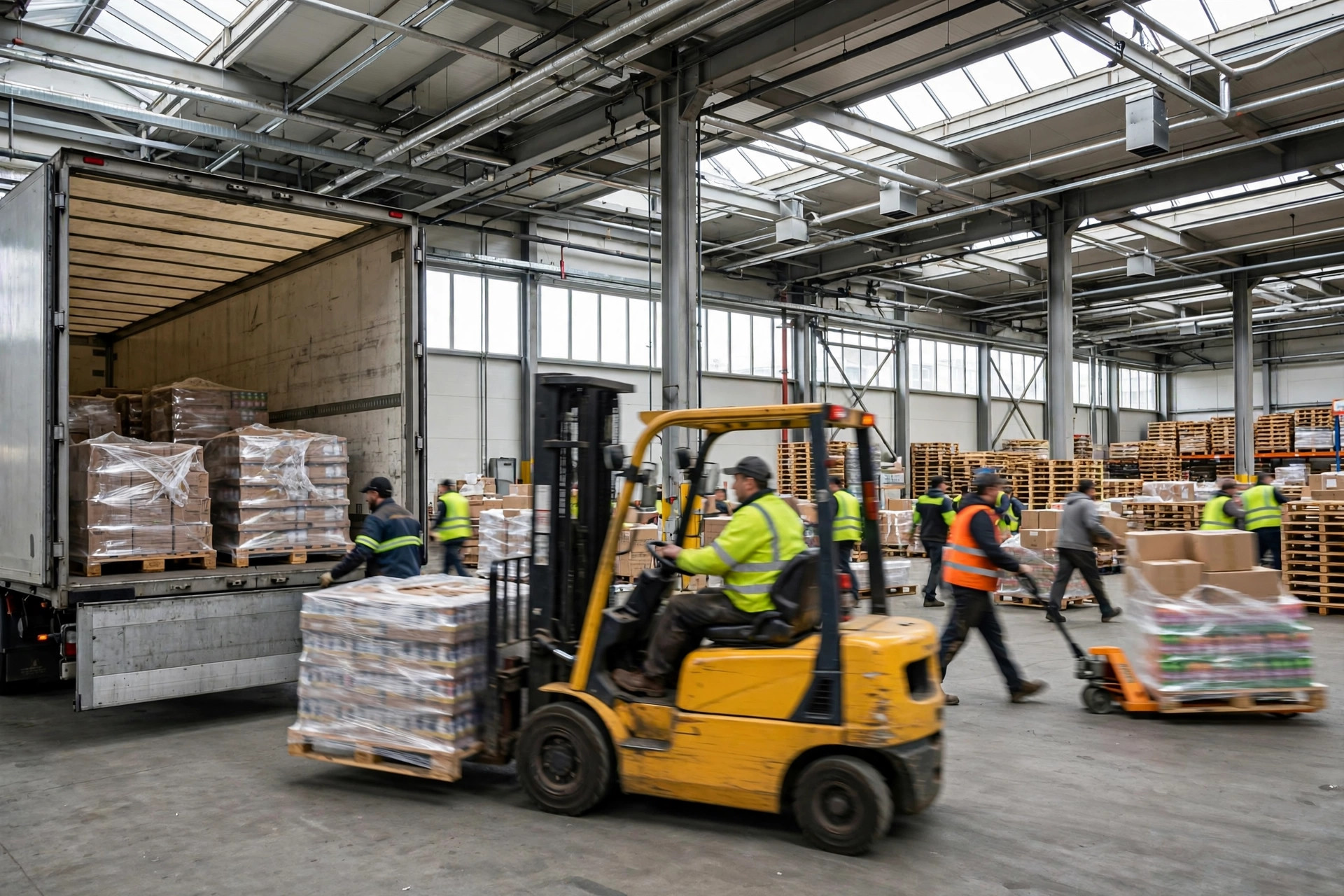
Here's the verdict up front: most warehouses pay for one handling touch they never needed. Freight arrives, gets broken down at receiving, gets put away into storage, then gets picked back out a few days later. The same pallet gets touched by a forklift twice. That is money walking out the door.
WES putaway optimization exists to fix exactly this. The moment freight arrives, the system has already figured out where it's going: anything that can flow straight through to shipping goes to outbound staging or straight to a pick face. Only freight that genuinely needs storage goes into a storage location. One less touch isn't about saving forklift fuel — it's about eliminating every cost attached to that touch.
Why WES Has to Own This, Not the WMS
A WMS can do putaway rules: A-movers near the dock, heavy freight low. But WMS rules are static. They can't see what's happening right now.
One case sticks with me — and I've seen this pitfall three times across different clients: November 2023, a 3PL outside Shanghai running an 18,000-square-meter facility for small home appliances. The week before Singles' Day, their receiving area was buried under 400+ pallets. Forklift drivers were working 8 AM to 10 PM and still couldn't keep up with putaway. The owner asked me: "We configured ABC putaway rules — why is it getting worse the busier we get?"
Three days of data told the story: the rules were right, but the timing was wrong. Of those 400 pallets, 120 were already committed to outbound orders shipping the next morning. Static rules dutifully put them into storage, and the next day pickers pulled them right back out. 120 pallets, each touched one extra time, for nothing.
A WMS tells you where freight belongs. A WES tells you whether it should go there right now. Dynamic putaway orchestration weighs four live inputs:
- Open demand: are there outbound orders (or planned waves) needing this freight in the next 24–72 hours?
- Storage reality: is the target location full, half-full, or nonexistent right now?
- Resource state: are the forklifts slammed? Are the flow-through lanes clear?
- Freight characteristics: shelf life, lot requirements, mixed pallets.
Static rules only look at number four. WES looks at all four.
The Four-Step Flow-Through Setup
Step 1: Tag the destination at receiving — before assigning a location
Traditional flow: receive → QC → WMS assigns location → put away. New flow: receive → WES computes destination → tag it (flow-through / replenishment-direct / store) → route by tag.
The tagging logic lives in the WES decision engine. A starting template:
- Outbound demand in the next 48 hours covers ≥80% of inbound volume → flow-through
- Demand exists but covers <80%, and pick-face inventory is below the replenishment trigger → replenishment-direct (straight to the pick face)
- No near-term demand → store (normal putaway rules)
That 48-hour window isn't arbitrary: too short and flow-through volume never materializes; too long and forecasts get unreliable, so freight piles up in staging. I usually start clients at 48 hours and tune after two weeks of data. The Shanghai 3PL landed on 36 hours — they run two order waves a day, and 36 hours covers exactly three waves.
Step 2: Tier your flow-through — it's not one thing
Flow-through comes in three forms with very different cost and risk profiles:
| Form | What happens | Best for | Watch out for |
|---|---|---|---|
| Full-pallet flow-through | Whole pallet moves from receiving to outbound staging | High volume, single SKU, full-pallet outbound | Staging lanes clog if space runs out |
| Break-bulk flow-through | Pallet broken down at receiving, sorted to orders | Multi-SKU, small batches, e-commerce orders | Break-bulk labor is expensive |
| Replenishment-direct | Skips storage, goes straight to the pick face | Pick face running low, inbound arrives just in time | Pick-face capacity is limited |
The decision framework is a simple 2×2: horizontal axis is "how well inbound volume matches near-term demand," vertical axis is "SKU concentration." Top-right (high match, concentrated SKUs) → full-pallet flow-through. Top-left → break-bulk flow-through. Bottom half → check the pick face; replenish direct if it fits, otherwise store it.
Step 3: Write down who owns what — WES, WMS, and equipment
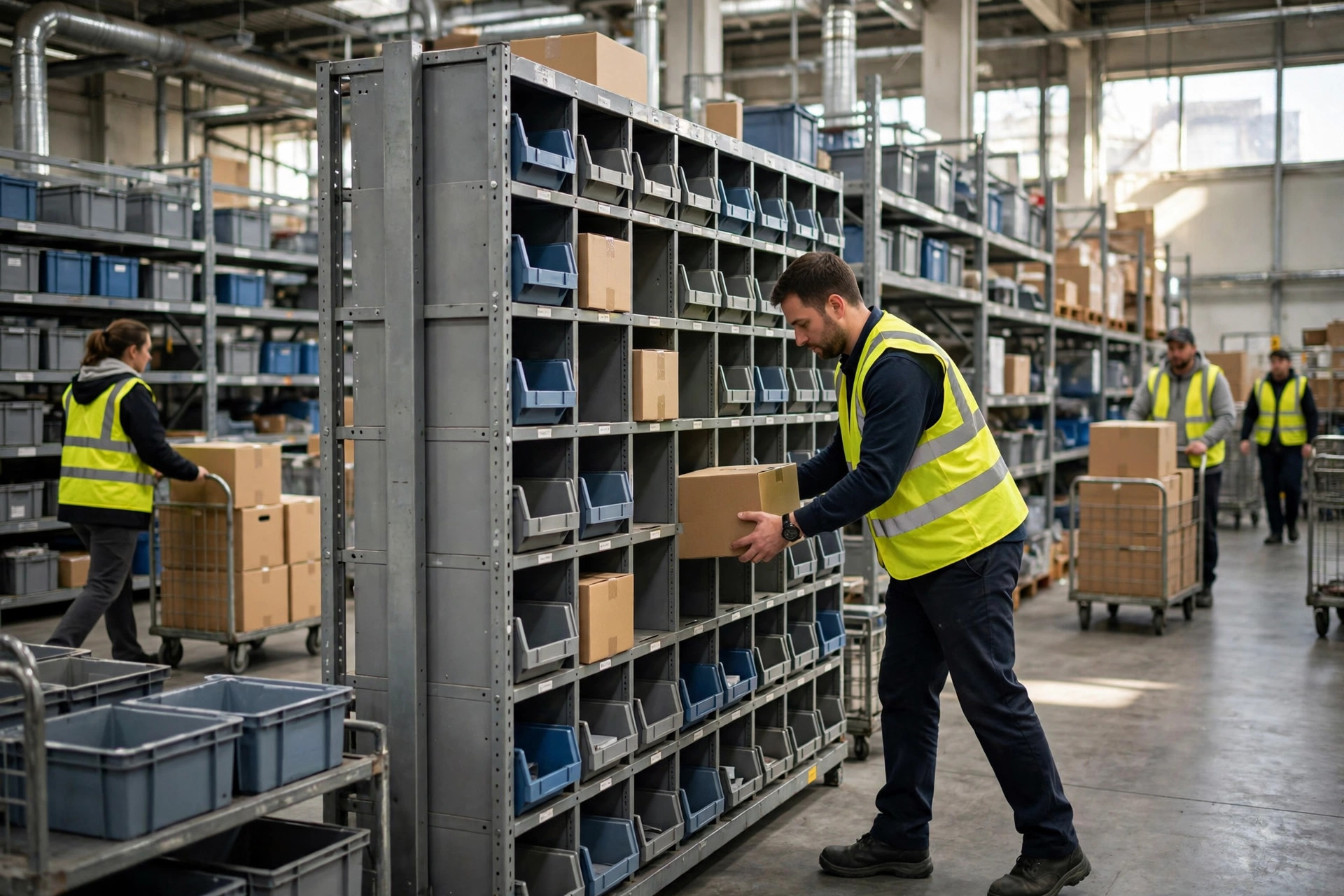
This goes on the go-live night checklist, non-negotiable: WES owns the destination decision, WMS owns location execution, MHE (conveyors/AGVs) owns the physical move. Three layers, written into the interface spec, so when something breaks you read the logs and know which layer failed.
The handoffs:
- WES receives the ASN → returns a destination tag plus a target (staging lane / pick face / unassigned) within 3 seconds
- Tag = store → WMS assigns a location under the existing putaway rules
- Tag = flow-through → WES dispatches the move task directly to the forklift terminal or AGV scheduler, bypassing WMS entirely
- Exceptions (target full, order cancelled) → WES recomputes within 10 seconds, issues a new destination, auto-voids the old task
Number 4 is the critical one. May 2024, a beauty e-commerce warehouse in South China: flow-through freight was already sitting in staging when the customer cancelled 30% of the orders. Without recomputation, that freight rots in staging. Their WES rescans in-transit flow-through every 10 minutes; when demand evaporates, the task flips to putaway and a forklift carries it off on the next pass. Flow-through decisions must be revocable. That's the real difference between WES orchestration and hardcoded rules.
Step 4: After go-live, watch three numbers and tune
- Flow-through rate = flow-through pallets ÷ total inbound pallets. Healthy is typically 15%–35%. Below 15%, your rules are too conservative. Above 40%, check whether freight that should be stored is being forced through.
- Flow-through dwell time = average hours flow-through freight sits in outbound staging. Over 24 hours means backlog — your demand forecast is too optimistic, tighten the threshold.
- Re-handle rate = share of flow-through freight that ends up being put into storage anyway. Over 10% means decision quality is poor — go check which data source is lying (orders, inventory, or wave plan).
Three Real Failure Modes
Failure 1: No physical separation for the flow-through zone. 2022, an auto-parts warehouse in North China. Flow-through pallets and awaiting-putaway pallets shared the receiving floor, separated by nothing but painted lines. When things got busy, drivers ignored the lines: flow-through freight got put into storage, storage-bound freight got dragged to outbound. A full week of chaos. Lesson: the flow-through staging area must be physically distinct — its own dock doors, its own location numbering range, its own location group in the WES.
Failure 2: Forcing lot/expiry-controlled freight through. Food, pharma, anything with strict FIFO — flow-through's biggest risk is breaking lot traceability. The freight ships before lot capture is complete, and the system's lot records no longer match reality. My rule: expiry-sensitive SKUs are excluded from flow-through by default, unless lot capture has moved upstream to receiving and the WES can read lot data in real time.
Failure 3: Turning flow-through into a KPI target. One operations director heard flow-through saves money and set a "flow-through rate ≥ 50%" KPI. To hit it, the warehouse flowed through freight that needed two weeks of storage. Outbound staging turned into a mountain, they hired temp labor for weekend re-warehousing, and spent an extra six figures in a month. Flow-through rate is an outcome metric, not a target. The target is minimum total handling cost. Flow-through is one lever, not the goal.
The Counterintuitive Call: Sometimes an Extra Touch Is Cheaper
Here's the contrarian take: more flow-through isn't always better. The most extreme counterexample — a book e-commerce warehouse with brutally fragmented SKUs, 40+ per pallet. Their WES calculated a 50% flow-through rate, but break-bulk flow-through labor ran about $1.10 per unit while normal putaway-plus-pick totaled roughly $0.75 per unit. Flow-through saves forklift moves, but break-bulk flow-through spends manual sort labor. Both sides of the ledger have to be counted.
The math is simple:
Flow-through cost per pallet = break-bulk labor (if any) + sort labor (if any) + one move Traditional cost per pallet = two moves + putaway labor + pick labor
Only when the left side is below 85% of the right side (keep a 15% safety margin) is flow-through genuinely cheaper. The book warehouse kept full-pallet flow-through for bestsellers during peak season and killed break-bulk flow-through entirely. Total cost dropped 12%.
Back to that Shanghai 3PL: three months after go-live, flow-through rate held at 28%, peak receiving backlog dropped from 400+ pallets to under 150, and forklift shifts went from two to one and a half.
WES putaway optimization comes down to one sentence: when freight arrives, ask where it's going before deciding where it goes. Get that order right, and you save one touch — plus the labor, equipment, and time behind it.
By Lin Xiao, WMS Implementation Consultant