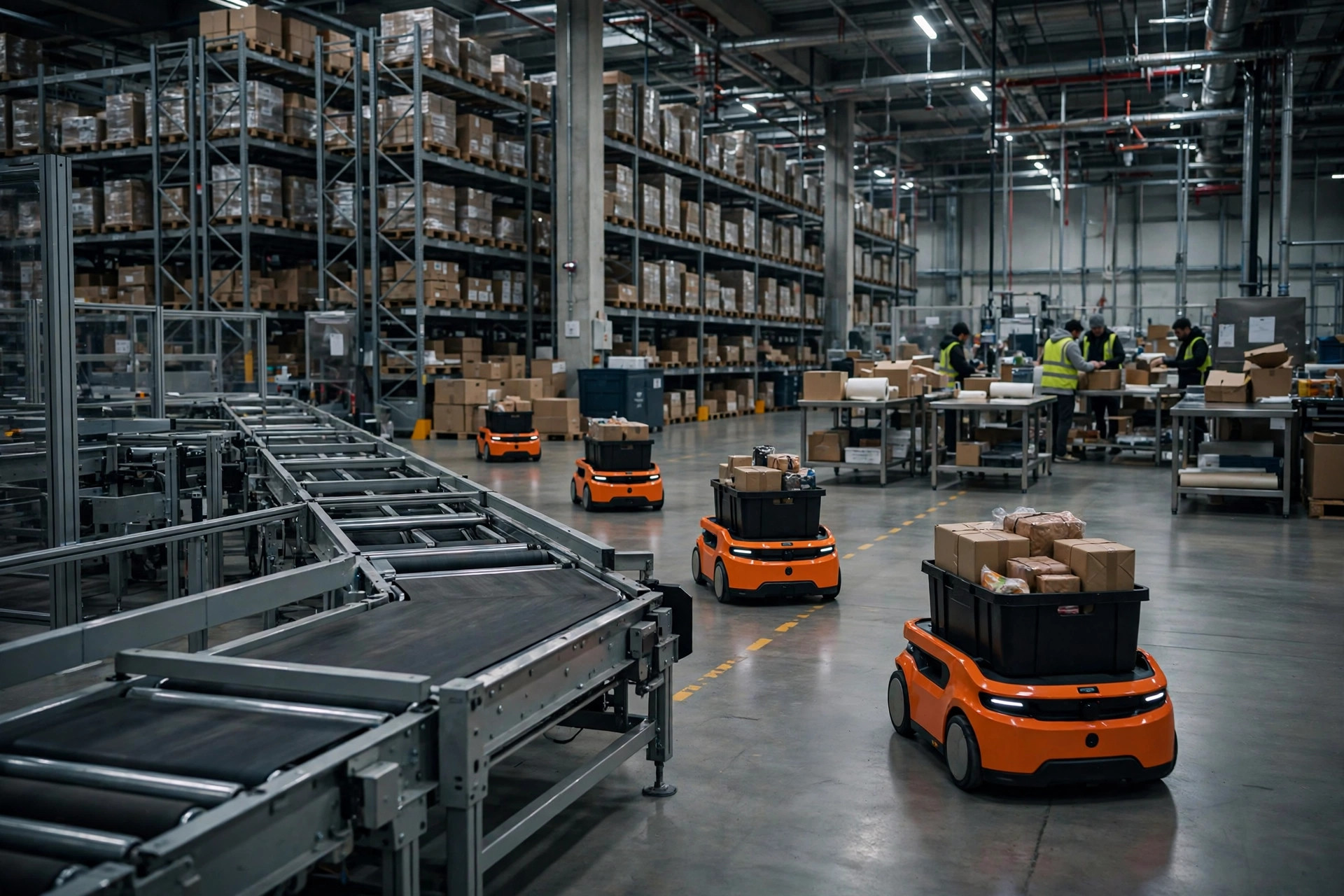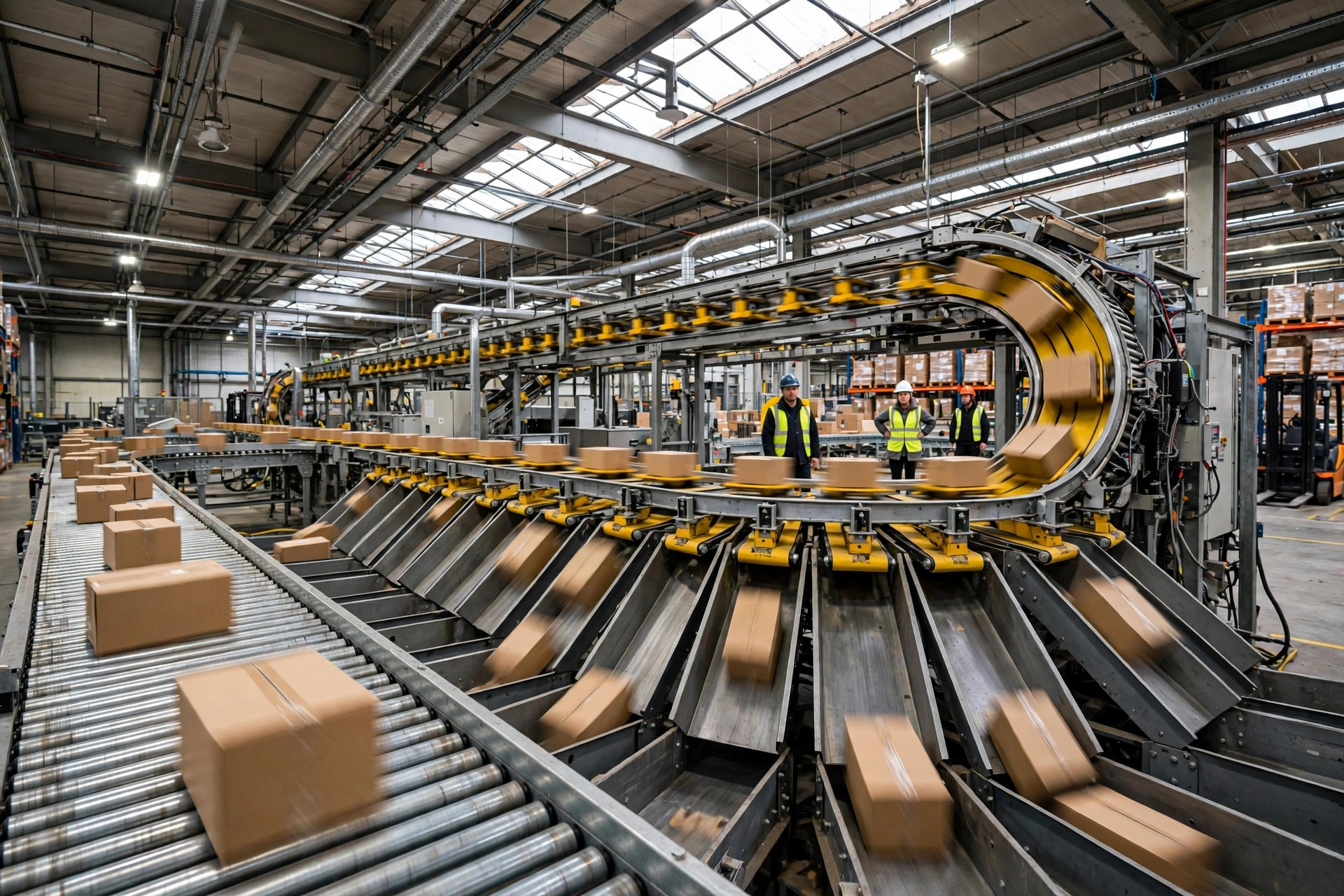
The hardest part of WES equipment orchestration was never the performance of any single machine. It is the fact that three machines keep three different clocks. The conveyor pushes at a fixed takt, the sorter consumes at carrier takt, and the AMR fleet moves on a task queue. When no single logic aligns those three clocks, the most expensive machine on the floor usually ends up waiting on the cheapest interface.
According to published selection guides from multiple sortation equipment vendors, a cross-belt sorter's rated throughput typically sits in the range of 10,000 to 20,000 parcels per hour; conveyors commonly run at 1 to 2 meters per second; and an AMR fleet manager's dispatch cycle is generally measured in seconds. Put those three numbers side by side and the first conclusion writes itself: the three subsystems do not even live on the same time scale. WES equipment orchestration is, at its core, the work of aligning millisecond, sub-second, and second-level clocks onto one production takt.
WES Equipment Orchestration Starts with Three Clocks
Start with the phenomenon. On a typical line where a conveyor inducts, a cross-belt sorter sorts, and AMRs handle exceptions and full cartons, timing misalignment shows up in three familiar forms: the sorter idling while it waits for induct, the conveyor backing up while it waits for the sorter, and AMRs queuing at the handoff station waiting for tasks. The common thread is that each machine looks fine in isolation; the failure only appears at the handoff instant.
There is a structural fact here that is easy to miss. Coordination between conveyor and sorter has traditionally been solved with PLC hard interlocks — photoeyes plus safety chains, latency measured in milliseconds. An AMR is a software-defined machine: every move passes through task allocation, path planning, and traffic control in the fleet manager, so its decision latency is inherently measured in seconds. If a WES schedules an AMR the way it schedules a conveyor, misalignment is all but guaranteed.
What a Misalignment Costs in a Three-Way Coordination
In June 2024, a 3PL distribution center in eastern China serving a top e-commerce platform reviewed its 618 shopping-festival peak and found a counterintuitive number: during peak hours, the cross-belt sorter was processing only about sixty percent of its rated capacity — while downstream, the AMRs assigned to exception parcels and return cartons were queuing at the handoff. The equipment vendor's post-mortem was blunt: the timing configuration had treated the AMR as a downstream sink of infinite throughput, and the entire handoff had been given just two dock positions. A single dock's full handoff cycle — align, lift or transfer, clear — takes several times longer than the sorter's per-parcel sort takt, so two docks could never mathematically keep up. The fix was unglamorous: four docks instead of two, plus appointment-based dispatching of exceptions from the WES. Dwell time for exception parcels at the handoff fell from hours to the ten-minute range.
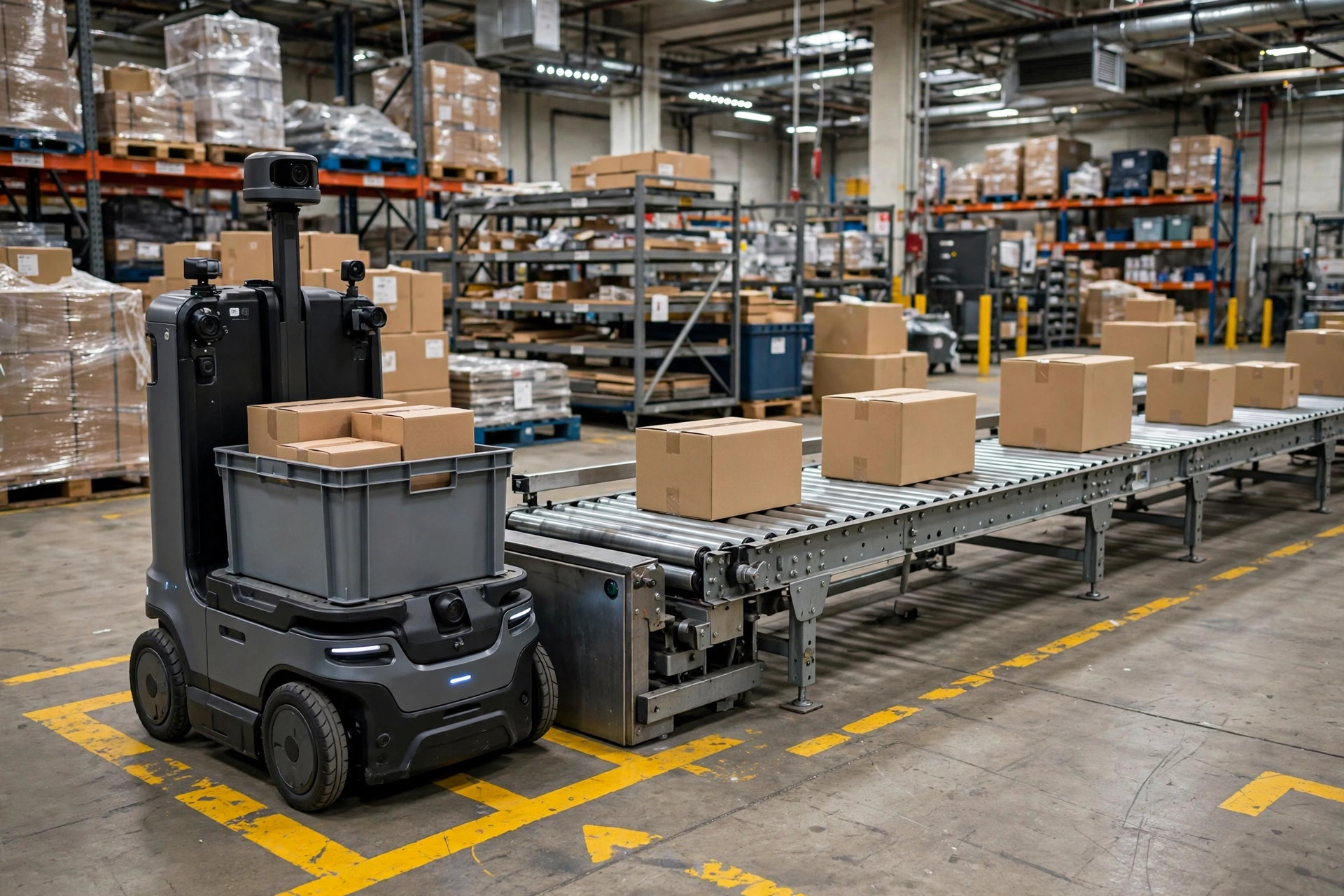
A second case comes from southern China. A cross-border e-commerce warehouse commissioned in late 2023 used AMRs to replenish cartons from storage to the sorter induct stations, with conveyors returning the empty cartons. In the first month, the most common sight on the floor was AMRs queuing in front of the induct stations while the conveyor ran dry waiting for cartons at the other end. The attribution pointed to a clash of two takt philosophies: the conveyor is push-based and runs at a fixed takt no matter what, while AMR replenishment was pull-based, with the WES dispatching tasks triggered by induct-station inventory levels. With no buffer designed between push and pull, the AMR arrived before the carton was empty, and the carton sat empty while the AMR was still en route. The eventual fix was takt forecasting inside the WES: dispatching one takt cycle ahead of the sort plan so that AMRs "arrive early" instead of "depart on demand." Induct starvation largely disappeared.
Both cases reduce to the same accounting logic: the throughput of a three-party coordinated system equals the slowest of the three takts, multiplied by a loss factor at each interface. Everyone calculates standalone machine capacity during equipment selection; almost no one calculates the interface takt as its own line item.
Three Layers of Root Causes in WES Orchestration Timing
Dig one level deeper, and timing problems in WES equipment orchestration usually come from three layers — and the layers amplify one another.
The first is the physical interface layer: docking accuracy, transfer heights, communication protocols. A docking deviation on the order of plus-or-minus 10 millimeters between an AMR and a conveyor can trigger a failed transfer and a retry, and a single retry can consume an entire takt cycle. The defining trait of this layer is that it is expensive to fix, because the fix is hardware.
The second is the takt-matching layer: the ratio among induct takt, sort takt, and handoff takt. Common engineering practice sizes induct capacity at 1.1 to 1.2 times sort capacity, and sets the number of handoff docks by rounding up single-dock handoff time divided by the sort takt interval, plus one spare. Note the logic: redundancy is not waste; it is absorption capacity for variance. A timing configuration with no redundancy looks beautiful at steady state and falls apart at the first peak-season wave.
The third is the decision-latency layer, and it is the most underestimated of the three. The PLC world runs in milliseconds, WES task orchestration runs in seconds, and the AMR fleet manager adds path planning on top. The real bottleneck in a three-party coordination is often not the most expensive machine but the slowest decision loop. Here is the counterintuitive judgment: in many projects the bottleneck is not the sorter at all, but the few seconds it takes the WES to dispatch a task to an AMR — a delay that turns into visible queuing at high takt rates.
A Configuration Framework That Actually Ships
From that attribution, timing configuration converges on three steps. First, do the takt math: list per-unit times and parallelism for induct, sort, and handoff, find the theoretical bottleneck, and size everything around it with a 1.1 to 1.2 redundancy factor. Second, decouple by layer: push millisecond-level coordination — e-stops, interlocks, photoeye triggers — down to PLCs and edge controllers, and let the WES handle only second-level task orchestration. Do not try to run two time scales on one system. "Fully centralized scheduling" sounds elegant, but at high takt rates, decision latency eats every theoretical optimization gain. Third, give exceptions their own lane: exceptions, returns, and full cartons — the three unplanned flows — need independent handoff takts and buffer positions. Sharing takt with the mainstream flow means a single exception contaminates the rhythm of the entire line.
| Coordination pattern | Fits | Strength | Cost |
|---|---|---|---|
| PLC hard interlock + WES task layer | Single line, mid throughput | Lowest latency, most stable | Inflexible; line changes touch hardware |
| Unified WES orchestration | Multi-line, large AMR fleets | Globally optimal dispatch, easy to scale | Higher decision latency, sensitive to network jitter |
| Siloed, manual fallback | Pilots, low volume | Fast to launch | Collapses at scale; highest long-run cost |
On the trend side, two data points matter: the VDA 5050 AMR communication interface standard has advanced noticeably over the past two years, and mainstream WES vendors have started building takt simulation into their pre-sales tooling. My judgment, with a timeline attached: within the next two to three years, WES timing configuration will move from project-by-project tuning to productized templates — the same road WMS wave strategies walked years ago. But templating does not mean simplification. Quite the opposite: templates only work once parameters that used to live in veteran engineers' heads — interface takts, decision latencies — become measurable, simulatable engineering inputs.
Several questions have no standard answers yet, and they are worth watching. When an AMR fleet grows past fifty units, can second-level WES dispatching still keep up with millisecond line takt, or is a second-tier edge scheduler needed? When the conveyor, the sorter, and the AMR come from three different vendors, where exactly should the boundary of timing responsibility sit in the protocol stack? And when push-based and pull-based takt philosophies must coexist on the same line, is there a general formula for optimal buffer depth? None of these has a settled conclusion — but each one will decide whether the next project succeeds or fails.
By Dr. Chen, Supply Chain Researcher