Let me give you the answer up front: WES and WMS are not substitutes. In my projects, the overwhelming majority of warehouses asking for WES don't actually need it — they need to configure the WMS they already own correctly. WMS answers "which orders ship today, where's the stock." WES answers "this minute, who does what first, who gets the aisle." Bad wave strategy, sloppy slotting, rush orders handled by shouting? That's a WMS configuration problem. Buying WES for that is like racing shoes for a sprained ankle. WES only earns its price when your automation becomes a scheduling black box and people and machines fight over floor space. Below: a 7-signal self-check plus a decision tree. Five minutes, and you'll know your answer.
WES vs WMS: The One-Sentence Division of Labor
I explain the three layers with one sentence: WMS is the brain — it decides what to do. WES is the dispatcher — it decides how, and who goes first. WCS is the hands and feet — it just moves the equipment.
| WMS | WES | WCS | |
|---|---|---|---|
| Layer | Planning: orders, inventory, slotting | Execution: task orchestration, real-time dispatch | Equipment: device commands |
| Answers | Which orders ship today? Where is stock? | Which task goes to whom, right now? | Does the conveyor run? |
| Time granularity | Waves / shifts | Minutes, even seconds | Real time, milliseconds |
| Example | Wave strategy, slotting, replenishment | Wave release pacing, AMR right-of-way, exception reflow | Sorter divert action |
Once this clicks, most confusion evaporates. WMS says "wave 5, 400 orders, stock in zone A." WES decides "release 100 of those 400 first, route the AMRs down aisle 3." WCS makes the sorter's pusher arm actually push. Three layers, three jobs — but data has to flow cleanly between them. Every failure story below starts with a broken data link.
Here's the counterintuitive take first: plenty of warehouses screaming for WES haven't configured their WMS wave strategy correctly. Waves released in one blob by order creation time; at the evening carrier cutoff, 2,000 orders slam into the sorter and the chutes jam. The boss sees the mess and concludes "we need WES." I've seen this exact mistake three times. Every time, the fix was the same: waves in reverse carrier-cutoff order, 400 orders max per wave — jams gone, not a dollar on WES.
Do I Need WES? 7 Signals to Self-Check
Score yourself: 3+ hits → read the decision tree. 5+ → WES is probably worth a business case.
Signal 1: Wave release needs a babysitter. Someone has to guard the screen daily, manually releasing and topping up waves. Release 10 minutes late and you miss the carrier cutoff. The WMS wave templates exist but nobody trusts them — everything runs on the veteran supervisor's gut.
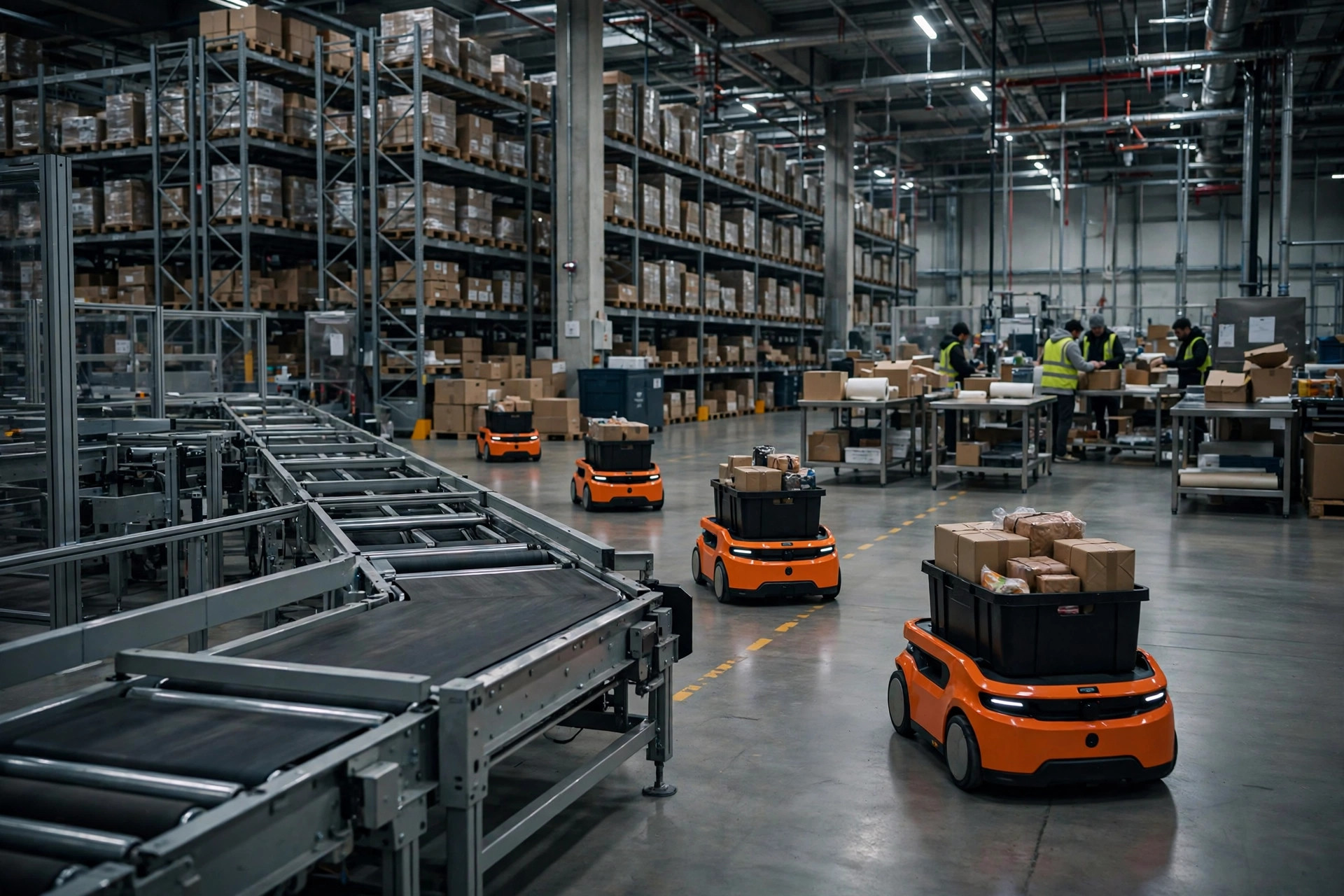
Signal 2: Your automation is a black box. The sorter spins and AMRs roll, but WMS sees none of it — idle bots, jammed lines, you find out by walking the floor. Automated but uncoordinated.
Signal 3: People and machines physically fight. Pickers and AMRs contest the same aisle mouth — bots alarm "path blocked," pickers curse the tin cans. WMS assigns tasks but can't referee who moves first.
Signal 4: Rush orders run on shouting. A key account's expedite lands; the supervisor yells "do this one first" down the floor — and the equipment doesn't honor it, because machines run on a separate task queue.
Signal 5: One equipment alarm kills the whole line. A sorter chute jams with no automatic exception reflow. Totes pile up; the root cause gets guessed at. WMS only knows "order not complete" — not where it's stuck.
Signal 6: Peak headcount doesn't scale output. You added 30% more people last peak; throughput rose 10%. The bottleneck isn't hands — it's orchestration.
Signal 7: Two or more automation systems, each a silo. AMRs from vendor A, a sorter from B, an AS/RS from C — three silos that point fingers when something breaks. This is WES's classic entrance: you need a neutral master dispatcher.

Optimize WMS First or Go Straight to WES: The Decision Tree
Four questions, in order:
Question 1: Does automation handle more than half of your picking capacity? Not yet → optimize WMS first. The bottleneck is almost certainly waves, slotting, replenishment — WMS fundamentals.
Question 2: Is your core pain a planning-layer problem — wave strategy, slotting, replenishment timing? Yes → optimize WMS. The action list: ① rebuild wave templates around carrier cutoff times, working backward; ② size each wave from sorter chute count and available labor; ③ redo ABC classification and get slow movers out of the golden slots. Run that a month, re-take the 7-signal test. Down to 2 or fewer hits? You don't need WES.
Question 3: Do people and machines — or machines and machines — need real-time coordination? WMS dispatches at wave/minute granularity — it can't referee "does the AMR yield now" or "person or robot for this order." Daily second-level conflicts → WES deserves a business case.
Question 4: Do you have two or more automation systems that need unified dispatch? Yes → go WES. Vendor A's system will never command vendor B's equipment; a neutral WES exists for this.
The tree ends in exactly two places: "optimize WMS, re-check in 6 months" or "build the WES business case." Skip the middle path — a "lightweight WES trial" costs nearly as much in integration and org change as the real thing.
Two real stories; names withheld.
In 2024, a beauty 3PL in the Yangtze River Delta, shipping 6,000–8,000 orders a day with a cross-belt sorter. The owner: floor jamming daily, "we definitely need WES." Two days on the floor showed the WMS released waves by order creation time — at the 8 PM cutoff rush, 2,000+ orders hit the sorter in one wave and the chutes choked. The fix: waves re-sequenced by the three carriers' cutoff times, 400 orders per wave max, next wave only after the sorter cleared the last. Jams gone. Peak survived. Zero dollars on WES. A WMS problem with a WES prescription — the classic misdiagnosis.
In 2023, a cross-border e-commerce warehouse in South China: 40 AMRs mixed with manual picking. Every afternoon the same showdown — AMRs alarming "path blocked," pickers yelling, supervisors playing traffic cop. WMS pushed tasks down and washed its hands of right-of-way. That's WES territory: virtual lanes for AMRs, automatic equipment slowdown during manual peak windows. Two weeks later, deadlock alarms were basically zero. The real-time coordination pain came first, then WES. That's when the money is well spent.
Three Failure Points — I've Seen This Exact Mistake Three Times
Failure point 1: WMS master data is garbage, so WES can't command anything. WES can be brilliant and still fail if the slotting data is wrong — it sends an AMR to A-03-02 and the stock isn't there. One food warehouse in East China went live with WES and drowned in exception tasks for three months; root cause, 15% of slot inventory didn't match reality. Cycle-count first, get accuracy above 98%, then talk WES. Reverse the order and WES becomes a very expensive scapegoat.
Failure point 2: The integration is half-done — status never flows back. Sending commands down is easy. The hard part is equipment reporting back "here's where I'm stuck" in real time. Too many projects test "commands go down" and never "exceptions come back up." My go-live night checklist always includes this line: unplug one machine's network cable and watch whether WES detects it within a minute and reroutes its tasks. Clients try to skip it every time.
Failure point 3: WES goes live, and nobody watches the dispatch dashboard. WES needs a human in the loop: a dispatcher with authority and KPIs. I've seen dashboards mounted on the wall as decoration while alarms rang unanswered and everyone drifted back to shouting. Before you approve the project: where does the dispatcher sit, and can they stop a line? Can't answer both — don't approve.
Go-Live Night Checklist: Check Every Box Before You Sleep
- WMS waves, ABC slotting, and replenishment rules optimized and run a full month; 7-signal retest scores 2 or fewer — otherwise your WES is paying off WMS's debts.
- Status feedback from every device integrated; the three drills — network drop, material jam, emergency stop — all pass.
- The dispatcher role is staffed, empowered, and measured; dashboard alarms have an owner.
- WMS ↔ WES ↔ WCS data dictionaries aligned: one slot, one task number, one name everywhere.
- Rollback plan written: if WES dies, can WMS hold the floor alone for 4 hours? If not, don't go live.
WES is a good tool, but it cures coordination disease, not management disease. Going live with WES on a misconfigured WMS is painkillers for a fever — discomfort fades, root cause stays. Walk the checklist; the answer follows.
By Lin Xiao, WMS Implementation Consultant