
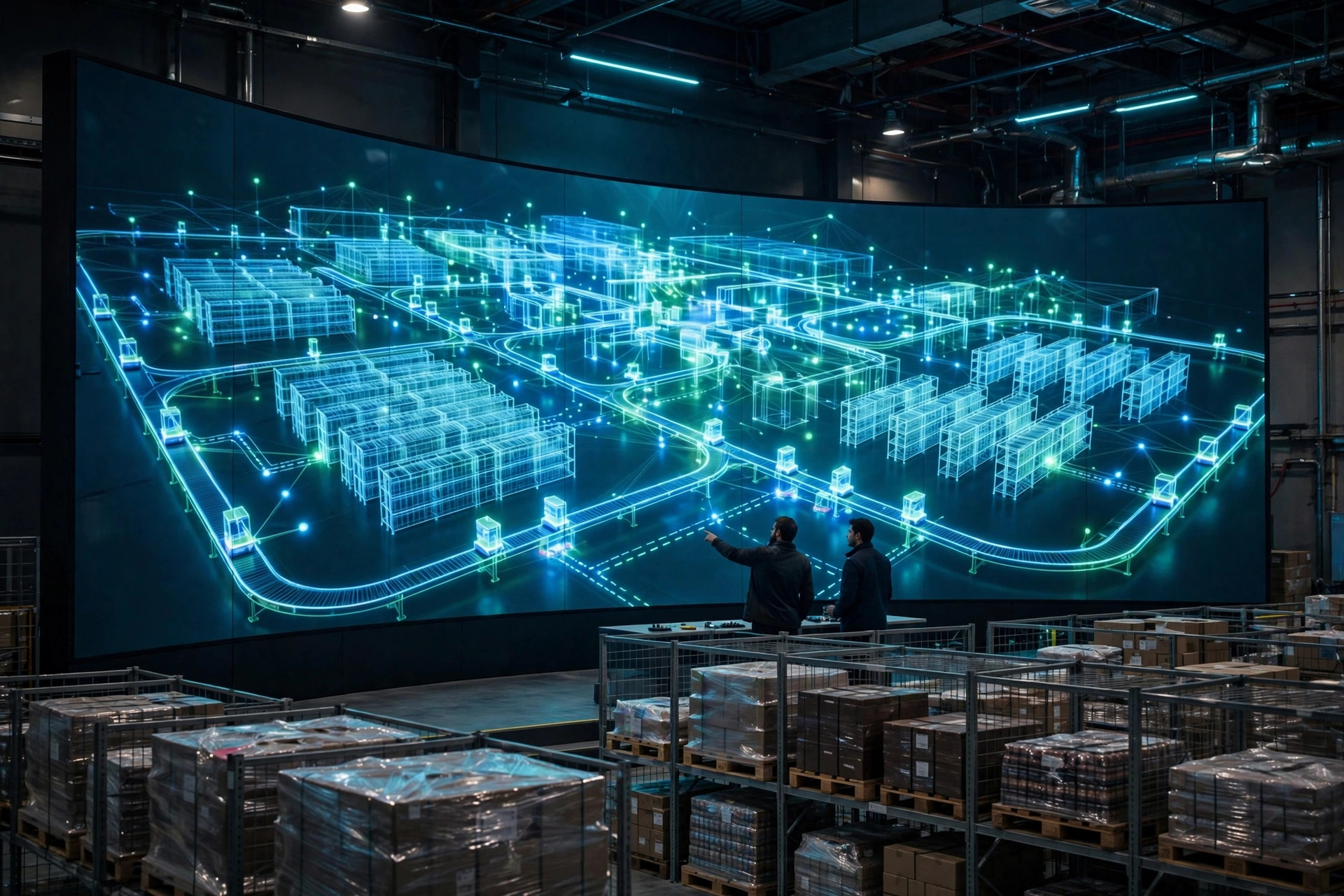
Rerouting a conveyor in a regional distribution center routinely means three days of downtime, with direct costs easily reaching six figures. That money could have been saved with a few servers and two weeks of simulation time. The more automated a warehouse is, the harder its layout is to change once built — and the cost of being wrong lands entirely after go-live. Digital twin warehouse simulation exists to fix exactly this "decide first, regret later" problem.
Why Simulate First: The Cost of Being Wrong Arrives After Go-Live
Over the past decade, layout rework has become almost standard in newly built automated warehouses: conveyor routings that do not make sense, pack-and-check areas drowning in orders during peak season, AMR fleets queuing daily in one main aisle. None of these problems are visible on a planning-stage floor plan, because a drawing is static and a warehouse is dynamic. Congestion, queuing, and demand peaks are all phenomena of the time dimension, which static drawings cannot compute.
According to publicly available industry observations, rework cost structures follow a pattern: moving equipment and re-routing conveyors are the small part. The real cost is the downtime window and the cascading adjustments — a mid-size rework pushing total direct and indirect costs into six-figure territory is not unusual. That explains why the simulate-first logic keeps gaining acceptance in automated warehouse planning: mistakes are cheapest at the planning stage and most expensive after go-live, and simulation simply moves the moment of discovery earlier.
The research side supports the direction. Gartner has placed digital twins prominently in its strategic technology trend reports for multiple consecutive years, DHL's Logistics Trend Radar has carried digital twins across several editions with its positioning shifting from "worth watching" toward "landing soon," and third-party consultancies generally forecast double-digit annual growth for the digital twin market over the coming years (see the original reports for exact figures). But heat is not maturity. Market enthusiasm and technical readiness are two different things, and that distinction deserves its own judgment below.
What a Warehouse Digital Twin Actually Models: Five Elements
A digital twin usable for layout decisions comes down to five modeling elements: static geometry (racking, aisles, equipment positions, building columns), equipment behavior parameters (conveyor speeds, AMR obstacle-avoidance and dispatch logic, lift cycle times), order and goods flow (order profiles, wave rules, SKU ABC distribution), human behavior (picker walking speeds, check-time distributions), and rules and policies (slotting logic, replenishment triggers). The first two determine what it looks like; the last three determine what it looks like in motion — and layout decisions depend on the motion.
Here is a counterintuitive judgment: more realism is not better. The marginal return on simulation fidelity diminishes fast. What decides between layout options is usually a macro-level conclusion like "where does the bottleneck appear under peak orders," not whether some device's turning radius is modeled to the centimeter. In my experience, 80 percent of decision value comes from 20 percent of modeling effort; the remaining modeling work mostly buys psychological comfort. Chasing real-time-twin fidelity turns a planning exercise into an IT project, and that is precisely why many simulation projects stall: the modeling team spends three months polishing visuals while the decision-maker only ever needed an answer to "will option A jam during peak season."
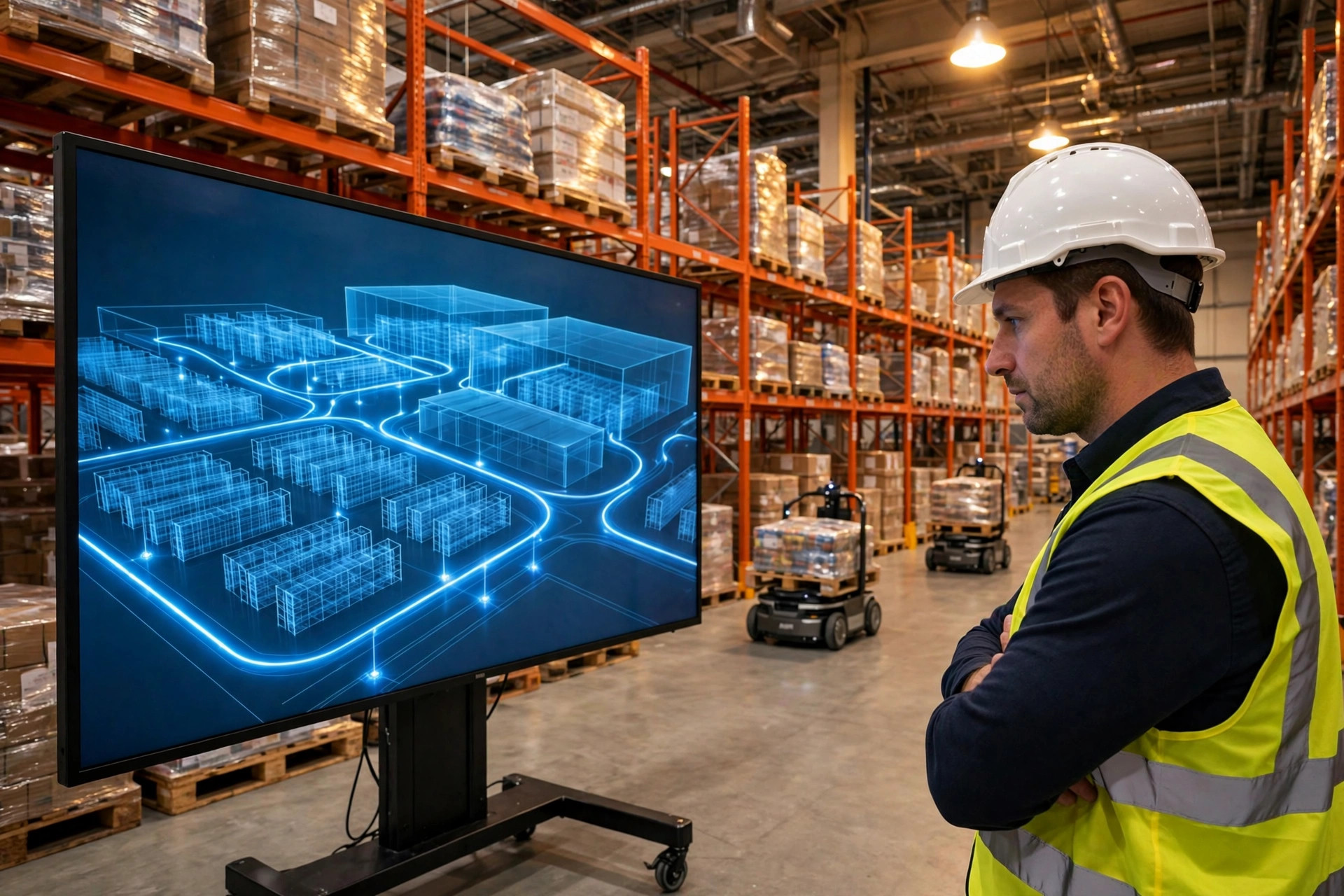
A 2023 case from the American Midwest illustrates the point. A 3PL building a new e-commerce fulfillment center used simulation during planning to validate its wave-picking process: running peak-season order profiles through the model revealed that check-station queuing pushed average order dwell time roughly 20 percent above the design value (per actual project measurement). Check stations were raised from six to nine before construction, and the first peak season after go-live passed without incident. According to the systems integrator's public project review at an industry conference that year, making that same change after go-live — conveyor rework plus downtime — would have cost an order of magnitude more than the simulation itself. A second case comes from Europe: in 2024, an automotive parts distribution center wavered between narrow-aisle (VNA) and wide-aisle designs, with racking and forklift investments differing by hundreds of thousands of dollars. Simulation compared both options under identical order profiles for pick efficiency and replenishment congestion, and found that VNA's storage-density advantage was partly offset by aisle congestion under high-frequency replenishment. The final choice was a hybrid. Both cases share one lesson: simulation never validates "which option is theoretically better" — it validates "under my order profile, which option breaks first."
Which Projects Justify Simulation: A Three-Axis Decision Framework
Not every warehouse deserves a digital twin simulation. Three dimensions decide: scale of automation investment, irreversibility of layout, and order volatility.
| Dimension | Worth simulating | Not worth it |
|---|---|---|
| Automation investment | Conveyors, high-bay storage, ASRS, AMR fleets — heavy assets | Mostly manual picking with conventional racking |
| Layout reversibility | Equipment nearly impossible to move once installed | Adjustable racking, flexible processes |
| Order complexity | Tens of thousands of SKUs, complex wave rules, strong seasonality | Simple, stable order profile |
The logic is plain: simulation buys the right to trial and error, and the more expensive trial and error is, the more simulation is worth. New builds and automation retrofits of existing sites are the two classic cases — retrofits arguably more so, because existing buildings and processes constrain the design and leave even less room for error. A few-thousand-square-meter, manual-pick operation is well served by experience plus back-of-envelope math; simulation there is overkill that cannot pay for itself.
A rough accounting (order-of-magnitude terms; actual projects will vary): a layout simulation engagement typically costs a low single-digit percentage of the automation equipment investment and takes two to six weeks. A mid-size post-go-live rework starts in the six figures in direct and indirect costs, plus several days of downtime. Simulation's real economic value is not "optimizing a few percent of efficiency" — it is cheaply falsifying impossible options. The value of falsifying a wrong design equals the entire cost of the rework it prevents.
Where Digital Twin Warehouse Simulation Stands: A Maturity Assessment
Why now? Four attributions: computing costs keep falling, making large-scale simulation runs affordable; game-engine-grade 3D rendering has dramatically improved modeling productivity; simulation software has matured from academic tools into industrial products with growing warehouse template libraries; and AMR and conveyor vendors have begun opening equipment-behavior parameter interfaces, so modeling no longer relies entirely on manual estimation. The first two lower costs, the last two mature the supply side — together pushing simulation from research project to engineering tool.
My trend judgment: within three to five years, offline simulation at the planning stage will become standard practice for automated warehouse projects. The basis is two rigid logics — per-project automation investment keeps rising, and rework costs are not falling — which means the economics of "simulate first" only improve. But the "real-time twin," bidirectionally linked with WMS and equipment controls to guide live operations, is further out. The bottleneck is not the model but data governance and organizational maturity: how many warehouses have location master data and equipment-state data clean enough to sustain a continuously updated twin? The answer to that question sets the timeline.
When simulation can run a thousand times, the scarce resource is no longer computing power but the ability to ask the right question. What is the first question your warehouse should validate in simulation? And when everyone plans with simulation, does the planning capability gap disappear — or does it migrate elsewhere, perhaps to anticipating shifts in order profiles? There are no standard answers, but they are worth settling before breaking ground.
By Dr. Chen, Supply Chain Researcher






