It was 6:40 on a Tuesday morning, peak season, and I was doing my usual early walk through the warehouse before the shift started. The moment I reached the consumables corner, my nose wrinkled — turpentine and paint fumes hanging in the air.
Three drums of paint thinner. Two with the lids off, one lying sideways on a pallet, still seeping from the rim. Cardboard boxes and stretch film stacked right next to them, a forklift rolling past. We keep thinner there for the maintenance crew to wipe down equipment and for the packing team to mix ink. Whoever used it just grabbed and left it. Nobody thought it was a big deal.
I stood there thinking one thing: if this catches fire, the whole consumables area is gone.
What a hazmat storage cabinet actually protects you from
Let me be straight with you: a lot of people misunderstand these cabinets. They think "explosion-proof" means it prevents explosions. Not quite. Paint thinner and similar solvents typically have flash points below 60°C. A spark, a static discharge, or just a hot summer day in the warehouse, and the vapors can form an explosive mix with air. What a flammable storage cabinet really does is two things: first, its construction buys you time — the double walls and air gap slow heat transfer so a fire outside doesn't ignite what's inside, giving people time to evacuate and fight the fire. Second, if a container leaks inside, the raised sill keeps the spill contained instead of spreading across the floor.
OSHA spells it out in 29 CFR 1910.106(d)(3): construction, capacity, labeling — all hard requirements for hazmat storage cabinets in a warehouse, not suggestions. When the insurance inspector walks your facility, this is one of the first things they check.
5 OSHA requirements for hazmat storage cabinets
1. Cabinet construction. A steel cabinet must be double-walled 18-gauge sheet steel with a 1.5-inch air space between the walls. A wooden cabinet needs at least 1-inch exterior-grade plywood on the bottom, top, door, and sides. That air gap is the whole point — it's insulation in a fire. Our first purchase was a cheap single-skin metal cabinet that dented if you kicked it. It didn't count. We replaced them all.
2. Capacity limits. No more than 60 gallons of Class I or Class II flammable liquids per cabinet; up to 120 gallons for Class III. Most paint thinners fall into the first two classes. Sixty gallons sounds like a lot until you do the math — a few large drums and you're full. Don't stack extra containers on top of the cabinet or beside it to cheat the limit. Over is over.
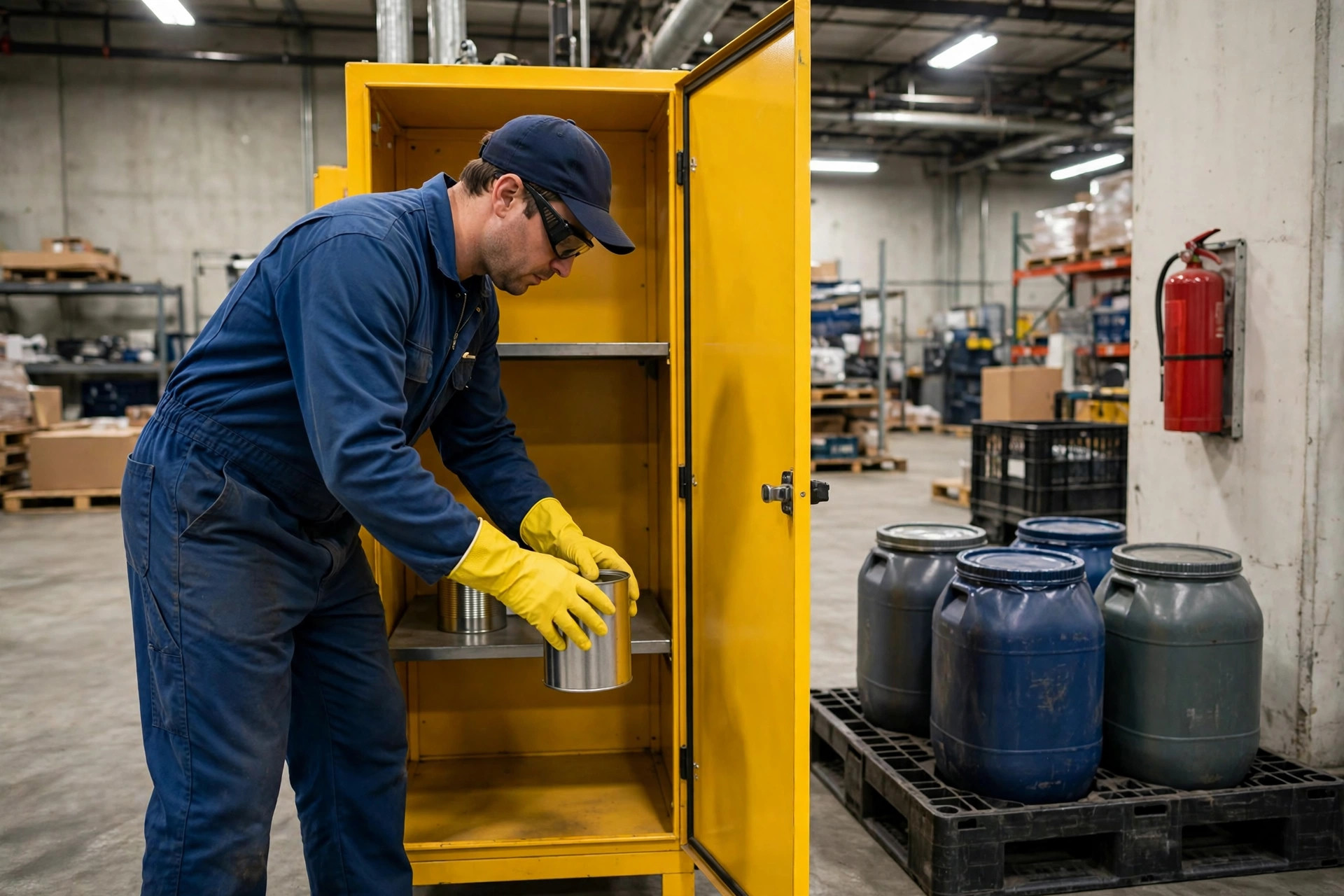
3. Doors kept closed, 2-inch sill. OSHA requires doors that close tightly — many compliant cabinets have self-closing doors. The bottom sill must be raised at least 2 inches above the cabinet floor to contain leaks. We made it a house rule: grab what you need, close the door behind you. When a veteran trains a new hire, that's lesson one. A cabinet with the door hanging open is money wasted.
4. Conspicuous labeling. OSHA's exact words: each cabinet must be marked "Flammable—Keep Fire Away." The yellow color itself is the industry shorthand — yellow means flammable liquids, red means combustibles, blue means corrosives. Don't buy a gray cabinet, park it in the corner, and expect anyone to know what's inside.
5. Ventilation and placement. OSHA does not require cabinets to be vented — but if you do vent one, the duct must go outdoors and meet the standard's requirements; no improvising with spare ductwork. And never block aisles or exits with the cabinet, and don't pile cardboard or pallets around it. We learned that one the hard way: our first cabinet ended up buried behind stock in the consumables area, where firefighters couldn't have reached it in a real fire. We moved it against a wall, near the aisle but out of the traffic path.
How we run it now
Buying the cabinet was step one. Managing it is the long game. Here's what's written on the wall in our consumables area:
Segregate by type. Thinner, paint, and cleaning solvents each get their own section. Incompatible chemicals never share a cabinet. A logbook hangs on the cabinet door — who took what, how much, when. It looks old-fashioned, but it's the only thing that makes cycle counts work.
Bond and ground when pouring. Moving thinner generates static. We keep a grounding wire on the cabinet door — clip it on before pouring, ten seconds of work.
Weekly walk-around. Every Monday morning, our maintenance lead circles both cabinets: do the doors close tight, is there liquid pooled in the sill, are the labels legible, has anyone stacked junk on top. Anything wrong goes on the whiteboard and gets fixed the same day.
Cap the inventory. The cabinet holds one week's worth, no more. Excess goes back to the hazmat store. The fuller the cabinet, the bigger the risk and the messier the counts. One week, one refill — it works.
Three mistakes we made buying cabinets
Mistake one: treating an ordinary metal cabinet as a safety cabinet. Procurement bought two cheap single-skin tool cabinets and painted them yellow. The EHS auditor took one look — no air gap, doors that didn't seal — and shook his head. In a fire, that's just a metal box conducting heat straight in. Returned, reordered, lost two weeks.
Mistake two: buying one big cabinet instead of two. The 60-gallon limit is the 60-gallon limit. We crammed thinner, paint, and solvents into one cabinet to save money. Finding anything took forever, and incompatible stuff ended up side by side. Two smaller cabinets, sorted by type, solved it. Buy two small ones rather than overstuffing one big one.
Mistake three: forgetting grounding. Cabinet in place, drums inside, job done — or so we thought. Then a static snap while pouring thinner scared a young tech half to death. Now the grounding wire hangs on the cabinet door, and clipping it on before pouring is non-negotiable. You can't see static, but thinner vapor absolutely ignites from it.
The math: this money wasn't wasted
Honestly, I winced at the price too. A standard 30-gallon yellow cabinet runs one to two thousand dollars; a domestic one costs several thousand RMB. Two cabinets plus grounding wires, labels, and spill pallets came to just under ten thousand.
Now run it the other way: a single OSHA serious violation starts in the five figures — and that's just the fine. One small fire in the consumables area, one day of warehouse downtime in peak season — what's a day of outbound worth? How much does your insurance jump the next year? And if someone gets hurt, no amount of money fixes that.
Here's the counterintuitive part: people think "my warehouse is small, just a few drums of thinner, I don't need this." Wrong. Small operations with a few drums are exactly where things get left out in the open. Thinner doesn't care how big your warehouse is. When it goes wrong, it goes big.
A few reminders for fellow operators
First, buy the right cabinet. A single-skin metal box or an ordinary tool cabinet is not a flammable storage cabinet. Read OSHA 1910.106(d)(3) and buy against the clauses.
Second, a cabinet with the door open is no cabinet at all. I've seen warehouses with beautiful cabinets, doors propped open year-round, rags and gloves stuffed inside. That's worse than not buying one — it gives you the illusion of compliance.
Third, on a new hire's first day, walk them to the cabinet and spend three minutes there. What it is, why it exists, why the door stays shut. That's what we do now. Three years running, and we haven't had another morning that smelled wrong.
By Chen Feng, Warehouse Operations Manager