Last summer, I almost got heat exhaustion in my own warehouse.
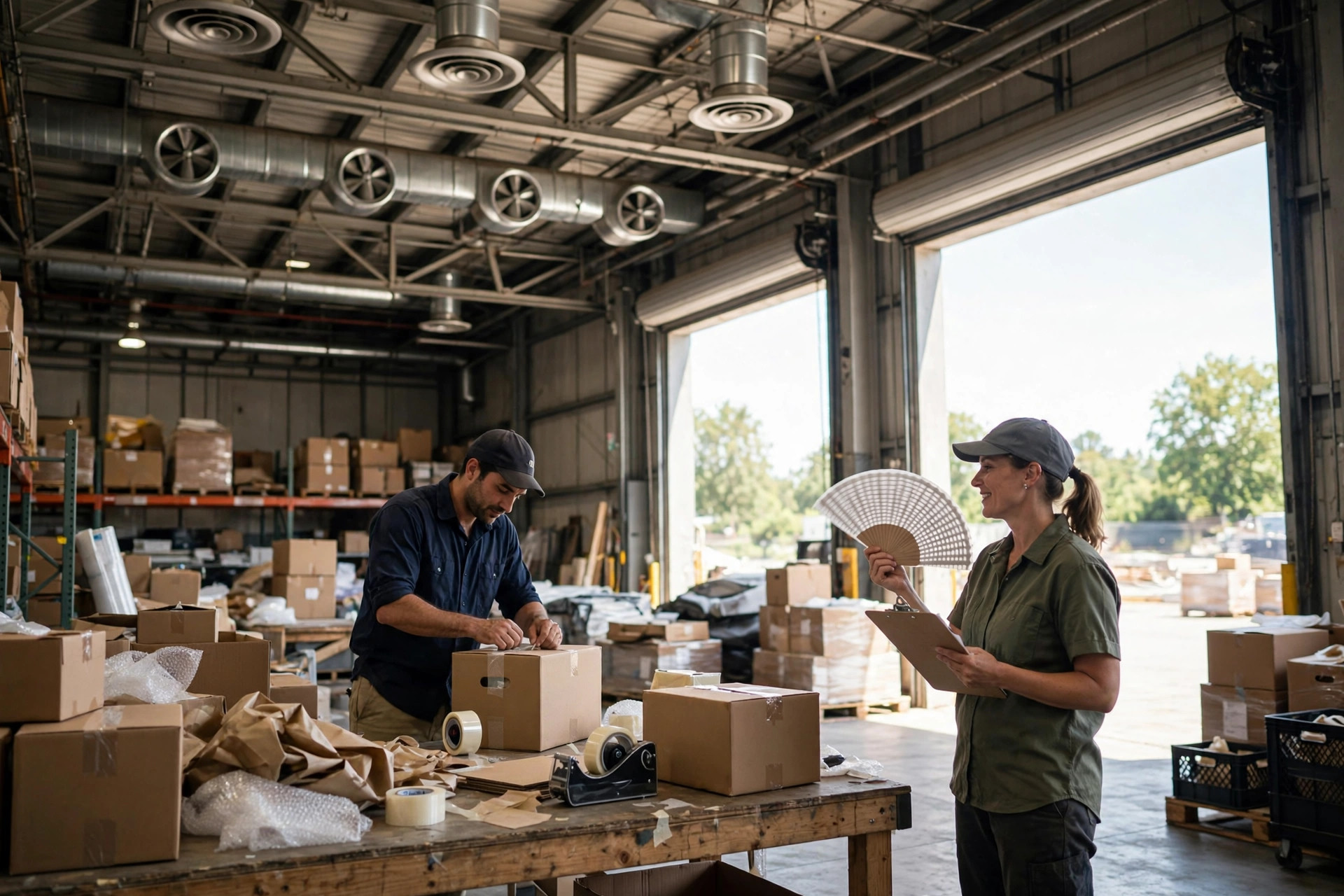
It was late July, three in the afternoon, and the metal roof had been baking all day. The air inside felt like soup. Xiao Li, who runs our packing table, was sweating through his shirt, and the tape kept slipping off his hands. I stood in the aisle with my back soaked through and thought: if this keeps up, the people will break down before the freight does. Warehouse cooling had officially moved from "someday" to "right now."
Here is the problem, though. We run a small warehouse. The big-company playbook — central AC, climate-controlled everything — is a fantasy at our scale. So I spent most of the summer doing it the small-warehouse way: talking to vendors, visiting other small warehouses, and figuring out what actually works when you cannot throw money at the problem. Three options kept coming up: HVLS fans, roof exhaust, and evaporative cooling. Here is the honest math on all three.
Warehouse Cooling Starts With Three Bills, Not One
I made myself answer three questions before buying anything, and I still use them:
Bill one: what does it cost to get it running? Equipment price is only part of it. Installation, wiring, roof reinforcement — those line items have a way of showing up after you have already committed. Ask the only question that matters: "What is the total to have this installed and spinning?"
Bill two: what does it cost every month? A cooling system runs for months. Electricity is a slow bleed. Do not take a rep's word for "very efficient." Get the rated power in writing, then do the math yourself with your own electricity rate and hours of use. If you cannot do that math, do not buy it.
Bill three: does it actually work in a warehouse like yours? This is the hardest one, because every warehouse is different. Ceiling height, roof material, vent placement, racking density — all of it changes the result. The reliable move is to go see a warehouse like yours where the system is already running, and stand in it. Or buy one unit first and test it for a summer. Ask the vendor for measured field data, not brochure numbers.
There is also a hidden bill people forget: maintenance. How often do filters change? How long is the motor warranty? When it breaks, who shows up and how fast? A system that dies during the hottest week of the year is worse than no system at all.
HVLS Fans: Our First Move, and Why It Worked
Bottom line up front: we started with one HVLS fan. One. As a test.
Why that one first? The most unglamorous reason possible: it is just a really big fan. It does not make cold air. It slowly moves the air around — pulling the hot layer down from the ceiling, breaking up the dead, stale pockets where nobody wants to stand. Our ceiling is high enough, the aisles between racks are wide, and we hung it right over the pick-and-pack area where people actually work.
On the first afternoon after installation, I stood under it during the hottest part of the day. Honest review: do not expect air conditioning. It does not blow cold. It blows moving air. But Xiao Li said his hands were not sticky anymore, and his packing pace came back.
It has real limits, though. First, if your ceiling is too low, do not force it — the blades feel oppressive overhead, and you risk conflicts with high racks and light fixtures. Second, a fan cannot fix heat, only stuffiness. If your metal roof is radiating heat and the inside is genuinely scorching, all you are doing is stirring hot soup. It works best paired with exhaust. Third, installation is not a DIY job — mounting and load ratings have to be done by an experienced crew, to spec.
Roof Exhaust and Evaporative Cooling Each Have a Temper
Roof exhaust is the second bill. The idea is as simple as opening a window: pull the hot air out through the roof, and let fresh air come in through the doors and windows. A friend's warehouse runs roof exhaust; he says opening the door in the morning no longer feels like opening an oven.
But exhaust has a ceiling of its own. It swaps air, it does not cool air. When it is blazing hot outside, the air coming in is still hot — you just end up no more stifling than outdoors. On its own, it will never make a warehouse feel cool.
Evaporative cooling is where I almost learned an expensive lesson. The principle is seductive: water evaporates, absorbs heat, and the air that comes out feels cool. A warehouse down the street installed evaporative units, and for the first week everyone raved about them. Then humidity climbed. The cartons stacked near the wall went soft. Labels on a few cases curled up from damp. The owner shut the units off and spent days airing the place out.
That one stuck with me: pick the wrong cooling equipment and you do not just waste electricity, you damage freight. Evaporative cooling adds moisture to the air. Paper products, food, electronics, anything moisture-sensitive — all off-limits. Flip it around, though: if you store hardware or anything that does not mind humidity, and your ventilation is good, evaporative cooling can be a genuinely good deal.
As for portable coolers, my verdict is: fine for emergencies, useless as a strategy. They work for a single spot — a temporary packing station, a corner where someone is stuck for a day. Trying to cool a whole warehouse with them is a losing game on both cost and coverage.
| Option | Upfront cost | Monthly electricity | Best fit | Biggest gotcha |
|---|---|---|---|---|
| HVLS fan | Medium | Relatively low | High ceilings, people-dense pick/pack areas | Moves air, does not cool it; needs ceiling height |
| Roof exhaust | Relatively low | Relatively low | Metal roofs with heat trapped at the top | Swaps air, does not cool it; useless when it is hot outside |
| Evaporative cooling | Medium | Relatively low | Moisture-tolerant freight, well-ventilated buildings | Adds humidity; damages moisture-sensitive freight |
| Portable cooler | Relatively low | Relatively high | Temporary stations, small corners | Tiny coverage; not a real strategy |
The "high" and "low" in that table are relative judgments from visiting several warehouses and talking to several vendors — not measured data. Get real quotes and field data from vendors for your own building, and run the numbers with your own electricity rate.
The Free Tricks: How We Survived Before Spending Anything
First, shift the schedule. Move the heavy work out of the hottest hours. Start earlier in the morning, and save the lightest jobs — cycle counts, labeling, light packing — for the afternoon furnace. We ran that schedule last summer and the complaints dropped off a cliff.
Second, cross-ventilate. Open the dock doors on both sides in the morning while it is still cool, and let the breeze flush out the heat that built up overnight. Close the sun-facing side in the afternoon, keep the shaded side open. Zero cost — as long as your layout allows a through-draft.
Third, keep cold water everywhere. Big cooler in the break area, ice, salty water, the works. I watched Xiao Li drink a cup of ice water, sit for ten minutes, and come back a different person. Cool the people first; the equipment comes second.
Fourth, shade the roof. Look into shading or insulation for a metal roof — a one-time investment that pays back every summer, and it shrinks the heat load for everything else you install.
Advice for Warehouses Like Ours
If you run a small warehouse — a few thousand square feet, a small crew — here is my advice on summer cooling:
Use up the free moves first. Cross-ventilation, shifted schedules, cold water on hand. You will be surprised how much of the worst discomfort disappears without spending anything.
Then spend a little on one thing. Buy one unit. Put it in the worst spot. Test it for a summer. If it works, buy more. If it does not, you have capped your loss. A small warehouse cannot afford to "buy the full system" on a guess.
And finally, match the equipment to your freight first, and your people second. Moisture-sensitive freight rules out evaporative cooling. Low ceilings rule out a big fan. There is no best equipment, only the best fit for your building.
Big companies have big-company ways. Our money has to work twice as hard, and every dollar has to land where it counts.
Small warehouses have their own way of surviving.
By Xiao Ma, Small Warehouse Owner