A warehouse roof leak is rarely expensive because of the roof itself. It becomes expensive because of a few lease lines nobody read carefully. When teams sign a warehouse lease, they negotiate rent, square footage, clear height, and dock doors. Few put a warehouse roof leak and lease repair responsibility on the negotiation list. Then the first heavy rain arrives, water drips onto cartons, and the question changes from whether to fix the roof to who pays, who is liable, and who covers the damaged goods. A warehouse roof leak is, at its core, a problem of responsibility that was left unclear before signing and becomes very hard to clarify afterward.
According to common practice in United States industrial leasing, roof responsibility is rarely captured by a single phrase like "the landlord is responsible." A lease usually breaks the roof into parts: structural deck, waterproof membrane, drainage, and anything the tenant added later. Structural failure and membrane aging can carry entirely different liability. Add in exclusion clauses, repair timelines, and notice obligations, and two leases that look similar on the surface can produce very different outcomes after the same leak.
Warehouse Roof Leak Lease Repair: What the Lease Actually Says
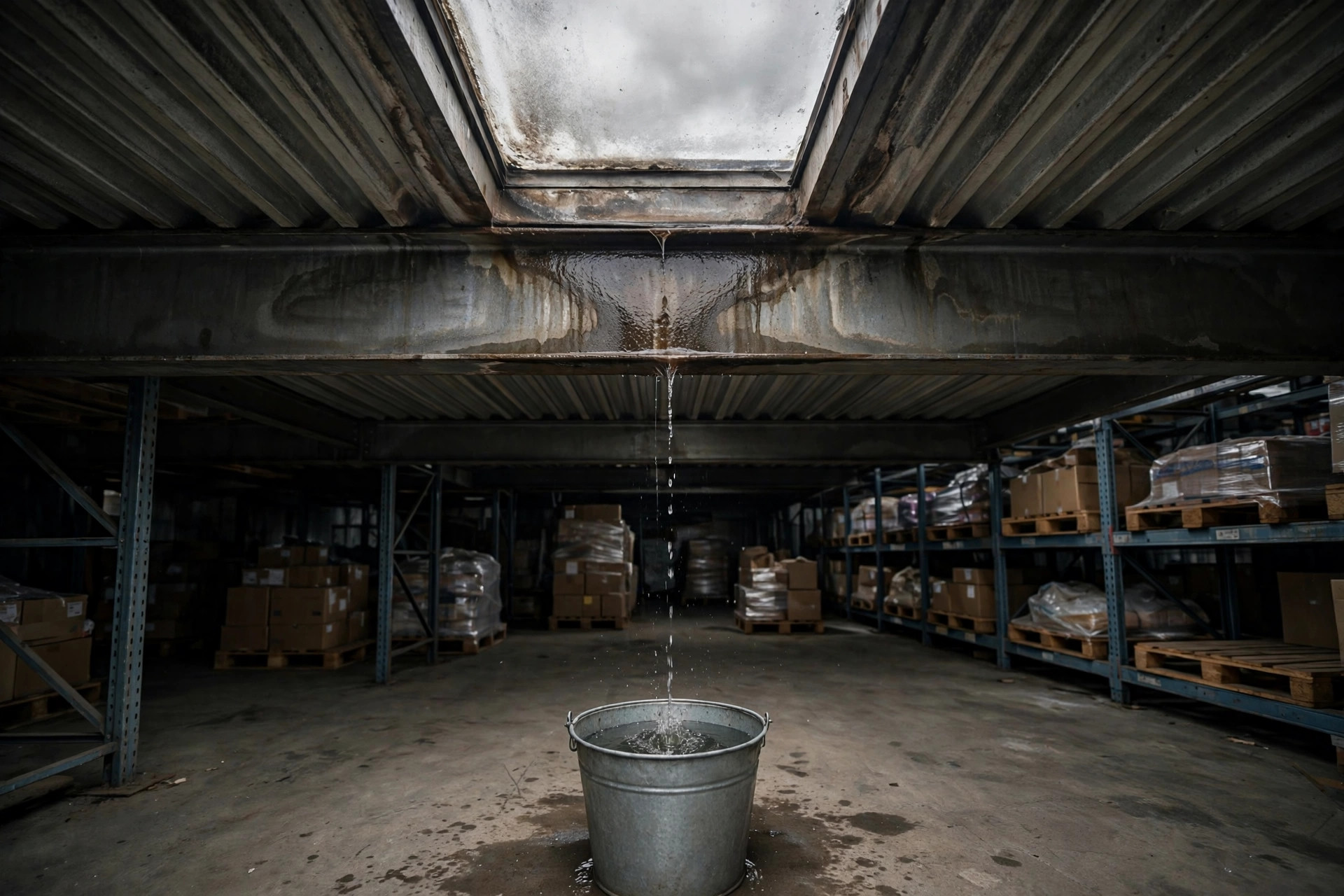
In the fall of 2023, a third-party warehouse in New Jersey handling e-commerce fulfillment, roughly twenty thousand square meters, with three years left on its lease, developed a leak near a skylight after two days of steady rain. Water dripped onto the third level of a high-bay rack. The team moved product quickly, and the immediate damage stayed within a few dozen cartons with damp packaging. What followed cost more than the leak itself. The operator blamed an aged membrane, the landlord's responsibility. The property manager blamed a ventilation pipe the tenant had added near the leak, so the tenant was responsible. The repair dragged on for three weeks, the leak widened, the repair cost was split, and the cargo damage, because nobody could prove which rainstorm damaged which batch, was absorbed by the operator.
What matters here is what the lease was missing. First, a definition of "roof." It said the landlord was responsible for roof repair, but not whether the membrane, insulation, gutters, and skylight seals counted as part of the "roof." Second, a timeline. It required the tenant to notify "promptly," but never said how many business days the landlord had to inspect or provide a plan. Without a timeline, "promptly" means whatever the slower party wants. Third, temporary protection. Between leak and repair, nobody was assigned to install sheeting, move goods, or protect inventory. That gap is where most damage happens.
A second case: In early 2024, an Inland Empire warehouse handling import distribution had a lease assigning roof structure and membrane to the landlord, and inspection and reporting to the tenant. Before the rainy season, the manager sent staff to the roof, found two drains blocked by debris, cleared them, and kept dated photos. When the first storm arrived, an old seam still seeped, but the night shift reported it through both channels named in the lease, with timestamps and photos. The landlord's crew arrived the next day, covered it, and finished within a week. Cargo damage stayed small, and complete records sped up the insurance claim and cost-sharing discussion. The difference was not how serious the leak was. The lease spelled out who inspects, reports, repairs, and how fast, and the team followed it.
From those two cases comes a practical checklist. Walk through each row and confirm your lease has a matching sentence. If a row has none, you left that cost to future negotiation.
| Roof item | Common responsible party | What to confirm before signing |
|---|---|---|
| Structural deck, load-bearing beams | Landlord | Whether "structure" is explicitly included, and the repair timeline |
| Waterproof membrane, seams, sealant | Often landlord, depends on lease definition | Whether it counts as part of the "roof," and whether aging is landlord responsibility |
| Gutters, drains, downspouts | Often split | Who clears them, and who pays when a blockage causes a leak |
| Skylights, daylight strips | Depends on lease language | Who covers seal aging versus glass breakage |
| Tenant-added vents, HVAC curbs, solar mounts | Often tenant | Who waterproofs penetrations, who inspects them, and the warranty length |
| Temporary cover, goods relocation, damage protection | Often unassigned | Must be written separately; the gap between leak and repair needs an owner |
| Inspection and reporting | Often tenant | Inspection frequency, reporting channels, and evidence preservation |
Warehouse Roof Leak Repair and Cargo Damage Claims
Cargo damage is the hardest part of a leak dispute to calculate. Water damage rarely has a clean timestamp: a damp carton may have been hit by this storm, last week's storm, or months of elevated humidity. A claimant must prove a long chain: the leak occurred, its location matches the damaged goods, the goods were in good condition beforehand, and the amount has support. One missing link discounts the claim.
When a leak is discovered, follow a fixed evidence and reporting sequence. First, photograph and video the scene: leak point, drip path, affected goods, water on the floor, with timestamps, wide shots and close-ups. Second, move goods and install temporary protection, recording what moved, where it went, and the labor it took. Third, report through the channels named in the lease, by both email and phone, and keep the sending records. A single verbal call is not enough. Fourth, log every conversation in writing: who visited, what they saw, what was promised, and the repair date. 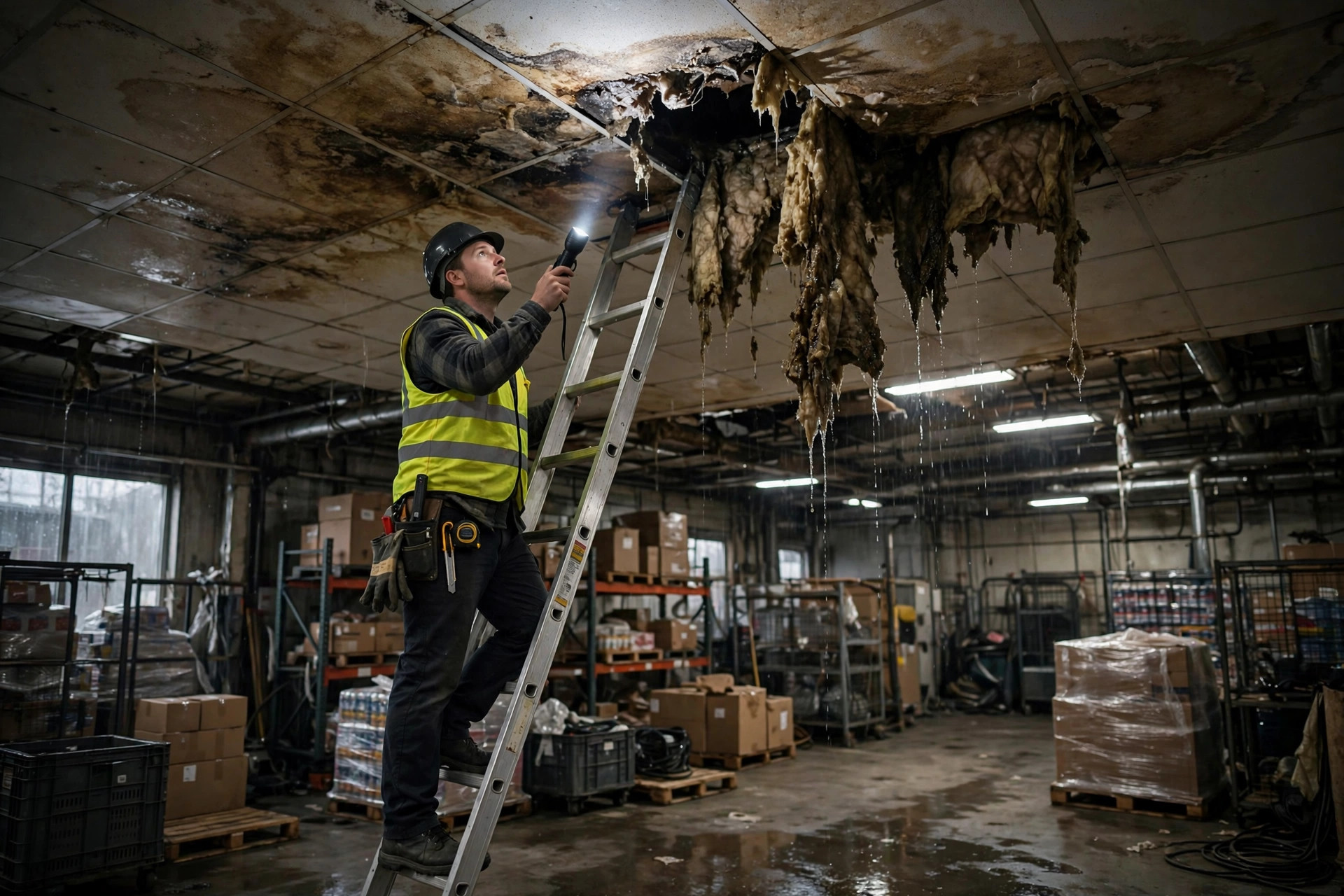
Fifth, build a separate cargo-damage list: product, quantity, batch, damage level, photos, and disposition, whether dried and sold, discounted, or written off.
Counterintuitive but true: after a leak, the most valuable action is often not "fix it immediately" but "document it immediately." Many warehouses rush to mop up and resume operations, which is understandable. But if the floor is mopped before photos are taken and goods moved before records are made, proving the link afterward becomes very hard. Documentation is not about lawsuits. It keeps the insurer or landlord from ending the discussion with "that cannot be proven." Half an hour of photos and notes is often worth more than months of argument.
When calculating costs, keep three buckets separate. The first is repair cost: who repairs what, for how much, per the lease. The second is cargo damage: direct loss by goods value, plus indirect costs such as chargebacks, return handling, and repackaging labor. The third is downtime: closed aisles, longer picking paths, delayed peak-season orders. That bucket is hard to quantify but belongs in the discussion. Mix them and the easiest reply is "this bill cannot be verified." Separate them, and negotiation has something to hold onto.
Insurance deserves the same early attention. Whether a property or cargo policy covers roof-leak damage depends on wording to review before an incident, not after. Some policies treat "long-term seepage" and "sudden leakage" differently. Some require routine maintenance and timely reporting, or the claim may be denied. Lease, inspection, reporting records, and policy wording corroborate one another after a leak. If any one is missing, the claim gets harder.
How to Inspect the Roof Before Renewing the Lease
A roof inspection before renewal is the highest-return action here. As a lease nears expiration, many teams negotiate only rent and forget the roof has aged. Make inspection part of renewal, not something discovered after signing.
Inspection can follow three steps. First, review records: how many leaks occurred, each repair record, response time, and whether any leak recurred. Recurring leaks deserve special attention, because they suggest the prior repair was only temporary. Second, walk the roof: drains clear, seams and sealant cracked, stains around skylights and penetrations, areas of ponding. Take photos, invite the landlord, and have both sides sign off. Third, renegotiate terms: fill the gaps, such as membrane responsibility, repair timelines, temporary protection, inspection duties, and a joint pre-rainy-season inspection. If the landlord will not add terms, at minimum attach a written statement of current roof condition.
The trend is clear: disputes are shifting from "whether to repair" to "how to allocate." Goods value density keeps rising, so one leak affects more value than it used to, and insurers ask about roof age and repair history at renewal more often. Clarify responsibility at signing and renewal, fix inspection and reporting routines, and leaks will still happen, but the losses and arguments afterward will be much smaller.
That leaves an open question: as warehouses rely more on automation and high-value inventory, should the roof, the least technical-looking problem in the building, have its own inspection standard and responsibility checklist like fire protection and security? Or will it stay buried in the lease appendix until the next heavy rain reminds everyone?
By Dr. Chen, Supply Chain Researcher