Every lithium battery salesperson opens with the same line: "It's expensive up front, but cheaper over five years." Half of that sentence is true. The other half is a trap — it quietly assumes you run a multi-shift fleet. If you're a single-shift operation with a small fleet, that sentence is pure sales theater. Back in my systems integrator days, I ran this math for dozens of warehouses. Here's the full lithium vs lead acid forklift battery cost comparison, laid open.
First, the physics. If you don't understand the principle, every number that follows is numerology.
Two Different Species, Not Two Versions of the Same Thing
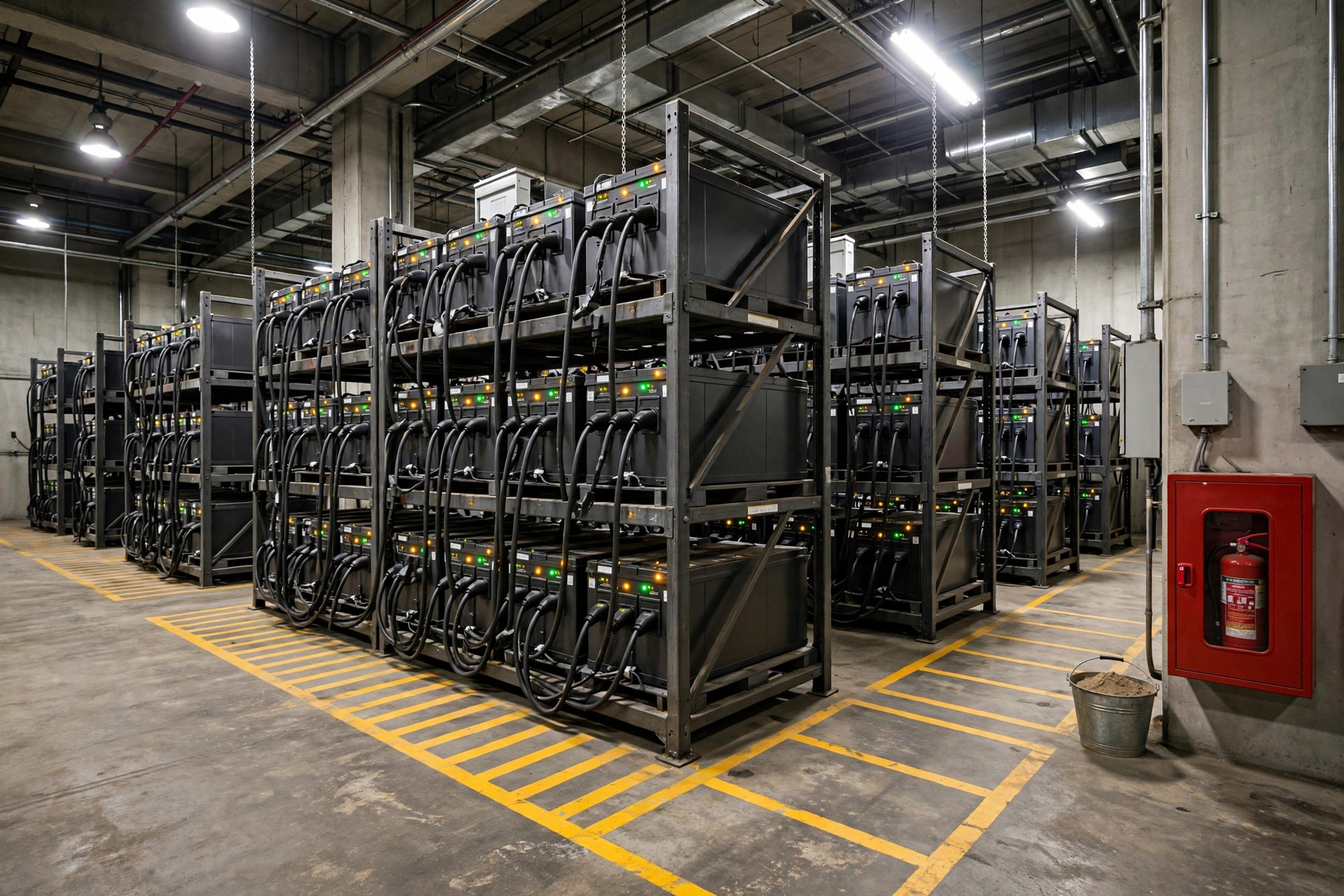
Think of a lead-acid battery as a giant water tank. It takes 8–10 hours to fill, plus several hours of cooling before you can touch it — like filling a cistern overnight. That means a two-shift truck needs 2–3 packs in rotation: one working, one charging, one cooling. Charging efficiency is around 80%; the other 20% escapes as heat and hydrogen gas, which is why battery rooms need ventilation and explosion-proofing.
Lithium is a different animal entirely. It charges in 1–2 hours with no cooldown. A 30-minute lunch break plugged in can recover a serious chunk of capacity — think phone fast-charging. One pack per truck covers multiple shifts. Charging efficiency is 95%+. No watering. The catch: upfront cost runs $8,000–$25,000 per pack versus $2,000–$6,000 for lead-acid — roughly 3–4x.
Cycle life tells the same story in different units: lead-acid delivers 1,000–1,500 cycles (under two-shift duty, that's a replacement every 2–3 years), while lithium delivers 2,000–3,000+ cycles (7–10 years). It's like buying tires — one cheap set that wears out in 2 years, one expensive set that lasts 8.
The 5-Year TCO Table: Single Truck, Two-Shift Basis
Here is the lithium vs lead acid forklift battery cost comparison, measured per electric forklift over 5 years on a two-shift schedule. One caveat before you read it: quotes vary wildly between vendors. The ranges are honest estimates — the methodology matters more than any single number. Plug in your own electricity rate and labor burden.
| Cost item (5 yrs / 1 truck) | Lead-acid | Lithium |
|---|---|---|
| Initial purchase | 2.5 packs × $2,000–6,000 ≈ $5,000–15,000 | 1 pack × $8,000–25,000 ≈ $8,000–25,000 |
| Replacement cycle | 1 replacement ≈ $4,000–12,000 | 0 (lifespan covers 5 years) |
| Battery-swap labor | 15 min × 2 swaps/day × labor rate ≈ $8,000–15,000 | 0 (no swaps) |
| Watering + inspection labor | ≈ $2,000–4,000 | ≈ 0 |
| Electricity (efficiency gap) | ~80% charging efficiency ≈ $3,000–6,000 extra | Baseline |
| Total | ≈ $30,000–50,000 | ≈ $18,000–26,000 |
Notice where lithium actually wins? It's not the electricity — that line item is a rounding error. The three real wins are: eliminating the second and third battery packs, eliminating the mid-life replacement, and eliminating the daily ritual of swapping, watering, and inspecting batteries. When a salesperson pitches you on "95% charging efficiency," they're pointing at the sesame seed. The watermelon is "one pack doing the work of three."
In multi-shift operations, the payback lands around month 36. The first three years pay back lithium's upfront premium; from year four on, it's pure savings.
Two Real Cases: One Home Run, One Near Miss
Case 1: A 3PL in Fontana, California, 2024 — 18 trucks, two shifts. The classic lead-acid setup: 45 battery packs for 18 trucks, and a battery room eating nearly 2,000 square feet — square footage that could hold racking. Daily battery swaps ran 36 events at 15 minutes each, effectively employing half a person just to move batteries. Watering was outsourced at over $9,000 a year. After switching to lithium: 18 packs, the battery room shrank by half, and the freed space became staging for roughly 400 extra pallet positions. Electricity costs dropped about 12% from the efficiency gain — but nobody cared about that line item. Their math was labor and square footage. Payback: 30 months.
Case 2: A small warehouse in Ontario, 2023 — 6 trucks, single shift. The owner was nearly sold on a full lithium conversion. I walked the floor: single shift meant one full cycle per day, and 8 hours of lead-acid charging fit perfectly into overnight off-peak power. Six trucks meant six swaps a day — negligible labor. I ran his numbers: 5-year TCO came out around $12,000/truck for lead-acid versus $16,000/truck for lithium. Lithium was 30% more expensive. Under single-shift duty, all three of lead-acid's weaknesses (extra packs, swap labor, watering) simply vanish, leaving only its one strength: cheap upfront cost. The owner stayed with lead-acid and spent the savings resurfacing the warehouse floor — a 10x better use of that money.
The Decision Boundary: Three Scenarios, Don't Buy Wrong
The dividing line is sharp — and this is where most lithium vs lead acid forklift battery cost comparison write-ups go wrong, because they never ask about your shift pattern. Here's my verdict:
Scenario 1: Two or three shifts, fleet of 10+ trucks → lithium, no debate. Payback in roughly 36 months, then $2,000–5,000 saved per truck per year after that. Still buying lead-acid here is setting money on fire in the battery room.
Scenario 2: Single shift, fleet of 8 or fewer → stick with lead-acid. Don't let "maintenance-free" and "fast charging" marketing move you. Under single-shift duty, every lithium advantage gets discounted while the upfront premium stays full price. Spend the savings somewhere with a real ROI.
Scenario 3: Single shift with opportunity-charging windows → lithium is worth quoting. If you've got a 1-hour lunch and 2-hour gaps between shifts where trucks can plug in, lithium's opportunity-charging profile can compress you from "1.5 packs per truck" down to "1 pack." Rerun the math there — the breakeven point moves forward significantly.
Here's the counterintuitive part: most people think lithium saves on electricity. It doesn't — it saves on battery rooms and labor. If your warehouse labor is cheap and floor space is worthless, lithium's math looks terrible. If labor is expensive and every square foot is precious (Southern California warehouses, I'm looking at you), lithium's math looks absurdly good. Battery selection isn't a technology question — it's a question about your cost structure.
The Maintenance Traps: Lithium Is Not "Worry-Free"
Final section: the maintenance traps. First, a shot at the marketing: "maintenance-free" is only half a sentence. No watering is real. But these three traps have bitten plenty of people:
Trap 1: The charger must match the battery. Lithium's charging curve is nothing like lead-acid's. Charging lithium on a lead-acid charger undercharges it at best and locks out the BMS at worst. I saw a facility reuse old chargers to save money — three brand-new lithium packs threw faults within two months. Root cause: charger protocol mismatch. Warranty denied — classified as operator error.
Trap 2: Third-party lithium retrofit kits. There are aftermarket kits that convert old lead-acid trucks to lithium at half the OEM price. But a forklift's counterweight and center of gravity were engineered around the weight of a lead-acid pack. Lithium weighs 30–40% less; get the ballast wrong and you've changed the truck's stability characteristics. Worse: the retrofit voids the UL listing, which becomes a problem at OSHA inspection time — and a nightmare if there's ever an insurance claim. Saving that money means gambling on safety. When it goes wrong, it goes very wrong.
Trap 3: Cold charging. Charging lithium below freezing causes lithium plating — permanent capacity damage. In a freezer warehouse (-20°C territory), charging has to happen in a warmer zone, or you spec heated battery variants — which add 15–20% to the price. Lead-acid is actually more forgiving in the cold (capacity drops, but nothing gets permanently damaged). Spec'ing lithium for a freezer without a cold-charging plan is signing a contract you haven't read.
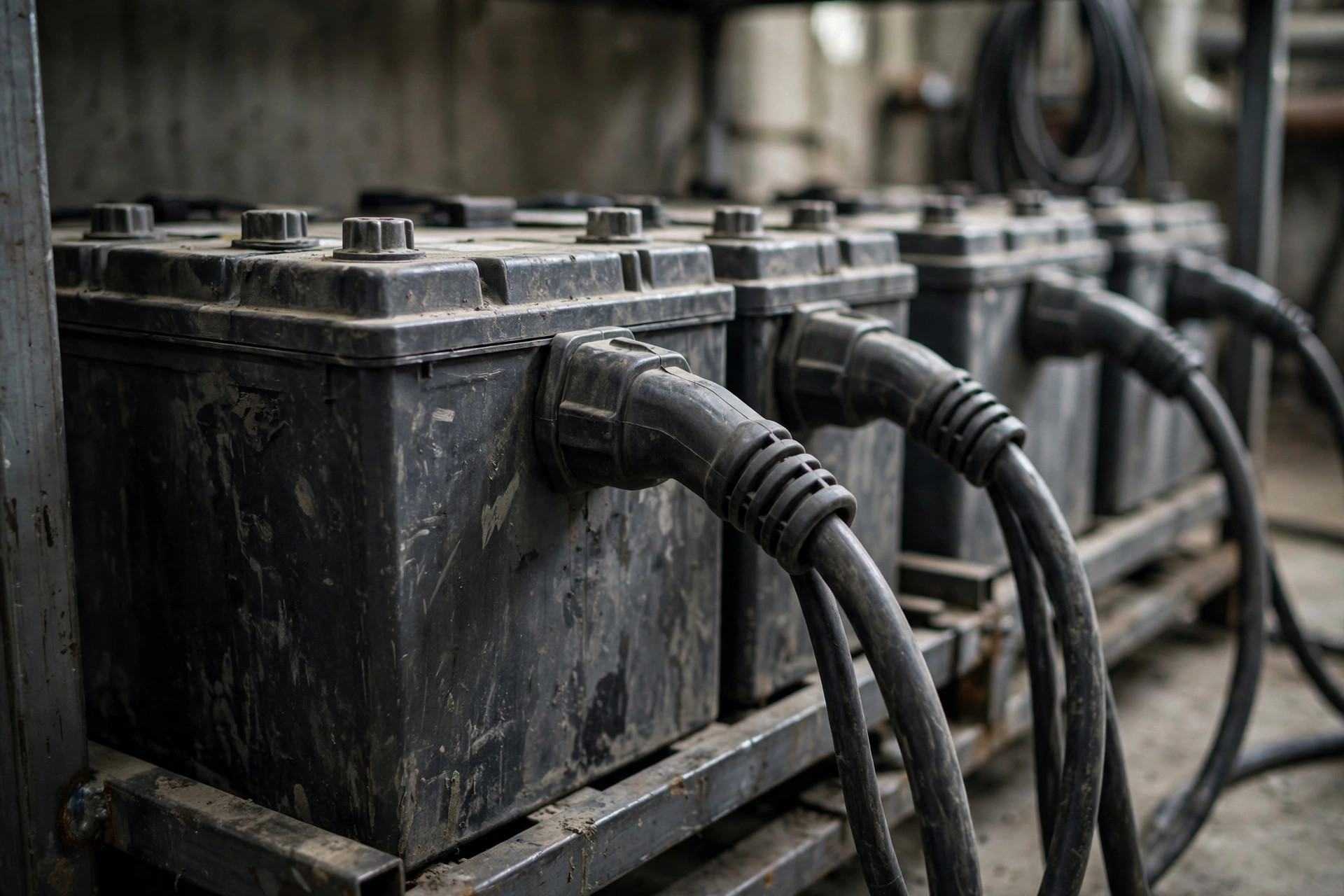
Lead-acid's traps are at least visible: skipped watering sulfates the plates (I've seen a maintenance crew ignore watering for six months and kill a $4,000 pack outright), hydrogen accumulation demands ventilation discipline, and skipped equalization charges let weak cells drag the pack down. But those traps are honest — lithium's traps hide inside the BMS. If you never read the data, you'll never know the battery is slowly killing itself.
Is the Money Worth It? Watch This One Number
Forget the spec sheets. Track this one number: your fleet's daily per-truck "waiting-for-power, swapping, and watering" labor hours × your fully burdened labor rate × 250 days. If that number exceeds the upfront price gap between lithium and lead-acid, go lithium with your eyes closed. If it's smaller, stay with lead-acid and spend the money where it actually moves the needle.
Battery selection was never a technology problem. It's an accounting problem — and every lithium vs lead acid forklift battery cost comparison ultimately reduces to that one ledger. Once the ledger is clear, the sales pitch loses its power.
By Da Liu, Automation Engineer