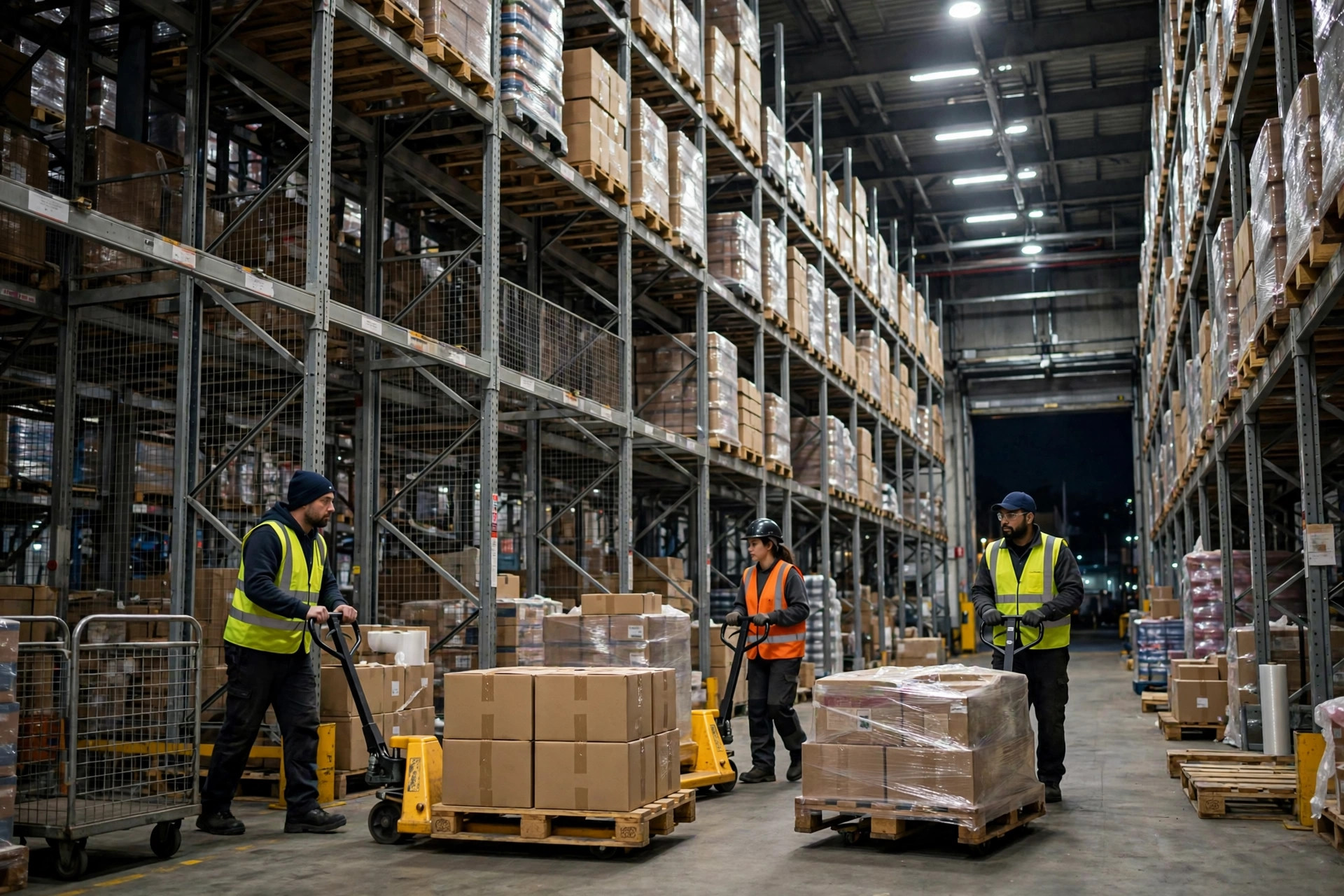
On April 1, 2022, in Staten Island, New York, ballot counters at Amazon's JFK8 fulfillment center read out a result that made national headlines: roughly 2,650 votes in favor to about 2,130 against. The Amazon Labor Union had won — the first union at an Amazon warehouse in the United States. A year earlier, at the BHM1 facility in Bessemer, Alabama, the Retail, Wholesale and Department Store Union had lost its bid by roughly 1,800 to 740 — only for the NLRB to later find Amazon had engaged in unfair labor practices, throw out the result, and order a rerun (which the union also lost).
Two elections, one win and one loss, separated by a continent. They point to the same phenomenon: the warehouse has become one of the most active front lines of union organizing in America.
The Phenomenon: Union Organizing Is Moving Into Warehouses
According to the NLRB, union election petitions rose by more than half in fiscal year 2022, reaching a multi-year high. Warehouses and logistics sit near the center of that wave: beyond the two Amazon facilities, more than 400 Starbucks stores have voted to join Workers United since late 2021, and organizing drives have surfaced at Home Depot and Apple retail stores as well.
Why warehouses? The attribution is not complicated. First, the gap between wages and pace: frontline warehouse pay has risen in recent years, but so have units-per-hour targets, so the perceived effort-to-reward ratio has not improved in step. Second, scheduling: mandatory overtime and last-minute shift changes hit workers' lives directly — the easiest issue for organizers to light. Third, safety perception: warehouse injury rates have long run above the manufacturing average in public data, and safety carries natural moral weight.
There is a fourth driver employers routinely miss: many organizing drives are triggered not by wages themselves but by a single mishandled conversation. A casual threat, a "caring" chat — either can push undecided workers toward the organizers.
The Data: Four Lines Employers Cross Most Often
Under the National Labor Relations Act, Section 7 protects employees' right to concerted activity; Section 8(c) protects employers' free speech. The space between those two rights is the entire employer playbook. Labor lawyers summarize the employer's hard limits in a four-letter mnemonic — TIPS. During an organizing drive, management must not:
- T — Threaten. No "the union comes in, the warehouse closes," no "vote yes and forget about raises." Even an offhand remark, once recorded or corroborated by several workers, is a textbook unfair labor practice.
- I — Interrogate. No "do you support the union?", no "who went to yesterday's meeting?", no "did you sign a card?" The setting does not matter — a formal sit-down counts, and so does a casual question at pre-shift.
- P — Promise. No "skip the union and you'll get a raise in December," no "tear up the card and I'll move you to day shift." Promising benefits to trade away organizing rights is unlawful.
- S — Spy or surveil. No sending someone to watch who picks up flyers in the break room, no lists of meeting attendees, no pulling security footage to see who hands out authorization cards.
The consequences are concrete: workers or the union can file unfair-labor-practice charges with the NLRB within six months. A sustained charge can mean posted notices, reinstatement with back pay — or the election result being set aside and a rerun ordered, exactly what happened with the first Bessemer vote.
What Employers Can and Cannot Do During Union Organizing
TIPS draws the red lines. Inside them, employers are not required to stay silent. Section 8(c) expressly preserves the right to communicate facts, opinions, and predictions, free of threats. In practice, compliant employers do the following:
| Cannot do (TIPS violations) | Can do (lawful response) |
|---|---|
| Threaten closure, pay cuts, or benefit losses if the union wins | Share facts: publish the company's raise history, benefits spending, and safety investments |
| Ask workers whether they support the union or who attended meetings | Keep an open door: tell employees plainly they can bring any issue to management directly |
| Promise raises or better shifts in exchange for dropping the drive | Explain business reality: use public financial data to show the cost structure and let workers judge |
| Watch who takes flyers or log meeting attendees | Manage normally: enforce existing rules (e.g., leaving the workstation during work time) evenly for everyone |

Three procedural points deserve emphasis. First, the 24-hour rule: under long-standing NLRB doctrine, employers may not deliver campaign speeches to assembled workers within 24 hours of the vote. The line is strict — once the last all-hands wraps up the day before, only ordinary one-on-one communication remains. Second, solicitation rules must be neutral: a company may bar solicitation during work time in work areas, but the rule has to apply equally to union and non-union solicitation alike. Banning union flyers while allowing bake-sale flyers is discrimination. Third, organizers' access: during non-work time in non-work areas, employees may distribute union materials to coworkers; a blanket ban "to keep order" will not survive scrutiny.
A necessary caveat: this is a summary of public legal knowledge, not legal advice. NLRB doctrine keeps moving — in November 2024, the Board held in Amazon.com that mandatory captive-audience meetings against unionization are themselves unlawful. As of this writing, rulings of that kind may still face court challenges. For your specific facility, every step should run through counsel.
The Trend: A Shrinking Toolbox, and Why Fundamentals Matter More
Phenomenon, data, attribution — taken together they support one forward-looking judgment: organizing activity in warehousing is more likely to grow than fade in the coming years. E-commerce fulfillment keeps depending on human labor, and younger workers bring a baseline expectation of having a voice. The structural drivers are not going away. Meanwhile the employer's traditional tools — above all the mandatory mass meeting — are being taken off the table one NLRB decision at a time.
That leads to a counterintuitive conclusion: the people who most need training are not the executives writing the speeches, but the frontline supervisors opening their mouths. Most unfair-labor-practice charges do not originate in the CEO's all-hands letter. They start with a night-shift lead asking "were you at that meeting yesterday?", or a team lead quietly moving an activist to nights when making the schedule. Of the four TIPS letters, the one employers violate most is the most innocent-looking: I, interrogation. A supervisor exchanges dozens of remarks with workers daily; any "caring" question touching the organizing drive can become an exhibit.
So the highest-return investment is TIPS training down to the team-lead level — plus a paper trail: date, place, and witnesses for every compliant conversation. Documentation is the cheapest insurance in this game.
One open question to close: as the law keeps narrowing what employers are allowed to say, the reason workers don't turn to a union can only come from the everyday — whether pay keeps up with the rate, whether schedules are predictable, whether safety spending is real. When the organizer knocks, the vote a worker casts is not really about the union. It is about every pre-shift meeting of the past three years in which they felt brushed off.
By Dr. Chen, Supply Chain Researcher