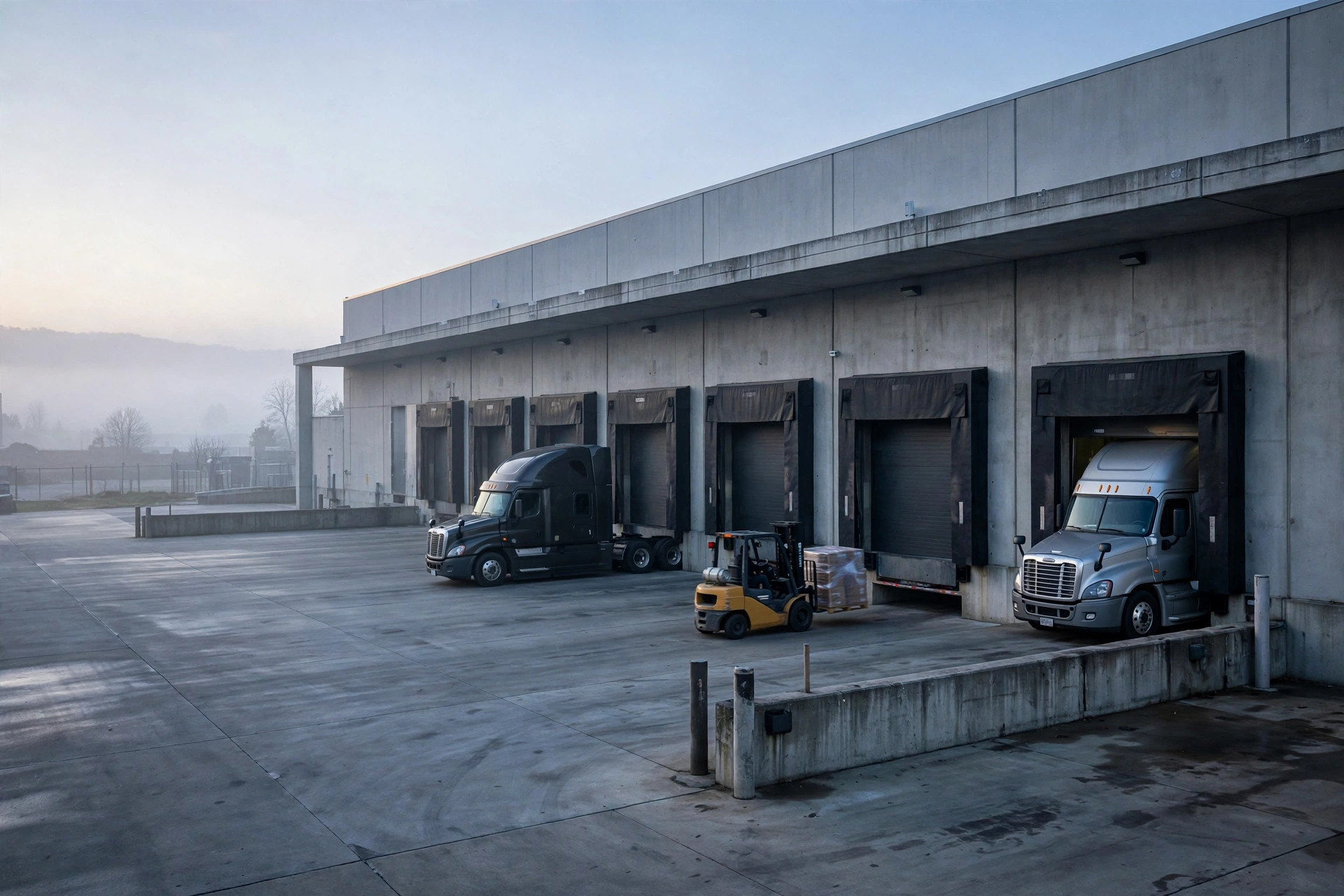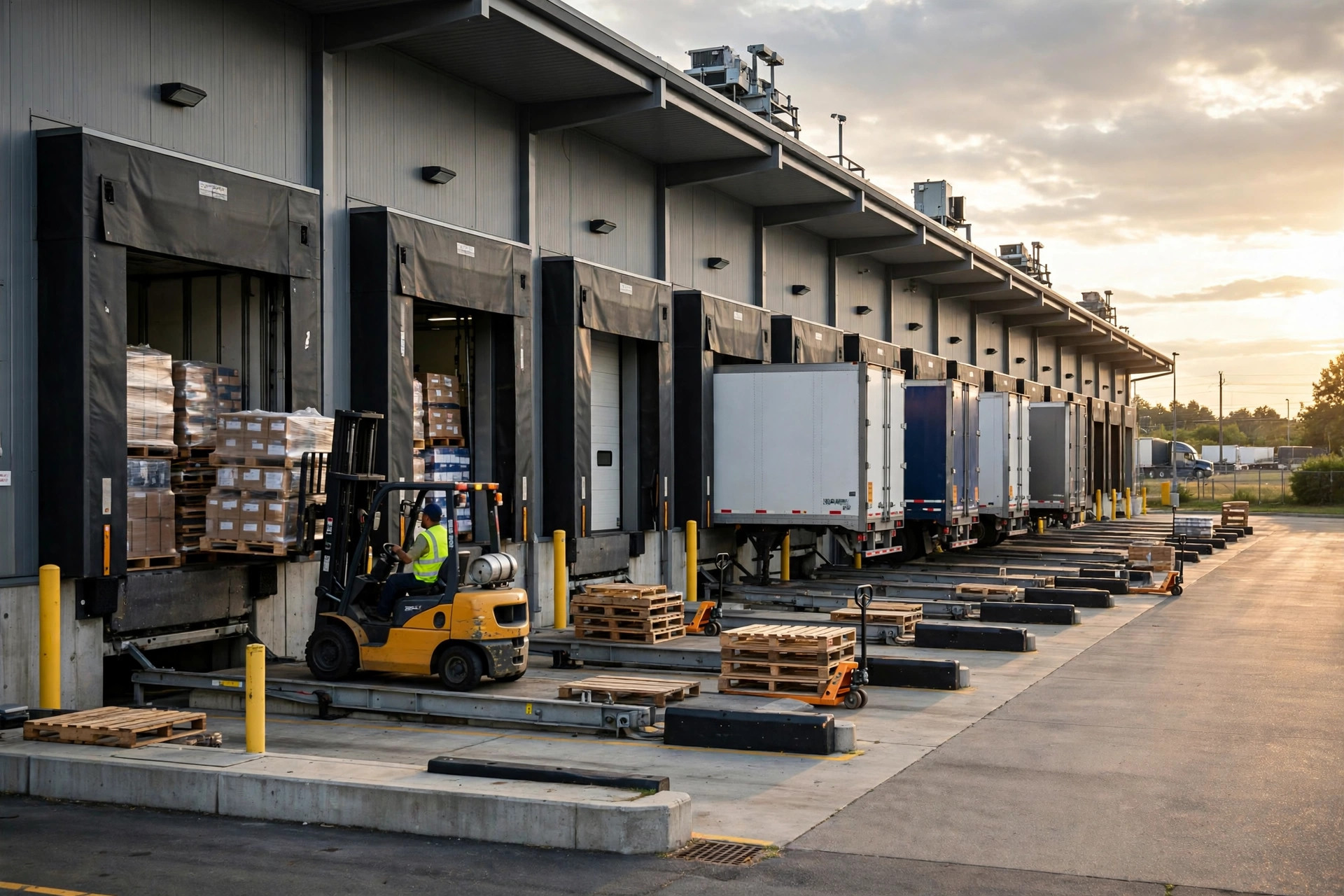
I'll be honest with you: I've run a 32,000-square-foot warehouse for five years, and until last month I had never once sat down to figure out how many dock doors per square foot a warehouse actually needs.
Here's how I got schooled. My landlord called about subleasing the 50,000-square-foot building next door and asked if I wanted it. My first instinct was to do the rent math — 50,000 square feet, at today's rates, that's a lot more money every month. Then on the way to tour the building, my partner asked me the simplest question in the world: "How many doors does it have?" I said, "Four, I think." He said, "Is that enough?" And I had... absolutely no idea.
Big companies hire consultants for site selection. We small warehouse owners can't afford that kind of money, so we learn by asking around, copying the neighbors, and paying tuition in the form of mistakes. Here's what a month of asking around taught me — including the industry rule of thumb everyone quotes and nobody explains: one dock door per 10,000 square feet.
Where the 1-Per-10,000 Rule of Thumb Comes From
Every industrial broker in Southern California seems to carry this rule of thumb in their back pocket: one dock door per 10,000 square feet of warehouse. It's not an official standard from anywhere — it's just the number that survived years of people walking buildings and closing deals.
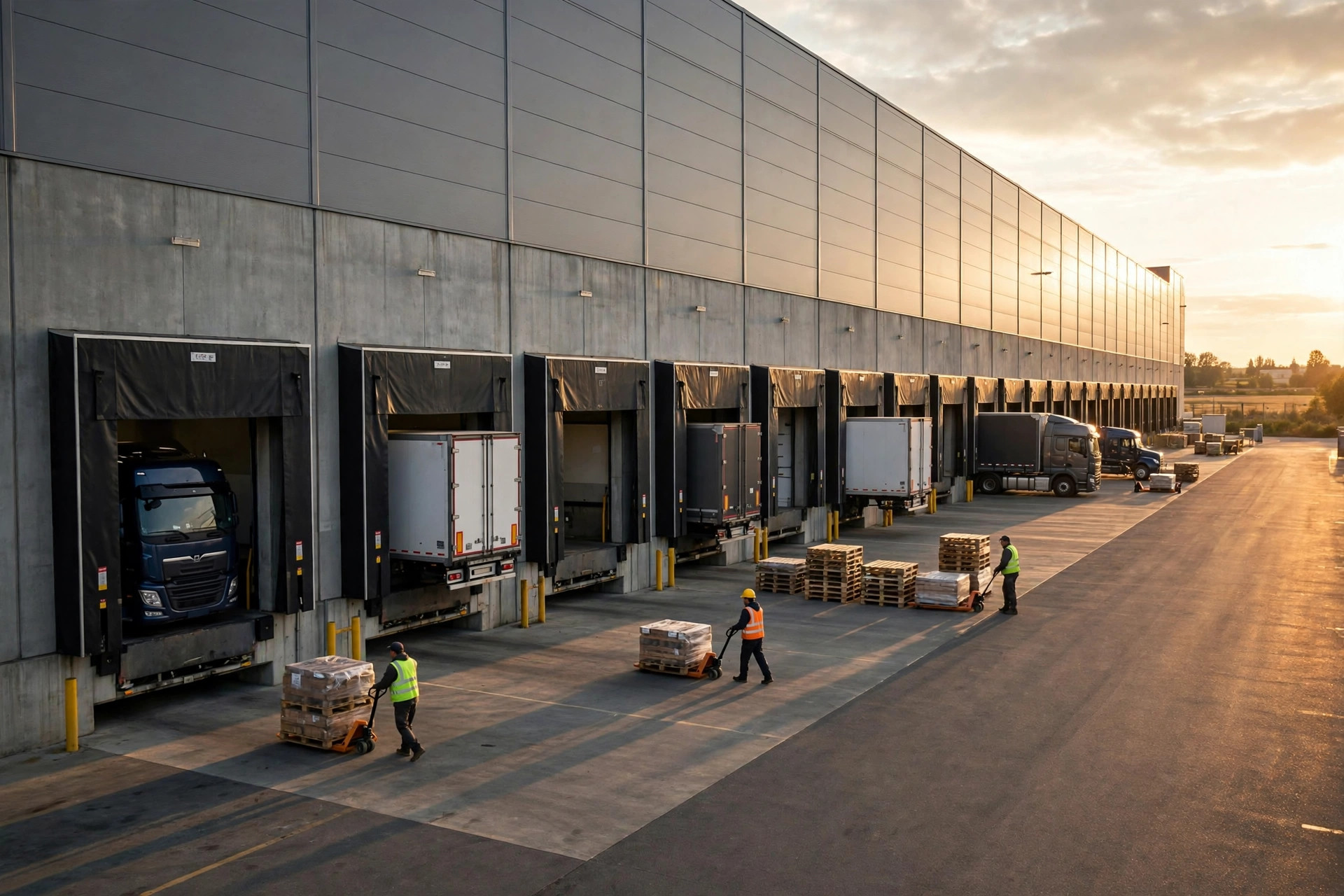
The logic behind it is dead simple. A standard 53-foot trailer takes roughly 45 minutes to an hour from backing in to pulling out — unloading or loading plus paperwork, when things go smoothly. One door running an 8-hour day turns about 8 to 10 trucks. And a plain-vanilla 10,000-square-foot distribution warehouse sees roughly that many trucks a day. The two sides of the equation meet, and you get your 1:10,000.
Sounds neat. The catch is the phrase "plain-vanilla." If your operation isn't plain vanilla, applying this rule blindly is how you dig your own hole.
Same Square Footage, Completely Different Door Math
Here's the table I pieced together from brokers, warehouse neighbors, and one very patient operations manager in Fontana. Treat these as industry rules of thumb, not engineering specs — validate them against your own operation:
| Operation type | Rule of thumb (sq ft : doors) | Why |
|---|---|---|
| Bulk / long-term static storage | 1 : 15,000–20,000 | Freight comes in and sits. Doors are decoration. |
| General distribution / wholesale | 1 : 8,000–12,000 | This is where the 1:10,000 rule was born. |
| E-commerce / fast-turn | 1 : 5,000–8,000 | Doors are the throat of the whole operation. |
| Cross-dock / transload / near-port | 1 : 2,500–5,000 | Trucks flow like water. Too few doors means no business. |
Same 50,000 square feet: a storage play gets by fine on 3 doors, while a transload operation would starve with 10.
And here's the contrarian take nobody tells small owners: more doors isn't always better. Every door is a money pit on a maintenance schedule — dock levelers need service, dock seals get replaced every couple of years, the door itself breaks. Plus each opening eats roughly 10 feet of wall, and wall space is where racking and pack stations live. The real question for a small warehouse isn't square footage at all. It's this: how many trucks need a door at the same time during your peak hour? Square footage is just a lazy proxy. Trucks are the real parent of your door count.

What Too Few Dock Doors Really Costs
Let's do the math, because vibes don't pay detention bills. Take an 80,000-square-foot distribution warehouse. By the rule of thumb it should have 8 doors. It actually has 5 — three doors short.
One peak-season day, 10 trucks show up inside a 6-hour window. Each truck takes about an hour, dock to departure. Five doors running full tilt handle 5 trucks; the other 5 sit in the yard, waiting an extra 1 to 2 hours each on average.
That's where the meter starts running:
- Detention. Hourly detention charges are standard practice in US trucking. A few extra waiting hours across several trucks adds up to hundreds of dollars in a single day. Multiply that by 60 days of peak season and you're burning five figures — because you were short three doors.
- The hidden bill is worse. Drivers who get burned waiting will refuse your loads next time, or quote higher. Appointment windows go to waste. Your forklift operators stand around the dock earning their hourly wage doing nothing. And your customer? Their freight didn't ship on time, and that dings your scorecard.
Fewer doors saves you rent — buildings with generous door counts do command a premium. But it burns cash every single day of peak season. Run this math before you sign the lease, not after.
Two Bruises, Three Street-Smart Rules
Bruise number one is mine. My own building has 2 doors for 32,000 square feet, and most days one door is plenty. Then came the week before Thanksgiving 2024: five trucks in one day. Both doors maxed out, three trucks queued outside, the longest wait nearly 3 hours. A driver started honking. I walked the line with coffee, apologizing truck by truck, and somehow nobody filed a complaint. Since then, I stagger every carrier appointment a full week ahead of peak season. Not enough doors? Make up for it with time. It's a peasant's fix. It works.
Bruise number two belongs to my buddy Lao Lin. He leased 100,000 square feet near Ontario with 8 doors — a 1:12,500 ratio, technically compliant with the rule of thumb. But he runs e-commerce returns, a fast-turn business. Peak season brought 20-plus trucks a day, the queue spilled onto the street, and the city handed him a citation. His fix: lease a second, smaller 20,000-square-foot building next door with 4 more doors, dedicated to cross-dock overflow. Meeting the ratio didn't save him. Your business type is the real parent of your door count.
After those two bruises, here are the three things I now check on every warehouse tour:
- Count dock doors and drive-in doors separately. A landlord says "12 doors" and four of them turn out to be grade-level drive-ins that a 53-footer can't use. Count them one by one; don't trust the headline number.
- Look at the yard. A dozen doors mean nothing if the yard is so tight that trailers can't maneuver. If you can't stage 3 to 5 queued trucks at peak, mentally discount the door count.
- Ask whether doors can be added. Some buildings have knock-out panels in the wall where doors were planned but never cut. Adding a door is far cheaper than moving. A retrofit runs in the tens of thousands of dollars — get a contractor quote, don't take my word for it — which looks like pocket change next to a season of detention bills.
Small warehouses have small-warehouse ways of surviving. I can't afford a 1:5,000 luxury door ratio, but staggered appointments, a well-run yard, and an honest peak-hour count let my 2 doors punch like 4. Doors are fixed. Brains aren't.
By Xiao Ma, Small Warehouse Owner