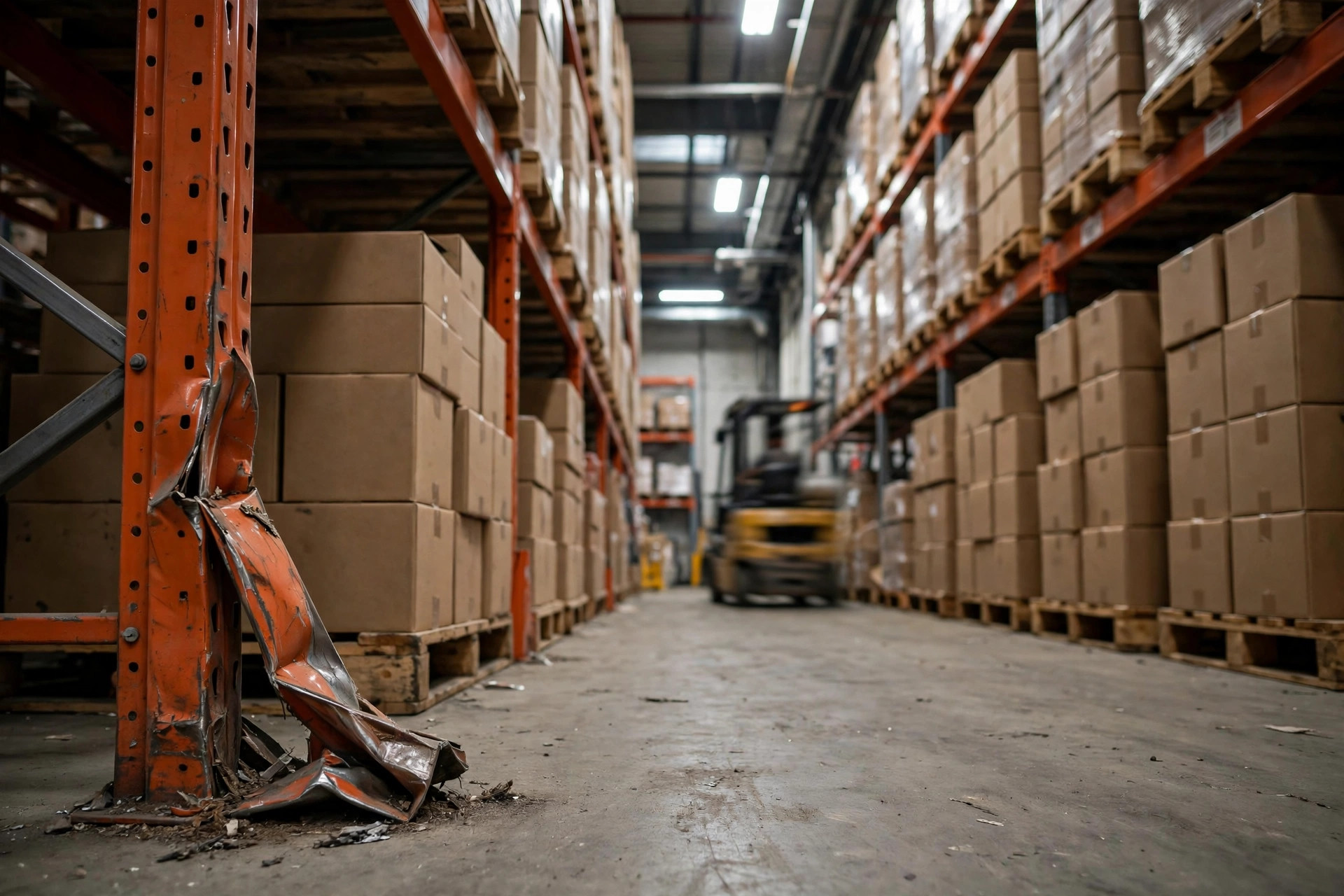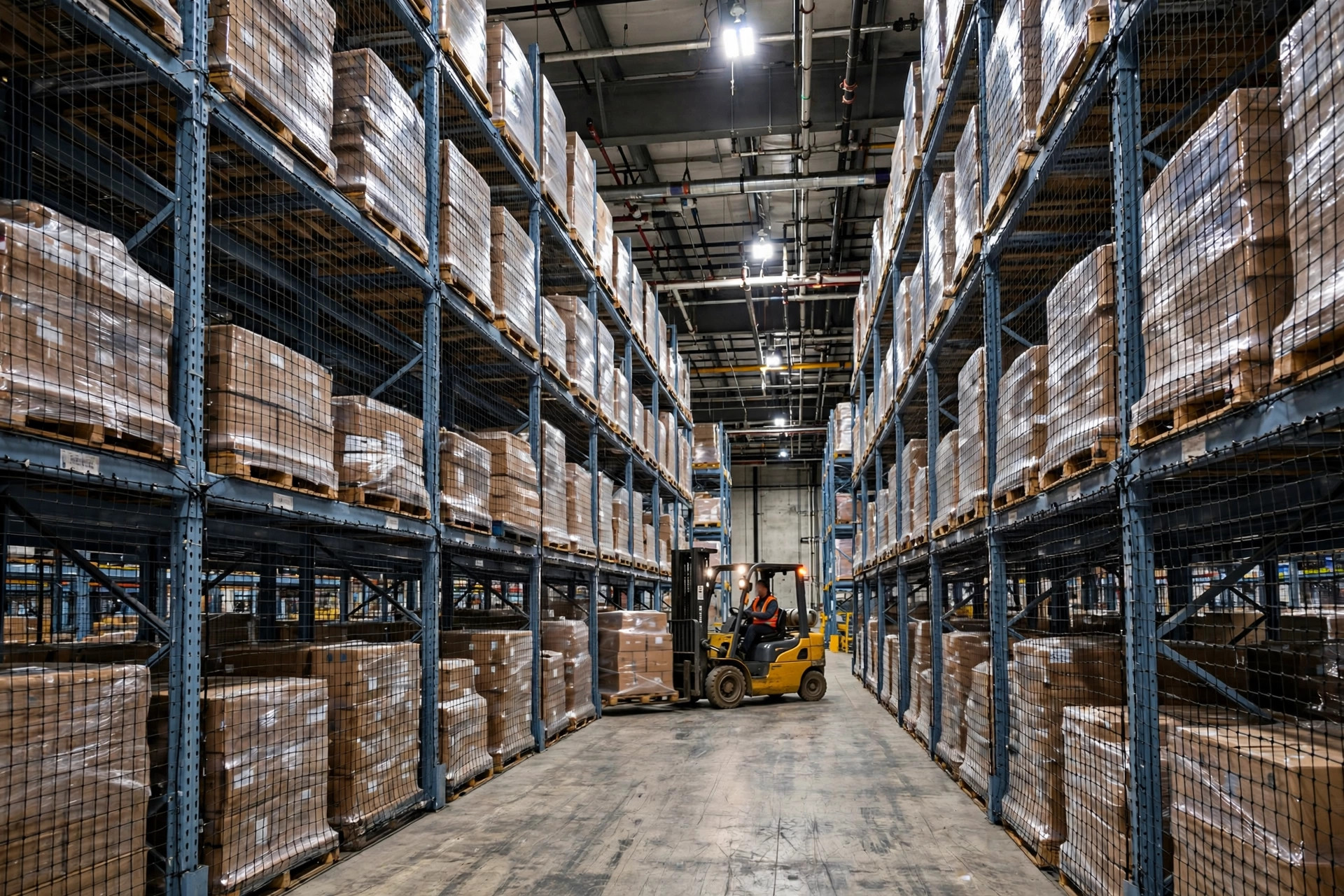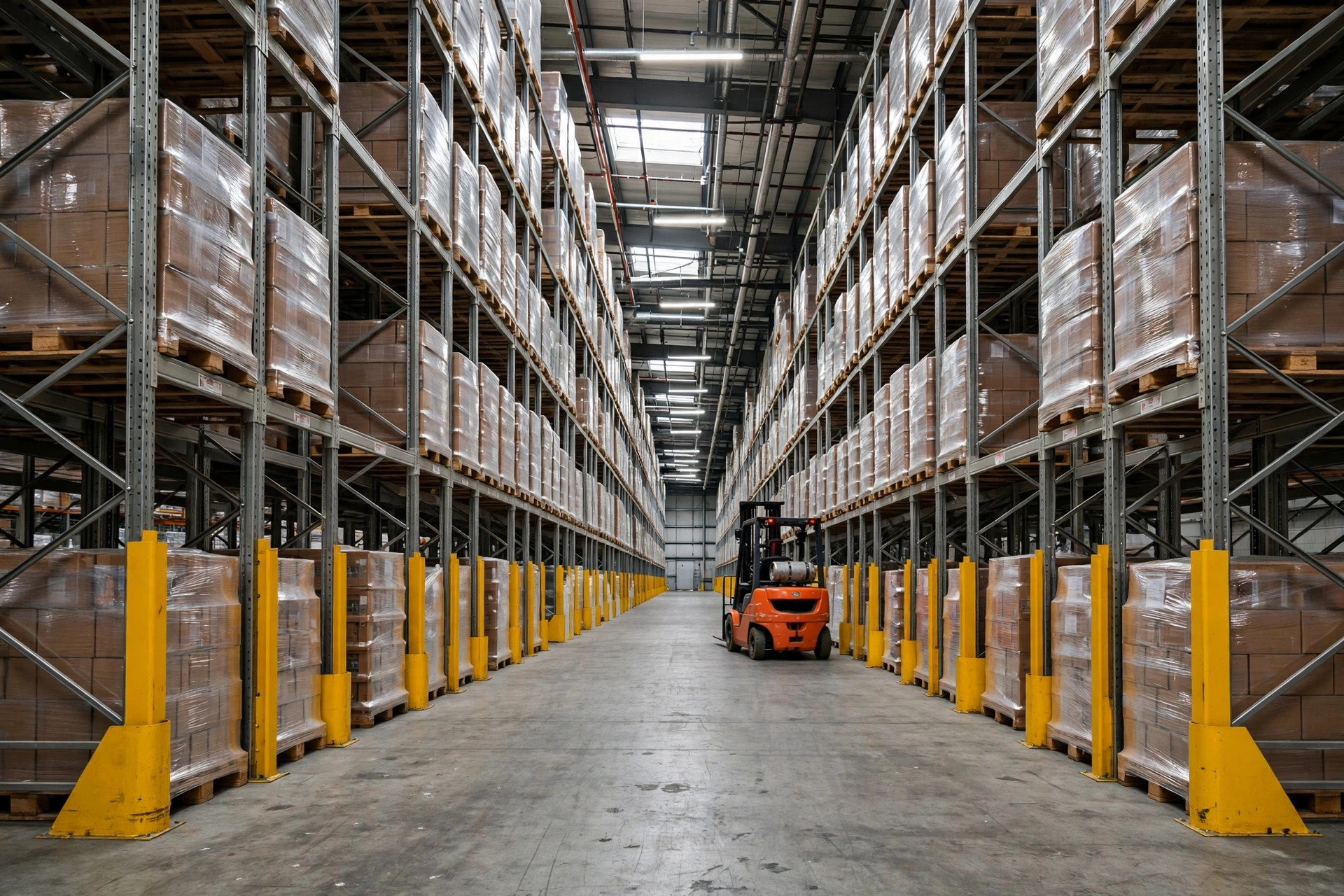
In any warehouse operating more than three years, the base of the rack columns tells a story: dented lower sections, scraped paint, leaning anchor bolts. Rack-safety firm Damotech, drawing on 150,000+ rack bays inspected per year, reports roughly 85% of all rack damage within the bottom 24 inches of the upright — exactly where forklift forks and counterweight tails sweep through. Column impact is the most frequent structural damage in a warehouse, and the most likely to be deferred. Column protectors and impact guardrails exist for precisely this height band.
Start with the data: an impact never costs just one column
Per OSHA statistics, U.S. forklift incidents cause roughly 85 deaths and about 34,900 serious injuries yearly. Forklifts account for only ~1% of warehouse accidents yet contribute more than one in ten serious injuries — a contrast compiled by several safety organizations from OSHA data: infrequent incidents, high severity each time.
Intella Parts' analysis of OSHA public records (2017–2024) found 317 forklift-related deaths in seven years — Texas 48, California 26 — led by crushing, struck-by, and overturns. A column struck hard enough to collapse is the textbook chain turning a struck-by event into a crushed-by one.
RMI's "Guideline for the Assessment and Repair or Replacement of Damaged Rack" v3.0 (May 2023) draws a hard line: any upright with bends, tears, or rips exceeding 1/2 inch must be unloaded and taken out of service until repaired or replaced. Two overlooked rules: only identical OEM parts count as "replacement" — everything else is a "repair" needing a licensed engineer's approval — and rack-failure liability rests with the rack owner.
Two real cases: repairing racks costs an order of magnitude more than protecting them
First, from a Damotech industry webinar: roughly 10% of rack bays hide a "high-priority" safety issue demanding immediate action. One cold-storage example: a single bay forced out of service after column damage cost about $54,000 in unloading labor, lost throughput, and cold-chain disruption. A vendor estimate from its own customer sample — the figure varies by facility — but the structural truth holds: the cost center is never the column itself. It is the idle bay.
Second, from Material Handling & Logistics News: a warehouse running open-column, bolt-together racking without reinforced front columns spent $4,000–$8,000 per month on rack repair. The manager eventually replaced the front uprights with column-core models, and the problem essentially disappeared. The company knew columns were getting hit; it simply kept choosing "repair" over "protect" for years.
Why it happens: columns keep getting hit, protection keeps getting postponed
Four compounding factors drive column impacts: geometry (a 48-inch pallet leaves little aisle margin; swinging counterweight tails clip aisle-end columns in turns), pace (peak-season and night-shift time pressure raises light-contact probability), sightlines (the column base sits in the operator's blind spot when reversing), and loads (overhanging pallets exceed design width).
Protection stalls on organizational reasons: whose budget pays. Safety says operations, operations says engineering, engineering files it as "one-time spend, long-term benefit" that never makes the year's list. Add the "fix it after it breaks" habit — a repair is only a few hundred to a few thousand dollars — and companies postpone protection three to five years, until one incident idles a bay.
Column protectors vs. impact guardrails: two different logics
A column protector is a close-fitting sleeve — steel or polymer — wrapping one column's base, 16–24 inches tall, covering exactly the damage zone. Its logic: the column will get clipped, so let the impact land on the protector first.
An impact guardrail is area denial: a continuous barrier at aisle ends, intersections, and equipment zones, so the forklift never reaches the columns behind it. Wider radius, but it consumes floor space — awkward for older facilities with tight aisles.
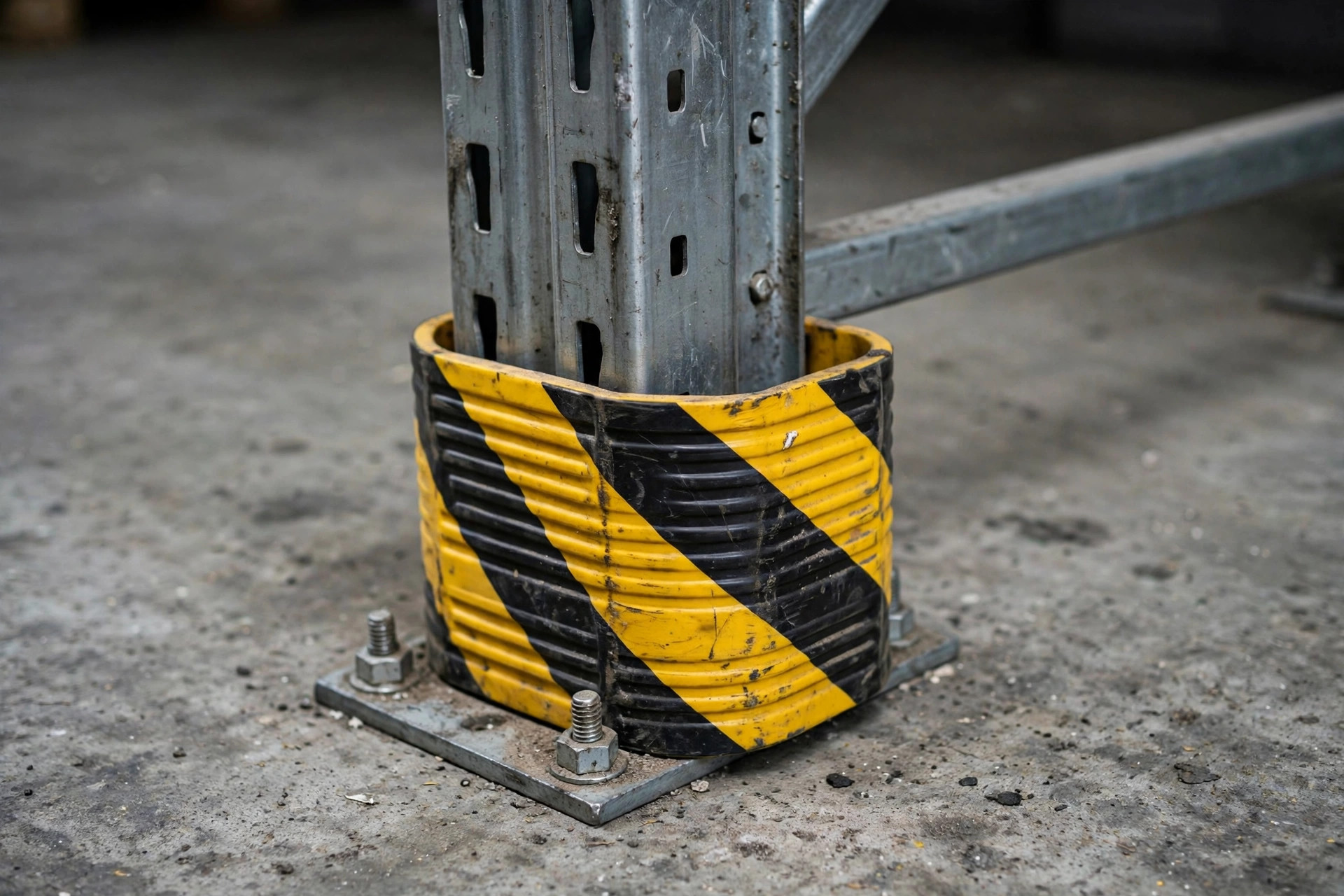
Prices differ too: HDPE or steel protectors run roughly $6–9 per unit in bulk (hundreds minimum), tens of dollars singly through U.S. distributors; flexible guardrail systems run about $30–$230 per set. Caveat: import wholesale and installed U.S. pricing are two different things — confirm installation and anchoring are included in quotes.
The math: protection cost versus one serious impact
A rough model for a mid-size warehouse: 200 aisle-facing columns with protectors, materials plus installation, lands in the low thousands; guardrails at six high-risk intersections add a few thousand more. Full coverage in one pass: typically $10,000–20,000.
A single impact serious enough to take a bay out of service breaks down like this:
| Cost item | Order of magnitude | Notes |
|---|---|---|
| Column replacement or engineered repair | Hundreds to low thousands | Materials, freight, labor; OEM uprights often ship in weeks, engineered repair kits install in about 30 minutes (Damotech data, vendor figure) |
| Bay downtime | Thousands to tens of thousands | ~$54,000 for one cold-storage bay in the cited case; ambient warehouses scale by rent and throughput |
| Product loss | Depends on goods value | Collapsed loads are usually a total loss |
| OSHA penalties | Up to $16,550 per serious violation; up to $165,514 per willful or repeated violation | Per current OSHA penalty levels; check the official site for the latest figures |
| Insurance and knock-on costs | Hard to quantify, real all the same | Premium increases, customer audit deductions, 3PL contract risk |
Protection investment roughly equals one medium-severity impact. Damotech's ten-year comparison claims engineered repair kits run up to 85% cheaper than repeatedly replacing uprights — a vendor number favoring its own product, but directionally credible: prevention and engineered repair both beat "replace the column after every hit."
Three counterintuitive judgments
First: protect not the most-hit columns, but the costliest-to-fail. A mid-aisle column clipped ten times a year, lightly each time; a freezer high-bay base column or one beside an egress path, untouched for three years — then a progressive collapse. Priority should follow probability × consequence, not impact frequency.
Second: protection does not license relaxed inspections. The severe part of the RMI guideline is damage discipline: past half an inch, unload; repairs need an engineer's sign-off; the owner carries liability. A common pattern: protectors neatly installed while the columns behind them have long since deformed — "the guard covers it, so nobody looks." Protectors absorb energy; they cannot fix hidden damage.
Third, a trade-off: rigid versus flexible, decided by where you want the energy to go. Steel transfers it into anchor bolts and slab — column survives, anchors may loosen. Polymer barriers deform to absorb it, kinder to column and forklift, but need checks for used-up deformation. High-frequency/low-severity spots suit flexible; low-frequency/high-severity suit rigid. No product is optimal everywhere.
The trend: protection is moving from optional to mandatory
Three forces are making protection non-negotiable. Enforcement: OSHA's warehousing National Emphasis Program puts rack safety on the checklist — protected columns and addressed damage are visible at a glance. Insurance: more carriers ask about inspection and protection programs at renewal; warehouses without records lose leverage. Automation: as mobile robots proliferate, impacts shift from operator error to navigation error. The logic moves from "guard against drivers" to "guard against system error" — but protection stays. A machine bends a column past half an inch just as well.
So "how much does peace of mind cost" is answered in the timeline, not the price list: protection spending is one-time and certain; impact losses are probabilistic, but their expected value dwarfs the protection cost. For companies still in "break then fix," the question is not affordability — it is whether they will admit that past years' repair spending could have bought several rounds of protection.
One open question: once unmanned forklifts and mobile robots push human error low enough, will protection standards be rewritten — down, or up, since machines run around the clock and impacts grow more uniform? No industry consensus yet, but warehouses planning automation should already have this line in the spreadsheet.
By Dr. Chen, Supply Chain Researcher