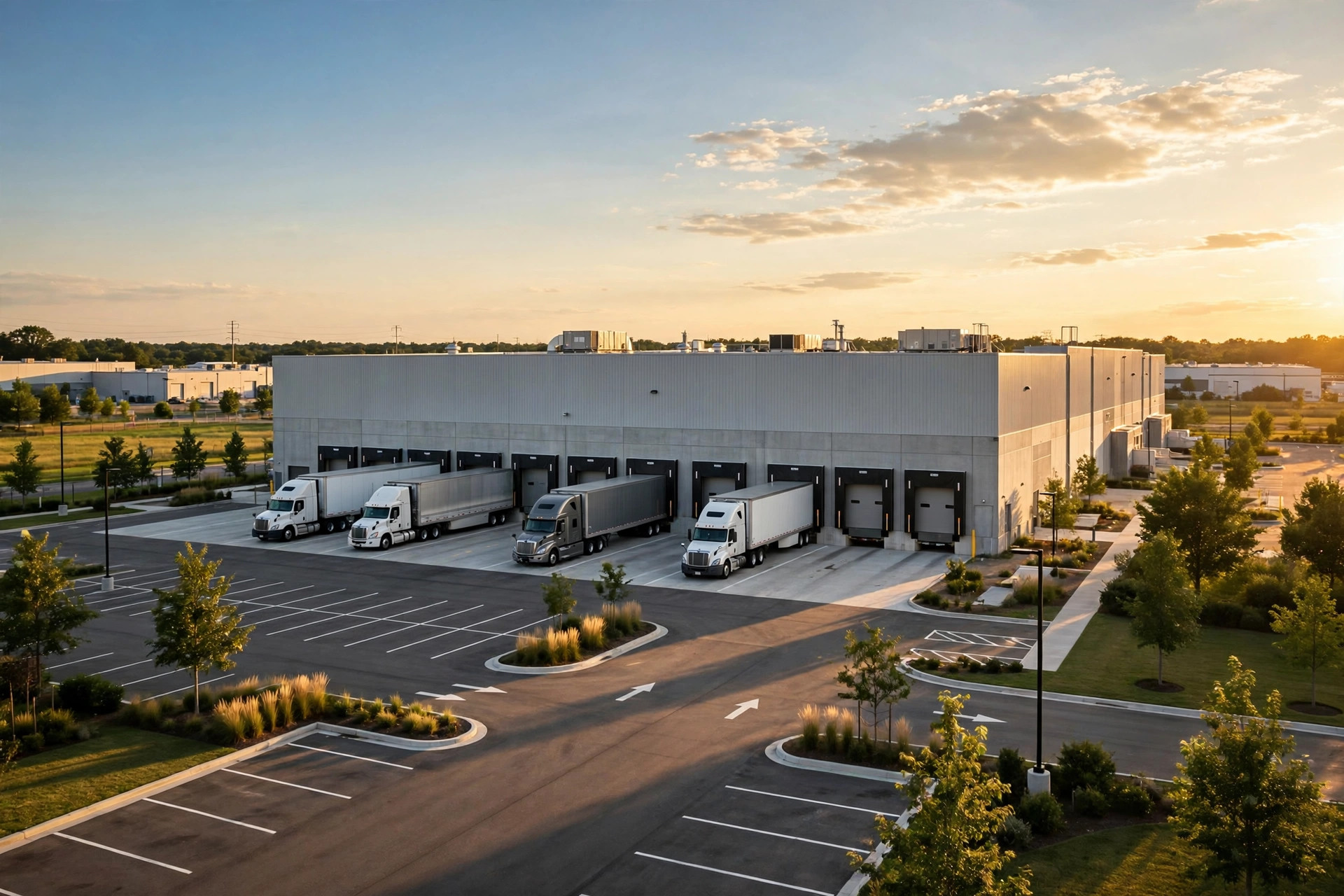
In California's Inland Empire, the same scene keeps replaying: a lease with no warehouse lease expansion option, and a tenant forced to move three years later. A home-furnishings e-commerce company signed a 50,000-square-foot lease around 2021, when the space felt generous. Three years later, orders have doubled, every pallet position is spoken for, and the 30,000-square-foot unit next door has gone vacant. Same building, same dock doors — a perfect fit. The tenant calls the landlord: a letter of intent is already signed with a 3PL. No notice owed, no waiting period required. What remains is a binary choice: cope, or relocate. And in the current U.S. industrial market, relocation costs far more than most tenants estimate.
The data: space is tightening, and landlord leverage is returning
According to Cushman & Wakefield's Q1 2026 U.S. industrial market report, the national industrial vacancy rate fell to 6.8% — 20 basis points below its late-2025 peak and the lowest reading since year-end 2024. National asking rents sat around $10.20 per square foot per year, up 2.1% year over year. CRE Daily's data puts average warehouse and distribution asking rents at $10.54 per square foot in Q2 2026, up 4% year over year — slower than the double-digit surges of 2021–2022, but still moving upward.
The supply side deserves the closer look. Only 54 million square feet delivered nationwide in Q1 2026, down 27% year over year — the lowest quarterly delivery total since mid-2017. Meanwhile demand is widening in an unexpected direction: data-center and AI-infrastructure occupiers accounted for more than 8% of new leasing activity year to date, per the same report. Tenants are no longer competing only with each other; they are competing with the companies supplying the AI buildout.
Vacancy easing from its peak, rents grinding higher, new supply at a decade low, new demand drivers entering the picture: in this environment, every square foot the landlord controls becomes more valuable, and the clause moves from a nice-to-have to a term worth negotiating hard.
Expansion option, renewal option, purchase option: three different cards
Tenants often conflate the various "rights" in a lease and discover, too late, that the card they thought they held cannot be played:
| Clause | What it governs | When it triggers | Core value |
|---|---|---|---|
| Expansion option | Right to lease additional, usually adjacent, space during the term | While the lease is active, when neighboring space becomes available | Grow in place instead of relocating |
| Renewal option | Right to extend the existing premises on agreed terms at expiry | Before the current term ends | Avoid eviction or a steep reset at expiration |
| Purchase option | Right to buy the property if the landlord sells | When the landlord decides to sell | Convert rent into an asset (usually an investment thesis) |
| Right of first negotiation / first refusal | Priority to negotiate or match terms on adjacent space | Before or after space hits the market | Weaker than an expansion option, but better than nothing |
The critical differences are the time horizon and the object: the first answers "we outgrew the space mid-lease," the second "can we stay when the term ends," the third "should we buy the building." The Inland Empire tenant's pain point is solvable only by the first — its term had years to run, so renewal was irrelevant; the landlord had no intention of selling, so purchase was irrelevant.
One misconception deserves a direct rebuttal: that a good relationship with the landlord guarantees priority access. In a 6.8%-vacancy market, the landlord is fielding calls from 3PLs and data-center supply-chain firms. A verbal promise has no enforcement mechanism; a priority not written into the lease does not exist.

The four mechanics that decide an expansion option's worth
An expansion option is not a sentence; it is a bundle of mechanics. Lease disputes cluster around four technical points, each of which must be nailed down at signing:
First, the trigger scope. The strongest version covers "any space that becomes available in the building," ideally extended to the park.
Second, the rent-setting mechanism. Three structures dominate U.S. industrial leases. One: lock the rent at signing with annual escalations — fully predictable, but landlords rarely agree. Two: set rent at "then-current market rate" at exercise — easy for landlords to accept, but the tenant bears market risk. Three: market rate at a discount (say, 95% of market) with third-party arbitration — if the parties cannot agree, an independent appraiser sets the number. The third is the most common compromise: it decouples whether you get the space from what you pay.
Third, exercise windows and notice duties — in both directions. The lease should obligate the landlord to give written notice some 30 to 90 days before adjacent space becomes available, and give the tenant a defined window to decide. One-sided drafting is no drafting: a surprising number of disputes come down to the landlord "forgetting" to notify. An expansion option without a landlord notice obligation is worth a fraction of one with it.
Fourth, the landlord's cooperation duties. These include a standstill on third-party deals during the tenant's decision window, delivery standards for the expansion space, and term alignment — typically the expansion space must run at least as long as the remaining master term. These details decide whether exercising the option means "smooth growth" or "won the clause, lost the execution."
The counterintuitive point: the real value of an expansion option is the option itself, not the discount
This is where a firm judgment can be made, and it may run against intuition: the greatest value of an expansion option was never cheaper rent — it is the choice itself, the right not to move.
Consider the rough economics of relocating a 50,000-square-foot operation (order-of-magnitude illustration; verify against current local market data): fit-out, equipment moves, and systems cutover, plus two to four weeks of disrupted operations, a productivity ramp in the new building, and — most damaging — lost orders if the move lands ahead of peak season. Against rents rising 2% to 4% a year (see the Cushman & Wakefield figures above), paying slightly more for expansion space is usually an order of magnitude cheaper than absorbing a full relocation.
Put differently, the clause is insurance — and what it insures is not rent, but business continuity. Viewed through an options-pricing lens — the premium is whatever concession you make in negotiation, the payoff is avoiding a high-cost move — the option's value rises with business-growth uncertainty. It does not fall.
A two-axis framework: should you fight for an expansion option?
Not every tenant needs one; negotiation capital is finite. Two axes give a quick read:
- Horizontal: growth uncertainty over the next three to five years (low → high)
- Vertical: scarcity of quality space in your market (abundant → scarce)
Tenants in the high-uncertainty × high-scarcity quadrant — growing e-commerce sellers and 3PLs in demand-strong markets like the Inland Empire, Northern New Jersey, and Greater Houston — should put it in their top three negotiating priorities, and be willing to trade rent or term length for it. Tenants in the low-growth × abundant-space quadrant — stable regional distributors, for example — can downgrade to a right of first negotiation. The diagonal cases are judgment calls: uncertain growth in a scarce market should at minimum lock in the landlord's notice obligation, securing the right to know before the right to act.
The framework's subtext: the clause's negotiating value correlates with market tightness. The 2026 data — 6.8% vacancy easing down, new supply at a decade low — is tilting the balance back toward landlords. Which means the clause is harder to win now than it was two years ago, and more necessary.
An open question to close on
Zoom out one level. Buried in the Cushman & Wakefield report: more than 8% of new leasing this year comes from data-center and AI-infrastructure tenants, while warehouses built after 2020 have absorbed roughly 200 million square feet of net demand — the newest, highest-rent-paying space is being claimed first by the strongest occupiers. If that pattern holds for three to five years, industrial scarcity may shift from a cyclical phenomenon to a structural one: not tight because the economy is hot, but tight because the demand structure itself has changed.
If that is where we are headed, does this clause graduate from something only sophisticated tenants negotiate into a standard lease fixture? And when every tenant starts asking for one, what new counter-clauses will landlords invent? A lease is a bet both sides place on the future. The only difference is whether anyone read the odds table before signing.
By Dr. Chen, Supply Chain Researcher