Let me open with the math behind warehouse rack safety netting requirements. In 2016, OSHA fined a Family Dollar distribution center $12,471 for stacking pallets and boxes on dented, unstable racking while 60 employees worked below, exposed to falling objects (OSHA inspection 1173557.015, cited under the General Duty Clause). That was the 2016 price. Under OSHA's current penalty schedule, confirmed in a May 2026 memo, a serious violation runs $16,550 per item — and a willful or repeated one goes up to $165,514.
That same citation today starts at $16,550. A 10-foot polyester rack safety net retails for about $71 (Mytee two-pack, $142.99). One citation buys roughly 230 nets. That's the whole lens I bring to this as a cost guy: forget "safety culture" talk, put both numbers on the table, and the answer is obvious.
This piece covers warehouse rack safety netting requirements — what OSHA actually says, what the three protection options cost, and where the money is well spent versus wasted.
Warehouse Rack Safety Netting Requirements: What OSHA Actually Wrote
Here's the counterintuitive part: no OSHA regulation says "you must install rack safety netting." Not one.
The governing text is 29 CFR 1910.176(b), "Secure storage": stored material must not create a hazard; tiered goods must be stacked, blocked, interlocked, and height-limited so they are stable and secure against sliding or collapse. The word "netting" appears nowhere in it.
OSHA cites through two doors.
Door one is the General Duty Clause, Section 5(a)(1) of the OSH Act: employers must keep the workplace free of "recognized hazards." The Family Dollar citation went through this door — forklift-damaged uprights still in service, still loaded. That's a recognized hazard. OSHA needs no netting-specific rule; it only needs to show the hazard was recognized and you did nothing.
Door two is 1910.176(b) itself. Trimark United East (OSHA inspection 1049012.015) is the textbook case: rack columns with damaged bases, broken cross-bracing, columns never anchored to the floor. And it was a repeat — the company had been cited for the same thing before, with the earlier citation becoming a final order in September 2014. Repeat violations under the current schedule run up to $165,514 per item, ten times a serious.
Then there's Accurate Automatic Manufacturing (OSHA inspection 1287786.015, 2018): racking not anchored to the floor, cited under the General Duty Clause at $9,054, settled down to $4,527 after contesting. See the pattern? The dollar figure is negotiable; the fact of the hazard is not. Once an inspector writes "recognized struck-by hazard" in the report, everything after that is you paying for that sentence.
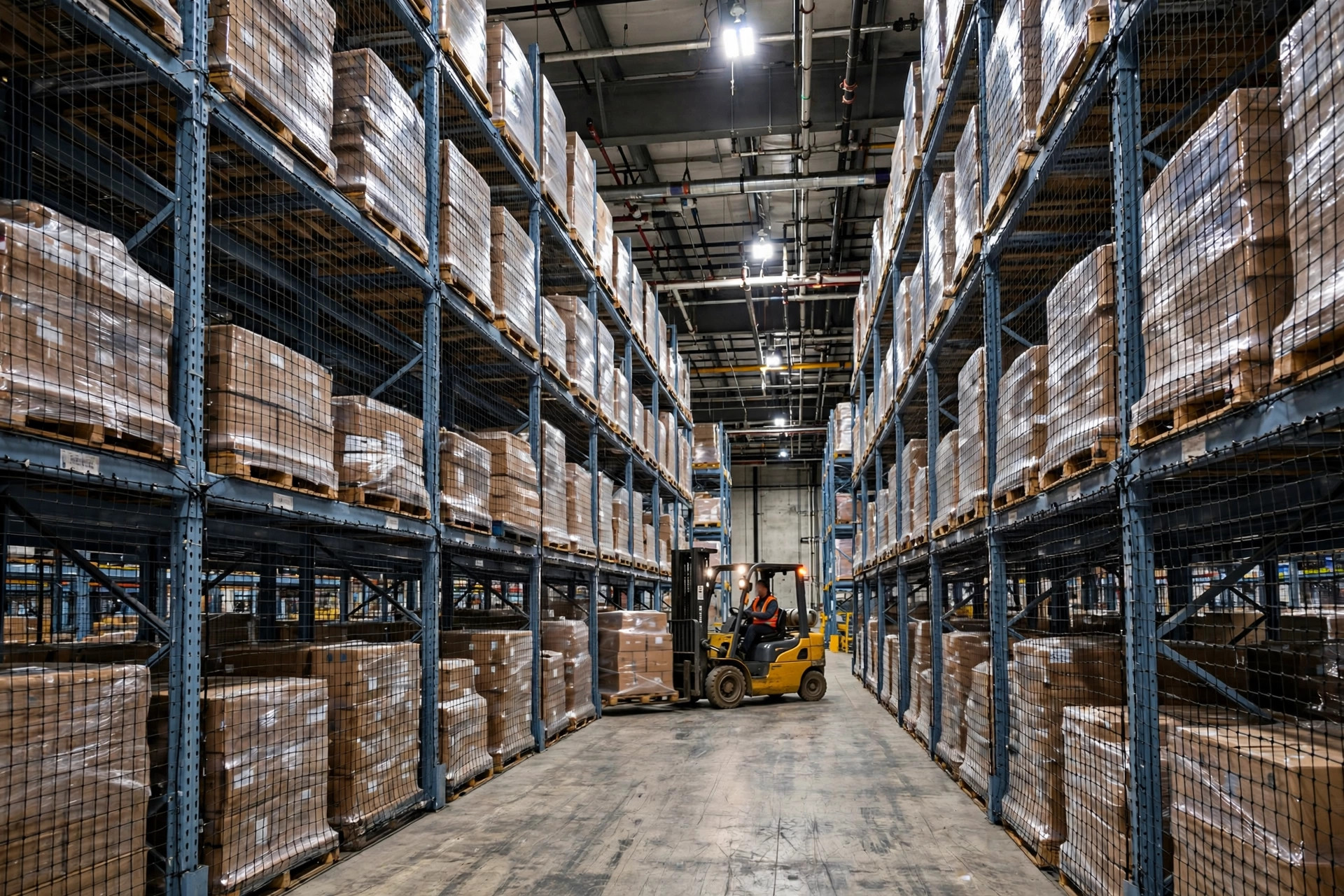
So the honest answer to "when is netting required" is: when your warehouse has a recognized falling-object hazard and you haven't abated it. An inspector looks at three things: damaged racking, any history of falling product, and high-bay loose cartons above pedestrian aisles. Hit two of three and you're getting cited, net or no net. Netting is one abatement method, not a named mandate.
One more thing vendors won't tell you: ANSI/RMI MH16.1 is the engineering standard for rack design, and inspectors treat it as evidence of "recognized" practice — but it is not an OSHA regulation. If a supplier says "MH16.1 requires netting," ask for the clause number.
Breaking Down the Cost of Three Falling-Object Options
Three mainstream options. Prices are public retail; the math is per 10-foot bay, three levels:
| Option | Material per level | 3 levels | Install | Lifespan | Stops | Weakness |
|---|---|---|---|---|---|---|
| Polyester safety net | ~$71 (Mytee 2-pack $142.99) | ~$215 | Easy, hook-and-strap | 5–8 yrs (UV/wear) | Single items sliding off | ~800 lb rating per net; dense mesh blocks sprinklers |
| Wire mesh decking | $78–129 (Uline $39–43/deck, 2 decks per 96" level) | $235–390 | Easy, drop-in | 10+ yrs | Loose items + pallet sag | Most expensive; heavy |
| Back stop bars | Tens of dollars/level (per supplier quote) | ~$100–150 | Easy | 10+ yrs | Full pallets sliding back | Won't stop loose cartons |
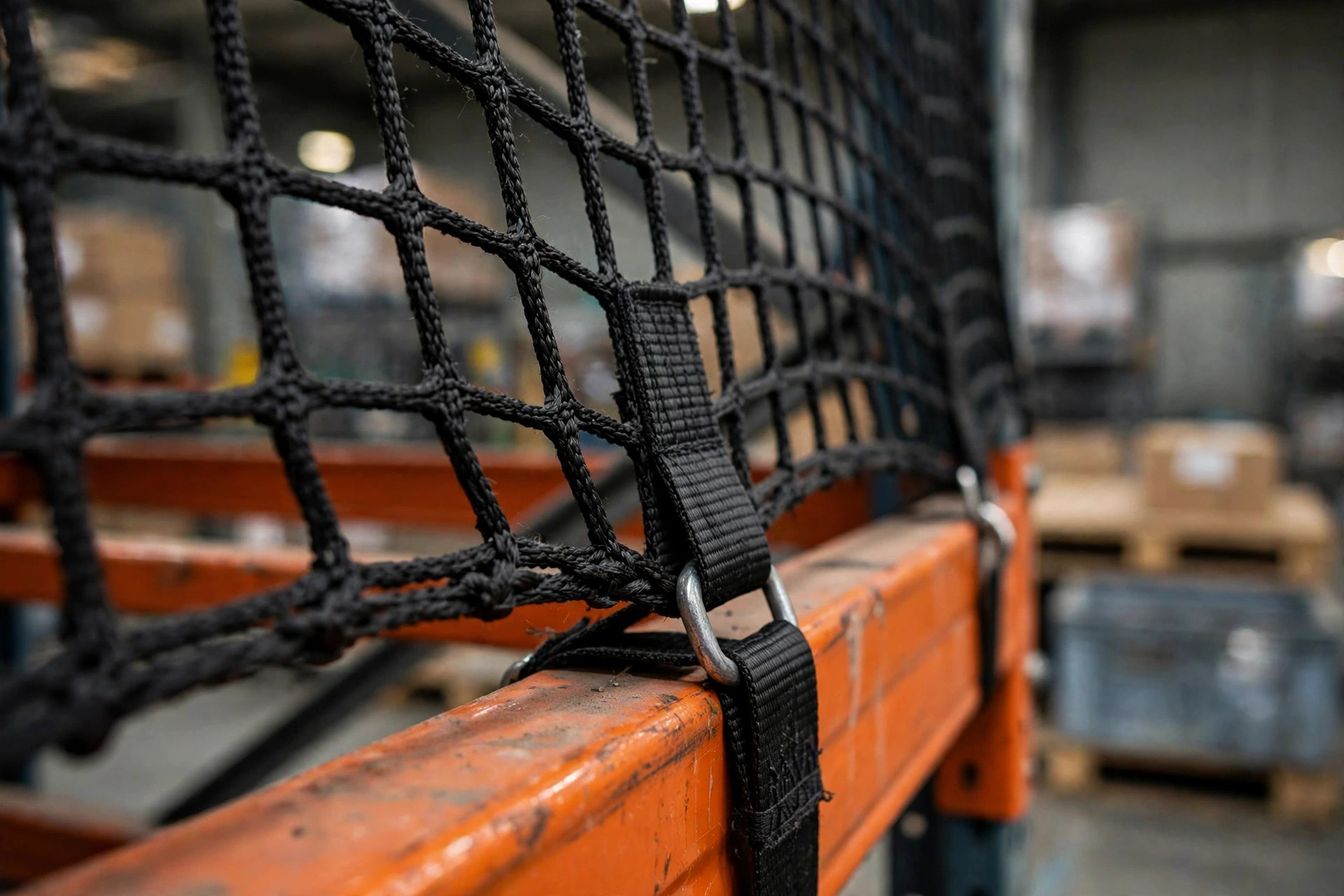
See the pattern? Netting is cheapest, but it stops single items — rated around 800 lbs per panel. If a whole bay collapses, no net and no wire deck will save you. Buying netting to prevent collapse is buying the wrong insurance. Collapse prevention is column protectors, floor anchors, and forklifts that don't hit things. Plenty of buyers aim their money at the wrong risk.
The deeper trade-off: denser mesh catches more, but it also blocks sprinkler water. NFPA 13 requires flue spaces in rack storage; fully enclosed netting can fail fire inspection — a compliance move that creates a new violation. Wire mesh decking is the fire-friendly option; its open grid lets water through. That's why warehouses with in-rack sprinklers often pay double for decking.
Where Rack Safety Netting Pays: The Three-Question Test
Blanketing the whole warehouse in netting is the most wasteful compliance spend I see. Use three questions; net only the bays that answer yes to all three.
1. What does this row face? Back against a wall or facing an equipment zone — falling product hits nobody. Lowest priority. Facing pedestrian aisles, pick zones, pack stations — highest. Net those.
2. What's stored? Fully shrink-wrapped full pallets rarely fall. Loose cartons, odd-shaped items, unwrapped goods — a forklift bump sends them moving. Net those.
3. How high? Ground-level drops injure few people. Anything above head height over a walkway — treat as mandatory.
Run the math on a typical 3PL: 800 bays, roughly 30% facing aisles = 240 bays. Netting three levels on just those: 240 × $215 = $51,600 in material. Netting all 800: $172,000. Selective installation saves $120,400 with nearly identical compliance effect — because OSHA cites recognized hazards, not coverage percentage.
Where does the saved money earn more? Two places. Column protectors and guard rails — the Family Dollar citation specifically called out impact-damaged racking, so protectors attack the root cause. And forklift operator training — most falling-product incidents start with a fork strike. Both count as abating recognized hazards. An inspector can't fault either.
The Closing Calculation
Compliance is an expected-value problem:
Expected annual incident cost = annual probability of a falling-object event × total cost per event Annualized netting cost = total investment ÷ service life (years)
Total cost per event: the OSHA citation (serious starts at $16,550, and multiple citations per inspection are the norm; repeat starts at $165,514) + direct injury costs (medical, comp) + indirect costs (downtime, investigation, legal, insurance hikes — industry estimators commonly run multiples of direct cost) + lost throughput during abatement. Any single line item dwarfs a $215-per-bay net by two orders of magnitude.
So here's the computable conclusion: pull your last three years — how many falling-product events, what did each cost. If expected annual incident cost exceeds annualized netting cost, netting is a profitable purchase. If you've had zero events in three years, your hazard was small to begin with; spend the money on protectors and training instead, where the return is higher.
Don't spend because it "feels unsafe." Don't skip because it "probably won't happen." Run the numbers; the answer speaks for itself.
By Lao Zhou, Logistics Cost Analyst