A new 5,000-lb electric counterbalance forklift starts around $30,000. The forklift lease vs buy debate is never settled by the price tag — it is settled by how many hours a month you actually run the machine. Buyers want to save on rent; renters want to save on the down payment. Both stare at the visible numbers and ignore the hidden ones.
In October 2025, the operations director of a 3PL in Ontario, California showed me his peak-season bill: from September through December he had added four short-term rental trucks at $320 per truck per day, delivery fees extra. Four months of rent came to just over $150,000 — enough to buy four brand-new trucks outright, with change left over. The worse part was 2024, when he had listened to a salesman and bought three trucks at once. The following February through May, all three sat in a corner of the warehouse for four straight months while depreciation kept ticking and the tires slowly went flat. Money wasted, and wasted because the decision was based on a feeling that peak season would be short on trucks — not on hours.
Cost Per Hour: The Only Formula That Matters
Forklift lease vs buy needs no mysticism. One formula settles it:
Cost per hour = (monthly depreciation OR monthly lease payment + average monthly maintenance + average monthly energy) ÷ actual monthly operating hours
The numerator is money; the denominator is work. If the denominator stays low, the cheapest numerator still loses. Take a $35,000 electric truck as the example: five-year depreciation with an $8,000 residual value means $450 a month in depreciation; average maintenance (tires, brakes, hydraulic oil, amortized annual inspection) runs $220 a month; charging costs about $90 a month. The numerator totals $760 a month. The denominator has three possible lives:
- Slow season, 80 hours a month: $9.50 an hour
- Normal months, 160 hours a month: $4.75 an hour
- Peak season, 240 hours a month: $3.17 an hour
Same truck, and the hourly cost swings by a factor of three. So the question "is it cheaper to buy or lease a forklift" is malformed — the first question has to be: how many hours a month will it work.
Forklift Lease vs Buy: Buy, Long-Term Lease, and Short-Term Rental Side by Side
| Buy (own) | Long-term lease (36–60 months) | Short-term rental (weekly/daily) | |
|---|---|---|---|
| Monthly fixed cost | ~$760 (depreciation + maintenance + energy) | $800–$950 lease + ~$90 energy | $280–$350 per week, plus delivery |
| 80 hrs/month | $9.50/hr | ~$11–$13/hr | ~$14–$18/hr |
| 160 hrs/month | $4.75/hr | ~$5.60–$6.50/hr | — (nobody rents this way) |
| 240 hrs/month | $3.17/hr | ~$3.70–$4.30/hr | — |
| Capital tied up | $30k–$50k per truck upfront | Zero or low down payment | Zero |
| Residual risk | Yours | Lessor's | None |
The figures above are typical industry magnitudes — get your real quote from a dealer — but the relative positions of the three lines never change: the less you use it, the more buying loses; the more you use it, the more renting loses. Short-term rental has the highest hourly cost of the three. Its only value is flexibility — during those peak months, you cannot afford the luxury of year-round idle capacity.
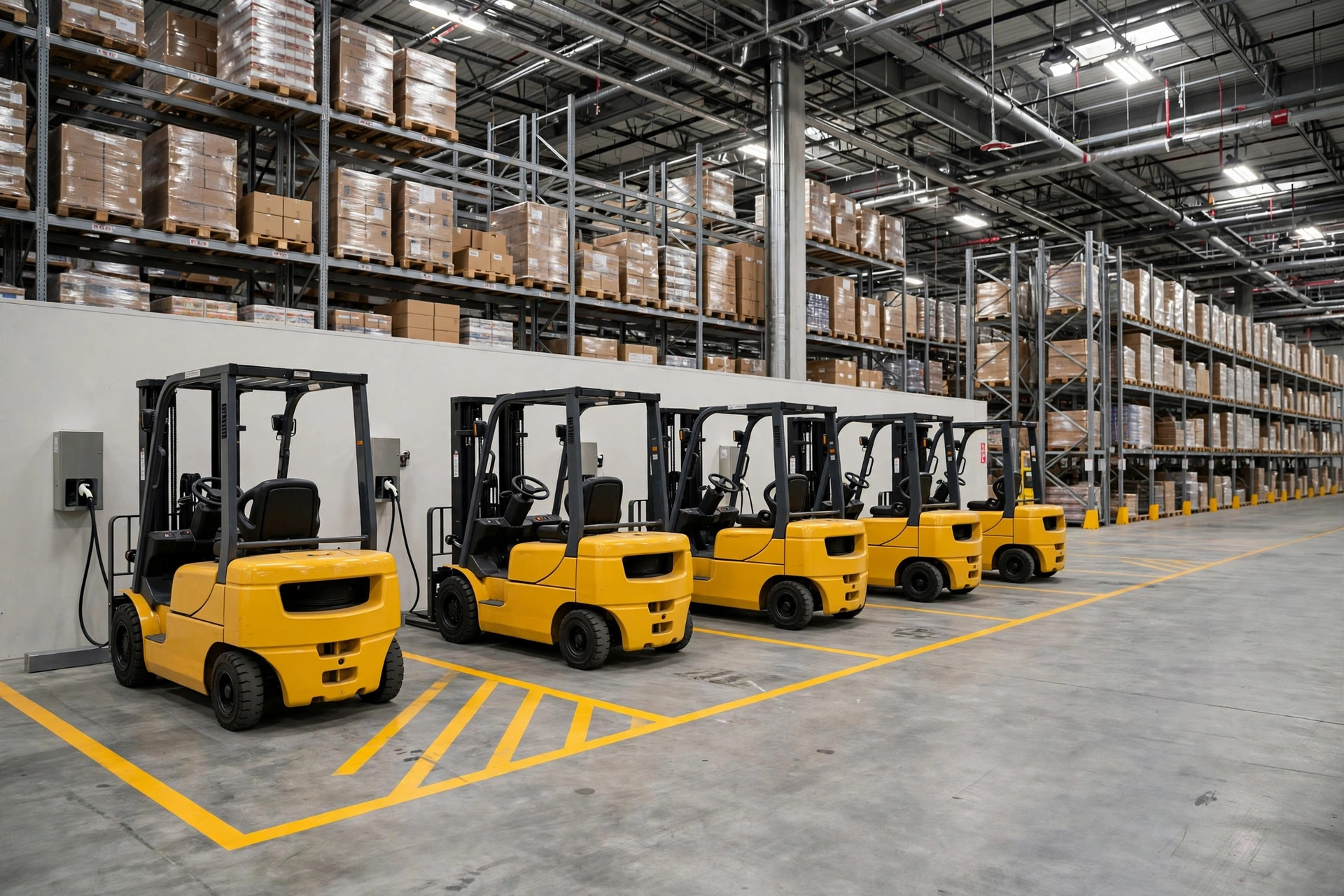
The cautionary tale comes from an e-commerce warehouse in Atlanta in early 2024. After a blowout fourth quarter in 2023, the owner bought six new trucks at once. When the promotions ended in February 2024, daily usage dropped from 9 hours to 2.5, and four of the six trucks sat parked long-term. By the formula above, each truck still burned $450 a month in depreciation — four trucks, four months, $7,200 of depreciation for nothing, before counting the tied-up capital. Had the core fleet been four owned trucks plus two short-term rentals for the peak, the slow season would have cost nothing extra.
The Counterintuitive Part: Below 30% Utilization, Buying Always Loses
The industry rule of thumb: on a single shift, a truck running 160–176 hours a month is at 100% utilization. Below 50 hours a month — under 30% utilization — buying is a guaranteed loss. Depreciation alone pushes your hourly cost past $15 an hour, worse than short-term rental, and you have tens of thousands in capital locked up on top.
Here is the part that stings: an idle forklift is not "costing nothing." It is a depreciation ATM. Batteries sulfate sitting still, tires go flat, hydraulic seals age, and five years later the residual value comes in lower than what your books assumed. The biggest cost of buying a forklift was never the purchase price — it is all those hours you reserved for it that never produced work.
Four Levers That Actually Save Money
Lever one: measure four real weeks of hours first. Do not trust the shift lead's estimate. Log every truck's hour-meter reading for four consecutive weeks, separating slow weeks from peak weeks. Without that number, everything after this is guesswork.
Lever two: run a hybrid fleet — buy the base load, rent the peak. Size the owned core fleet to the guaranteed workload of slow plus normal months, where utilization will clear 60% and buying wins decisively. Cover the extra 20–30% of peak demand with short-term rentals. Had the Ontario 3PL run four owned trucks plus two peak-season rentals, it would have saved tens of thousands of dollars a year.
Lever three: cost electric energy separately. Charging an electric truck costs roughly one-third to one-half of diesel or propane fuel (it moves with US industrial power and fuel prices — use your actuals), but the battery pack needs replacement in about five years at several thousand dollars. Amortize the battery replacement into monthly maintenance before comparing, and do not compare fuel alone.
Lever four: ask your CPA about residual value and taxes. Under US tax rules, equipment purchases may qualify for accelerated depreciation or Section 179 expensing (confirm with your CPA and the current year's rules), which pulls the real cost of buying down further. Lease payments simply hit expenses. Have your accountant run both sides at your company's tax rate — a five-minute exercise.
The Takeaway: A Line You Can Calculate
Stop asking "lease or buy." Ask "how many hours did it work this month." Plug your measured monthly hours into this line:
- Under 60 hours a month: do not buy. Rent short-term or outsource the moves — buying means working for depreciation.
- 60–160 hours a month: long-term lease is the stable choice, predictable monthly cost, zero residual risk.
- Over 160 hours a month: buy. An owned fleet gives the lowest hourly cost.
The formula once more: cost per hour = (monthly depreciation or lease payment + average monthly maintenance + average monthly energy) ÷ actual monthly operating hours. Run all three lines, pick the smallest number. Forklifts do not tell stories. Numbers do.
By Lao Zhou, Logistics Cost Analyst