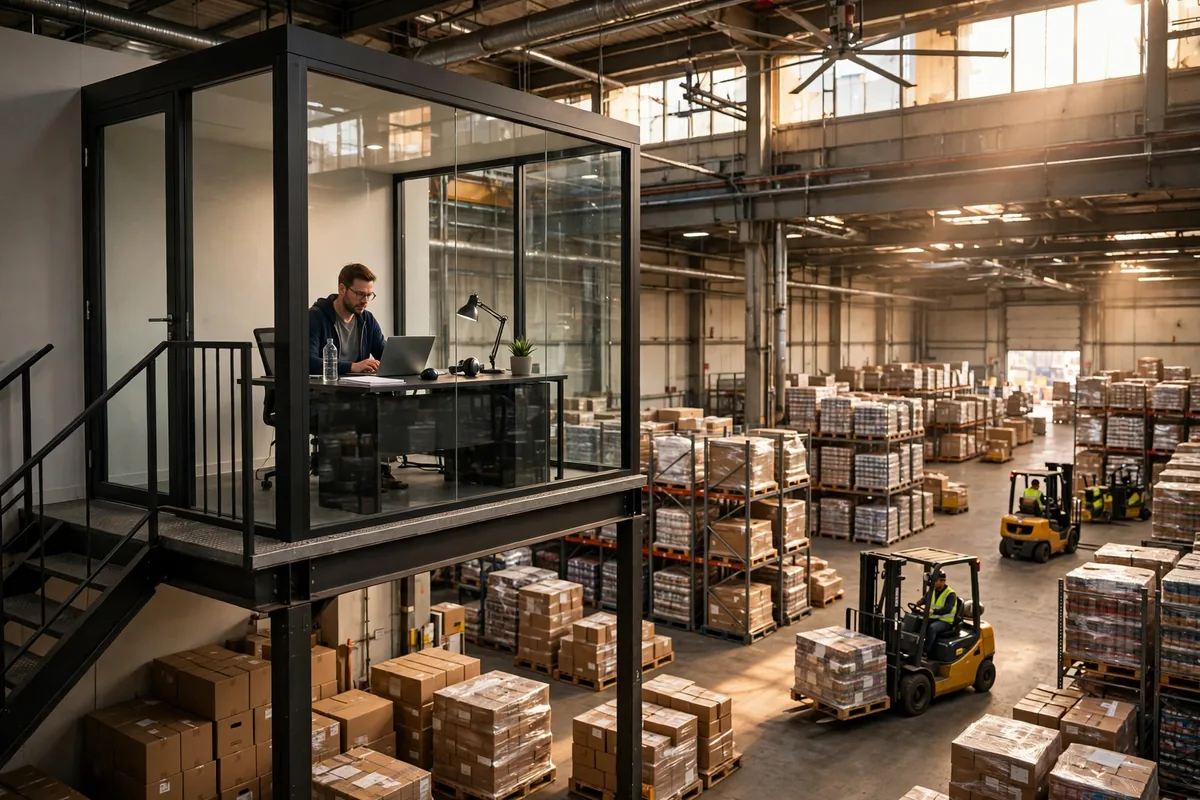
Brothers, let me tell you about something we did right before peak season last year that still makes me shake my head. We moved 12 people — customer service and operations — out of a rented office and into a mezzanine inside the warehouse. It was our first real attempt at fitting an office inside a warehouse, and looking back, it was a gamble. The rent savings were real, more than ten thousand yuan a month. But for the first two weeks, our customer service reps had to cover one ear every time they picked up the phone. Every time a forklift reversed downstairs, that beeping alarm went straight into the receiver, and customers kept asking, "Are you guys doing roadwork over there?"
Fitting an office inside a warehouse comes down to three layouts: up on the mezzanine, behind a glass partition, or squeezed into a corner. We have tried all three, and we have stepped in every hole each one has to offer. Let me lay out the numbers for you. Saving rent is a good thing, but not if you pay for it with throughput.
The Mezzanine: The Most Common Way to Fit an Office Inside a Warehouse
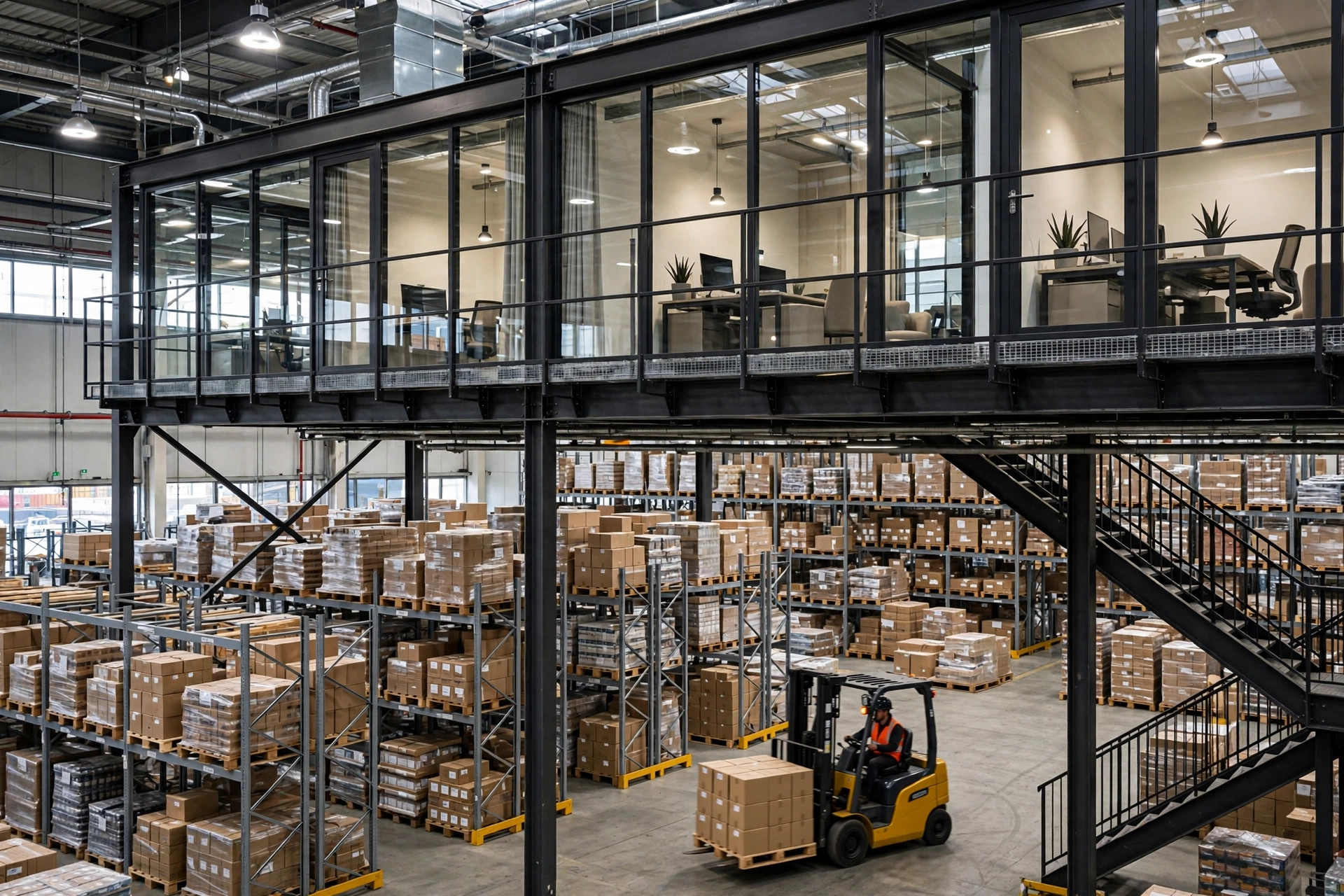
The mezzanine is the most common way to fit an office inside a warehouse. It takes no floor space, and from up there you can see the whole operation, which managers love. The problem is just as obvious: noise. In our first week up there, Lao Li, our customer service lead, told me his throat was raw by the end of the day — not from talking too much, but from shouting over the noise from below. Forklift alarms, pallets thudding onto the floor, tape guns at the packing benches, it all drifts upward. We ended up spending a few thousand yuan on sound insulation under the mezzanine deck, and we shifted the customer service call peak away from the 10 a.m. forklift rush. That is what finally saved our throats.
The mezzanine has another flaw: summer heat. The steel roof bakes in the sun, and up on the mezzanine it runs several degrees hotter than the floor below. You need a dedicated air conditioner, or nobody can sit there after 2 p.m. Add those two costs together, and a good chunk of the first year's rent savings goes right back out the door. The insulation cost a few thousand yuan, and the extra air conditioner cost about the same again. We did not budget for either. That is the part nobody tells you when they show you a photo of a mezzanine office: the fit-out is only the first bill. The second bill arrives in July, and the third one arrives every time a customer asks why your phone line sounds like a construction site. Here is the honest truth: the mezzanine works for a small crew, five or six people. Past ten, the noise and the heat alone will wear people down.
The Glass Box: The Prettiest Warehouse Office Layout, the Scariest Power Bill
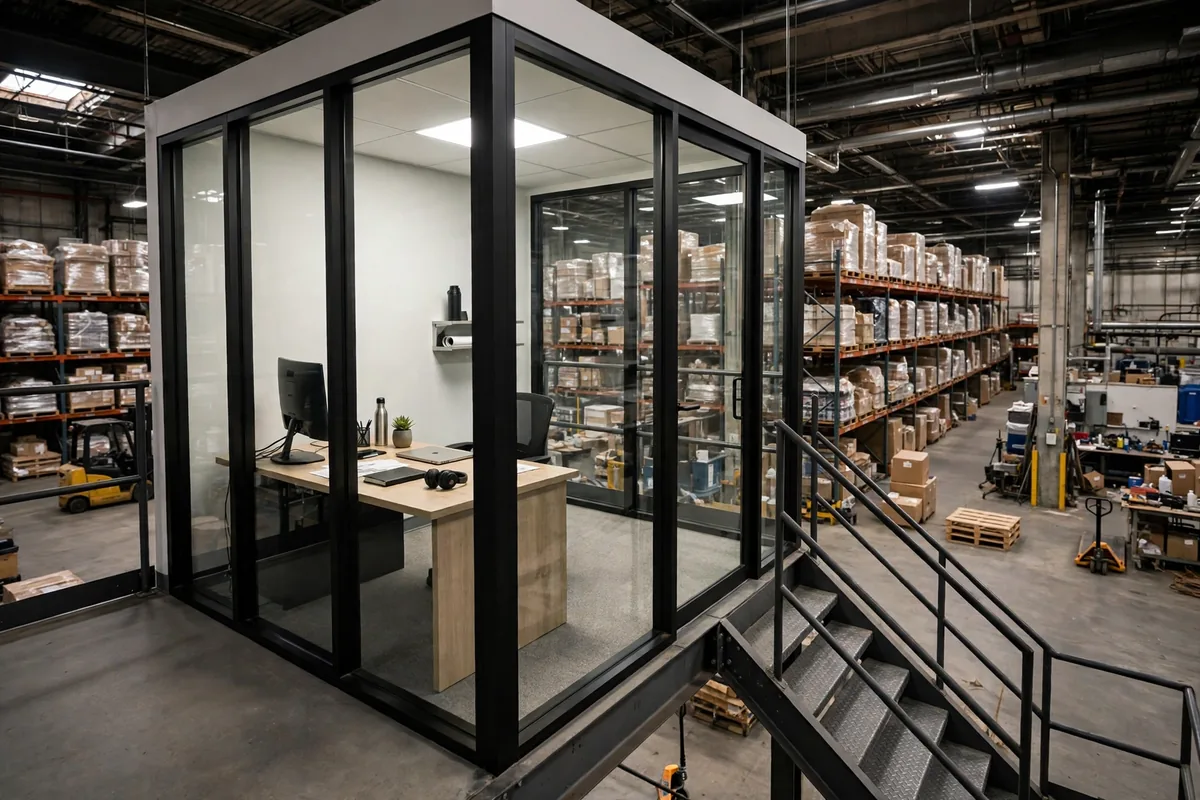
The second layout is a glass-partitioned office. Bright, clean, and it looks great when a client visits. One of our customer warehouses did exactly this: a 30-square-meter glass room, tens of thousands of yuan in fit-out, and the photos looked like a showroom. Then summer arrived, and the glass box turned into a greenhouse. The air conditioner ran around the clock, and the monthly power bill came in several hundred yuan higher than the old rented office. Worse was the glare: once the afternoon sun swung around, the computer screens went white, and one of our operators spent two weeks shielding her monitor with a piece of cardboard before we finally put film on the glass.
The glass box carries a hidden cost, too. The sound insulation is better, but communication gets slower. Before, customer service could just shout a question over to the packing bench. Now they have to call or message, and each round trip eats half a minute. Multiply that by a few dozen exchanges a day and you have lost half an hour. Looking good costs money, and nobody shows you that bill before the renovation starts.
The Corner Desk: Cheapest to Set Up, First to Get Evicted
The third option is the corner squeeze: a few desks and computers pushed into a spare corner of the warehouse. Zero cost. That is how we started, with three operators crammed beside the receiving area. Cold in winter, hot in summer, and the moment peak season hit, that corner was the first space to be taken. The night before a big promotion last year, an unexpected delivery had nowhere to go, and the shift manager moved the operators' desks next to the packing benches with one sentence. Computer cables stretched ten meters across the floor, and two people spent the night working on laptops while crouching.
The corner has another problem: dust. Warehouse dust gets everywhere. Keyboards needed replacing every three months, and computer fans clogged up and hummed like angry bees. The rent you save ends up getting spent another way. The corner layout works as a stopgap for two or three months. Treat it as a permanent plan and you are only fooling yourself.
Three Layouts in One Table: Decide by Three Numbers
| Layout | One-time cost | Extra monthly cost | Biggest trap |
|---|---|---|---|
| Mezzanine office | Sound insulation and AC, tens of thousands of yuan | AC power | Noise, summer heat |
| Glass partition | Fit-out, tens of thousands of yuan | AC power | Greenhouse heat, glare |
| Corner desks | Almost nothing | Computer replacements | Evicted at peak, dust |
Do not start by asking how much rent you save. Ask three numbers instead. First, how far is the office from the floor, and how many trips a day does customer service make down there? Second, will this space get taken over when peak season hits? Third, can anyone actually sit there in summer and winter? Our final answer was a split: customer service stayed on the insulated mezzanine, and operations moved back into the glass room. Separate them, and each gets what it needs.
We ran the numbers again a year later. The mezzanine insulation and air conditioning cost tens of thousands of yuan, and the glass room fit-out cost about the same. The first year's rent savings were basically wiped out. Year two is when the savings finally started to stick — but only because the people stayed. Two of our customer service reps quit in that first year, one over the noise and one over the heat, and hiring their replacements cost more than the rent we saved. That is the line on the spreadsheet most people forget to write.
Most people think the office should sit as close to the floor as possible, so they can keep an eye on things. I think that is exactly backwards. Put customer service too close to the packing benches, and every call carries the noise of the floor — customers hear it and think you are unprofessional. Seat operations next to the freight, and their attention gets pulled all day by forklifts, receiving, and exceptions, while their real work never gets done. The best distance between an office and the floor is "see it, but do not touch it": you can see the whole floor from the door, but it takes you two minutes to walk down there. Those two minutes are a firewall.
Here is the honest truth. Moving the office into the warehouse saves rent on the first line of the spreadsheet, but efficiency is the bigger number. Before you build anything, run a three-month test: put two desks in a corner and see whether the setup survives peak season. Then decide whether to spend money on a mezzanine or a glass room. Do not renovate first — changing a finished renovation costs far more than not building it at all. Brothers, saving rent is a skill. Just do not let your efficiency go out the door with it.
By Chen Feng, Warehouse Operations Manager