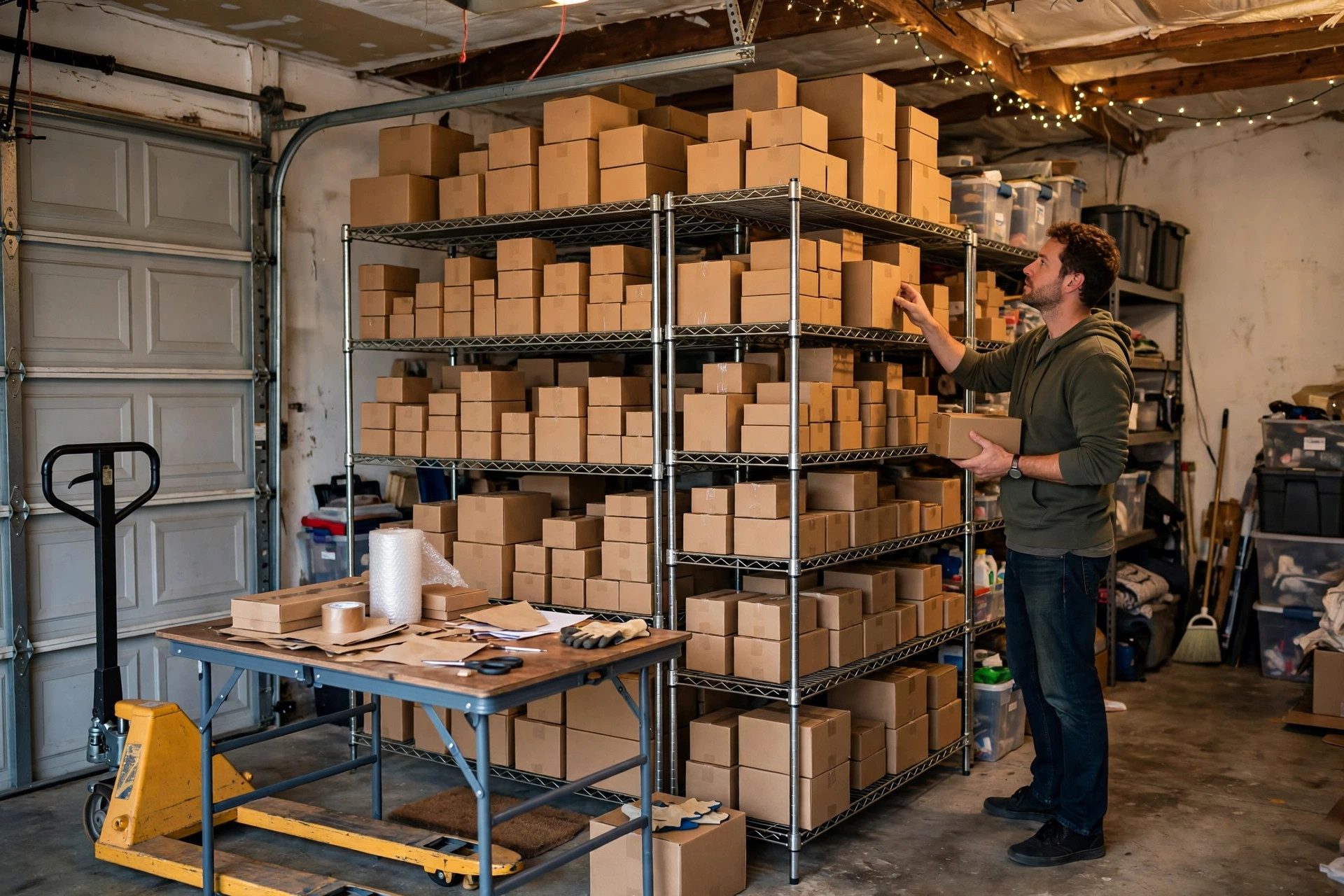
We small warehouses cannot afford to burn money like that — and that is exactly why warehouse office space inside a warehouse layout is a decision worth getting right. That is the first thing I think every time I see a neighbor in our industrial park renting a separate office down the road. My warehouse is 3,000 square meters. Picking, packing, customer service, and bookkeeping all live under one roof. Last year I rented a 40-square-meter office outside, and the monthly rent plus service fees cost me about half a packer's salary. Three months later I gave it up and moved the office back inside the warehouse. It saved money, sure — but my first layout was a disaster. Customer service had to shout over the forklift alarms, and every time a forklift reversed, the whole office looked up.
Here is the real conflict behind warehouse office space inside a warehouse layout: a warehouse wants wide-open flow, and an office wants a quiet, closed little room. The two needs fight each other by nature. The layout is just you finding a way to live with that fight. I have tried three setups over the last two years, and here is each one, honestly.
The Mezzanine Office Inside a Warehouse Layout: Saves Floor Space, Tests Your Nerve
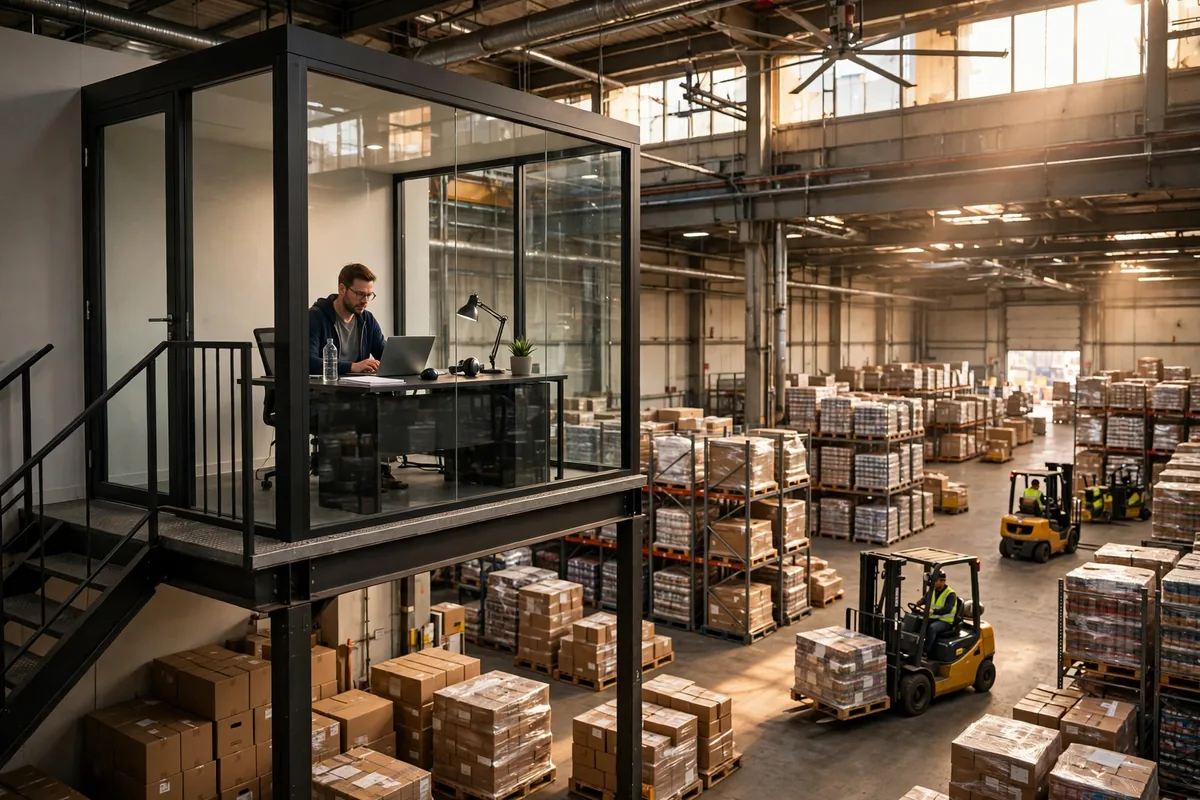
The first option is a mezzanine — a steel platform built in one corner of the warehouse, offices upstairs, packing or storage still running underneath. This is what I use now. In September 2025 we spent two weeks building a 60-square-meter mezzanine: packing below, three desks and a row of filing cabinets above.
The advantage is real: it eats zero floor space. Not one square meter of storage is lost. For a small warehouse like mine, where every square meter has to earn its keep, that matters more than anything. The view is a bonus too — stand up upstairs and you can see the whole packing floor, who is hustling and who is dragging their feet.
But the mezzanine has the most serious traps. First, structure and fire safety. A steel mezzanine is not just an iron shelf. Load ratings, escape stairs, and sprinkler coverage all have to be done properly — we had to redo our fire-safety work once. Second, noise. The packing machines and tape guns drift upward, and phone calls upstairs turn into shouting matches until we added insulation and a ceiling. Third, heat. A mezzanine sits close to the roof, hot air gathers up there, and we ended up running an extra air conditioner all summer.
Here is the counterintuitive part: a mezzanine saves floor space, not money. The steel, stairs, insulation, and air conditioning often cost twice what a partition costs. It fits warehouses where floor space is worth more than gold and every pallet slot counts. It is a bad fit if you just want "somewhere cheap to put a desk."
The Partition Office: Cheapest to Build, Easiest to Regret
The second option is a partition — walling off a corner of the warehouse with light steel framing and drywall. This was my first version, and it is the first choice of most small warehouses: cheap and fast, done in a weekend.
In March 2025, I partitioned off a 25-square-meter office in the northeast corner for two customer service staff. The build cost was small and it was finished in two days. Within a month, every problem showed up. First, the partition ate floor space that used to hold two rows of racking, and the forklift turning radius stopped working — pickers had to take a longer loop every trip. Second, the partition blocked the line of sight to a fire exit, and during an inspection we were told to fix it; we ended up replacing one wall with glass. Third, lighting: the office depended on the warehouse's high windows, and after 3 p.m. the lights had to stay on.
The lesson is that cheap things usually charge you somewhere else. A partition saves on build cost and pays you back in lost workflow and rework. If you do partition, follow three rules: never put it next to a main aisle, never block a hydrant or sprinkler, and never build all four walls solid — at least one side should be glass, for light and for line of sight.
The Container Office: Most Flexible, Most Dependent on Your Site
The third option is a container office: buy a used shipping container, fit it out, and crane it into a corner of the warehouse. It sounds like a social-media gimmick, but a friend of mine who runs a small cross-border warehouse actually did it — in May 2026 he turned a 20-foot container into a two-person office with air conditioning and network cabling in under two weeks.
The container's strength is flexibility. You do not touch the warehouse structure, and if you move, the whole office can be lifted out. Sound insulation beats a drywall partition, and summer heat is manageable with a shade canopy on top. The downsides are just as direct. First, it eats a solid block of floor space, and once it is placed it is hard to move. Second, headroom is limited — two people is fine, three or more feels cramped. Third, some industrial parks and fire departments do not accept this kind of "temporary structure," so ask before you crane it in, not after.
None of the three wins outright. The right one depends on what your warehouse is shortest on. Short on floor space? Build a mezzanine. Short on cash? Partition. Short on certainty, or likely to move? Use a container.
The Money Math for Warehouse Office Space: Renting Outside vs. Building Inside
Feelings do not settle this; numbers do. The figures below are a hypothetical worked example, sized to a 3,000-square-meter small warehouse — a scenario illustration, not market pricing. Suppose renting a 40-square-meter office outside costs 6,000 yuan a month including service fees, or 72,000 yuan a year. A partition might cost 15,000 yuan once, with almost no running cost after that. A mezzanine might cost 80,000 yuan once, or 16,000 yuan a year spread over five years. A container office might cost 30,000 yuan once, or 6,000 yuan a year over five years.
On paper, all three beat renting outside. The partition pays for itself in under three months, the container in about six months, the mezzanine in a little over a year. But rent is only one column of the ledger. The other column is what the layout costs you: how much storage does the partition's footprint give up? How much extra electricity does the mezzanine's air conditioner burn? How many extra minutes do pickers lose every day to a longer route? In our case, the extra walking the partition caused worked out to a few thousand yuan a year in labor. The gap between "saving rent" and "adding hassle" is usually hiding in those invisible numbers.
My advice: run two columns before you decide — one for rent saved, one for efficiency and rework lost. Write both down. Only then decide.
A Decision Checklist for Small Warehouses Like Ours
Here is the checklist we earned the hard way. Copy it and tick it off:
- Headcount first: three people or fewer, a partition or container is enough; five or more, go straight to a mezzanine and stop cramming people into a small box.
- Floor space second: if pallet slots are so tight you are queuing for empty space, skip partitions and containers and build up.
- Fire safety before construction: ask the park management and the fire department first. Sprinklers, exits, escape stairs — do not gamble on any of them. One round of rework costs enough to sting for six months.
- Test the noise: stand in the spot for half a day and listen. Tape guns, forklift alarms — can you live with it? If not, budget for insulation.
- Keep one glass wall: whatever you build, at least one side should let you see the operation floor. Managing people and watching progress both depend on it.
- Run both columns of the math: rent saved and efficiency lost. Decide only when both are on the page.
Small warehouses have their own way of surviving. An office does not have to sit in a glass tower to work. Tucked inside a warehouse, it can work just fine — as long as you pick the right layout, run the full math, and never gamble on fire safety. These days our office sits upstairs and packing runs below. Customer service no longer shouts into the phone, the rent is saved, and the math finally adds up.
By Xiao Ma, Small Warehouse Owner