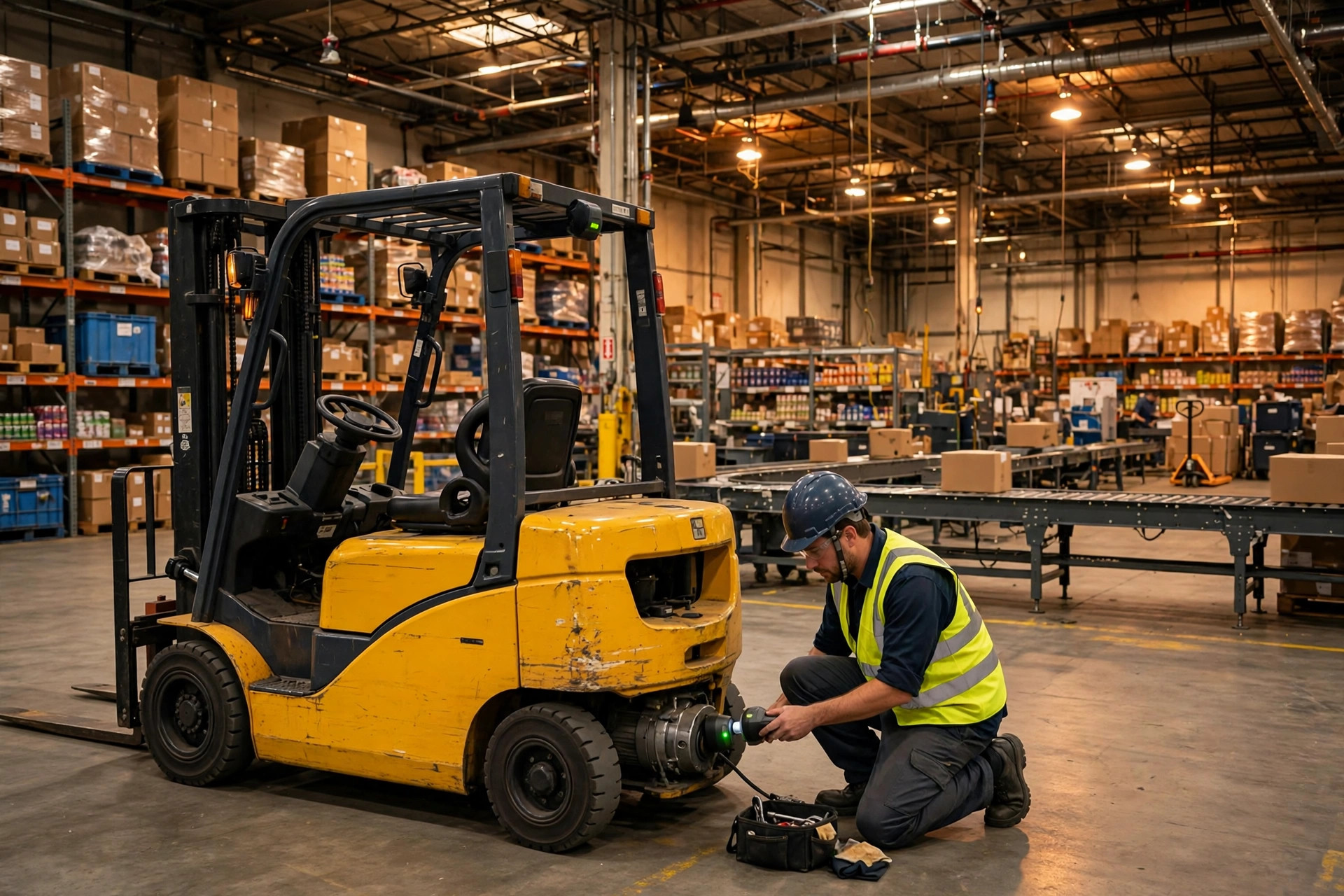
Start with the principle: warehouse equipment is like a car — maintenance decides lifespan, repair decides downtime. Think of the maintenance shop as the warehouse's own dealership service bay. The question is never "whether to fix it." It is who fixes it, how fast, and where the parts come from. Get those three wrong and one dead forklift stops your outbound for half a day.
September 2023, I was auditing automation at a 60,000-square-foot e-commerce warehouse in Ohio. One chute on their cross-belt sorter had a belt tracking slightly off. The site lead said, "Waiting on the vendor's engineer, he's coming next Wednesday." I asked what happens until then: "Manual sort covers it." I did the math: that chute moved 4,000 units a day; six days of manual cover meant four extra people, $800-plus a day in labor, plus the mis-sort rate climbing from 0.2% to 1.5% and the customer-service cost behind it. A 20-minute belt adjustment turned into a $5,000 hole — because nobody on site dared touch it and there were no spares.
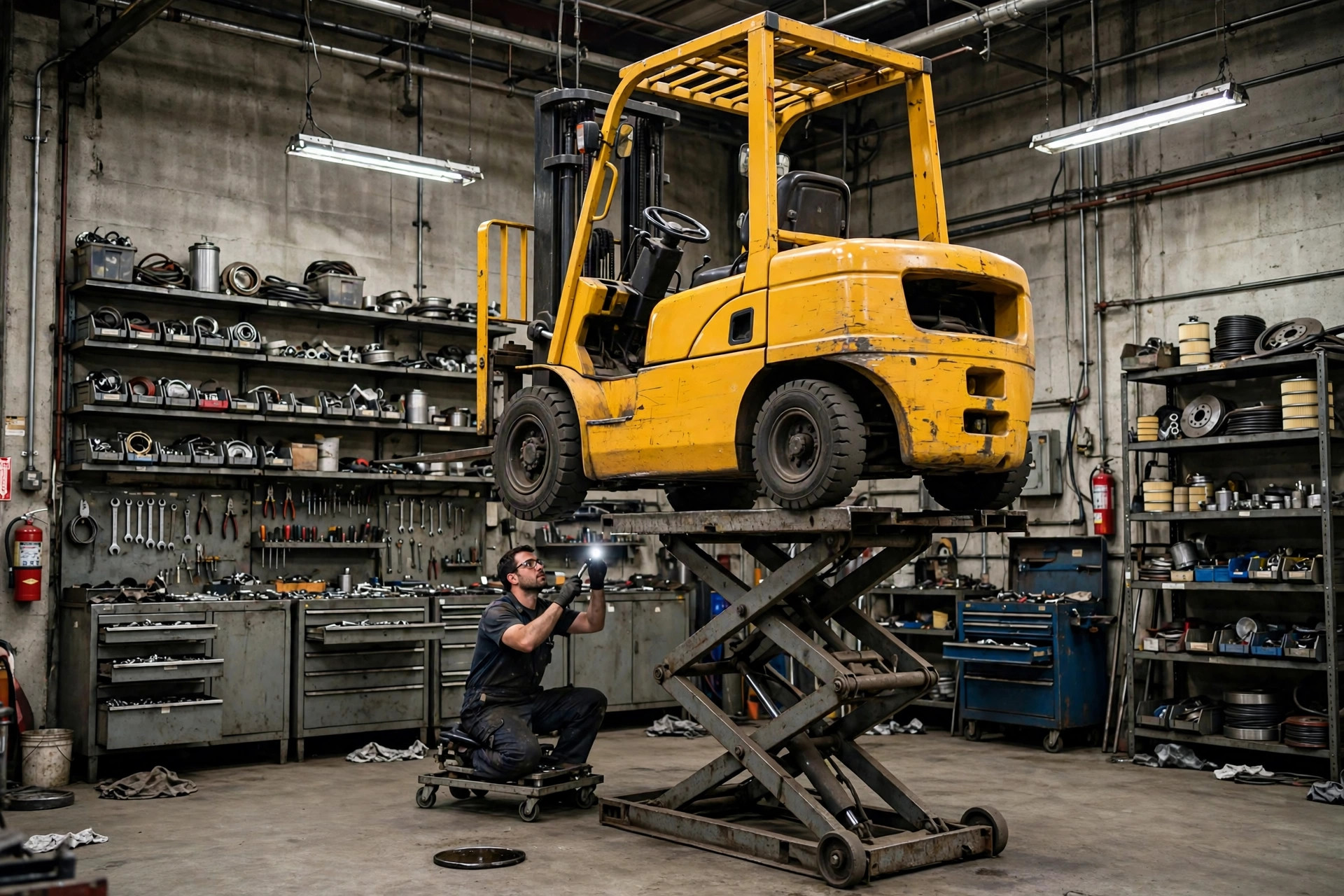
The opposite mistake: March 2024, a Texas 3PL whose owner spent $150,000 building a 2,000-square-foot shop — lift, air compressor, parts racks — and hired two full-time mechanics. A year later the two mechanics spent 60% of their time on standby, and $80,000 of parts inventory turned less than once. The forklifts needed two major repairs a year at $3,000 each outsourced. That $150,000 plus $140,000 a year in labor bought peace of mind, not payback.
So the maintenance shop is prime pseudo-demand territory. Blunt version: under 100,000 orders a month, fewer than 10 forklifts, no automated sortation — building your own shop probably loses money.
In-House vs. Outsourced: The Downtime-Cost Line
The math needs three numbers:
-
Cost of one downtime event = downtime hours x orders per hour x gross margin per order. A peak-season e-commerce warehouse doing 800 orders an hour at $3 margin loses $9,600 on a four-hour stop. That number anchors every decision.
-
Vendor response time. Ask your equipment vendor three questions: how fast can a field engineer be on site? Are common spares stocked locally? What is the nights-and-weekends surcharge? Put the answers in the service contract; verbal promises don't count. I have seen too many "4-hour responses" become "tomorrow morning."
-
In-house fixed cost. Space (2,000 sq ft at local rent) + equipment (lift, compressor, diagnostics — $50,000-100,000 one-time) + people (one mechanic's fully loaded annual cost, per local wages) + spares (below).
Decision line: annual outsourced repair spend x 1.5 < annual in-house fixed cost → keep outsourcing; otherwise → build the shop. The 1.5x is margin for "dead at midnight with nobody coming." Note what's not in this formula: pride and peace of mind — those are the owner's emotions, not the books.
Spare Parts: Three Tiers, Don't Stock Everything
Spares are where the money burns. My split:
Tier A (must have on site): belts, rollers, sensors, fuses, hydraulic hoses — anything where a failure stops you 4+ hours, costs under $500, and has a vendor lead time over 3 days.
Tier B (regional stock is fine): motors, gearboxes, controllers — expensive (thousands) but rarely fail; sign a 48-hour delivery agreement with the vendor instead of stocking.
Tier C (buy on demand): structural members, frames — fail once in years; stocking them creates inventory corpses.
The Math for Three Warehouse Sizes
| Warehouse size | Annual outsourced spend | Annual in-house fixed cost | Verdict |
|---|---|---|---|
| Small (<10 forklifts, no automation) | $20k-40k | $150k+ (space + 1 tech + spares) | Outsource, don't build |
| Mid (10-30 forklifts, conveyors) | $80k-150k | $180k-250k | Run the 1.5x line; most still outsource |
| Large (sortation + AS/RS) | $300k+ | $250k-350k | Build — downtime costs more |
Magnitudes for reference; local labor and rent vary, so get real quotes.
One more thing I check on every audit: the "repair or replace" age rule for forklifts. Under 5 years or 8,000 hours, repair almost always wins. Past 8 years with chronic hydraulic issues, you're funding a zombie — compare the next 12 months of projected repair bills against a replacement's monthly lease payment. I have seen warehouses spend $25,000 keeping a $18,000-value forklift alive for one more year. That is not maintenance, that is sentimentality with a wrench.
Safety Red Lines: The Shop's Own OSHA Bill
The maintenance shop is a high-frequency OSHA inspection zone. Three red lines:
One, annual lift inspection. OSHA's requirements for lifting equipment follow the latest published policy; the core is one sentence: have the annual inspection record. No record plus an incident equals willful.
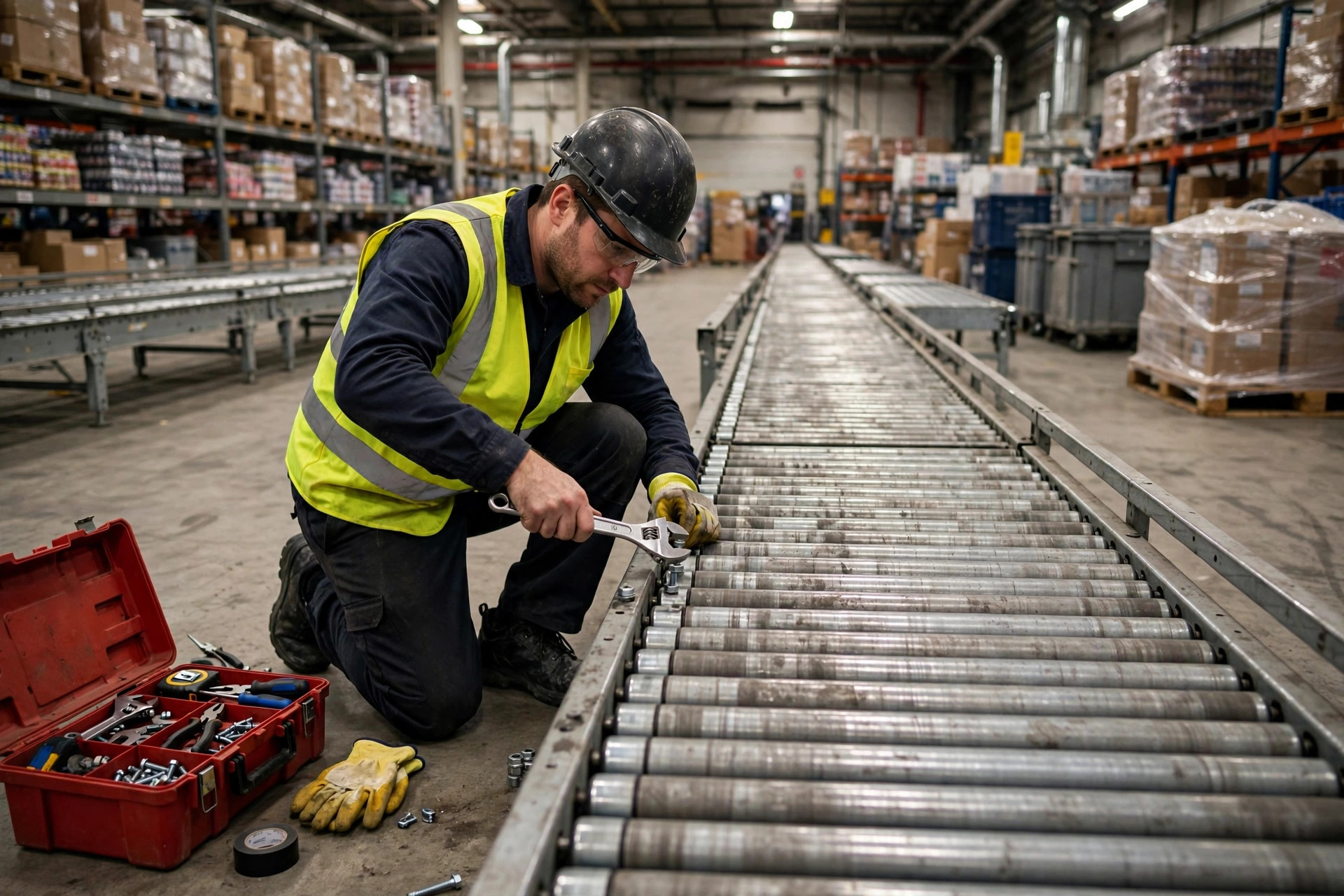
Two, lockout/tagout on electrical work. Servicing a conveyor without de-energizing and tagging starts at a serious-level citation. The LOTO procedure must be posted on the shop wall and every tech must pass the test.
Three, hazardous waste disposal. Waste oil, dead batteries, used filters don't go in the regular dumpster. Use a licensed hauler and keep the manifests. Environmental fines run higher than OSHA's and don't negotiate.
Is the money worth it? Watch one number: annual downtime loss. If a year of waiting on repairs burns more than one mechanic's annual cost, build the shop. Can't compute it? Then don't build — an investment you can't model is almost always a gut call.
By Da Liu, Automation Engineer