AI predictive maintenance for warehouse equipment is, at its core, stupidly simple: stick a vibration sensor on a forklift motor, let the AI listen to it every day, and get a heads-up before the thing dies. I've spent a decade as an automation engineer at a systems integrator, and I've watched warehouses spend a fortune on hundreds of sensors that never produced one useful warning.
How AI Predictive Maintenance Listens: Principles First
Press your ear against a failing forklift motor and you'll hear a steady hum with a "click-click-click" buried inside. Think of it like a doctor with a stethoscope: a healthy heartbeat is a regular thump-thump, and the moment a murmur shows up, the doctor knows something's wrong with a valve. A vibration sensor does exactly the same thing, except it listens to mechanical vibration between 0 and 10 kHz.
Every rotating part in a machine has its own "heartbeat frequency":
- Shaft frequency: motor speed — 1450 rpm translates to 24.2 Hz
- Bearing defect frequencies: the outer race, inner race, and rolling elements each have one, determined by the bearing's geometry (for a common 6208 bearing, the outer-race defect frequency is roughly 3.06× shaft speed)
- Gear mesh frequency: tooth count × shaft speed
When healthy, these frequencies sit at low amplitude. The moment a bearing raceway starts spalling, the defect frequency's amplitude starts climbing. The AI does two things: run an FFT on the time-domain signal to break it into a spectrum, then track the amplitude trends of those characteristic frequencies. A typical node samples at 10k–25.6 kHz and uploads an RMS value plus a spectrum packet once an hour — plenty, since bearings degrade over days, not milliseconds.
Bottom line: failures aren't sudden. A bearing gives you weeks to months between first detectable damage and seizure (verify against your own load and speed conditions). AI yells inside that window.
Sensor Placement: Forklifts and Conveyors Are Two Different Games
Time to call out the nonsense: plenty of vendors will hand you a quote for "500 measurement points across the facility." That's a textbook pseudo-requirement. Sensors don't get smarter the more you stick on — wrong placements produce nothing but noise.
Here's the selection boundary. One formula decides whether predictive maintenance is worth it:
Cost of one unplanned breakdown > (sensor hardware + annual platform fee) × 3
If catching a single breakdown per year pays back three years of cost, do it. Apply that ruler:
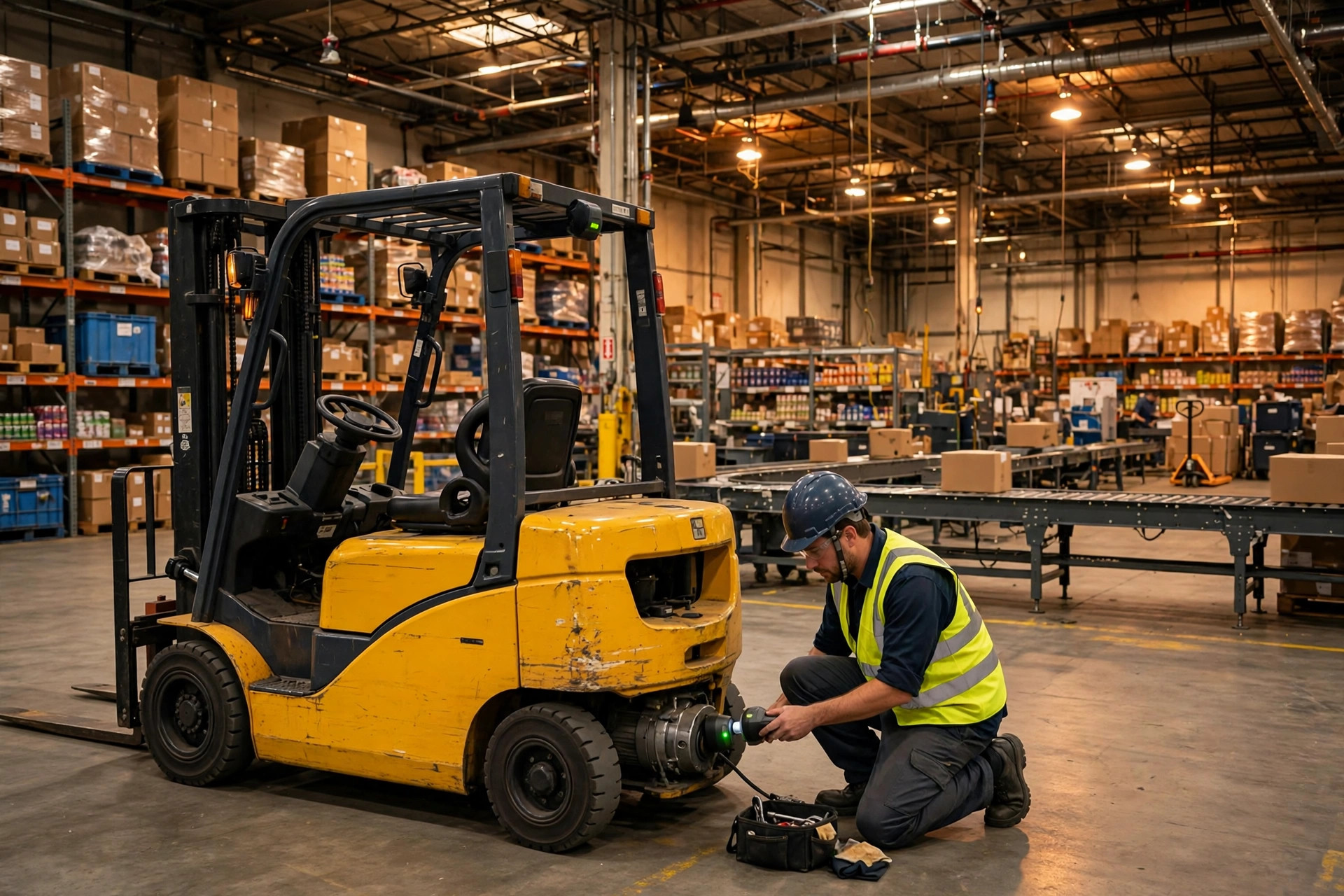
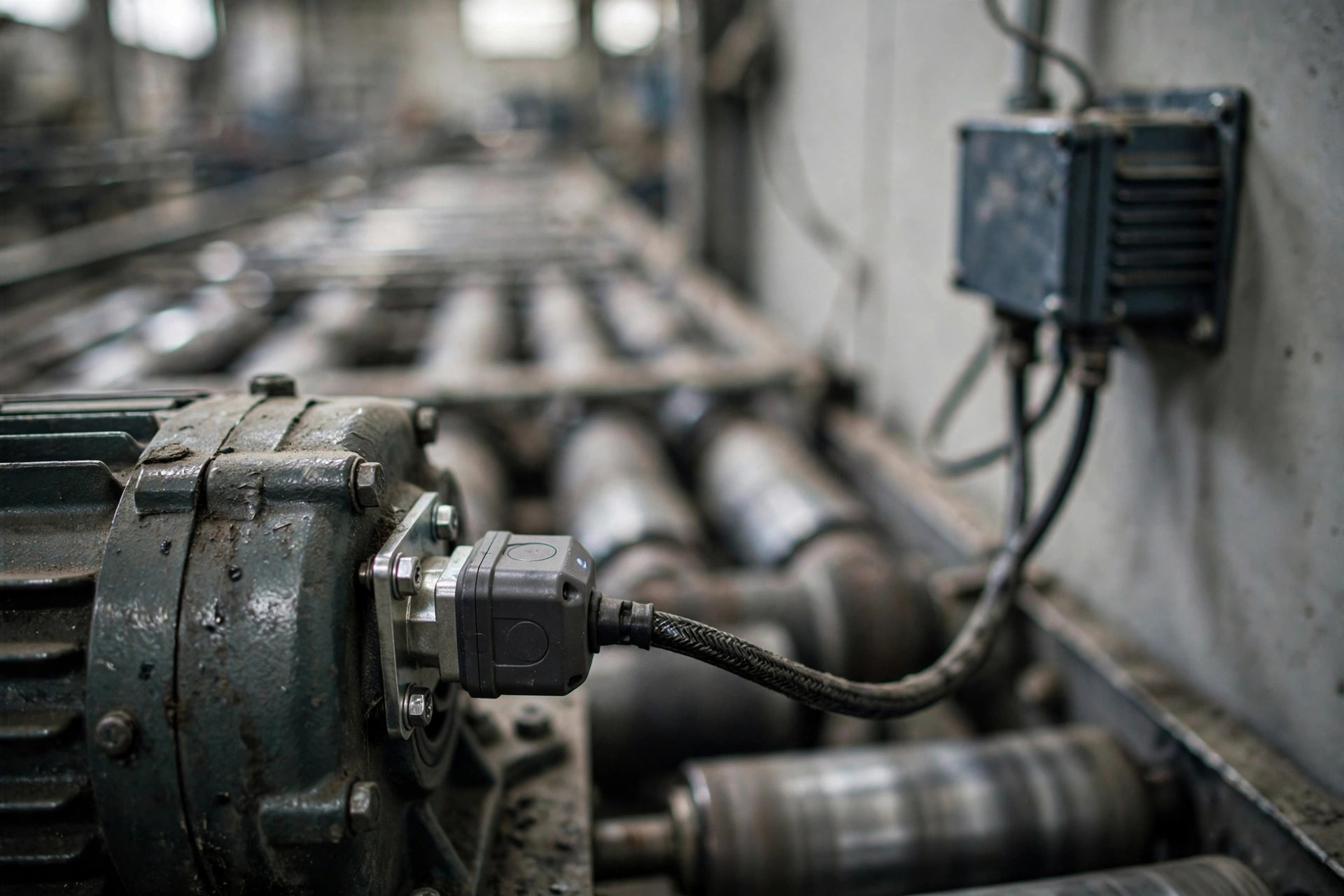
- Forklifts (electric): drive-motor bearings, hydraulic pump, steering motor. Forklifts move, so wiring is a pain — use wireless vibration-plus-temperature nodes on magnetic bases stuck on the motor end cap. A node runs roughly tens to low-hundreds of dollars depending on protection rating and battery life.
- Conveyors and sorters: gearbox input-shaft bearings, roller bearings, chain tensioners. Fixed equipment can use wired sensors — cheaper and more stable. The key is rollers: a 200-meter conveyor line can have hundreds of them. Don't instrument all of them — only the 10–20% of locations with the highest historical failure rates (pull your last two years of work orders; wherever failures cluster, that's your sensor map).
- Not worth it: manual pallet jacks, racking, chargers. Either a failure barely matters, or you can see the failure with your own eyes. Putting AI on those is just a donation to the vendor.
Two Predictive Maintenance Cases: This Is What a Warning Looks Like
Case one: an e-commerce fulfillment warehouse in Dongguan, September 2024. A 200,000-square-foot facility running 8 electric forklifts, shipping 6,000+ orders a day. Mid-September, one forklift's drive-motor bearing showed its outer-race defect frequency climbing — vibration velocity RMS drifted from 2.8 mm/s to 7.1 mm/s (per ISO 10816, 2.8 is Zone A "good," 7.1 is already Zone C "not permitted for continuous operation"). The system warned on day 12. The maintenance lead opened it up: visible spalling on the outer raceway. Two weeks later that truck would likely have died during Singles' Day peak prep — one truck down at peak means thousands of missed shipments a day, and emergency rental premiums alone would buy dozens of sensors.
The lead time in both cases: 1–3 weeks — not the "six months advance warning" on some vendor decks. Bearing physics sets the pace; a six-month warning means either the threshold cries wolf daily or someone's inventing numbers.
Case two: a 3PL sortation hub in Suzhou, March 2025. The conveyor's gearbox showed the second harmonic of the gear-mesh frequency creeping up for three weeks, running 8°C hot. Early-stage gear wear. The crew swapped in a spare gearbox during a weekend window — 4 hours of downtime. Wait for the teeth to actually break and you're looking at 2–3 days with the whole line down. When the sorter stops, everything stops.
Taming False Alarms: Thresholds Are Dead, Baselines Are Alive
Half of all predictive maintenance projects die from false alarms. A technician gets woken up by a 3 a.m. text three times, finds a healthy machine each time, and on the fourth night he blacklists the number. The project dies that night.
The root cause is always the same: fixed thresholds applied to wildly different machines. The same conveyor's baseline can shift 30% between summer and winter. The right approach is baseline learning: run the system for 2–4 weeks after installation, record without alarming, learn each machine's normal vibration fingerprint, and set the alarm line as baseline plus an adaptive margin. After a major overhaul or parts swap, trigger a manual baseline relearn.
Three practical moves for false alarms:
- Alarm on trends, not single points: only raise a warning after 3 consecutive over-limit sampling cycles. Filter out one-off spikes (a forklift clipping a rack sends vibration through the roof 10× — that's not a fault).
- Cross-check parameters: vibration over limit plus temperature rising together doubles confidence. Vibration alone with flat temperature? Flag it for observation, don't call anyone at midnight.
- Tiered escalation: trend anomalies go to the maintenance lead's app; sustained deterioration gets a text; only "expected failure within 72 hours" gets a phone call.
Predictive Maintenance vs. Scheduled Inspections: It's Division of Labor, Not Replacement
People ask: we already have a veteran tech walking the floor with a handheld vibration meter every month — why do we need AI? Straight to the comparison:
| Dimension | Manual periodic inspection | AI online predictive maintenance |
|---|---|---|
| Sampling frequency | Once a month (blind between visits) | Once an hour, 365 days a year |
| Detection timing | Fault signatures found about 2 weeks late on average | Trend captured the day it appears |
| Labor cost | Senior tech spends 2–3 days/month covering the floor | Near zero after commissioning |
| Hidden cost | Depends on one person's experience — walks out the door with him | Data lives in the system, immune to turnover |
| Best fit | Few assets (<20 critical machines), tight budget | Many critical assets, high cost of downtime |
Here's the counterintuitive call: a small warehouse with fewer than 20 critical machines should NOT buy AI predictive maintenance. A veteran tech plus a handheld meter (a few hundred dollars), half a day a month, will match AI's results. AI's value is scale — as asset counts grow, the blind spots of manual inspection multiply, and that's when online monitoring earns its keep. Any vendor pitching an "AI maintenance platform" to a warehouse with under 30 forklifts gets an earful from me — he's selling his quota, not a solution.
The Real Pitfalls: Sensors Need Maintenance Too
A few honest traps, all of which I've stepped in:
- Batteries: wireless nodes claim 3-year battery life; in a -10°C freezer warehouse it can be 1 year. Freezer sites should go wired, or budget for annual battery-swap labor.
- Gateway outages: one gateway down kills the whole site's stream. Gateways need dual power plus local buffering — at least 72 hours of cache.
- Model drift: after a major overhaul, old baselines are garbage — skip the relearn and false alarms will drown you.
- Data ownership: ask the vendor where the raw vibration data lives. If it's on their cloud and you stop renewing, your historical baselines vanish with it. Get data exportability in the contract.
Is the Money Worth It? Look at This One Number
Forget the vendor's "reduce costs, boost efficiency" story. Calculate exactly one number: how much money your critical equipment's unplanned breakdowns cost you last year (repairs + lost throughput + overtime). If that number is more than 3× the annual cost of predictive maintenance, sign the PO. If it doesn't even reach 1×, go fix your technician's inspection checklist first — that beats any AI.
The technology is genuinely good, but it only solves "can we hear it." Whether someone actually goes and fixes it after hearing — that's management. Sensors don't replace bearings by themselves.
By Da Liu, Automation Engineer