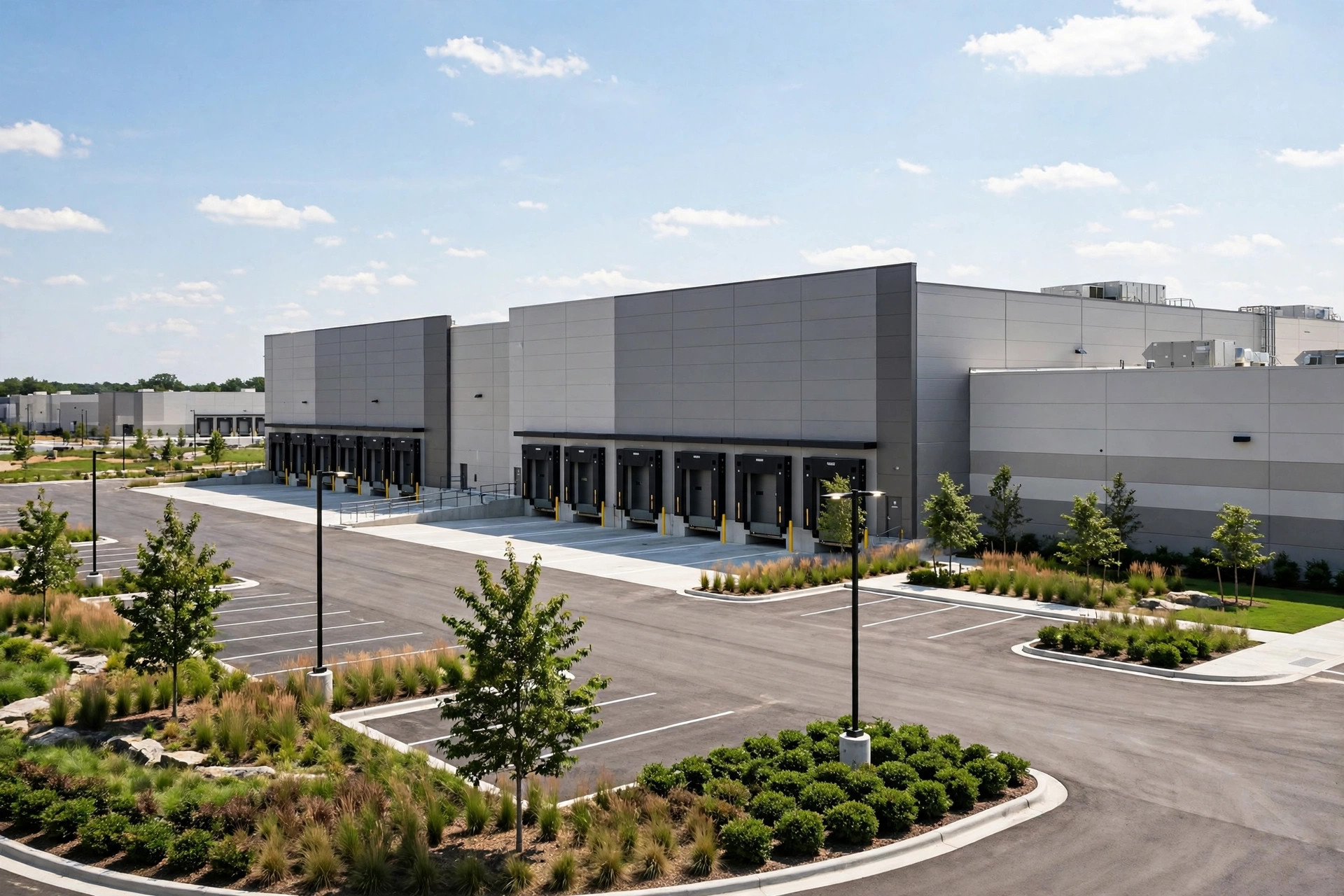
In early 2024, an e-commerce tenant leasing roughly 50,000 square feet of warehouse space in Ontario, California received its annual operating-expense reconciliation: the property tax line was nearly 40% higher than the year before. The explanation was straightforward — the building had changed hands in mid-2023, the county reassessed it at the new transaction price, and the tax bill followed. The tenant was on a standard triple-net (NNN) lease, which passes property taxes through pro rata. Every dollar of the increase landed on the tenant's books.
This was not an isolated case. Between 2022 and 2024, similar stories recurred across America's major logistics markets: tenants who had negotiated competitive rents at signing discovered, two or three years in, that the annual tax bill had become the least predictable line on their cost statements. According to market reports from major industrial brokerages, industrial property values in core US logistics markets rose roughly 30–60% between 2020 and 2022, with the Inland Empire, Dallas–Fort Worth, and Atlanta among the steepest climbers. Rising valuations do not raise tax bills automatically — but they do so through reassessment, and under the NNN structure, that transmission ends with the tenant.
Why the Tax Bill Keeps Climbing
The arithmetic is simple: assessed value multiplied by the effective tax rate. The assessed value is set by the county assessor; the effective rate reflects state law plus local add-ons, and it varies widely by state.
California illustrates one logic. Under Proposition 13 (1978), assessed value may grow by no more than 2% per year, the base rate is 1% of assessed value, and voter-approved local add-ons bring the effective rate to roughly 1.1–1.3% in most jurisdictions (confirm current figures with the local tax assessor). The critical second half of Prop 13: assessed value resets to market value only upon a change of ownership or new construction. A warehouse held by the same landlord for 15 years can therefore sit on a tax base half the size of an identical building next door that traded in 2022 — two tenants on the same street can face tax burdens differing by a factor of two, decided not by the tenant but by the landlord's acquisition date.
Texas follows a different logic. With no state income tax, local governments lean heavily on property tax, and effective rates for industrial property commonly run 1.6–2% or higher. Texas has no Prop 13–style cap, so assessed values track the market directly — in a rising cycle, Texas tenants feel the increase sooner and more sharply.
A representative case surfaced in San Bernardino County in 2023: a 3PL renewing an 80,000-square-foot lease learned its landlord had acquired the building in 2021 at roughly 45% above the prior transaction price. After reassessment, the tax bill had nearly doubled versus 2019, the year the tenant moved in. The lease's base year was still 2019 — and every dollar above that base fell contractually on the tenant.
How the Pass-Through Reaches the Tenant
Four overlapping factors explain the tenant's structural disadvantage.
First, the default lease structure. In US industrial leasing, the triple-net lease is the overwhelming norm: beyond base rent, the tenant pays its pro-rata share of property taxes, insurance, and common-area maintenance. Passing taxes through is not an exception requiring negotiation — it is the default; only its absence must be written in explicitly.
Second, information asymmetry. Most tenants have never seen the actual tax bill for their building. They know neither the assessed value nor when it was last reassessed. The bill goes to the owner; the tenant sees one number on a summarized statement.
Third, the base year. Modified gross and NNN leases define a base year, with the tenant covering only increases above that year's tax. The earlier the base year, the longer the window of increases the tenant absorbs — yet many tenants fixate on the rent figure at signing and never ask which year the base year is.
Fourth, opaque reassessment triggers. Sales and major improvements can both trigger reassessment, and the landlord alone decides whether those events happen.
The three mainstream structures allocate the tax very differently:
| Lease type | Who bears the property tax | The tenant's risk |
|---|---|---|
| Gross lease | Landlord absorbs it into rent | Tax-inclusive rent; increases are the landlord's problem — but expect a rent bump at renewal |
| Modified gross | Landlord covers the base-year amount; tenant covers the increase | The earlier the base year, the more the tenant pays |
| Triple net (NNN) | Tenant pays its full pro-rata share | Fully exposed; reassessment flows straight to the tenant |
A worked example makes the exposure concrete. Take a 100,000-square-foot warehouse assessed at $20 million. At a 1.2% effective rate, annual property tax is $240,000. If a transaction triggers reassessment and the assessed value rises 30%, the bill grows by $72,000 — all of it absorbed by the tenant under NNN, or about $0.72 per square foot per year. That figure frequently exceeds whatever rent-escalation concession the tenant negotiated at signing. (Illustrative calculation; confirm rates with the local assessor.)
What Tenants Can Negotiate
The objective is not to eliminate the pass-through — unrealistic in an NNN-dominated market — but to make it predictable, verifiable, and capped. Five items are worth pursuing before signing.
First, the right to see the bill. Write into the lease that the tenant may inspect the original tax bills, assessment notices, and reassessment records, with an annual reconciliation from the landlord. Without this, no other clause can be verified.
Second, set the base year correctly. Push for the lease commencement year as the base year, so the tenant covers only post-signing increases. Resist inheriting "the prior tenant's base year."
Third, a cap on annual increases — the single most important clause. Agree that the tenant's property tax exposure grows by no more than, say, 5% per year, with the landlord absorbing the excess. Such caps were rare in smaller leases before 2020, but a growing number of mid-size and large tenants have secured comparable protection in recent years.
Fourth, carve out landlord-triggered reassessments. Seek language providing that tax increases caused by the landlord's own actions — a voluntary sale, a refinancing — are not passed through, or are shared. A full carve-out is hard to win; shared treatment of the above-market portion is already a meaningful victory.
Fifth, appeal participation and refund sharing. Require the landlord to notify the tenant when it appeals an assessment, and share any resulting refund pro-rata. At renewal, reset the base year to the renewal year rather than measuring against a five-year-old baseline.

Where This Clause Goes in the Next Three to Five Years
Three grounded trend judgments follow from the data and the known transmission lags.
First, 2024–2026 remains a "catch-up" period for tax bills. The 2020–2023 valuation run-up has already happened, and county reassessments typically lag the market by one to two years. Even as transaction prices cooled after 2024, tax bills will keep reflecting the earlier peak with a delay. For tenants, tax volatility over the next two years may deserve more attention than rent volatility.
Second, the landlord's hold period is becoming a hidden site-selection variable. In Prop 13–protected California, a building held for over a decade versus one that traded at a 2022 peak can impose tenant tax burdens differing by a factor of two. Comparing only headline rents while ignoring the tax base systematically understates the true occupancy cost of newly traded properties.
Third, the annual increase cap is migrating from a large-tenant perk to a mid-size-tenant standard. As property tax becomes the second-largest occupancy cost after rent, tenant demand for predictability will only grow — and lease innovations historically diffuse downward from large tenants. Annual tax-increase caps are on track to become common in leases above roughly 50,000 square feet within three to five years.
At bottom, the pass-through clause is a reallocation of information and risk between landlord and tenant. For a decade it sat quietly inside the NNN default, drawing no attention. In the coming years, it is likely to become one of the most negotiated clauses at the industrial leasing table.
An open question for tenant teams: when the second-largest cost after rent is largely outside your control, should site selection examine a building's tax history the way it examines a financial statement? And given that the landlord inherently holds all the tax information, what mechanism design would make this pass-through genuinely predictable and verifiable? There are no standard answers — but tenants asking these questions already carry one more layer of protection than those who negotiated on headline rent alone.
By Dr. Chen, Supply Chain Researcher