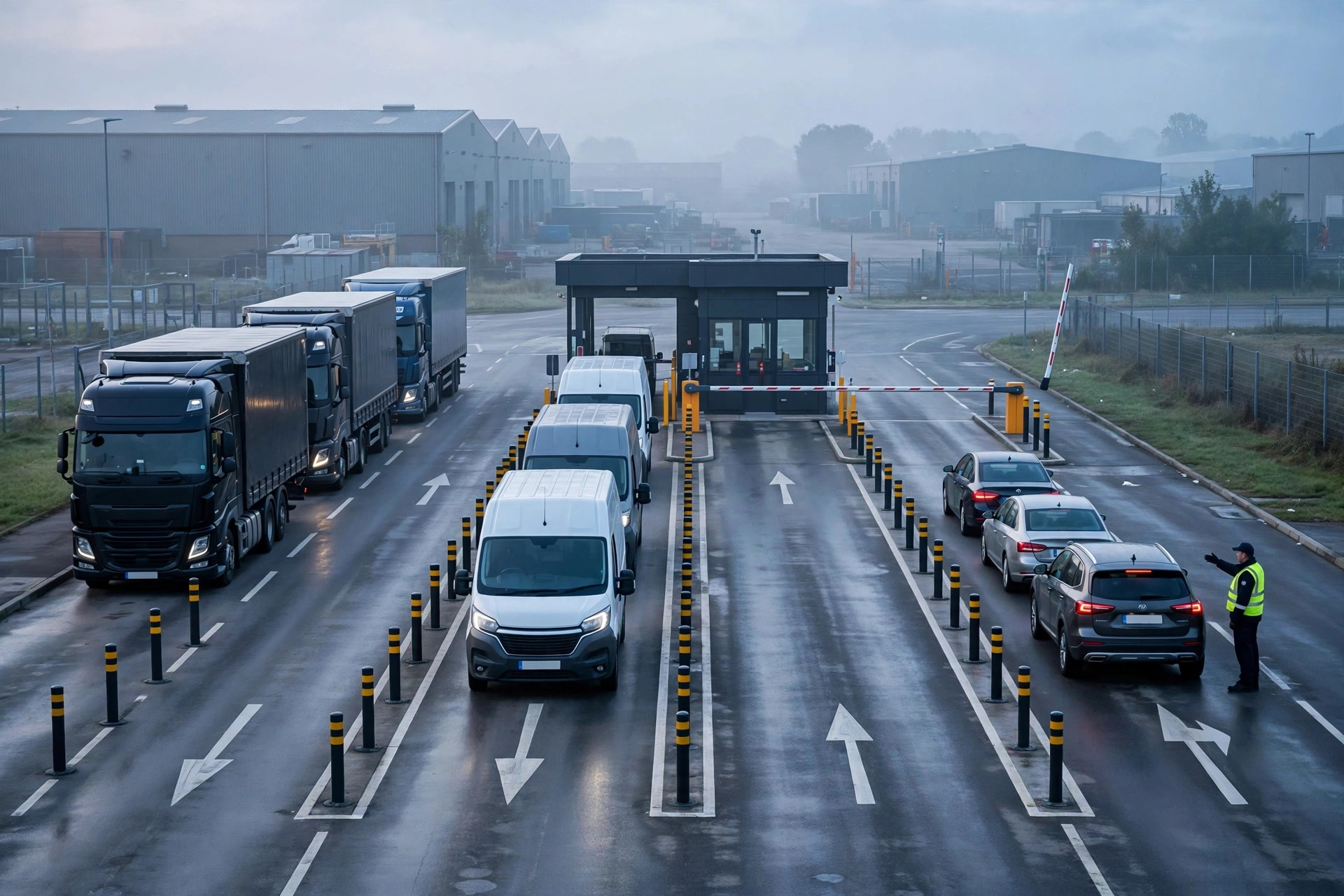
6:50 in the morning. I'm standing at the main gate, radio crackling nonstop in my pocket.
A 17-meter box truck is stopped inside the gate arguing over paperwork, four more trucks lined up behind it, going nowhere. Off to the side, employee cars are honking in a long line — they can't get in either. Our guard, Old Wang, is sweating through his uniform, waving trucks left and cars right, getting yelled at by both sides. That day, a dozen people clocked in late, the time-clock line stretched around the corner, and every team lead showed up at my office with a dark face.
Let me tell you something straight: warehouse gate traffic is the thing nobody thinks about until it blows up. Then it's the biggest problem in the building. My warehouse runs 200 people across three shifts. Peak season brings dozens of trucks a day plus courier vans running three rounds daily — all squeezing through one gate. Chaos isn't a risk. It's a schedule.
How Our Warehouse Gate Traffic Got This Bad
Ours is an old facility, built over a decade ago. Back then the design thinking was simple: make the gate wide, trucks can get in, done. So we had one 8-meter-wide road. Semis, employee cars, courier vans, visitor vehicles — everybody through the same throat.
When volume was low, it worked. Then e-commerce parcels took off, and courier runs went from one trip a day to three. Export containers picked up too, with 40-footers showing up every other day. And the employee cars — 200 people on e-bikes and sedans, all arriving around 7:00 and 19:00, right on top of truck arrival peaks.
Last fall, peak season, we had a bad one. 7:10 AM, a truck driver is at the gate arguing with the guard — the license plate on his appointment sheet is off by one digit, the guard won't let him in, the driver won't move. One truck. The whole gate sat dead for the better part of an hour. A dozen employee cars backed up all the way to the curb outside. Twenty-some people late for the morning shift, the pick line didn't start until 7:30, and we missed a carrier cutoff. The boss called me in and asked one question: "How long are you going to let the gate stay like this?"
Then there was the night shift incident. Past 9 PM, a courier van comes in to drop small parcels while a loaded truck is trying to leave. Neither yields. The young courier driver, hot-headed, swings the wheel — nearly clipped the truck's fuel tank. If he'd actually hit it, diesel plus a spark, I don't even want to think about it. That night I understood: this isn't about congestion anymore. It's a safety problem.
Two Dead Ends We Tried First
Dead end number one: time windows. We made a schedule — trucks must be in before 7:00, 7:00 to 8:30 reserved for employee cars. Sounded great on paper. Fell apart in a month. Drivers don't care about your schedule. They drive by GPS; arrival time is whatever it is. You tell a guy to arrive by 6:00, he shows at 6:40 — do you turn him away? If you do, he parks at the gate and blocks everything worse. If you don't, the schedule is toilet paper. We scrapped it after a month.
Dead end number two: widen the gate. We went from 8 meters to 14, painted two lanes, figured that would fix it. It got worse. More lanes just meant more lane-grabbing — trucks fighting for the left lane, employee cars darting right, courier vans threading through gaps. One guard couldn't police it. Rush hour looked like an intersection with no traffic lights. That's when I learned something counterintuitive: a wider gate isn't automatically better. More lanes with no one in charge is just a bigger arena for the fight. Width only gives chaos a bigger stage.
What We Do Now: Full Separation, Three Flows, Three Gates
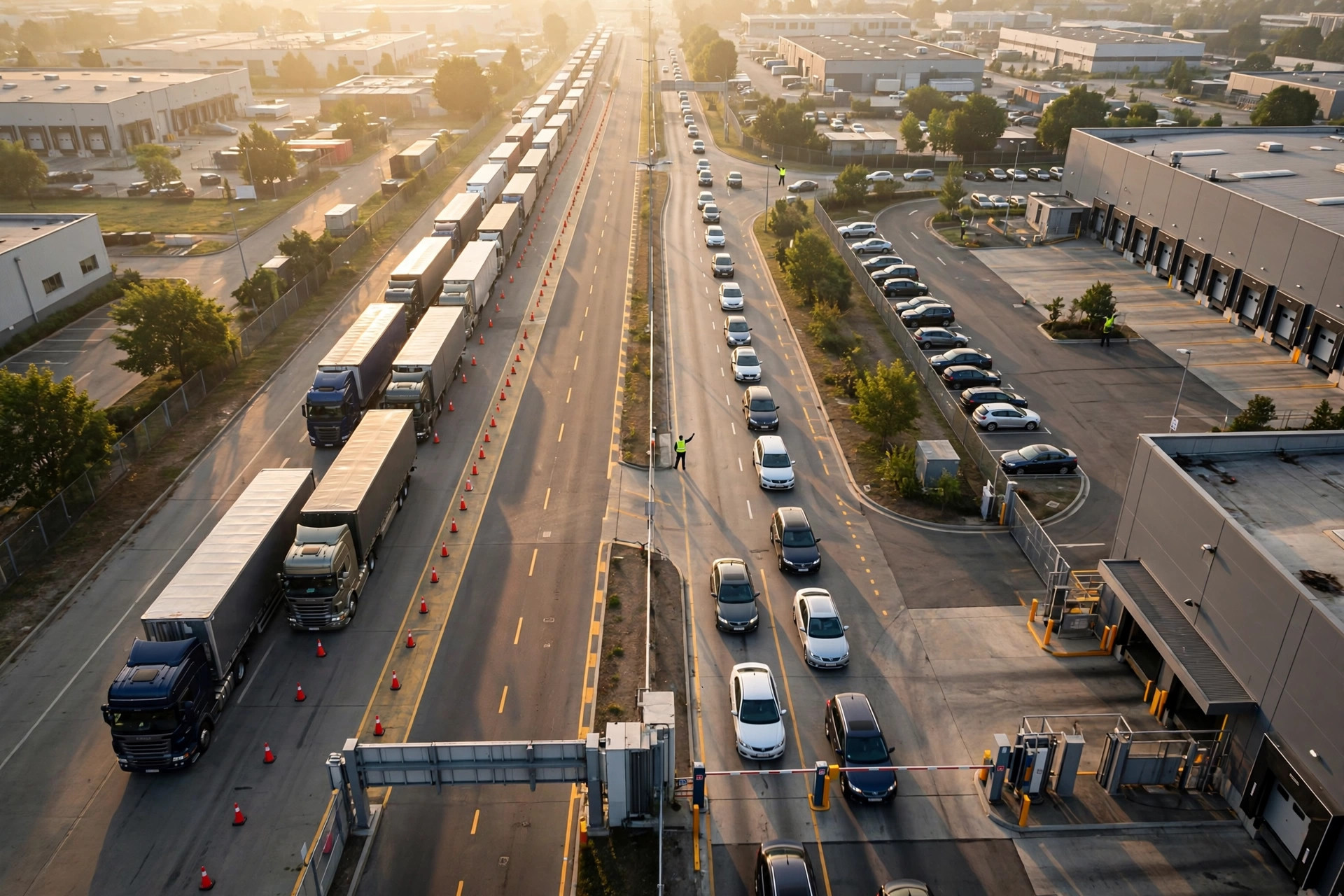
After half a year of trial and error, our rule today is eight words: separate the flows, give each its own gate.
- Trucks use the south gate. Dedicated truck lane, barrier plus weighbridge, entry by appointment. We still do appointments, but we dropped the rigid "must arrive by X" rule. Now it's "report in the group chat two hours before arrival." The guard knows which truck is coming, paperwork check takes seconds.
- Employee cars use the west gate. Side entrance, badge swipe, barrier lifts automatically. E-bikes and cars get their own narrow lanes, no interference.
- Courier vans use the north gate. Small vans get their own small barrier. Three fixed runs a day — morning, midday, evening — coordinated with the courier station manager, whose schedule is actually predictable.
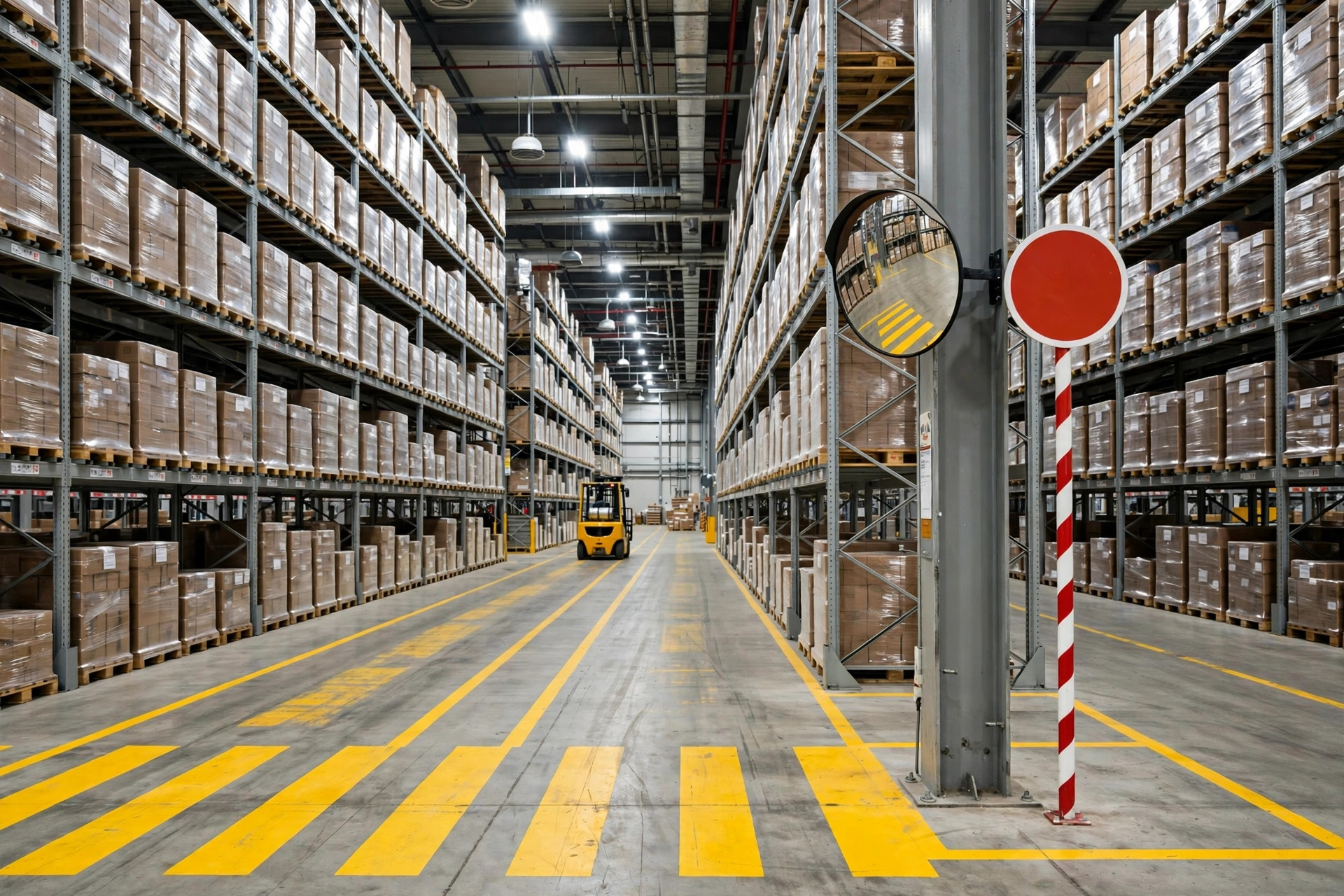
Between the three lanes: bollards and planters, full physical separation. Not painted lines — real barriers. Painted lines don't work. Drivers either don't see them or see them and ignore them. Once the bollards went up, nobody could cross lanes even if they wanted to.
Before vs. After: The Numbers Speak
| Metric | Before (single mixed gate) | After (three separated flows) |
|---|---|---|
| Avg. morning rush queue time | Around 40 minutes | Around 10 minutes |
| Gate scrapes / disputes per month | 2–3 | Basically zero |
| Guards needed at rush hour | 3, still overwhelmed | 1 on patrol is enough |
| Driver / employee complaints | Weekly | Nobody mentions it, even in peak season |
And the cost math. What did the retrofit cost? Repainting, moving a gate, two small barriers, relocating the guard booth, installing bollards — tens of thousands of yuan total. Roughly the price of a used forklift. In one peak-season month, the hours we stopped losing at the gate — pick lines starting on time, extra waves shipped — paid it back many times over. Honestly, it's the best money I've spent in years.
Three Reminders for Fellow Operators
First, bollards and paint before gadgets. A lot of warehouses jump straight to license-plate recognition and appointment systems. Money spent, gate still chaos. Get the physical separation right first — make it impossible for vehicles to mix — then talk about smart systems.
Second, don't fight drivers, work with them. Drivers are working stiffs too. A rigid "arrive by 7:00 or else" rule they can't meet just guarantees a standoff. "Report in the chat two hours ahead" is something they can actually do, and it gives you what you need. Half of gate traffic is a planning problem; the other half is a communication problem.
Third, don't underestimate the courier vans. Many warehouses obsess over the big trucks and figure small vans "can squeeze in anywhere." Wrong. Courier vans run the most trips, their drivers are young and in a hurry — they're the most likely to cause a scrape. Give them their own lane and sleep better.
Warehouse gate traffic comes down to one sentence: don't make three completely different kinds of vehicles fight over the same doorway. Separate them, and everybody's day gets easier.
By Chen Feng, Warehouse Operations Manager