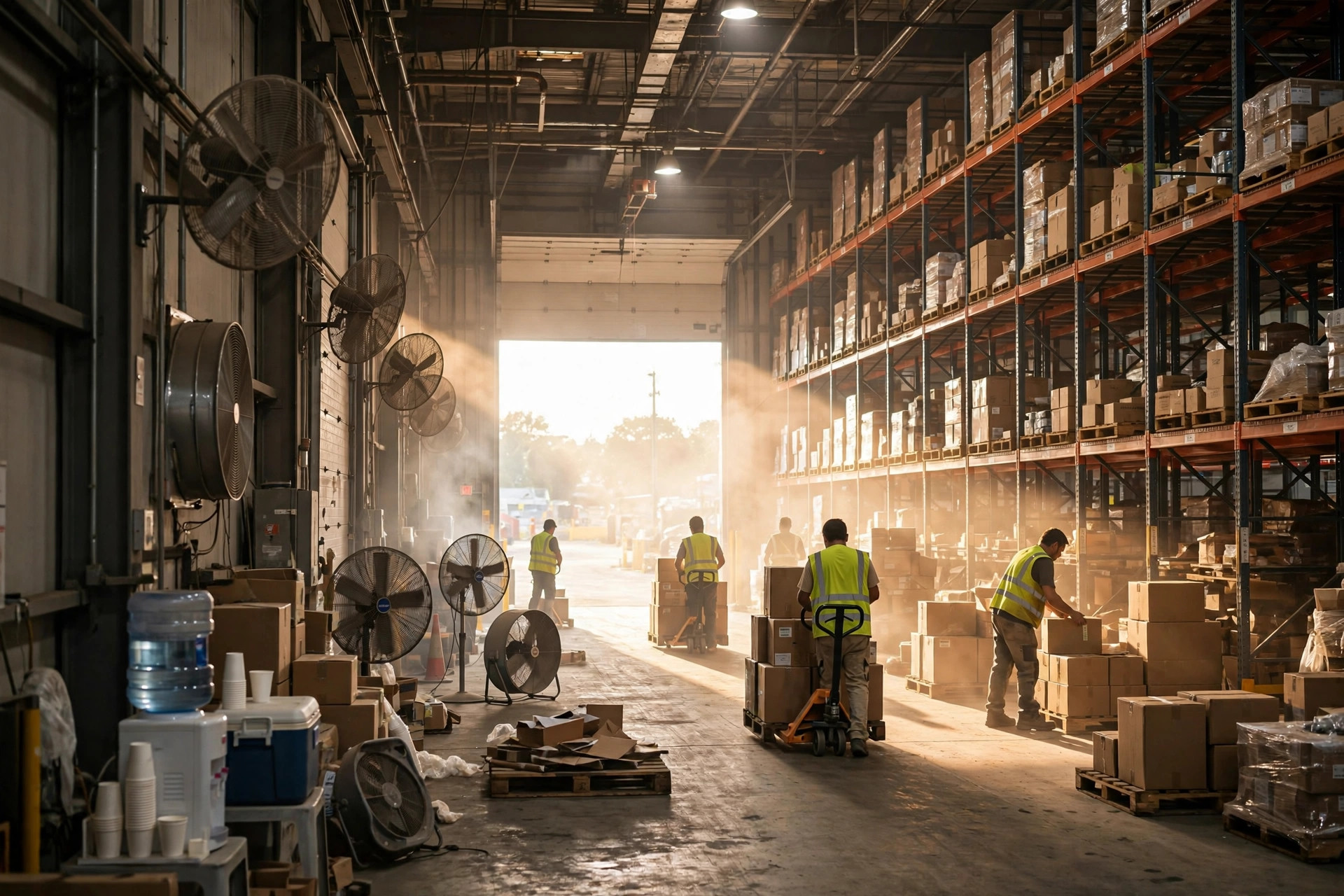
Last July, on a Tuesday, I walked into the warehouse at 6 AM for the early shift and the wall thermometer already read 88°F. That was the morning I finally sat down and figured out what temperature triggers OSHA heat safety requirements in a warehouse. For years I had treated heat as just part of the job — drink water, tough it out. Then an OSHA inspector knocked on the door of the 3PL next door to us, and everything changed.
The dock doors were wide open, not a breath of air moving. I have run warehouses in the Inland Empire for over a decade — I had seen plenty of days like that, but I never treated them as a compliance problem until I had to.
What temperature triggers OSHA heat safety requirements: three lines, not one
Here is the honest truth as of October 2026: federal OSHA still has no dedicated heat standard — no rule that says "a warehouse over X degrees is a violation." But that does not mean nobody is watching. Three lines, from softest to hardest.
Line one: the proposed federal rule. On August 30, 2024, OSHA published a Notice of Proposed Rulemaking on heat injury and illness prevention. It laid out two trigger levels: a heat index of 80°F as the initial trigger (water, rest areas, acclimatization for new workers) and 90°F as the high-heat trigger (mandatory paid rest breaks, dedicated observation, and more). Important: this is only a proposal, not in effect. Do not quote it as law — but use it as a compass for what is coming.
Line two: the line that actually brings inspectors to your door — OSHA's Heat National Emphasis Program. Updated April 10, 2026, running five years through April 2031. It states plainly: any day the heat index hits 80°F or higher is a "heat priority day." On those days, an inspector in your building for any other reason will ask about your heat program — water, rest, shade, training. And on days the National Weather Service issues a heat advisory or warning, inspectors can run random heat inspections in high-risk industries. No complaint needed. No incident needed. From 2022 to 2024, OSHA ran roughly 7,000 heat-related inspections, issued 60 citations, and sent about 1,400 hazard alert letters. In 2024 alone, heat-related penalties topped $2 million, and about 50 U.S. workers die from heat every year. That is why OSHA is not letting go.
Line three: California's own line, which is the one that governs my building. Under Cal/OSHA's outdoor heat rule, shade and water kick in at 80°F; "high-heat procedures" — regular observation, effective communication — start at 95°F. The indoor heat rule took effect July 1, 2024: it triggers at 82°F with radiant heat or heat-retaining clothing, and 87°F elsewhere, requiring a written plan, cool-down areas, and controls. California is a state-plan state — stricter than federal, never looser. If you run a warehouse here, the federal lines are reference material. The California line is the law.
The tuition we paid: one collapse, half a line down
July 2025, our Fontana warehouse: the dock hit a 93°F heat index. Around 2 PM, a temp-agency worker — his third day with us — collapsed at the door of the 40-foot container he was unloading. We called 911. The ER diagnosed heat exhaustion. He spent two nights in the hospital.
OSHA never showed up that time. But the bill came anyway: a workers' comp case, a rate-hike threat letter from the temp agency, half our unload line idle for over two hours, three containers stacked up in the yard — and the customer complaint email that same night. That is when it hit me: the OSHA fine is only the visible cost of a heat incident. Workers' comp, downtime, and customer trust cost more, every time.
How the federal trigger actually works in practice
People ask me all the time: with no federal standard, does 80°F even count? Here is how I read it, in three sentences.
First, 80°F heat index is where inspectors start asking questions — not where you are in violation. The NEP is explicit: on heat priority days, officers ask about your heat protections. Come up empty and you will not get a citation on the spot, but it goes in the file — then they look at your written plan, training records, and water stations, with the General Duty Clause hanging over all of it. Those 60 citations in 2024 were written under that clause.
Second, NWS advisory days are the random-inspection line. On a heat advisory day in June 2026, the auto-parts 3PL next door got a knock. The inspector's opening line: heat advisory day, random heat inspection. He checked water, rest areas, and the written plan. They had no written plan and walked away with a hazard alert letter and a corrective-action deadline. We were in the same advisory zone, but our written plan and that day's log kept the inspector from ever coming through our door. Compliance looks like a cost until the day it becomes a shield.
Third, the proposed 90°F is the line that is coming. Not in effect yet, but I am already building to it. When the final rule lands, the triggers will very likely be 80/90°F — so I set rest frequency and observation to the 90°F level now, and we change nothing on day one. That is what doing compliance ahead of the curve means, instead of chasing it from behind.
The math: what heat safety actually costs
Owners always ask what this costs. Here is our spend next to the cost of one incident.
| Measure | Order of cost | What it buys |
|---|---|---|
| HVLS industrial fans (6 for the building) | A few thousand dollars each, one-time | Air movement across the floor, a few degrees of perceived relief |
| Water stations + electrolyte mix (8 stations) | A few hundred dollars a month, ongoing | The most basic life-safety item |
| Heat-index tiered response (schedule shifts) | Near zero | Move heavy work to early or night shifts |
| Written heat plan + training records | One-time setup, annual refresh | Your shield when OSHA knocks |
And one incident? Ambulance, ER, workers' comp increase, half a line down for two hours, a customer complaint — easily into five figures, before OSHA writes anything: a serious citation runs into the tens of thousands per violation (check OSHA's current penalty schedule for exact figures). Prevention costs a fraction of one incident.

Our playbook: the heat-index response card
Since the summer of 2026, this table has lived on our office wall, and every supervisor carries a copy. First item at the morning huddle: check today's forecast heat index, find your row.
| Heat index | Level | Fixed actions |
|---|---|---|
| Below 80°F | Normal | All water stations stocked, heat mentioned at huddle, new-hire training confirmed |
| 80–90°F | Heat-day protocol | Supervisor floor check every 2 hours, enforced hydration reminders, rotate heavy tasks, halve new-worker loads |
| 90°F and up | High-heat response | Shorten continuous work periods, increase break frequency, supervisor stays on the floor, emergency numbers and ice packs staged |
| NWS heat advisory/warning | Maximum | Run the 90°F+ protocol, keep that day's inspection and hydration logs on file |
Two things that surprised me
First: the hottest place in a warehouse is not the dock — it is the mezzanine and the pack stations. The dock doors are open, so at least there is cross-ventilation. The mezzanine sits under a steel roof that has been baking all day, trapping heat with zero airflow. We measured it one afternoon: 91°F at the dock, 98°F on the mezzanine. So do not hang one thermometer. Put one on the mezzanine, one at pack-out, one at the top rack levels, and set your level by the highest reading.
Second: the most effective cooling measure is not equipment — it is the schedule. Six HVLS fans bought us a few degrees of perceived relief. Moving container unloads and full-pallet builds to 6–10 AM, out of the afternoon peak, worked immediately and cost almost nothing. Owners want to buy a device; anyone who has worked the floor knows the schedule is the free air conditioner.
And there is a trade-off worth thinking through: do you cut productivity targets on hot afternoons? During peak season I voluntarily cut our afternoon UPH target by 10%, and some people called me soft. But do the math: one worker going down stops half a line for two hours and kills the whole day's rhythm; a planned 10% cut costs a controlled 10%. The math is easy. The hard part is having the nerve to ask the owner during peak. My experience: put the incident-cost table on his desk, and he will want the cut more than you do.
So do not wait for OSHA's knock to go buy a thermometer. Run your summer on the 80°F line — small money, done early — and when the inspector walks in, you hand over records instead of a blank stare. Compliance is not for OSHA's benefit. It is your own way back out.
By Chen Feng, Warehouse Operations Manager