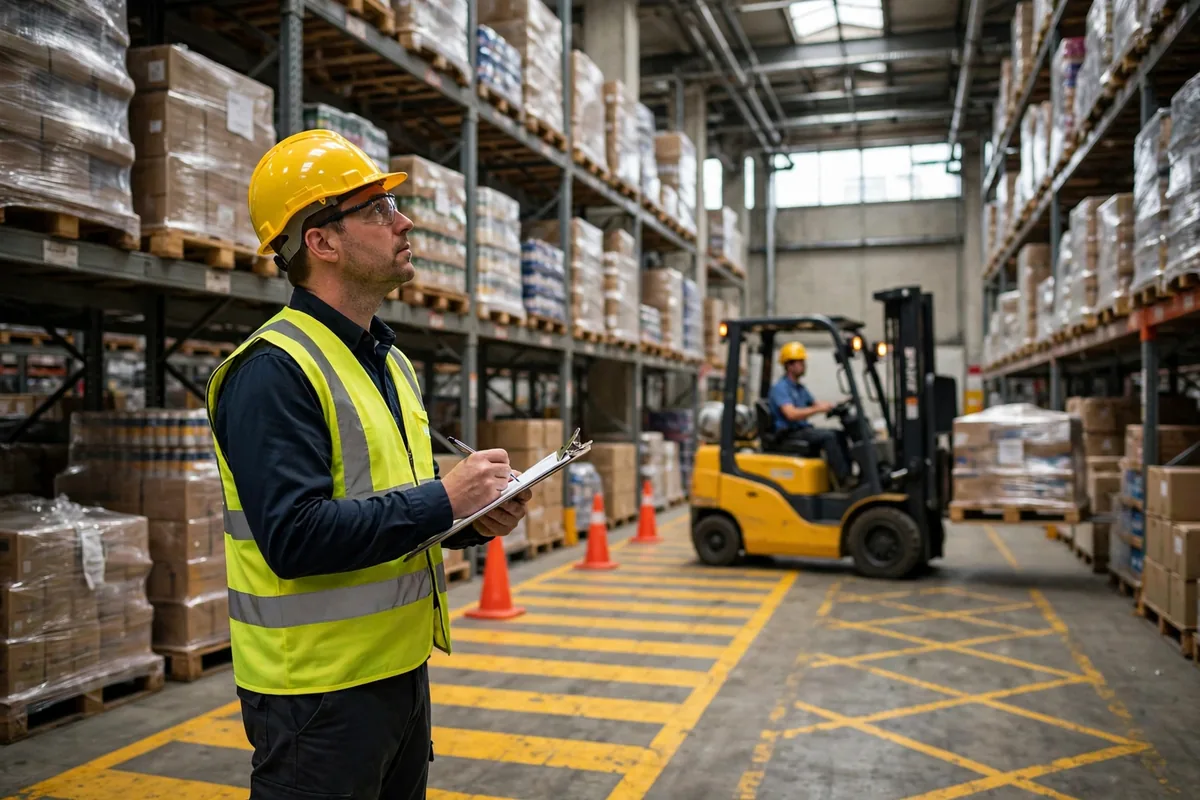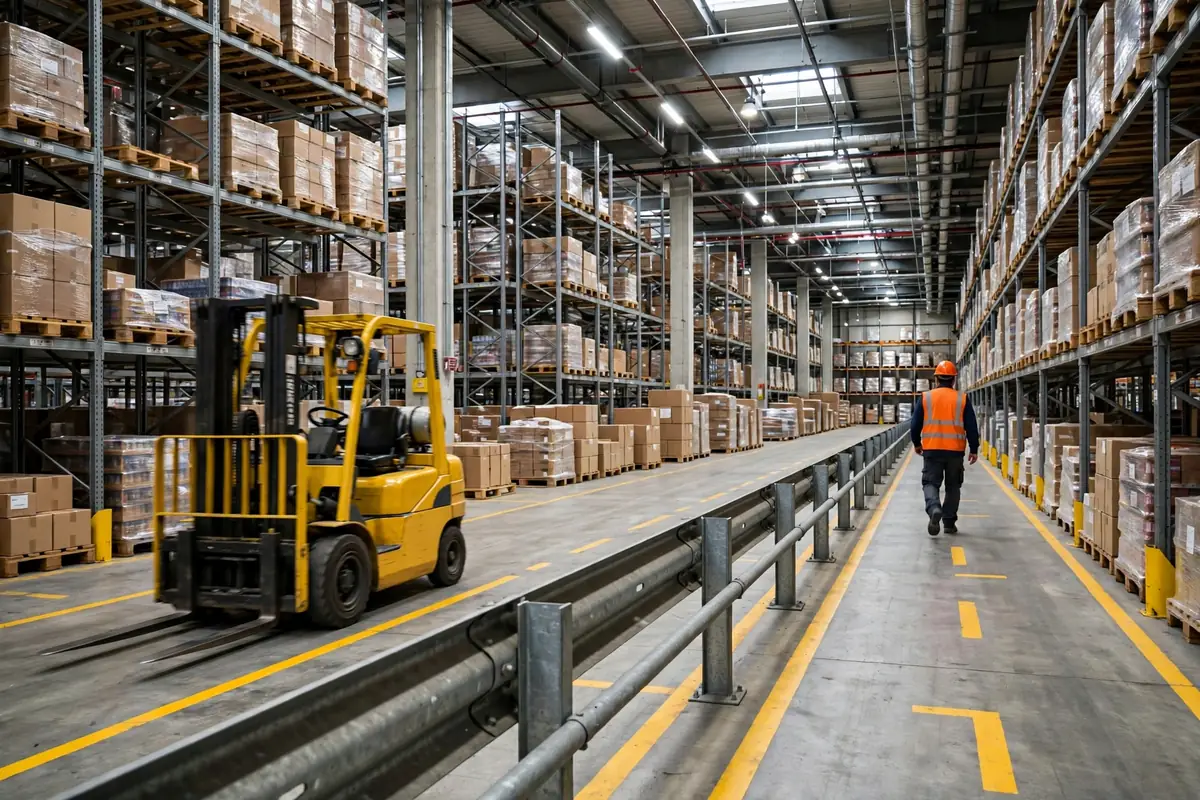
It was 7:40 on a Tuesday morning, and forklift pedestrian traffic was already sharing one aisle at a 3PL warehouse in Ontario. Night shift had just handed over. A picker named Lee came out of Zone B pushing a pick cart, earbuds in, eyes on his pick list. On the same main aisle, Old Wang was backing a forklift out with a full pallet, and from the driver's seat, Lee was completely in the blind spot. Both of them stopped at the same instant. The pallet ended up less than half a meter from Lee's knee.
Nobody got hit. Wang swore, Lee's earbud fell out, and the two crews spent half an hour in the shift meeting arguing about whose fault it was. The drivers said pickers walk around with their heads down. The pickers said forklifts drive like they're in a race. Let me be straight with you: blaming people is pointless. When people and forklifts share one aisle, an accident is a matter of time, not luck.
After that morning I pulled our safety log for the past year. Fourteen near-misses involved a forklift and a pedestrian. Eleven of them happened on the main aisle or at intersections, and two ended with someone going to the clinic with a scrape. Not one of them happened because somebody was unskilled. Every single one was a routing problem. You can run all the training you want and plaster the walls with slogans, but if the layout forces people and trucks into the same space, the layout is the problem.
Forklift pedestrian traffic: time separation first, physical separation second
A lot of warehouses react to an incident by buying guardrails and building walls. They spend the money and keep the problem. In my experience the order should be: separate by time first, then by space. Time separation costs nothing. Space separation costs a little. Walls are the last resort.
Time separation means staggering the peaks. In our warehouse, 7:00 to 10:30 in the morning is peak picking. During those hours, the main aisle belongs to pickers and hand carts, and forklifts stick to the outer replenishment lane. From 10:30 to 11:30 is the replenishment window: pickers go back to their stations for checking and packing, and forklifts move in to restock. We run the same split in the afternoon, 2:00 to 4:00. On night shift, when inbound volume is heavy, forklift work and manual cycle counting run on completely different shifts.
The forklift crew pushed back at first. They said replenishment would slow down. Two weeks of data settled it. Pickers went from 62 lines an hour to 71, because they stopped having to freeze every few minutes to let a truck pass. Forklift replenishment got bunched together, but with less empty travel, the time per pallet actually dropped. Staggering the work doesn't make one side lose. It stops both sides from waiting on each other.
But time separation has a hard limit: it only controls planned work. A customer drops in a rush order, a driver shows up early, the system spits out an urgent transfer, and a forklift has to enter the aisle right now. Time separation solves maybe seventy percent of the problem. The other thirty percent needs physical separation.
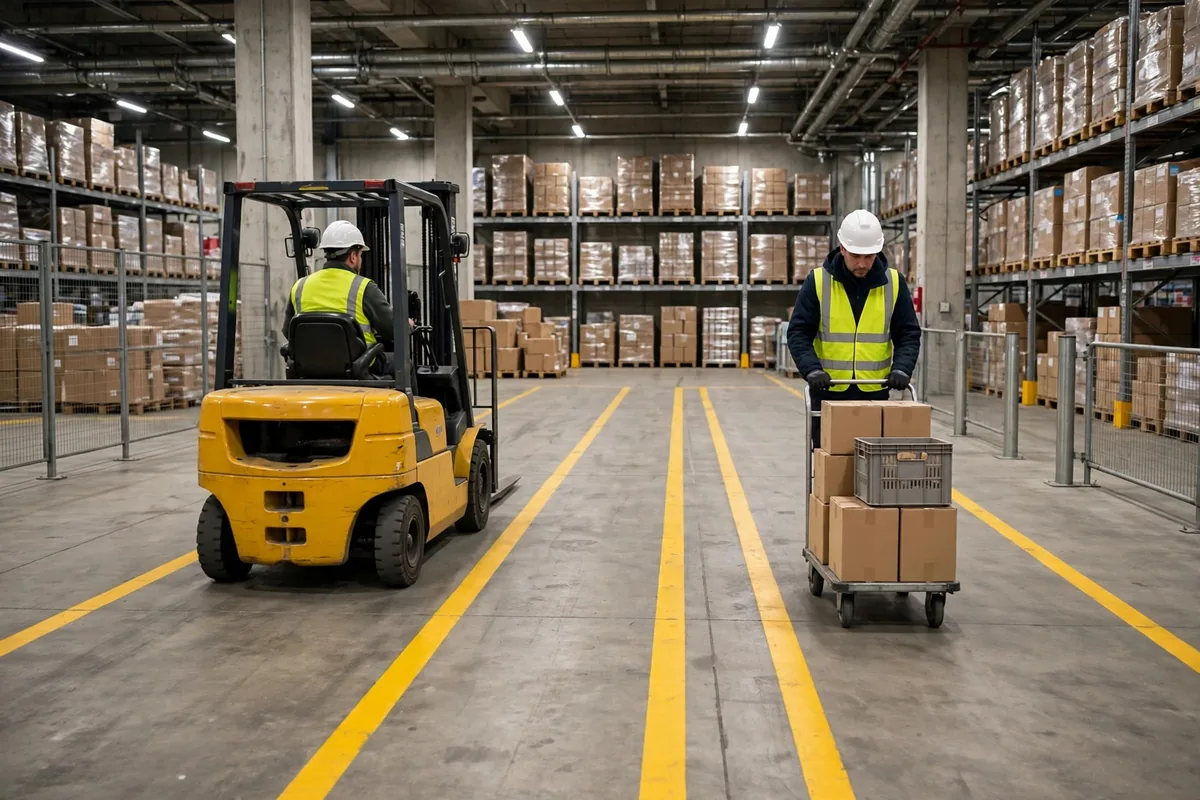
We did physical separation in three tiers, spending money in proportion to the risk. Tier one is floor markings and a marked pedestrian walkway. That is the cheapest fix there is. Marking one main aisle costs a few hundred dollars: pickers on the green line, forklifts on the yellow line, crosswalks and stop markings at intersections. Tier two is convex mirrors and blue warning lights at intersections, so a pedestrian sees a blue spot on the floor long before the forklift rounds the corner. Tier three is physical guardrail, and we only put it in three places: the dock doors, the charging area entrance, and the ends of high-bay racking.
Do not reverse that order. I have seen a warehouse do it backwards: they spent big money walling off the whole floor with guardrail first. Within weeks, pickers were climbing over the rails to take shortcuts, and a dirt path got worn into the floor underneath the rails. It was more dangerous than before the guardrail went in. Guardrail goes where people actually walk, not where the drawing says they should walk.
Pedestrian traffic separation: more isolation is not better isolation
Here is the unpopular opinion: some safety projects get the incident count down and kill productivity at the same time, and then everyone quietly tears the fix out. You would have been better off never installing it.
We made exactly that mistake in 2023. Before peak season, management approved a budget to wall off the picking area from forklift traffic completely, with only two gates in and out. The first month looked great on paper: zero incidents. In the second month, picking productivity dropped about twenty percent, because pickers were walking nearly two extra kilometers a day on detours. In the third month, people started climbing the rails. One picker fell and sprained an ankle badly enough to miss two weeks.
We tore out half the guardrail and went back to floor markings plus two movable barriers. The lesson is simple: the point of separation is to reduce the number of times people and trucks meet, not to make people unable to move. A picker walks ten thousand steps a day. Add fifty meters of detour to every trip and you have added two kilometers to their legs. Their legs give up first, and then the rule gives up.
So we have a rule now. Any new isolation measure runs as a two-week trial, and the pickers vote on it. If more than three in ten say it forces a bad detour, we change the design and try again. It sounds crude, but it is what keeps the fix alive. Near-misses involving forklifts and pedestrians in our warehouse fell from fourteen a year to three. Picking productivity did not drop. It actually rose by more than ten percent, because people stopped spending their day dodging trucks.
What the whole thing cost
Let me put the numbers on the table. Floor markings and signage for the whole building ran about $4,000. Convex mirrors and blue lights at eight intersections, about $6,000. Guardrail at three spots plus two movable barriers, about $9,000. Add the lost hours during the two-week trial period, and the whole project came in under $25,000.
Now compare. One picker with a minor injury costs well over $8,000 in a month once you add medical care, lost shifts, and a temp replacement. A serious injury is a different order of magnitude, before you even get to the insurance premium increase. Twenty-five thousand dollars to take eleven near-misses a year off the board is not a hard decision.
There is one cost you should not cut: training. In the first week after the change, I ran three walk-throughs on the floor myself, forklift drivers and pickers walking the new routes together, arguing about it on the spot and fixing it on the spot. Sending out a memo and sticking up a poster is the same as doing nothing.
If you run a warehouse, do three things this week. Tonight before you leave, walk the main aisle and count every spot where a person and a forklift have to cross paths. Tomorrow morning, shift the forklift and picking peaks apart by one hour and try it for a week. Next week, put a convex mirror on the single most dangerous intersection. Don't wait for the accident to hold the meeting. Nobody can afford to bet on that half a meter.
By Chen Feng, Warehouse Operations Manager